
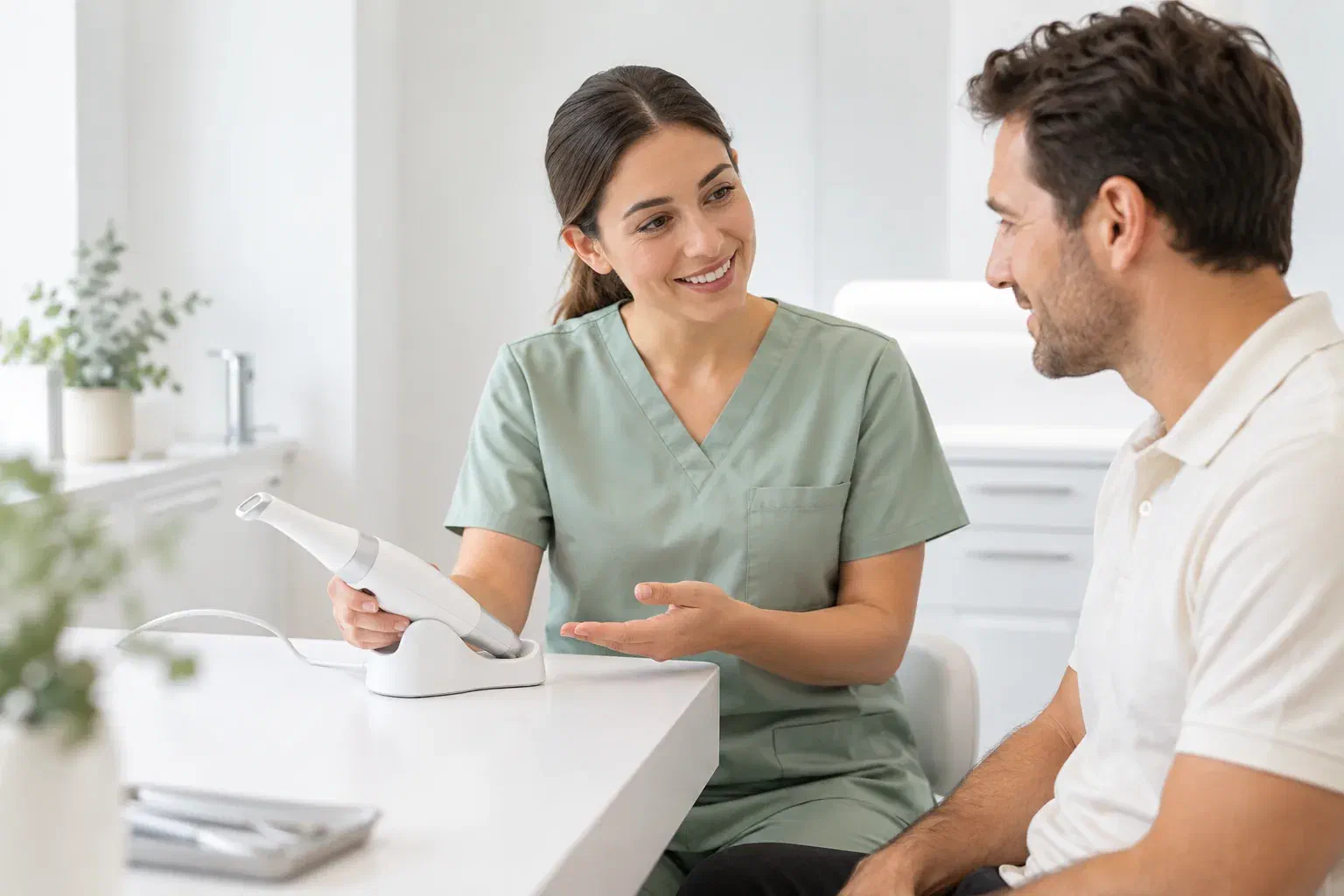
Illustrative discussion of an optical dental scanner, not a photograph of clinic equipment
General & Family Dentistry

Digital Dental Impressions in Brampton

Already had X-rays and now told you need a scan? They are different tools. If you are travelling from Brampton, learn what an optical impression records, what it leaves to other imaging and how it fits into planning a crown or appliance.

Scans and X-rays, sorted out for Brampton

Light on the surface, not a look inside.

The word scan gets used for many things in dentistry, which can be confusing. A digital impression is an optical scan. It uses light to trace the outside of your teeth and gums and turns that into a three-dimensional surface model. The model is then used to design a restoration or appliance, or to support a treatment plan. It does not look inside teeth or bone.

Think of it as a replacement for the tray of soft material, in cases where it suits. It is a way of gathering measurements, not a treatment. Whether it can be used for you depends on the part of the mouth being recorded, the dental work planned and the precision required. Some situations still call for conventional material, and a finished piece may still need adjusting.

Ask how your impression would be collected and what is available for your particular care. If you have found impressions difficult, because of gagging, limited opening or an earlier bad experience, tell us. The team can explain suitability and the steps in plain terms, without assuming any one method suits every patient or procedure.

Ask what your record will capture
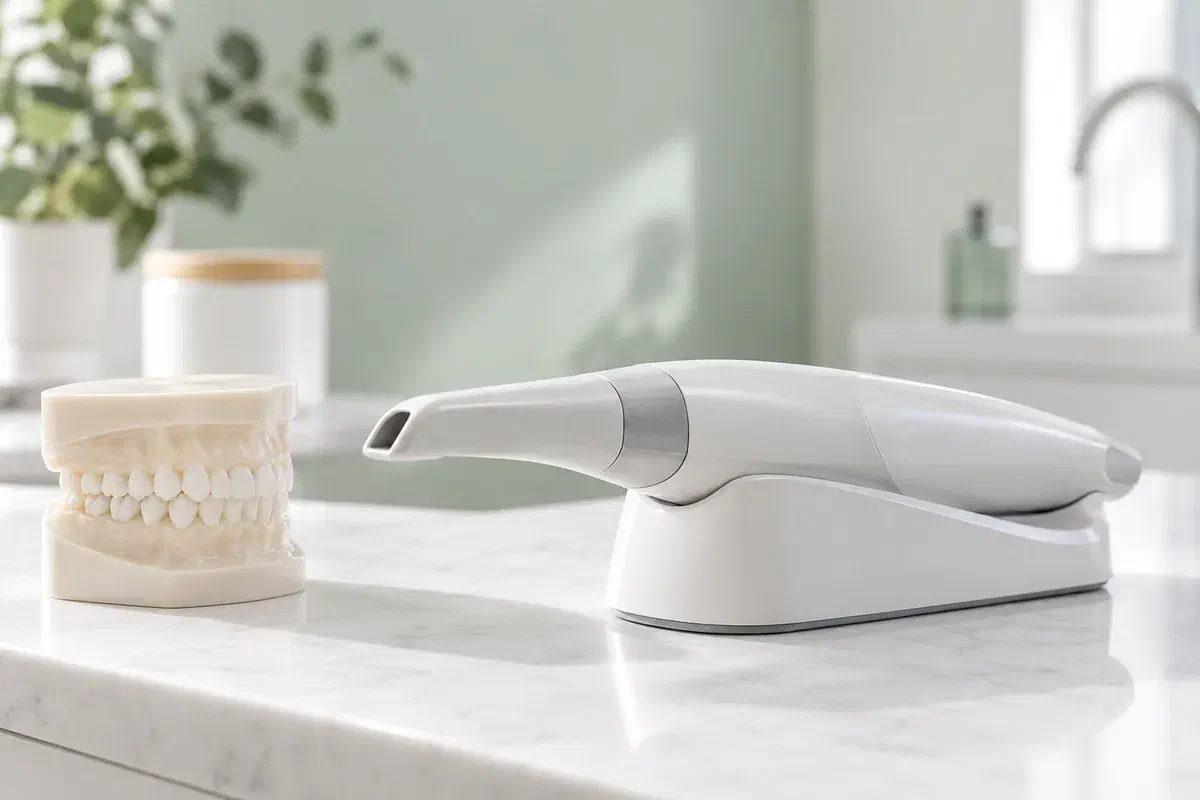
Illustrative unbranded optical scanner beside a dental teaching model
When a record becomes necessary

A clear job for every impression.

A scan earns its place when a specific piece of dental work depends on it. Ask which surfaces will be captured and how the model will be used in planning or producing your treatment.

Planning a crown or appliance

Designing a crown or another suitable restoration usually means recording the prepared tooth, the teeth on either side and the bite. Some appliances depend on an accurate model as well. Ask what your case calls for, rather than requesting a scan with no treatment in mind.

Trouble tolerating material in the mouth

Trays can be unpleasant for some people. Explain what made you uncomfortable before. An optical method may be worth raising where suitable, but the scanner still has to move near your teeth and cannot be promised to remove every difficulty.

Changes since a record was taken

A new filling, a moved tooth or a different plan can make an earlier impression out of date. Mention what has changed. An old file is only reused if it still provides what the present treatment needs.

Because it relies on light, a digital impression shows only what is visible. It is not a dental X-ray or a CBCT examination and cannot take the place of imaging chosen to assess roots, bone or other hidden structures.

What the surface model offers

Detail where the dental work will sit.

The digital model builds while you are in the chair, so the team can watch for gaps or blurry spots and record them again before the file is accepted. After that, the record feeds into whatever clinical and laboratory process your restoration or appliance requires. Success means having the surfaces the work depends on, captured well.

Avoiding a full tray of material makes the experience easier for some people, though everyone is different and scanning time depends on the case. Agree in advance on how to signal for breaks, how wide you can open and which position is most comfortable.

Patient information: UCLH — digital impressions in dental care

A model you can understand

If the system displays it, the team can show you what is being recorded and why teeth next to the treated one, or on the opposite jaw, are included. The model helps with planning and does not replace an examination.

A starting point for design

A suitable file may be passed through the appropriate professional workflow to help design or make your dental work. Ask what happens next and who is responsible. Taking the scan does not on its own fix when the work will be finished.

A check that nothing is missing

The record needs every detail the planned restoration or appliance relies on. A section may be scanned again, or recorded another way, if information falls short. That step is part of producing an impression worth having.

What the visit looks like

Four steps from question to usable model.

Each appointment reflects the treatment behind it. Find out ahead of time whether the visit covers records only, or also tooth preparation, a temporary restoration or something else.

  1. Explain the purpose and the method

    Your dentist describes why the impression is needed and whether scanning suits your case and is offered. Raise questions about limits, alternatives and fees. Mention gagging, restricted opening or positioning needs at this point.

  2. Prepare the surfaces

    The scanner needs a clear view of the teeth being recorded. That may involve drying them or managing the surrounding gum tissue, depending on the procedure. A tooth that has been shaped for a restoration needs its margins captured accurately.

  3. Trace the teeth and register the bite

    A wand is passed over the relevant teeth so the model can form. The opposing teeth and how they close together may also be recorded. Keep to the positioning guidance, and use your signal any time you need a pause.

  4. Check the model and confirm the plan

    The team decides whether the record is suitable for its intended use, rescanning or changing method if necessary. Before you go, confirm the next appointment, what to do with any temporary work and when the finished piece will be checked.

After your scanning appointment

The scan needs little; the treatment may need more.

A scan alone usually involves no recovery. Freezing, tooth preparation, a temporary restoration or other procedures carried out at the same time may each bring instructions of their own.

Keep a temporary intact

If a temporary restoration is placed, follow the dentist’s advice on chewing and cleaning. Contact the clinic if it comes loose, breaks or becomes painful. A completed scan is no reason to live with a damaged temporary.

Speak up about changes

A broken tooth, a filling done at another clinic or a bite that changes after the scan should be reported. The existing record may need to be reviewed. New pain or swelling calls for assessment rather than waiting for the lab.

Come in for the fitting

The finished restoration or appliance still needs checking in person. Ask about fit, bite, comfort, cleaning and adjustments. A digital process does not replace that evaluation, nor follow-up if something later feels wrong.

Different records for different questions

Surface scans, moulds and imaging each have a role.

The dentist works out what information is needed and how it can be recorded reliably. Ask why a method is recommended for you instead of assuming the newest option is automatically best.

For recording visible shape

Optical surface scan

This creates a virtual model that may feed a suitable restorative or appliance workflow. Suitability and availability should be confirmed. The scan is a single stage; assessment, design, manufacture and fitting are considered separately.

For cases suited to a physical mould

Material impression

Some clinical needs or arrangements still call for a tray and impression material. Share any past difficulty so comfort can be discussed. Using this approach does not, by itself, make the finished work inferior.

For what a surface scan cannot show

X-rays and other records

Imaging, photographs, bite records or another impression may answer questions the model cannot. The team should explain what each contributes. A surface scan cannot reveal what lies inside a tooth, the bone around it or whether treatment is suitable.

Brampton questions about the scan

What it shows, what it doesn’t.

Ask about the planned work, the method suited to your case and what follows the impression. Good answers link the technology to a definite clinical purpose.

(905) 876-4488
I just had X-rays at my check-up. Why do I need a scan as well?
X-rays show structures inside teeth and bone, which helps with diagnosis. An optical scan records the outer shape of teeth and gums so dental work can be designed to fit. They answer different questions, so one cannot stand in for the other.
Can a digital impression find problems under my gums?
No. The scanner only records surfaces it can see. Gum health, bone levels and problems below the surface are assessed through a clinical examination and, where appropriate, X-rays. Ask the dentist which assessments your situation needs.
Who can see the digital file of my teeth?
The record forms part of your dental chart and is shared only as needed for your care, such as with a laboratory making your restoration. If you have questions about how records are handled, ask the team when you book.
Do children ever need digital impressions?
Some children’s appliances or treatments may call for a record of the teeth. Whether a scan or a material impression is used depends on the child, the work planned and what is available. The dentist can explain the options and how to keep the visit manageable.
What is a bite record, and why is it taken separately?
A bite record shows how your upper and lower teeth meet. It helps ensure that a restoration or appliance fits into your bite rather than just onto one tooth. The dentist decides which bite position needs recording and how.
How can I keep the number of trips from Brampton down?
Ask when booking how many visits your treatment will likely take and whether any steps can share an appointment. Bring questions together, and confirm temporary care instructions before you leave so you know when a call is needed.
Digital impressions for Brampton households

Ask us which record your treatment really needs.

Get in touch with our Bronte Street practice to discuss your planned restoration or appliance and any worries about impressions. We can explain the records likely to be required and confirm what can be arranged. Bring your questions about comfort, timing and what comes after the scan.

Please confirm suitability and availability for your treatment. Images of scanners on this page are illustrative and do not show the clinic’s equipment.

Visit Milton Dental Clinic
Unit 1, 342 Bronte St. S, Milton, ON L9T 5B7
Get directions Clinic hours
Monday–Thursday
11am–7pm
Friday–Sunday
By appointment only

Areas we serve

  • Milton
  • Oakville
  • Mississauga
  • Georgetown
  • Halton Hills
  • Acton
  • Campbellville
  • Brampton
  • Burlington
  • Puslinch
  • Rockwood
  • Erin
  • Caledon
  • Etobicoke
  • Old Milton
  • Bronte Meadows
  • Timberlea
  • Dorset Park
  • Dempsey
  • Clarke
  • Beaty
  • Coates
  • Harrison
  • Scott
  • Willmott
  • Ford
  • Bowes
  • Cobden
  • Walker
  • Mountain View
  • Milton Heights
  • Hawthorne Village
  • Valley View
  • Fallingbrook
  • Nassagaweya
  • Trafalgar
  • Esquesing
  • Nelson
  • Brookville
  • Moffat
  • Glen Williams
  • Norval
  • Limehouse
  • Stewarttown
  • Ashgrove
  • Hornby
  • Silver Creek
  • Speyside
  • Scotch Block
  • North Oakville
  • River Oaks
  • Glen Abbey
  • West Oak Trails
  • Palermo
  • Bronte Creek
  • College Park
  • Joshua Creek
  • Uptown Core
  • Preserve
  • Iroquois Ridge
  • Lisgar
  • Meadowvale
  • Meadowvale Village
  • Churchill Meadows
  • Erin Mills
  • Central Erin Mills
  • Streetsville
  • East Credit
  • Creditview
  • Heartland
  • Sheridan
  • Mount Pleasant
  • Credit Valley
  • Huttonville
  • Churchville
  • Springbrook
  • Northwest Brampton
  • Bram West
  • Fletcher's Meadow
  • Fletcher's Creek South
  • Alton Village
  • Orchard
  • Millcroft
  • Headon Forest
  • Tansley
  • Brant Hills
  • Tyandaga
  • Kilbride
  • Lowville
  • Aberfoyle
  • Morriston
  • Arkell
  • Hillsburgh
  • Freelton
  • Carlisle
  • Waterdown
  • Flamborough
  • Mountsberg

How can we help?

Milton Dental Clinic

Have a question about your smile? Choose the option that works best for you.

For urgent dental concerns, please call.
Messages are reviewed during clinic hours.