
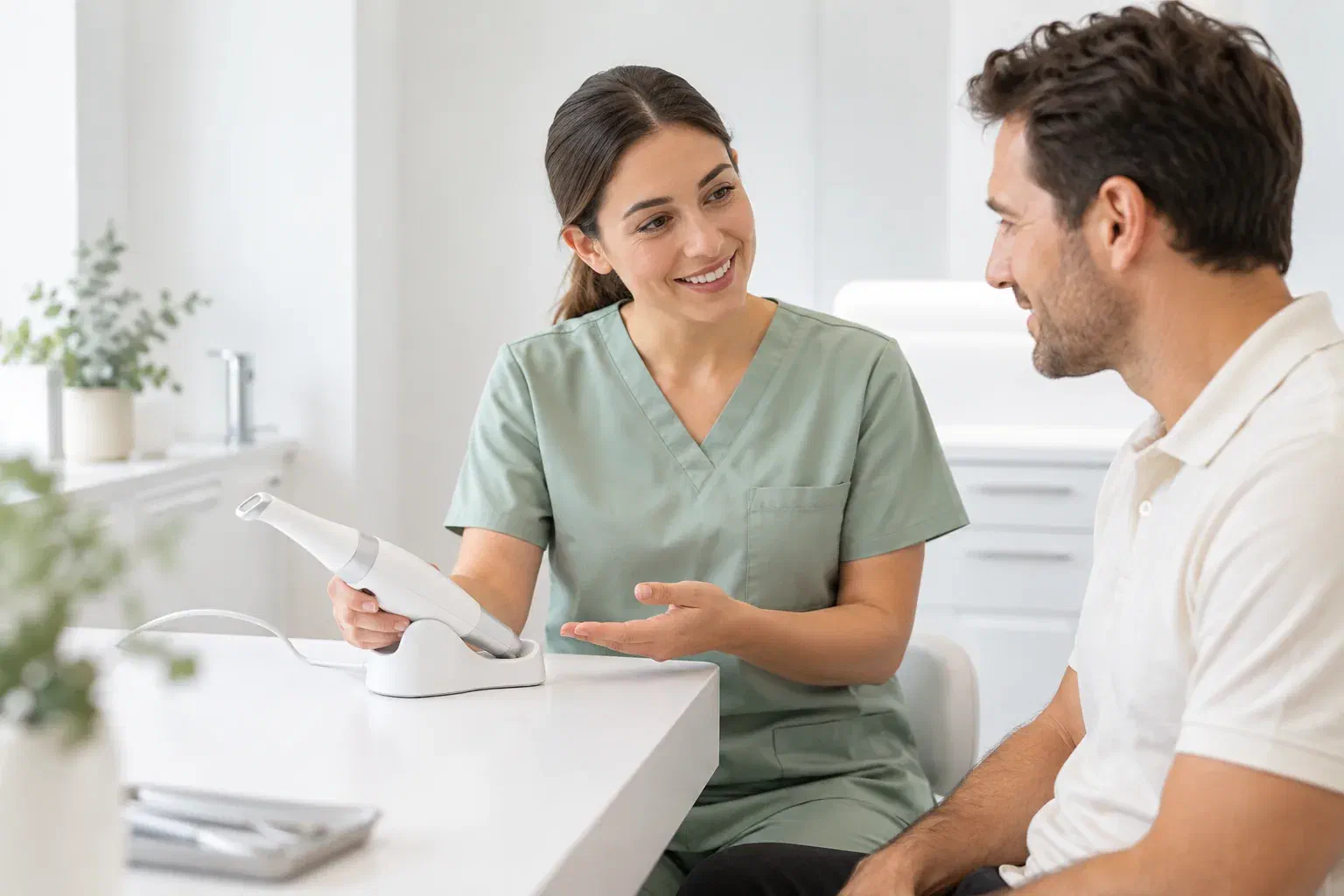
Illustrative discussion of an optical dental scanner, not a photograph of clinic equipment
General & Family Dentistry

Digital Dental Impressions in Oakville

Is a scan always better than a traditional impression? Not automatically. Coming from Oakville, learn how the dentist weighs an optical record against a tray, what each can capture and which questions help you understand the choice.

Weighing the options from Oakville

Newer is not the same as better suited.

Hearing that a clinic offers digital impressions can make it sound like the obvious choice. It helps to start with what any impression is for. Whether taken with a scanner or a tray, it records the shape and arrangement of teeth and surrounding tissue so a restoration, appliance or treatment plan can be developed. The optical version simply builds that record as a virtual model.

Neither method treats the tooth. Each is a way of collecting information, and the better one is whichever captures the required detail reliably for your particular work. In suitable cases scanning can replace impression material. In others, the location, the design being planned or the precision needed can point toward a conventional mould.

Ask the dentist why one method is being suggested for you and what arrangements are available. It also helps to mention anything that has made impressions difficult before, such as a sensitive gag reflex or trouble opening wide. Our team will discuss suitability honestly rather than treating either technique as right for everyone.

Ask why a method is recommended
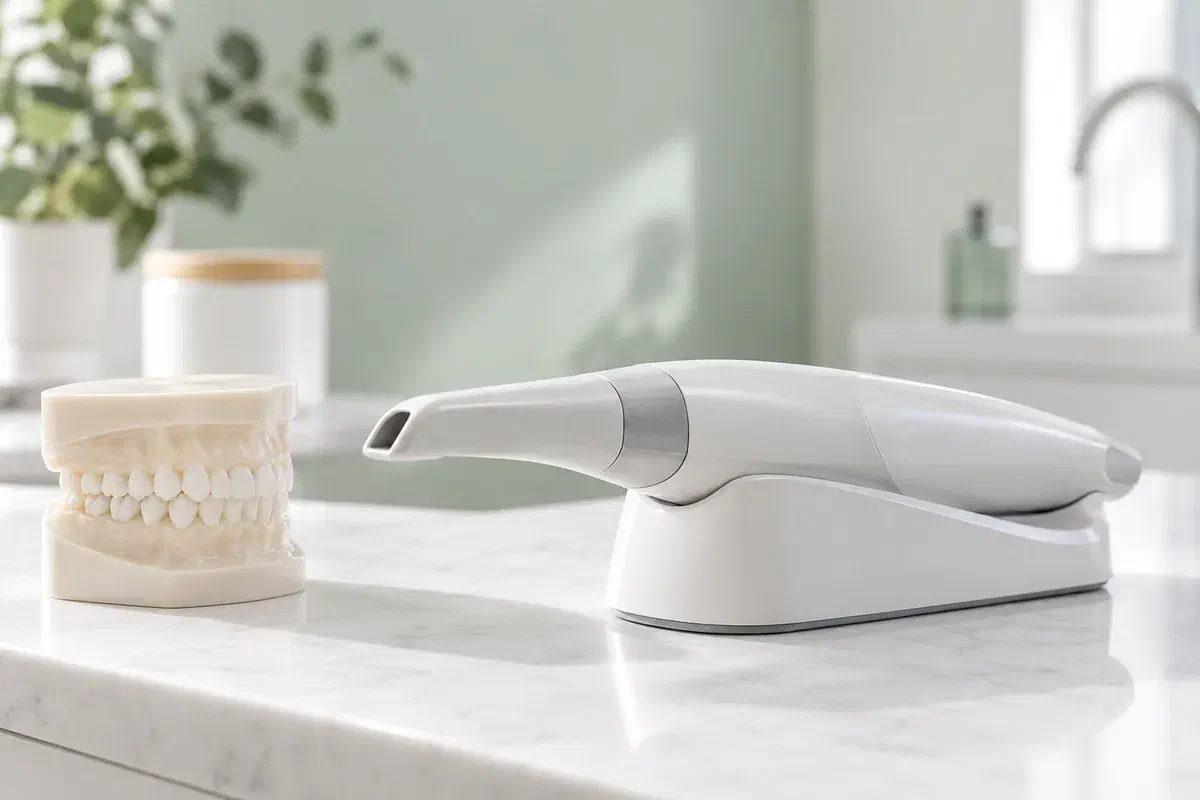
Illustrative unbranded optical scanner beside a dental teaching model
When the choice comes up

The work you need sets the terms.

Before comparing methods, be clear about what the impression must accomplish. Ask which areas need recording and how the file or mould will feed into the planning and making of your dental work.

Restorations and appliances that need a model

Crowns and other suitable restorations often depend on precise detail of the prepared tooth, the teeth beside it and the bite. Certain appliances need an accurate model as well. The method follows from those requirements, so a scan without a defined purpose is rarely helpful.

Comfort as part of the decision

For some people a tray of material is hard to tolerate. If that has been your experience, say what triggered it. Scanning may help where it suits the work, but the wand still needs to reach every relevant surface, and no method can promise to remove all discomfort.

Whether an existing record still applies

Since your last impression, a tooth may have moved, a filling may have been replaced or the plan may have changed. Any of these can limit an older record’s value. The team decides whether an existing file still contains what today’s work requires.

Whichever method is used, an impression captures visible surfaces. It is separate from dental X-rays and CBCT scans, which look at structures beneath those surfaces and cannot be replaced by a surface model.

Where scanning has an edge

Live feedback on the record itself.

One practical difference is timing. A digital model forms on screen during the appointment, so the team can often spot a missing area or unclear detail right away and record it again. Once accepted, the file can move into the appropriate clinical and laboratory process. The point is a dependable record, not the presence of a particular machine.

Some patients also find that skipping a full tray of material makes the visit easier. That is not universal, and how long scanning takes varies with the case. Discuss breaks, mouth opening and seating position before you start, so the process can be adapted to you.

Patient information: UCLH — digital impressions in dental care

Understanding what the team sees

If the system supports it, the dentist can show you the model and explain which areas are being recorded, including why neighbouring teeth or the opposing jaw are part of it. The model is a planning tool and does not diagnose problems by itself.

A record ready for the design stage

A suitable file may be shared through an appropriate professional channel to help design or manufacture your restoration or appliance. Ask what that stage involves and who is responsible for it. The scan alone does not determine when your work will arrive.

Quality checked on the spot

To be useful, the record must hold every detail the planned work depends on. Where information falls short, another pass or a different method may be needed. That verification is an ordinary part of obtaining a reliable impression.

A typical scanning visit

What happens between sitting down and leaving with a plan.

Appointments vary with the treatment involved. Confirm in advance whether yours is for records only, or whether tooth preparation, a temporary restoration or other care will happen too.

  1. Settle the method together

    The dentist explains why the impression is needed and whether scanning is suitable and available for you. Discuss limits, alternatives and any separate fees. Share concerns about gagging, jaw opening or positioning first.

  2. Prepare the teeth to be seen

    Surfaces must be accessible and clear enough for the scanner to read. Depending on the procedure, that may mean drying teeth or managing the gum tissue nearby. If a tooth was shaped for a restoration, its fine margins need careful capture.

  3. Build the model and record the bite

    The team moves a handheld scanner around the relevant teeth while the model takes shape. Your opposing teeth and how they come together may also be recorded. Follow positioning instructions, and signal whenever you need a pause.

  4. Review and agree on next steps

    The record is checked to make sure it suits its intended purpose. More scanning or another method may be needed. Confirm your next appointment, any care for temporary work and when your restoration or appliance will be assessed for fit.

What to expect afterwards

Aftercare depends on what else was done that day.

There is generally no recovery period for a scan alone. Freezing, tooth preparation, a temporary restoration or other procedures completed at the same visit can each come with their own guidance.

Protect any temporary work

With a temporary restoration in place, follow the dentist’s instructions on eating and cleaning. Contact the clinic if it becomes loose, breaks or feels uncomfortable. Having the final work already scanned is no reason to overlook a damaged temporary.

Flag changes before the final piece arrives

If a tooth fractures, a restoration is replaced elsewhere or your bite changes after the scan, tell the team. The record may need to be reviewed. Pain or swelling that appears in the meantime is worth a prompt visit, not patience.

Keep the delivery appointment

Clinical checks are still needed when a restoration or appliance is delivered. Ask about fit, bite, comfort and cleaning, and whether adjustments are required. Digital production does not replace that assessment or later follow-up if something feels wrong.

Side by side

Three routes to the information your dentist needs.

The dentist considers which details are needed and whether they can be recorded dependably. If a method is recommended, ask what makes it the right fit, rather than assuming the most modern-looking option wins.

Fits work that relies on surface shape

Intraoral scanning

A scanner produces a virtual model that may be used in a suitable restorative or appliance workflow. Confirm suitability and availability. Recording is one step; assessment, design, manufacture and fitting remain distinct considerations.

Fits needs a physical impression serves well

Tray and impression material

A conventional impression may still be advised for particular clinical requirements or arrangements. Tell the team about earlier difficulties so comfort can be addressed. This choice does not, by itself, make the finished dental work inferior.

Fits cases with unanswered questions

Supplementary records

Photographs, bite registrations, imaging or a further impression may address different questions. The team should explain what each adds. A surface scan cannot reveal every detail about the tooth, its supporting tissues or whether treatment is suitable.

Oakville questions about impressions

Comparing methods, one question at a time.

Ask about the treatment being planned, the method available for your case and what follows the record. Clear answers should connect the technique to a specific clinical need.

(905) 876-4488
Is a digital impression more accurate than a traditional one?
Both methods can produce a suitable record when used appropriately for the case. What matters is whether the required surfaces are captured clearly. The dentist chooses the approach most likely to give reliable information for your work and can explain the reasoning.
Who decides whether I have a scan or a tray impression?
The dentist recommends a method based on the work planned, the area to be recorded and the available arrangements, and you are part of that conversation. Share your preferences and past experiences so they can be considered alongside the clinical needs.
Will I need freezing for a digital impression?
Scanning by itself does not usually call for freezing. If the same visit includes preparing a tooth or other treatment, local anaesthetic may be used for that part. Ask what the appointment includes so you know what to expect.
Can the scan show whether I have a cavity?
No. A surface model is a planning record, not a diagnostic examination. Decay and problems below the surface are assessed through a clinical exam and, where appropriate, X-rays. The dentist will explain which assessments are needed for your situation.
What happens if part of the scan comes out unclear?
The team can usually rescan that area during the appointment. If the detail still cannot be captured reliably, another impression method or additional records may be suggested. The aim is a record complete enough for the next stage.
How should I plan appointments if I’m coming from Oakville?
Ask at booking how many visits your treatment is likely to need and whether records, preparation and temporary work can share one appointment. Knowing the sequence helps you arrange time away from work or school and avoid unnecessary trips.
Impressions for Oakville households

Not sure which method suits you? Let’s talk it through.

Contact our Bronte Street practice to discuss the restoration or appliance you need and how the impression would be taken. We can explain the records involved and confirm what can be arranged for your care. Bring questions about comfort, timing and the steps after the scan.

Suitability and availability should be confirmed for your treatment. Scanner images shown here are illustrative and do not depict clinic equipment.

Visit Milton Dental Clinic
Unit 1, 342 Bronte St. S, Milton, ON L9T 5B7
Get directions Clinic hours
Monday–Thursday
11am–7pm
Friday–Sunday
By appointment only

Areas we serve

  • Milton
  • Oakville
  • Mississauga
  • Georgetown
  • Halton Hills
  • Acton
  • Campbellville
  • Brampton
  • Burlington
  • Puslinch
  • Rockwood
  • Erin
  • Caledon
  • Etobicoke
  • Old Milton
  • Bronte Meadows
  • Timberlea
  • Dorset Park
  • Dempsey
  • Clarke
  • Beaty
  • Coates
  • Harrison
  • Scott
  • Willmott
  • Ford
  • Bowes
  • Cobden
  • Walker
  • Mountain View
  • Milton Heights
  • Hawthorne Village
  • Valley View
  • Fallingbrook
  • Nassagaweya
  • Trafalgar
  • Esquesing
  • Nelson
  • Brookville
  • Moffat
  • Glen Williams
  • Norval
  • Limehouse
  • Stewarttown
  • Ashgrove
  • Hornby
  • Silver Creek
  • Speyside
  • Scotch Block
  • North Oakville
  • River Oaks
  • Glen Abbey
  • West Oak Trails
  • Palermo
  • Bronte Creek
  • College Park
  • Joshua Creek
  • Uptown Core
  • Preserve
  • Iroquois Ridge
  • Lisgar
  • Meadowvale
  • Meadowvale Village
  • Churchill Meadows
  • Erin Mills
  • Central Erin Mills
  • Streetsville
  • East Credit
  • Creditview
  • Heartland
  • Sheridan
  • Mount Pleasant
  • Credit Valley
  • Huttonville
  • Churchville
  • Springbrook
  • Northwest Brampton
  • Bram West
  • Fletcher's Meadow
  • Fletcher's Creek South
  • Alton Village
  • Orchard
  • Millcroft
  • Headon Forest
  • Tansley
  • Brant Hills
  • Tyandaga
  • Kilbride
  • Lowville
  • Aberfoyle
  • Morriston
  • Arkell
  • Hillsburgh
  • Freelton
  • Carlisle
  • Waterdown
  • Flamborough
  • Mountsberg

How can we help?

Milton Dental Clinic

Have a question about your smile? Choose the option that works best for you.

For urgent dental concerns, please call.
Messages are reviewed during clinic hours.