
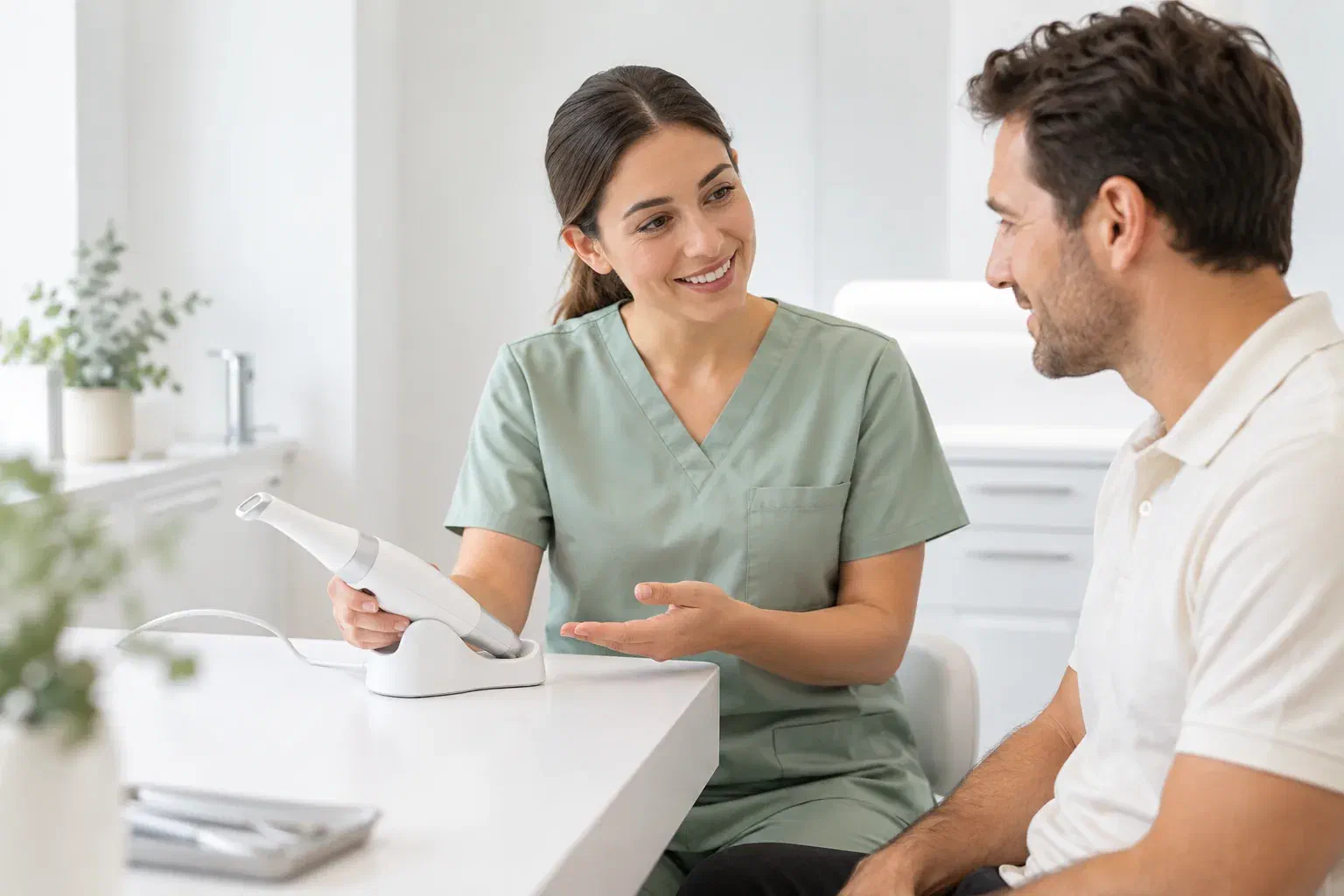
Illustrative discussion of an optical dental scanner, not a photograph of clinic equipment
General & Family Dentistry

Digital Dental Impressions in Rockwood

Once your teeth are scanned, the file goes on to the people who design and make the work. For those coming from Rockwood, here is what that hand-off involves, which questions to ask about it and why the dentist still checks everything at the end.

Behind the scenes, for Rockwood

Your scan has a journey ahead of it.

It is easy to picture the scanner as the whole story, but it is the beginning of a chain. The impression records the shape and arrangement of teeth and nearby tissues. That record is what technicians and clinicians use to design and produce a restoration or appliance, or to build a treatment plan. A digital impression does this with an optical scanner, creating a virtual model that can be passed along.

Being digital does not change what the step is: information gathering, not treatment. For suitable cases it can replace a tray of material, though the region being recorded, the design planned and the precision needed all influence whether it is used. It does not guarantee every case can be scanned or that a finished piece will fit without adjustment.

Ask how your impression will be taken, who will use it and what arrangements apply to your care. Tell us about a strong gag reflex, restricted opening or an earlier impression you found difficult. The team can explain suitability and the path the record takes, without assuming that one method or workflow suits every person.

Find out where your scan goes next
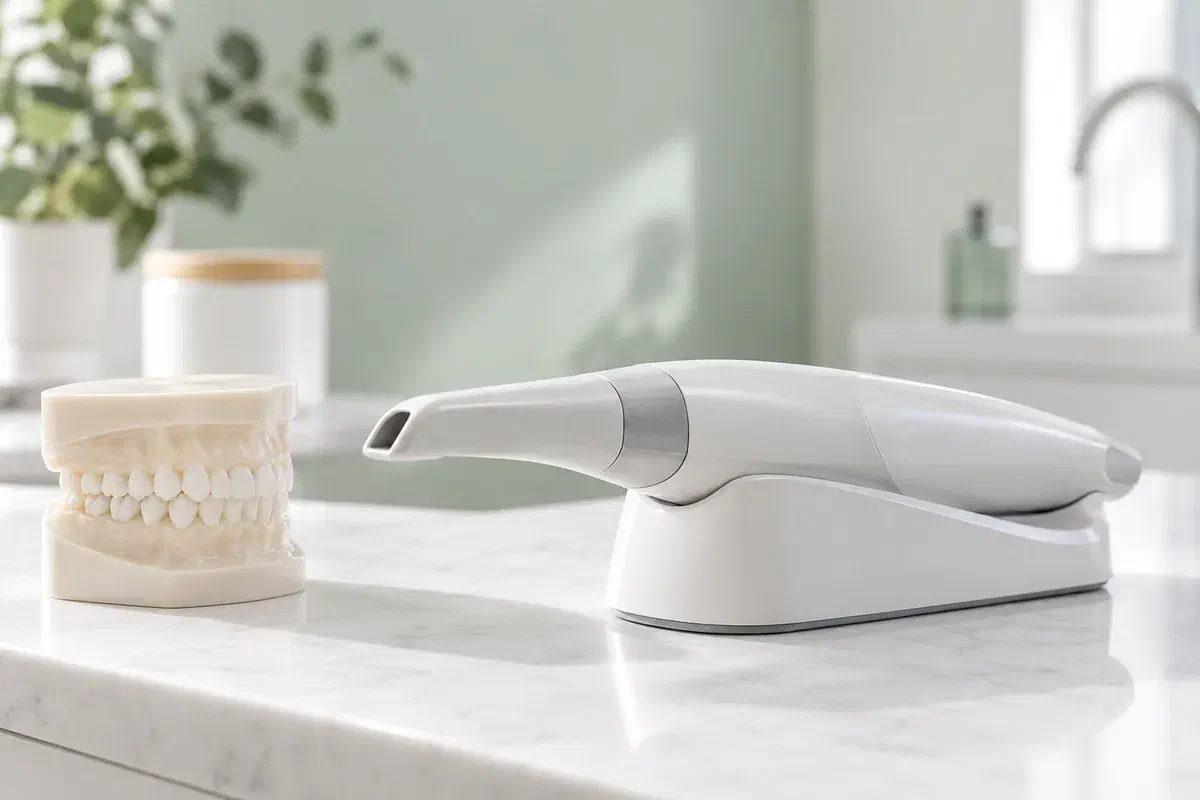
Illustrative unbranded optical scanner beside a dental teaching model
What the record must serve

Made for a purpose, then passed on.

Every scan should answer to a particular piece of work. Ask which surfaces the people designing it will need, and how the model will be used in planning and manufacture.

A restoration or appliance to design

Those making a crown or other suitable restoration typically need the prepared tooth, adjacent teeth and the bite. Certain appliances need an accurate full-arch model. Ask what the design stage requires for your case, rather than having a scan taken without a defined purpose.

Wanting a gentler recording step

If trays of material have been hard to tolerate, describe why. Where suitable, scanning may be worth raising. It still involves a wand moving around the teeth, so it cannot be promised to remove every difficulty.

A plan that has changed

New dental work, tooth movement or a revised treatment can make an earlier model the wrong starting point for design. Let the team know. A file is reused only when it still carries what the current work needs.

The model sent on for design shows outer surfaces only. It is separate from X-rays or CBCT imaging, which examine structures inside and beneath the teeth, and it cannot replace them.

Why a good file matters downstream

The people who build the work rely on the record.

A digital model can be checked as it builds, so gaps or unclear sections can often be rescanned during your visit instead of being discovered later by the person designing the piece. Once the clinician accepts it, the file enters the clinical and laboratory workflow for your treatment. A record that answers the designer’s questions is the real goal.

Avoiding a tray of material can make the appointment more comfortable for some people, though experiences differ and the length of scanning varies with the case. Talk about pauses, mouth opening and positioning before recording starts.

Patient information: UCLH — digital impressions in dental care

A model explained in plain terms

If the system displays it, the team can show you the model and why neighbouring teeth or the opposing jaw are included, since the designer needs them too. The model is for planning and does not diagnose anything.

A secure hand-off for design

A suitable file may be shared through the appropriate professional workflow so the piece can be designed and manufactured. Ask who is responsible for that stage and how questions from them are handled. The scan does not by itself set a ready date.

Details checked before sending

The model must contain everything the planned work depends on. Where information is missing, another pass or another method may be used before it leaves the clinic. That check helps the design stage go smoothly.

In the chair

Capturing a record someone else can build from.

The visit depends on the treatment involved. Ask in advance whether it is for records alone, or whether preparing a tooth or placing a temporary is also planned.

  1. Set out the purpose

    The dentist explains why the impression is needed, how it will be used and whether a scan fits your case and is offered. Ask about limits, other approaches and fees. Raise gagging, opening or positioning needs.

  2. Prepare for a clear view

    The teeth being recorded must be dry and accessible. Depending on the procedure, gum tissue may be gently managed. When a tooth has been shaped for a crown, its margins need to be visible so the designer can follow them.

  3. Record teeth and bite

    A handheld scanner moves over the relevant teeth as the model forms. Opposing teeth and your bite may also be captured, so the design meets them properly. Follow positioning guidance, and signal for any pause.

  4. Approve the file and plan ahead

    The team checks that the record suits its intended use before it is sent on, rescanning or switching methods if needed. Confirm the next appointment, temporary care steps and when the finished work will be fitted.

While the work is being made

Your part during the design stage.

Scanning on its own seldom needs recovery. A prepared tooth, freezing or a temporary placed during the same appointment may carry separate instructions to follow.

Look after the temporary

Follow the advice you are given on chewing and cleaning around any temporary restoration. Call if it comes loose, breaks or hurts. The final piece being in design does not make a broken temporary safe to ignore.

Let us know about changes

If a tooth breaks, work is replaced elsewhere or your bite changes after the scan, the design may be based on a record that no longer matches. Tell the team. New pain or swelling should be assessed promptly, not waited out.

Return for the try-in

The finished restoration or appliance is checked in your mouth for fit, bite and comfort, and you can ask how to clean it. Adjustments may be needed. Digital design and manufacture do not replace that clinical check or later follow-up.

Ways to give the designer what they need

Scan, mould or a fuller record.

The dentist weighs what information the design requires and how reliably it can be captured. If a method is recommended, ask what makes it the right choice, rather than assuming the most modern one is automatically superior.

Where a surface model meets the design needs

Digital scan

An optical scanner creates a model that may enter a suitable restorative or appliance workflow. Confirm that it suits your case and is offered. Recording is the first stage; design, manufacture and fitting are distinct steps that follow.

Where a physical mould is more suitable

Tray impression

Certain clinical needs or arrangements still call for impression material. Let the team know about any past trouble so comfort can be planned. Using a tray does not, by itself, make the finished work any less good.

Where the designer needs more

Supplementary information

Photographs, bite records, imaging or a further impression may answer different questions. Ask what each contributes. A surface scan cannot show everything about a tooth, the surrounding tissues or whether treatment is suitable.

Rockwood questions about the hand-off

Who uses the scan, and how.

Ask about the planned work, the recording method and what happens once the file leaves the chair. Good answers follow the record from capture to fitting.

(905) 876-4488
Who designs and makes my crown from the scan?
That depends on the arrangements for your treatment, which may involve a dental laboratory working with the clinic. Ask the team who will handle the design and manufacture of your piece and how they communicate with the dentist.
Can the lab ask for more information after the scan?
Yes. If a detail is unclear or something more is needed, the team may be asked for additional records, which could mean another short appointment. The aim is for the finished piece to fit properly.
Is the colour of my crown chosen from the scan?
Colour matching is usually discussed as its own step. The dentist may compare shades against your natural teeth or take photographs. Ask how the shade will be selected for your restoration and whether lighting or tooth whitening plans matter.
Is my scan kept after the work is finished?
Digital impressions become part of your dental record, which is kept according to professional requirements. If you have questions about how records are stored or shared, ask the clinic.
Can a scan be sent to a different lab if I prefer?
Lab arrangements are generally made by the clinic based on the work being planned. If you have a particular concern, raise it with the dentist so it can be discussed openly.
Should I call before driving in from Rockwood for the fitting?
It is a sensible habit. A quick call can confirm that the finished piece has arrived and that the appointment time still stands, and it gives you a chance to mention any changes to the tooth or temporary.
Booking from Rockwood

Ask us how your record will travel from chair to finished work.

Get in touch with our Bronte Street practice about the restoration or appliance you need and how the impression would be taken and used. We will outline the records likely to be involved and confirm what can be arranged. Bring any questions about comfort, timing and who makes the work.

Confirm that scanning suits your treatment and is available. The scanner images here are illustrative and are not photographs of clinic equipment.

Visit Milton Dental Clinic
Unit 1, 342 Bronte St. S, Milton, ON L9T 5B7
Get directions Clinic hours
Monday–Thursday
11am–7pm
Friday–Sunday
By appointment only

Areas we serve

  • Milton
  • Oakville
  • Mississauga
  • Georgetown
  • Halton Hills
  • Acton
  • Campbellville
  • Brampton
  • Burlington
  • Puslinch
  • Rockwood
  • Erin
  • Caledon
  • Etobicoke
  • Old Milton
  • Bronte Meadows
  • Timberlea
  • Dorset Park
  • Dempsey
  • Clarke
  • Beaty
  • Coates
  • Harrison
  • Scott
  • Willmott
  • Ford
  • Bowes
  • Cobden
  • Walker
  • Mountain View
  • Milton Heights
  • Hawthorne Village
  • Valley View
  • Fallingbrook
  • Nassagaweya
  • Trafalgar
  • Esquesing
  • Nelson
  • Brookville
  • Moffat
  • Glen Williams
  • Norval
  • Limehouse
  • Stewarttown
  • Ashgrove
  • Hornby
  • Silver Creek
  • Speyside
  • Scotch Block
  • North Oakville
  • River Oaks
  • Glen Abbey
  • West Oak Trails
  • Palermo
  • Bronte Creek
  • College Park
  • Joshua Creek
  • Uptown Core
  • Preserve
  • Iroquois Ridge
  • Lisgar
  • Meadowvale
  • Meadowvale Village
  • Churchill Meadows
  • Erin Mills
  • Central Erin Mills
  • Streetsville
  • East Credit
  • Creditview
  • Heartland
  • Sheridan
  • Mount Pleasant
  • Credit Valley
  • Huttonville
  • Churchville
  • Springbrook
  • Northwest Brampton
  • Bram West
  • Fletcher's Meadow
  • Fletcher's Creek South
  • Alton Village
  • Orchard
  • Millcroft
  • Headon Forest
  • Tansley
  • Brant Hills
  • Tyandaga
  • Kilbride
  • Lowville
  • Aberfoyle
  • Morriston
  • Arkell
  • Hillsburgh
  • Freelton
  • Carlisle
  • Waterdown
  • Flamborough
  • Mountsberg

How can we help?

Milton Dental Clinic

Have a question about your smile? Choose the option that works best for you.

For urgent dental concerns, please call.
Messages are reviewed during clinic hours.