

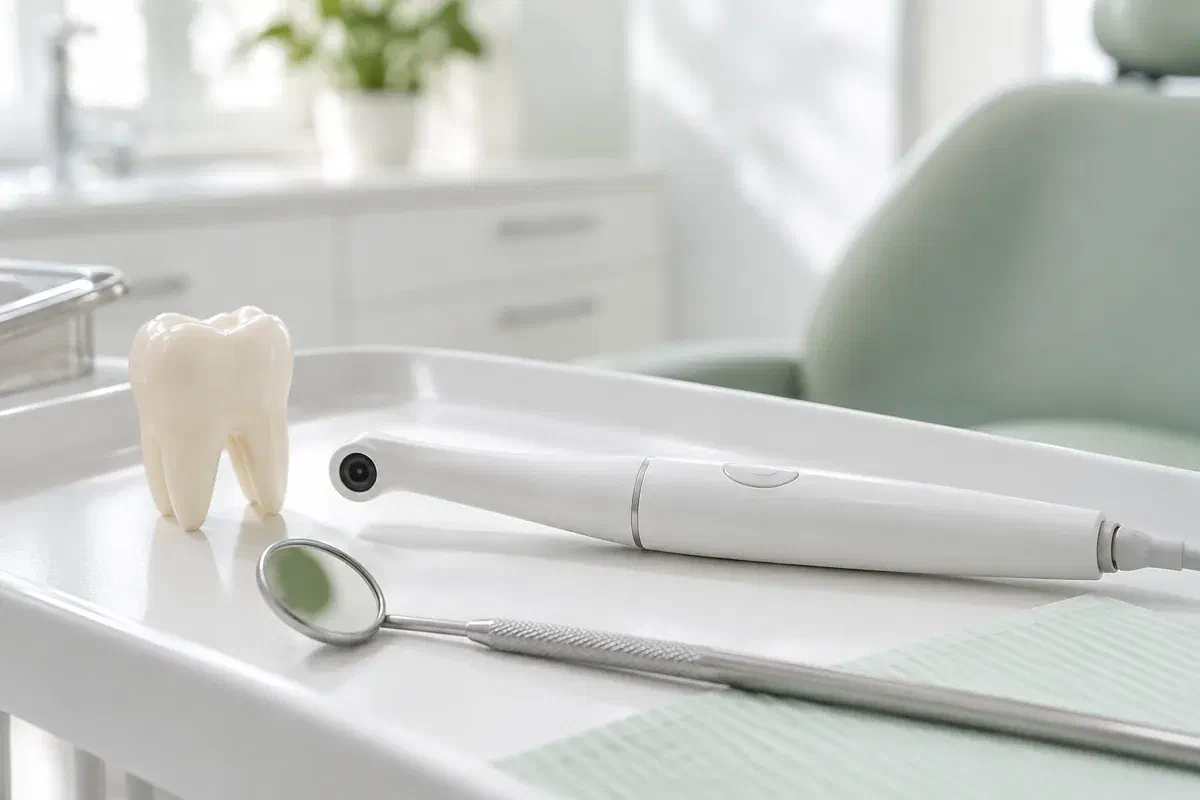
Illustrative dental consultation with a small intraoral camera, not actual clinic equipment
General & Family Dentistry

Intraoral Camera Examinations in Campbellville

Back at the kitchen table, someone asks what the dentist found, and the details have already blurred. A close-up from an intraoral camera can make a visible finding easier to grasp in the chair, so the explanation you bring home is one you actually remember.

Rural households in Campbellville

Remember the finding long after the drive home

Spoken explanations fade quickly, particularly after a busy day of appointments. A picture tends to stick. An intraoral camera is a slender, handheld device with a light at its tip, used to photograph tooth and gum surfaces that can be reached. With the image on screen, the dentist can show you a worn edge or a gap beside a filling instead of only describing it.

What you see is one piece of evidence, not a conclusion. Light, wet surfaces, the angle chosen and what the lens can reach all shape the result. Your dentist relates it to your symptoms, history and the rest of the exam before telling you what it suggests and whether treatment should be considered.

Campbellville sits within Milton’s boundaries but well outside the town centre, so many families group visits into one trip. When booking, ask whether photos would help with the concerns on your list and how the day can be arranged. During the exam, ask which tooth is shown, which detail counts and what is still unknown, so the summary you share at home is accurate.

Plan a household dental visit
Illustrative pen-shaped intraoral camera beside a tooth model and dental mirror
Things worth seeing for yourself

Findings that are easier to recall with a picture

An image helps most when it answers a clear question. Before the visit, jot down the one or two things each person would like explained. In the chair, mention them first, then ask how the photograph sits within everything else the examination turns up.

A tooth edge that has worn or chipped

Seeing a flattened or chipped surface makes it easier to remember which tooth needs care. The photo cannot show depth or cause. Mention sensitivity, grinding or any knock to the mouth so the dentist can interpret it fully.

A gap or shadow beside a filling

A close-up can show where food is catching or where a margin looks uneven. Interpretation still matters, and a dark line is not proof of a problem. Ask what other checks are needed before replacement is discussed.

A cleaning spot that keeps getting missed

A photo can locate a gumline area invisible in the mirror. Ask the team to show you the technique as well, so the advice carries into your routine and does not stay on the screen.

A camera photograph does a different job from an X-ray or a 3D digital impression. Each record answers its own question, so they cannot simply be swapped.

Why seeing helps remembering

A visual anchor for the explanation

When your dentist points to the exact spot on screen, the explanation attaches to something concrete. That is especially valuable for back teeth and surfaces you will never see yourself. There is no need to make sense of every reflection; just ask which part of the image is the point.

Photos can be stored in your record where appropriate, which may help at a later review. Comparing images is useful but imperfect, because angle and lighting affect how a tooth looks. A comparison should always be considered with the exam and your history, never as proof of change on its own.

Patient information: Carestream Dental — intraoral camera image capture and review

Knowing which tooth to keep in mind

Have the tooth and surface named for you. That makes it easier to notice relevant symptoms, clean the right place and describe things accurately if you call later. Ask about orientation, since enlarged images can be confusing.

A clearer basis for family decisions

If treatment is suggested, the photo helps you ask what it would accomplish and which findings support it. You may want to talk it over at home before deciding. Ask about alternatives, limits and whether waiting is reasonable.

Something to refer back to

For an area being monitored, ask what will be compared at the next visit and when that should be. Photos can sit alongside notes and symptoms. Ask which changes mean calling before then.

Inside a grouped visit

How the camera fits a busy appointment day

Photos are a short supporting step within each clinical exam. Mention sore areas, gagging or difficulty opening for anyone being seen so images can be taken comfortably.

  1. Share the concerns you brought

    The dentist discusses each person’s concern and examines the area. Ask where a photo would be useful. Some questions cannot be answered by appearance, and the camera never replaces an assessment.

  2. Photograph what is needed

    The lens is moved close to the relevant tooth or gum surface. A slight change in angle or a moment to clear saliva may help the image. Signal if you need to stop.

  3. Explain it in plain terms

    With the picture visible, ask what detail matters and whether it is something observed or something diagnosed. An image may show a feature without revealing depth, activity or cause. The wider exam fills in the rest.

  4. Map out follow-up together

    Next steps may be advice, monitoring, more tests or treatment options. If several family members need follow-up, ask whether visits can be coordinated. You can also ask how images are kept on file and shared, with consent, for care.

Once you are home

Carry the explanation, not just the memory of a picture

Having photos taken needs no recovery care. What matters is the advice or plan based on the full exam.

Jot down the key points

Before leaving, note the tooth, the finding and anything still uncertain. Ask the dentist to clarify unfamiliar terms. A magnified photo can look alarming, so the explanation is what you want to remember.

Put the advice into practice

Whether the finding involves cleaning, a worn or chipped tooth, or the gums, follow the instructions for that issue. Ask for a demonstration if it would help. Looking at an image does not fix the problem or replace planned care.

Keep the next appointment

If an area is being watched, put the review date on the household calendar and know which symptoms mean calling earlier. A stored photo does not replace the next exam. If a tooth starts to ache, feels different when you chew or something breaks off, phone rather than waiting for the scheduled date, whatever the earlier images looked like.

Other records you may hear about

When a photo is not the whole answer

The dentist chooses records based on the concern. Ask what each one adds and how it might change the plan.

Visible surfaces and where a problem sits

Close-up camera photos

Photos capture reachable features and make location easy to understand. They depend on clarity and interpretation. Excellent for explanation, but not a complete diagnosis on their own.

Questions that go deeper than the surface

Clinical tests and X-rays

A tooth that aches, reacts to cold or hurts on biting may need testing or radiographs, because the cause often lies where no camera can see. Ask why they are suggested and whether they can be done on the same day as other household appointments. A clear picture does not remove the need for a different investigation of a different concern.

Shape and fit for planned restorations

Digital impressions

An optical scanner may build a 3D model of the teeth when a crown or appliance is planned. That is a separate task from photographing a surface. Ask which records your care requires and how they would be taken.

Household questions

Photos, families and follow-up

Interpreting dental photos is the dentist’s job. Expect the image to be tied to the exam, with honest notes about uncertainty and time for your questions.

(905) 876-4488
Can a parent see the camera images during a child’s exam?
Often images can help a parent understand a child’s finding. Ask the team how they involve parents and how the visit can be kept comfortable for your child. The explanation matters as much as the picture.
Can several family members have camera-assisted exams on the same day?
Grouping appointments is often possible, depending on what each person needs. Mention everyone’s concerns when you book and ask how the day can be planned.
I forgot what the dentist told me. Can I call and ask?
Yes. Call the clinic and ask for clarification about the finding and the plan. It can help to write down the tooth and the advice during the visit so the details are easier to recall.
Is a dark spot in the photo always a cavity?
No. Stains, shadows, natural grooves and filling edges can all appear dark. The dentist assesses the area alongside other findings before making a diagnosis.
Can the camera see under my gums?
No. It photographs the visible gum surface and tooth. Pockets and bone around the teeth are assessed with other checks and, where appropriate, radiographs. Ask what those checks involve.
Does the photo replace a regular checkup?
No. A camera image captures selected surfaces at one moment. Regular exams cover far more, so keep the review schedule you agreed on and call sooner if new symptoms appear.
Visits from Campbellville

One trip, clear answers for everyone.

Call our Bronte Street practice with the concerns each family member wants checked. Ask whether close-up photos would be useful and how the appointments can be grouped. We can show what the images reveal, explain what they cannot tell us and help you plan the follow-up.

Photographs support a clinical assessment. The images on this page are illustrative and do not show clinic equipment.

Visit Milton Dental Clinic
Unit 1, 342 Bronte St. S, Milton, ON L9T 5B7
Get directions Clinic hours
Monday–Thursday
11am–7pm
Friday–Sunday
By appointment only

Areas we serve

  • Milton
  • Oakville
  • Mississauga
  • Georgetown
  • Halton Hills
  • Acton
  • Campbellville
  • Brampton
  • Burlington
  • Puslinch
  • Rockwood
  • Erin
  • Caledon
  • Etobicoke
  • Old Milton
  • Bronte Meadows
  • Timberlea
  • Dorset Park
  • Dempsey
  • Clarke
  • Beaty
  • Coates
  • Harrison
  • Scott
  • Willmott
  • Ford
  • Bowes
  • Cobden
  • Walker
  • Mountain View
  • Milton Heights
  • Hawthorne Village
  • Valley View
  • Fallingbrook
  • Nassagaweya
  • Trafalgar
  • Esquesing
  • Nelson
  • Brookville
  • Moffat
  • Glen Williams
  • Norval
  • Limehouse
  • Stewarttown
  • Ashgrove
  • Hornby
  • Silver Creek
  • Speyside
  • Scotch Block
  • North Oakville
  • River Oaks
  • Glen Abbey
  • West Oak Trails
  • Palermo
  • Bronte Creek
  • College Park
  • Joshua Creek
  • Uptown Core
  • Preserve
  • Iroquois Ridge
  • Lisgar
  • Meadowvale
  • Meadowvale Village
  • Churchill Meadows
  • Erin Mills
  • Central Erin Mills
  • Streetsville
  • East Credit
  • Creditview
  • Heartland
  • Sheridan
  • Mount Pleasant
  • Credit Valley
  • Huttonville
  • Churchville
  • Springbrook
  • Northwest Brampton
  • Bram West
  • Fletcher's Meadow
  • Fletcher's Creek South
  • Alton Village
  • Orchard
  • Millcroft
  • Headon Forest
  • Tansley
  • Brant Hills
  • Tyandaga
  • Kilbride
  • Lowville
  • Aberfoyle
  • Morriston
  • Arkell
  • Hillsburgh
  • Freelton
  • Carlisle
  • Waterdown
  • Flamborough
  • Mountsberg

How can we help?

Milton Dental Clinic

Have a question about your smile? Choose the option that works best for you.

For urgent dental concerns, please call.
Messages are reviewed during clinic hours.