

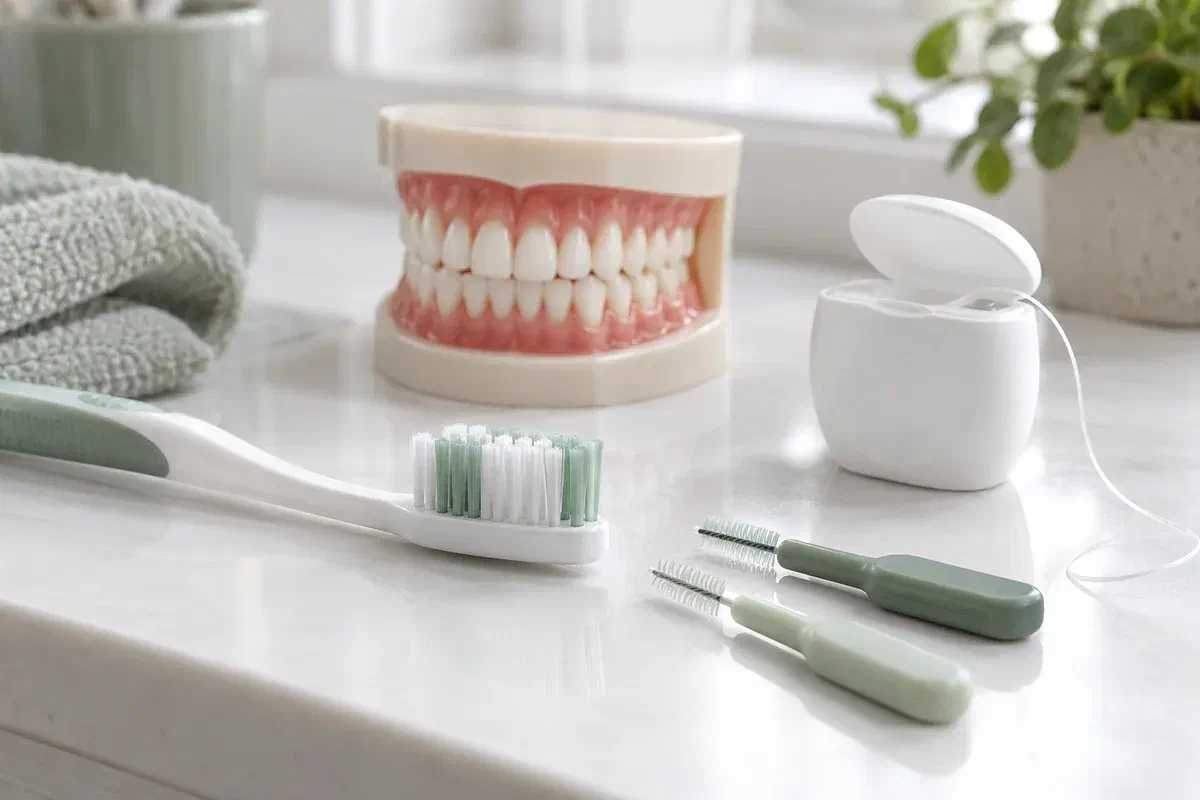
Illustrative brushing demonstration using a dental model
General & Family Dentistry

Oral Hygiene Instruction in Brampton

Sometimes the person learning to clean is a daughter, a son or a carer, helping someone they love. We show both of you a routine that respects comfort, ability and dental work, and keeps the patient involved.

Learning to help someone else

Two people at the sink, one routine that works for both

In many homes, an adult child ends up holding the toothbrush for a parent whose hands have stiffened, or a grandparent needs a reminder and a steady arm. Nobody shows the helper how to do it. You copy what you do for yourself, which can feel awkward from the side and leave the back teeth or a bridge barely touched.

Households in Brampton often span several generations, and it is fine to come in as a pair. The person receiving care shows us what they can still manage, the helper shows us what they do, and we look for the step causing trouble. Everyone is treated with respect, and the aim is to adjust the routine rather than assign blame.

Instruction forms part of regular dental and hygiene care and is guided by the examination. We demonstrate, let each of you try, and agree on a simple plan. You don't need to swap every product or learn a long sequence before seeing a worthwhile change, and the patient's own say remains central.

Book guidance for you and a helper
Soft toothbrush, interdental brushes, floss, and dental model for personal care instruction
Common challenges in shared care

What makes cleaning hard, for either of you

Tell us what happens during cleaning, including pain, catching, gagging, resistance or frustration on either side. A specific example lets us separate a technique problem from one that needs further assessment.

Spaces that are hard to see or reach

Crowding, a bridge or other dental work can change how an aid has to travel, and that's harder still from someone else's angle. We can identify the area and show a route. Under a bridge, the method usually differs from cleaning between natural teeth.

Gums that bleed or feel sore

Point out where bleeding appears and whether it seems tender. Inflammation, a rough restoration edge or too much pressure from an unfamiliar hand can be factors. Brushing harder or switching to a stronger rinse is not a dependable fix.

Grip, stamina, swallowing or senses

Arthritis, weak grip, tiredness, sensitivity to flavours or difficulty swallowing can all shape what's possible. Explain what the person can manage. The plan can include suitable tools, pacing and a clear split of who does which step.

Bring the toothbrush and aids used at home, along with any dentures or appliances. Seeing the real routine, including the helper's part, is more useful than a description.

Why shared instruction matters

Confidence for the helper, dignity for the patient

Plaque has to be cleared daily from the right surfaces with gentle, effective movements, whoever is holding the brush. A toothbrush and an interdental aid have different roles. Understanding which goes where helps a helper clean properly and helps the patient know what to expect, around natural teeth and dental work alike.

We'll ask both of you to practise or describe the steps back, so we can see that they make sense. If something seems unrealistic for your evenings at home, mention it before you leave. A short routine that both of you can keep up is worth far more than a thorough plan that falls apart in a week.

Patient information: NIDCR — oral hygiene techniques and daily care

A clear reason for every step

Ask what each movement is meant to clean. Knowing the purpose helps a helper stay focused and recognize when an aid isn't reaching. It also stops the household from collecting products that serve no clear role.

Aids chosen for the real mouth

Floss, holders, interdental brushes and other tools suit different spaces, and some are easier to use on another person. We'll explain how to use each and when it should not be pushed through a gap.

Reviews that ease the load

A later visit can show whether plaque, gum inflammation or the practical struggle has improved. Tell us which tasks went smoothly and which didn't. We can then rework the plan instead of treating the first attempt as final.

How we work with both of you

Listen, demonstrate, hand over, review

We need a true picture of what happens now. Please be open about difficulties for either person; the goal is easier, more effective care, not a judgement.

  1. Understand the patient and the helper

    We ask how cleaning is done now, who does which part and where it gets difficult. Mention discomfort, dentures or other appliances, medical or swallowing guidance and recent dental work. The examination shows whether instruction suits or treatment is also needed.

  2. Show positions and technique

    Using a model, mirror or the patient's own mouth, we demonstrate angle, movement and how a helper can see and reach comfortably. Ask us to focus on whichever space causes the most trouble rather than a general overview.

  3. Let each person try

    The patient does what they can, and the helper practises the rest while we watch and correct. Say if a handle is awkward, an aid catches or anything is uncomfortable. Another tool may suit better than persisting with one that doesn't fit.

  4. Divide the tasks and plan a recheck

    We agree on a manageable set of steps, who handles each and any product suggestions. Ask when to return and which symptoms warrant an earlier call. Written notes help everyone remember a route under a bridge or the size of a brush.

Keeping shared care going

Patience usually works better than pressure.

Follow the routine agreed for this mouth and come back with questions as they arise. Pushing harder, using more products or making sessions longer isn't automatically better.

One consistent brushing path

Use fluoride toothpaste and cover the surfaces we demonstrated. Working around the mouth in a set order helps prevent missed areas when evenings are busy. If brushing causes pain or bristles flatten fast, ask us to look at the pressure being used.

Ease aids in, never force them

Use the aid and method chosen for each space, knowing that different gaps may need different sizes. If something catches repeatedly or hurts, let us know, as the cause could be technique, fit or the tooth or restoration itself.

Adjust when health changes

Illness, fatigue or a change in ability can make even a short routine harder. Ask how to adapt it, and agree which tasks a helper can take on. An easier product doesn't automatically replace the cleaning that is needed.

Patient information: NIDCR — cleaning between teeth and the role of professional care

Options for Brampton households

Choose support around what's hardest.

A small change in technique, a different tool or specific help with dental work may be what's needed. The examination reveals when treatment should accompany the advice.

When either person's technique needs work

Refining brushing and interdental care

We can focus on brush angle, sequence and reaching the gumline and spaces between teeth. Ask us to demonstrate one area well before adding another. Reliable daily practice matters more than product names.

When bridges, implants or dentures change access

Care around restorations and appliances

Dental work may need methods matched to its design. Ask which aids are suitable and how to avoid catching or damaging parts. Advice should be based on the person's actual restoration or appliance, not a generic diagram.

When a helper takes on part of the routine

Assisted care

We may discuss a larger handle, a powered brush, another aid or a clear split of tasks. The helper is welcome at every visit. The plan should keep the patient participating as much as they wish and follow medical or swallowing instructions.

Questions from Brampton carers

Helping someone else brush: what people ask

There's no need to pretend a technique is clear if it isn't. Describe what feels awkward from either side of the toothbrush, and we'll adjust.

(905) 876-4488
Can I learn how to brush my mother's teeth for her?
Yes. With her agreement, we can show you positions and movements suited to her mouth and any dental work, then watch you try. The plan should still let her do the parts she can manage and respect any medical or swallowing guidance she has.
What position works best when cleaning someone else's teeth?
It depends on the person’s comfort, mobility and where you need to see. We can demonstrate positions that give you a clear view and steady reach without straining either of you. Ask us to show this for the specific areas that are hardest to reach.
Should the routine change for someone who has difficulty swallowing?
It may. Mention any swallowing difficulty and the advice already given by their medical team. The plan should follow that guidance, and we can discuss tools and methods that suit it. Seek urgent medical help for choking or breathing difficulty.
My father has a partial denture. Can that be included in the instruction?
Yes. Appliances and the natural teeth around them can need their own approach. Bring the denture and describe how it is cleaned now. We can explain suitable methods and point out areas near the appliance that need attention.
Is a powered toothbrush easier for a helper to use on someone else?
For some people it is, while others find the vibration or handle size uncomfortable. It may be discussed as one option. Ask us to compare it with a manual brush for the person’s mouth and abilities rather than assuming it suits everyone.
Can two or three family members learn the routine at the same visit?
Mention this when booking. If several people share care at home, it can help for them to see the same demonstration. Let the team know who will attend so the time can be planned, and keep the patient’s comfort and consent at the centre.
Coming in from Brampton

Bring the person you help, or come together.

Contact our Bronte Street practice to talk about shared brushing, cleaning between teeth or caring for dentures and other dental work. Tell us who does which step now and where it gets hard. We'll assess the concern and suggest practical changes for both of you.

When booking, let us know about any pain, bleeding or new change in the mouth so it can be checked alongside instruction.

Visit Milton Dental Clinic
Unit 1, 342 Bronte St. S, Milton, ON L9T 5B7
Get directions Clinic hours
Monday–Thursday
11am–7pm
Friday–Sunday
By appointment only

Areas we serve

  • Milton
  • Oakville
  • Mississauga
  • Georgetown
  • Halton Hills
  • Acton
  • Campbellville
  • Brampton
  • Burlington
  • Puslinch
  • Rockwood
  • Erin
  • Caledon
  • Etobicoke
  • Old Milton
  • Bronte Meadows
  • Timberlea
  • Dorset Park
  • Dempsey
  • Clarke
  • Beaty
  • Coates
  • Harrison
  • Scott
  • Willmott
  • Ford
  • Bowes
  • Cobden
  • Walker
  • Mountain View
  • Milton Heights
  • Hawthorne Village
  • Valley View
  • Fallingbrook
  • Nassagaweya
  • Trafalgar
  • Esquesing
  • Nelson
  • Brookville
  • Moffat
  • Glen Williams
  • Norval
  • Limehouse
  • Stewarttown
  • Ashgrove
  • Hornby
  • Silver Creek
  • Speyside
  • Scotch Block
  • North Oakville
  • River Oaks
  • Glen Abbey
  • West Oak Trails
  • Palermo
  • Bronte Creek
  • College Park
  • Joshua Creek
  • Uptown Core
  • Preserve
  • Iroquois Ridge
  • Lisgar
  • Meadowvale
  • Meadowvale Village
  • Churchill Meadows
  • Erin Mills
  • Central Erin Mills
  • Streetsville
  • East Credit
  • Creditview
  • Heartland
  • Sheridan
  • Mount Pleasant
  • Credit Valley
  • Huttonville
  • Churchville
  • Springbrook
  • Northwest Brampton
  • Bram West
  • Fletcher's Meadow
  • Fletcher's Creek South
  • Alton Village
  • Orchard
  • Millcroft
  • Headon Forest
  • Tansley
  • Brant Hills
  • Tyandaga
  • Kilbride
  • Lowville
  • Aberfoyle
  • Morriston
  • Arkell
  • Hillsburgh
  • Freelton
  • Carlisle
  • Waterdown
  • Flamborough
  • Mountsberg

How can we help?

Milton Dental Clinic

Have a question about your smile? Choose the option that works best for you.

For urgent dental concerns, please call.
Messages are reviewed during clinic hours.