

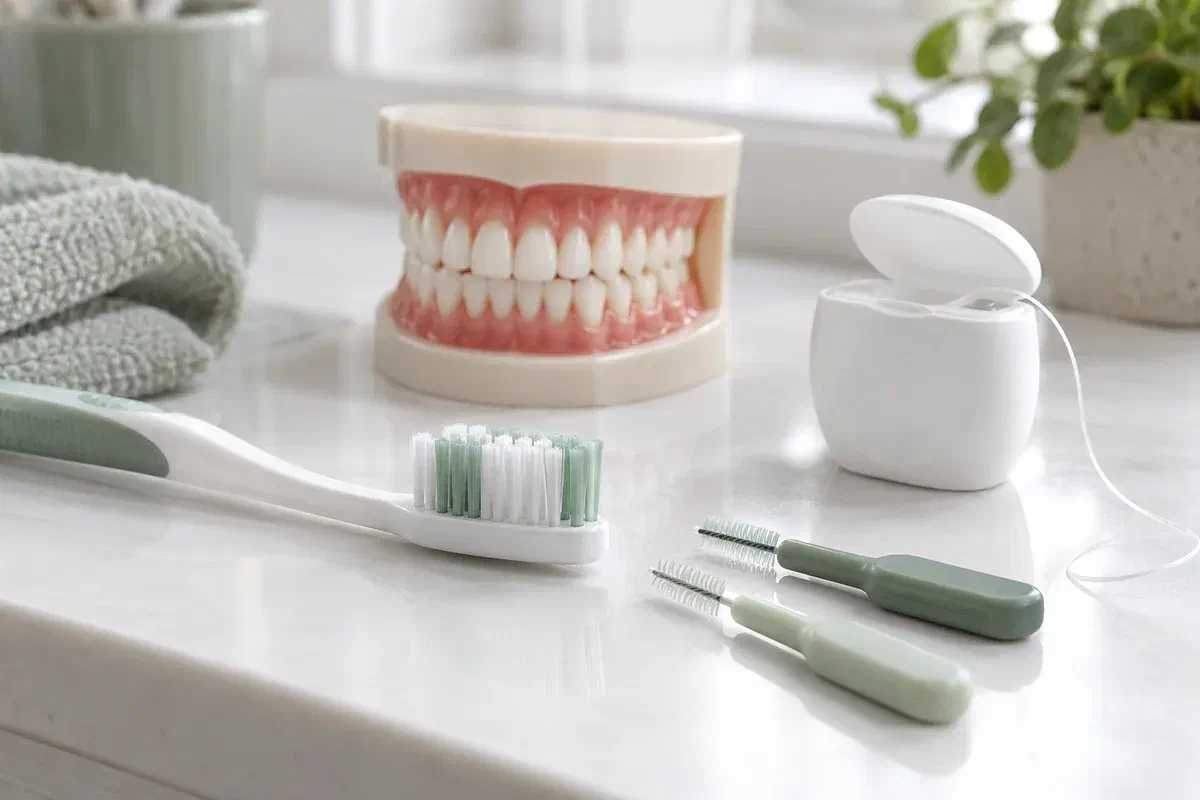
Illustrative brushing demonstration using a dental model
General & Family Dentistry

Oral Hygiene Instruction in Caledon

You brush, you floss now and then, but you're never quite sure it's working. Personal instruction shows you where plaque is collecting in your mouth and how to check your own cleaning between visits.

Checking your own cleaning

How would you know if you were missing a spot?

Most of us have no real feedback on brushing. We go through the motions, the toothpaste tastes fresh, and we assume the job is done. Then a checkup reveals inflamed gum near one molar or buildup behind the lower front teeth, and it's a surprise. The missing piece is knowing what thorough cleaning looks and feels like in your particular mouth.

From Bolton to the smaller villages across Caledon, people bring us this same quiet uncertainty. Start by showing us your usual routine and the tools you use. We'll point out exactly where plaque is gathering and why your current method passes it by, and we'll do it without making you feel you've failed at something simple.

Instruction sits within your regular dental and hygiene care and is directed by the examination. You'll see the problem areas, watch a demonstration, try it and agree a short plan. A complete change of products isn't needed, and the brush you already have may be perfectly fine once the angle is right.

Find out where your routine falls short
Soft toothbrush, interdental brushes, floss, and dental model for personal care instruction
Signs that something is being missed

Clues worth mentioning

Describe anything you notice: soreness, catching, gagging, a rough feeling on certain teeth, or plain uncertainty. A specific clue helps us decide whether technique is the issue or whether something should be examined further.

One area that always feels rough

Overlapping teeth, a bridge or a restoration can create a spot where deposits linger. We'll identify it and show how to reach it. Cleaning under a bridge involves a different method from cleaning between two natural teeth.

Pink on the brush or floss

Tell us where bleeding occurs and if the gum feels tender. It may reflect inflammation, a rough margin on a filling or crown, or simply pressing too hard. A stronger mouthwash or more vigorous scrubbing won't reliably fix it.

Practical limits on what you can do

Stiff hands, a short reach, tiredness or sensitivity to a flavour all affect how thoroughly you can clean. Let us know what's comfortable, and the plan will account for tools, pacing and support.

Please bring your toothbrush and any aids you use. Watching you clean the area we're concerned about tells us more than any description.

What you'll learn to notice

Feedback you can use every day

Clearing plaque daily depends on reaching the right surfaces with a light, effective touch. Brushing tackles the open faces of the teeth, and interdental tools deal with the gaps. Once you know which areas belong to which tool, you can tell much more easily whether your routine has covered them.

We'll ask you to practise and to describe what clean should feel like, so you leave able to check yourself. If a method seems unlikely to last past the first week, tell us and we'll trim it down. A modest routine with a built-in self-check beats an exhaustive one you can't evaluate.

Patient information: NIDCR — oral hygiene techniques and daily care

Purpose you can check against

Ask what a step is meant to reach. With that in mind, you can notice when an aid hasn't done its job and avoid buying products that add nothing for your mouth.

Aids sized to your gaps

Floss, interdental brushes, holders and similar tools fit different spaces, and dental work changes access. We'll show how to use each and when to stop rather than push one through a tight space.

Confirmation at your next visit

A review can show whether deposits and inflamed gums have settled and whether the method has become easier. Tell us what you kept up and what slipped. The plan can be refined from there.

How the session works

Find it, fix it, check it

The clearer the picture of what you do now, the better the advice. Be candid about habits and obstacles; this is about effective care, not about blame.

  1. Describe your usual routine

    We ask how often and how you brush, what you use between teeth and where you feel unsure. Tell us about tenderness, a retainer or other appliance, recent fillings or crowns, and who helps you if anyone does. The exam shows whether instruction is enough or treatment is required as well.

  2. Show you the missed areas

    We point out where plaque or inflammation suggests a surface is being skipped, then demonstrate brush placement and interdental access on a model or in your mouth.

  3. Practise and learn the self-check

    You try the movement while we refine it, and we discuss how a well-cleaned area should feel. Tell us if a handle is awkward, an aid catches or anything hurts. A different tool may fit better.

  4. Set priorities and a review

    We agree a handful of changes, explain any product suggestions and note sizes or routes. Ask when we should look again and which symptoms mean calling sooner.

Checking yourself at home

Thorough, gentle, and easy to verify

Use the method we planned and come back with questions. Harder pressure, extra products or longer sessions don't guarantee a cleaner result.

Follow a set route

Brush with fluoride toothpaste and give attention to the surfaces we demonstrated, in the same order each time. Afterwards, check the areas we discussed. If brushing hurts or bristles splay early, ask us to review your pressure.

Ease interdental aids into each gap

Use the aid we chose for each space; some gaps take different sizes. If an aid repeatedly catches or causes pain, let us know. Technique, sizing or an issue with the tooth itself may need attention.

Adjust when you're unwell or worn out

On days when sickness or exhaustion makes cleaning harder, ask how to keep the essential steps going. A household member may help with agreed tasks. An easier product doesn't automatically replace cleaning.

Patient information: NIDCR — cleaning between teeth and the role of professional care

Guidance for Caledon households

Where should the focus go?

A technique adjustment, a different aid or help with restorations may be what's needed. Your examination shows whether treatment should go alongside the advice.

When you're unsure your method is working

Brushing and between-teeth technique

We can work on brush angle, sequence and reaching the gumline and spaces between teeth. Ask to perfect one area before adding the next. A dependable habit matters more than product names.

When dental work hides missed areas

Care around restorations and appliances

A bridge or implant isn't cleaned quite like a natural tooth, and the method depends on how it was made. Ask which aids are suitable and how to use them without catching anything. Advice should reflect your actual restoration.

When comfort or ability makes thorough cleaning hard

Adapted or assisted routines

We may discuss a thicker handle, an electric brush, an alternative aid or help from a family member, who is welcome to attend. You stay part of the routine, and medical or swallowing instructions are followed.

Caledon questions about getting it right

Am I actually cleaning well enough?

If you're unsure whether you've got it, say so. We'll show you again and help you learn to check your own work.

(905) 876-4488
How can I tell if I'm actually cleaning my teeth well enough?
Your examination gives the clearest answer, since the team can see where plaque or gum inflammation remains. We can show you those areas and explain what a well-cleaned surface should feel like, so you have a way to check yourself between visits.
Does a fuzzy feeling on my teeth by evening mean I'm missing areas?
It can suggest plaque is building up, especially if it’s always in the same place. Point out the spot at your visit. We can check the area and adjust your technique or aid so that surface gets cleaned properly.
Can the team show me exactly where plaque is collecting in my mouth?
Yes. During the visit we can point out areas where deposits or inflammation suggest cleaning is being missed. Seeing them in a mirror makes it easier to understand why a technique change is being suggested.
Should my teenager come to the instruction session too?
If they’d like help with their own routine, mention it when booking. Instruction can be adapted to a younger person’s mouth and habits, and it’s often easier for them to hear the advice directly from the team.
Do overlapping front teeth need a special way of cleaning?
They often need a particular angle or aid, because crowded spaces can be tight or uneven. Ask us to look at the area and demonstrate an approach. If an aid shreds or won’t pass, tell us so we can try a different option.
Would brushing three or four times a day make up for poor technique?
Brushing more often won’t necessarily reach the areas being missed, and frequent forceful brushing may irritate the gums. Improving where and how you brush usually matters more. We can help you make your regular brushing sessions more effective.
Planning a visit from Caledon

Learn what clean really feels like.

Contact our Bronte Street practice to discuss brushing, cleaning between teeth or looking after dental work. Tell us where you feel unsure. We'll assess your mouth and give practical guidance you can check for yourself at home.

Let us know about any pain, bleeding or unusual change when booking, so it can be examined at the same visit.

Visit Milton Dental Clinic
Unit 1, 342 Bronte St. S, Milton, ON L9T 5B7
Get directions Clinic hours
Monday–Thursday
11am–7pm
Friday–Sunday
By appointment only

Areas we serve

  • Milton
  • Oakville
  • Mississauga
  • Georgetown
  • Halton Hills
  • Acton
  • Campbellville
  • Brampton
  • Burlington
  • Puslinch
  • Rockwood
  • Erin
  • Caledon
  • Etobicoke
  • Old Milton
  • Bronte Meadows
  • Timberlea
  • Dorset Park
  • Dempsey
  • Clarke
  • Beaty
  • Coates
  • Harrison
  • Scott
  • Willmott
  • Ford
  • Bowes
  • Cobden
  • Walker
  • Mountain View
  • Milton Heights
  • Hawthorne Village
  • Valley View
  • Fallingbrook
  • Nassagaweya
  • Trafalgar
  • Esquesing
  • Nelson
  • Brookville
  • Moffat
  • Glen Williams
  • Norval
  • Limehouse
  • Stewarttown
  • Ashgrove
  • Hornby
  • Silver Creek
  • Speyside
  • Scotch Block
  • North Oakville
  • River Oaks
  • Glen Abbey
  • West Oak Trails
  • Palermo
  • Bronte Creek
  • College Park
  • Joshua Creek
  • Uptown Core
  • Preserve
  • Iroquois Ridge
  • Lisgar
  • Meadowvale
  • Meadowvale Village
  • Churchill Meadows
  • Erin Mills
  • Central Erin Mills
  • Streetsville
  • East Credit
  • Creditview
  • Heartland
  • Sheridan
  • Mount Pleasant
  • Credit Valley
  • Huttonville
  • Churchville
  • Springbrook
  • Northwest Brampton
  • Bram West
  • Fletcher's Meadow
  • Fletcher's Creek South
  • Alton Village
  • Orchard
  • Millcroft
  • Headon Forest
  • Tansley
  • Brant Hills
  • Tyandaga
  • Kilbride
  • Lowville
  • Aberfoyle
  • Morriston
  • Arkell
  • Hillsburgh
  • Freelton
  • Carlisle
  • Waterdown
  • Flamborough
  • Mountsberg

How can we help?

Milton Dental Clinic

Have a question about your smile? Choose the option that works best for you.

For urgent dental concerns, please call.
Messages are reviewed during clinic hours.