

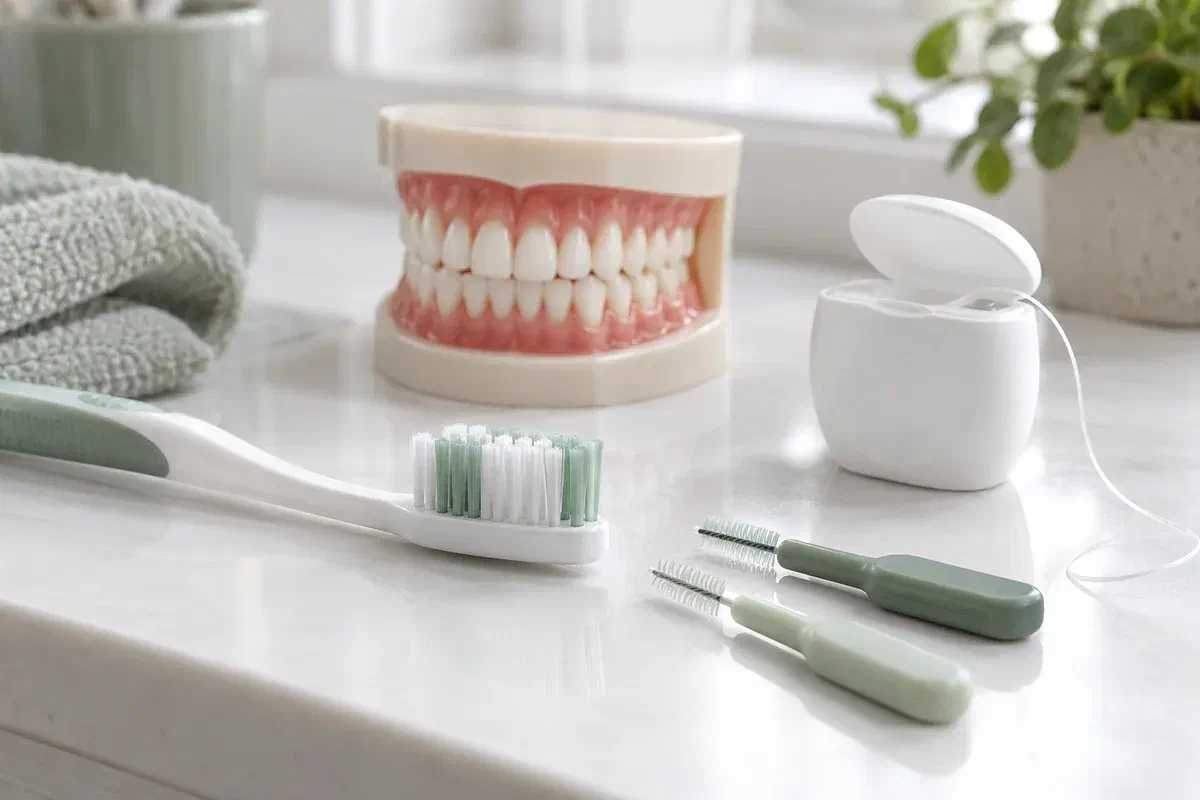
Illustrative brushing demonstration using a dental model
General & Family Dentistry

Oral Hygiene Instruction in Georgetown

A new bridge, crown or implant changes the shape of your mouth, and your old routine may no longer reach. We show you how to clean around the dental work you have now, step by step and without forcing anything.

Cleaning around new dental work

New bridge, new route.

The first time you try to floss after getting a bridge, you discover the string won't go where it used to. Teeth that were once separate are now joined, and the space beneath needs a different approach. Implants and crowns bring their own contours too. It's a common moment of confusion, and a clear demonstration usually helps a great deal.

From Georgetown, many people arrive with the dental work already in place and a vague memory of the advice they were given on the day. Bring your usual tools and show us how you've been managing. We'll look at the restoration, find the surfaces that are being missed and adjust the method, with no criticism of what you've tried so far.

Instruction is part of the ongoing care that keeps restorations and the teeth supporting them healthy, and it follows what the examination shows. You'll watch the technique, try it yourself and leave with a short plan. There's no need to master every tool at once, and some of the aids you already own may still be useful.

Learn to clean around your dental work
Soft toothbrush, interdental brushes, floss, and dental model for personal care instruction
Where new restorations cause trouble

Is something catching, bleeding or just confusing?

Describe what you notice while cleaning: soreness, snagging, gagging or annoyance. A specific example helps us decide whether the issue is technique or whether the restoration or gum needs further assessment.

A space that no longer behaves like a gap

A bridge joins teeth, and an implant crown sits on a post rather than a root, so the usual floss path may not apply. We'll point out the areas that need attention and show a suitable route beneath or around them.

Bleeding or tenderness near the restoration

Let us know where bleeding appears and whether the gum feels sore. Gum inflammation, a rough margin or a forceful technique could be involved. Brushing harder or switching to a stronger rinse is not a reliable way to settle it.

Dexterity, energy or sensory limits

Threading an aid under a bridge takes fine control, which can be harder with sore hands, limited reach, fatigue or flavour sensitivity. Tell us what you can manage, so we can plan tools, pacing and support to match.

Bring the brush and any threaders, picks or floss you've been using. Watching you clean around the actual restoration is more useful than a diagram.

Why the demonstration matters

Dental work is easier to look after once you know the route.

Plaque still forms on and around restorations, so the daily job of removing it continues. Brushing covers the visible faces, while interdental aids reach underneath and between. Understanding which tool belongs where lets you choose methods that suit the design of your bridge, crown or implant and the natural teeth beside it.

We'll ask you to practise or demonstrate the movement back to us, because cleaning under a bridge is easier to learn by doing than by listening. If a step feels too fiddly for your evenings, say so and we'll look for another aid. A simple method you keep using matters far more than a complex one you give up.

Patient information: NIDCR — oral hygiene techniques and daily care

Knowing what each aid reaches

Ask which surface or space a tool is meant for. When the purpose is clear, it's easier to guide the aid correctly and notice when it isn't reaching. It also stops you from collecting products that don't suit your restoration.

Tools matched to the design

Threaders, interdental brushes, floss and other aids suit different restorations. Size and access matter. We'll show how to use the right one for your dental work and when to stop instead of pushing it through.

A review once you've settled in

A later visit can check whether plaque, gum inflammation or the practical difficulty has improved around the restoration. Tell us which steps were easy and which were not, so the routine can be fine-tuned.

What we'll cover

Four stages, from confused to comfortable

We need to see how you've been managing so far. Please be frank about steps you've skipped; the point is better care for your dental work, not a verdict on your habits.

  1. Look at the restoration and your routine

    We ask how you clean around the new work, what tools you use and which areas feel difficult. Mention discomfort, other appliances and any help you receive. The examination shows whether instruction alone suits or the restoration or gum needs attention too.

  2. Demonstrate the route around it

    On a model, in a mirror or in your own mouth, we show how an aid travels beneath a bridge or around an implant crown. We'll focus on the exact restoration that confuses you rather than giving a general overview.

  3. Have you thread it yourself

    You try the method while we watch and correct small details. Speak up if an aid snags, a handle is awkward or something hurts. A different tool is often better than persisting with one that doesn't fit the design.

  4. Write down sizes, steps and a review

    We agree on a manageable plan, note any product suggestions and write down the aid sizes and route. Ask when we should check progress and which symptoms mean calling sooner.

Caring for it at home

Slow and careful around the new work

Use the method we developed for your restoration and ask when questions come up. Pressing harder, piling on products or cleaning for longer doesn't necessarily help.

Include the restoration in every brush

Use fluoride toothpaste and give attention to the crown, bridge or implant and the gumline around it, following a set order. If brushing hurts or bristles flatten quickly, ask us to review your pressure and angle.

Guide aids beneath, don't push

Use the aid chosen for each space with the movement we practised. If a tool keeps catching or causes pain, tell us. The reason could be technique, the size of the aid or something about the restoration that should be examined.

Simplify, but keep the essentials

When illness, fatigue or a change in ability makes cleaning harder, ask how to trim the routine without skipping the restoration. Someone at home may help with agreed steps. A product that feels easier isn't automatically a replacement for cleaning.

Patient information: NIDCR — cleaning between teeth and the role of professional care

Support for Georgetown smiles

Three starting points

The answer could be a technique change, a new aid or focused help with your restoration. The examination shows when professional treatment should accompany the advice.

When the rest of the mouth needs attention too

Everyday brushing and interdental technique

We can refine brush angle, cleaning order and how you reach the gumline and gaps between natural teeth. Ask us to demonstrate one area carefully before moving on. Practical daily skill matters more than product names.

When your restoration needs its own method

Bridges, crowns and implants

Dental work may need methods suited to its design. Ask which aids fit yours and how to clean without snagging or harming any component. Advice should be based on your own restoration rather than a general picture.

When comfort or ability gets in the way

Adapted or assisted care

We may suggest an easier handle, a powered brush, an alternative aid or support from someone you trust. They're welcome to attend. The plan should keep you involved and respect medical or swallowing guidance.

Georgetown questions about dental work

Cleaning around restorations: common questions

If a method still looks puzzling, tell us. We'll slow down, show it again and change the aid if it doesn't suit your restoration.

(905) 876-4488
When can I start cleaning normally around a newly placed bridge?
Follow the specific instructions you were given after the treatment, and ask the team if you’re unsure. Once you’re cleared to clean the area, we can show how to reach beneath the bridge and around its supporting teeth with a suitable aid.
What is a floss threader, and do I need one?
A threader helps guide floss beneath a bridge or other connected restoration. It’s one option among several aids. Whether it suits you depends on the design of your dental work and your dexterity, so ask us to demonstrate it alongside the alternatives.
If an implant can't get a cavity, why does it still need cleaning?
Plaque can still build up on the crown and along the gum around the implant. Keeping those areas clean is part of looking after the restoration and the tissue around it. We can show a method and aid suited to your implant’s design.
Can I use the same interdental brush around my implant as between natural teeth?
Sometimes, but not always. Implants and their crowns may need aids suited to their materials, shape and spacing. Ask us which tools are appropriate for your implant and how to use them without catching or damaging any part.
How can I tell whether I'm cleaning too roughly around my new crown?
Soreness, bleeding or an aid that catches repeatedly are signs to mention. Cleaning should feel controlled rather than forced. Bring your tools to a visit so we can watch your technique and check the crown and gum in the area.
Will looking after a bridge make my routine take much longer?
It usually adds a step, but it doesn’t have to be time-consuming once the method is familiar. Practising during your visit helps it become quicker. If the routine feels too long, tell us and we’ll look for a simpler way to cover what matters.
Visiting us from Georgetown

Show us the restoration, and we'll show you the way around it.

Contact our Bronte Street practice to talk about cleaning around a bridge, crown or implant, or brushing and interdental care in general. Tell us which area confuses you. We'll assess it and give practical guidance you can follow every day.

Please mention any pain, bleeding or recent change around your dental work when booking, so it can be checked as well.

Visit Milton Dental Clinic
Unit 1, 342 Bronte St. S, Milton, ON L9T 5B7
Get directions Clinic hours
Monday–Thursday
11am–7pm
Friday–Sunday
By appointment only

Areas we serve

  • Milton
  • Oakville
  • Mississauga
  • Georgetown
  • Halton Hills
  • Acton
  • Campbellville
  • Brampton
  • Burlington
  • Puslinch
  • Rockwood
  • Erin
  • Caledon
  • Etobicoke
  • Old Milton
  • Bronte Meadows
  • Timberlea
  • Dorset Park
  • Dempsey
  • Clarke
  • Beaty
  • Coates
  • Harrison
  • Scott
  • Willmott
  • Ford
  • Bowes
  • Cobden
  • Walker
  • Mountain View
  • Milton Heights
  • Hawthorne Village
  • Valley View
  • Fallingbrook
  • Nassagaweya
  • Trafalgar
  • Esquesing
  • Nelson
  • Brookville
  • Moffat
  • Glen Williams
  • Norval
  • Limehouse
  • Stewarttown
  • Ashgrove
  • Hornby
  • Silver Creek
  • Speyside
  • Scotch Block
  • North Oakville
  • River Oaks
  • Glen Abbey
  • West Oak Trails
  • Palermo
  • Bronte Creek
  • College Park
  • Joshua Creek
  • Uptown Core
  • Preserve
  • Iroquois Ridge
  • Lisgar
  • Meadowvale
  • Meadowvale Village
  • Churchill Meadows
  • Erin Mills
  • Central Erin Mills
  • Streetsville
  • East Credit
  • Creditview
  • Heartland
  • Sheridan
  • Mount Pleasant
  • Credit Valley
  • Huttonville
  • Churchville
  • Springbrook
  • Northwest Brampton
  • Bram West
  • Fletcher's Meadow
  • Fletcher's Creek South
  • Alton Village
  • Orchard
  • Millcroft
  • Headon Forest
  • Tansley
  • Brant Hills
  • Tyandaga
  • Kilbride
  • Lowville
  • Aberfoyle
  • Morriston
  • Arkell
  • Hillsburgh
  • Freelton
  • Carlisle
  • Waterdown
  • Flamborough
  • Mountsberg

How can we help?

Milton Dental Clinic

Have a question about your smile? Choose the option that works best for you.

For urgent dental concerns, please call.
Messages are reviewed during clinic hours.