

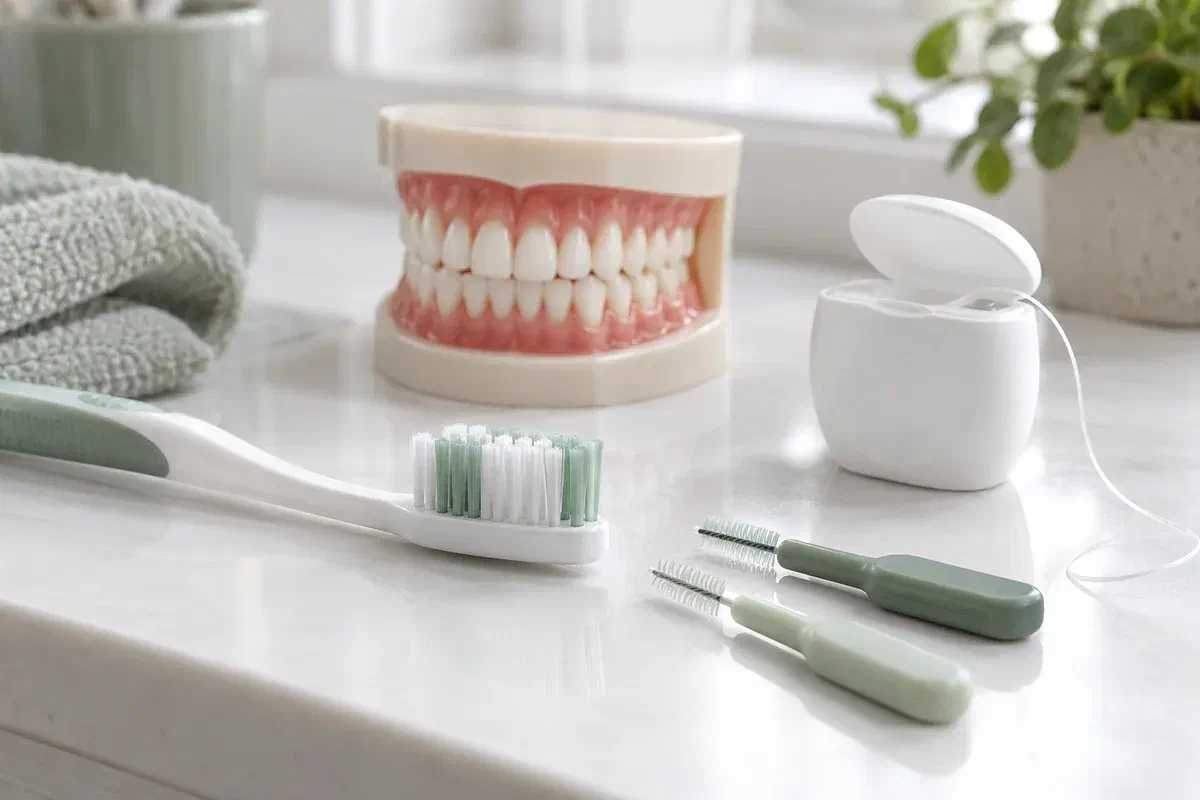
Illustrative brushing demonstration using a dental model
General & Family Dentistry

Oral Hygiene Instruction in Halton Hills

Stiff fingers, a sore wrist or a weak grip can turn two minutes of brushing into a chore. We look at your hands as well as your teeth and adapt tools and technique so daily cleaning stays manageable.

When your hands make it harder

A toothbrush shouldn't be a struggle to hold.

Most cleaning advice assumes nimble fingers. Wrap floss around two fingers, angle the brush just so, hold it there for a while. For anyone living with arthritis, a past injury or simply tired hands, those instructions can feel impossible, so certain steps quietly stop happening and the mouth pays for it later.

People come to us from Georgetown, Acton, Glen Williams and the smaller corners of Halton Hills with exactly this problem. We begin by watching you hold the brush and any aids you already own, and by asking which movements hurt or tire you. Then we look for changes in grip, tool or order that take strain off your hands.

This guidance fits within regular dental and hygiene care, and the examination shapes it. You'll see an approach demonstrated, try it at your own pace, and agree on a short plan. Nothing needs to be mastered in one go, and familiar tools can stay if they still work for you.

Ask about adapted cleaning
Soft toothbrush, interdental brushes, floss, and dental model for personal care instruction
Where hand trouble shows up

Small movements, big obstacles

Let us know how cleaning feels, including pain in the hands, catching between teeth, gagging or frustration. A concrete example lets us tell a technique or tool issue from something in the mouth that needs further assessment.

Spaces that need fine control

Crowded teeth, a bridge or other dental work can demand precise movements that hands find difficult. We'll identify those areas and look for a route that needs less dexterity. Under a bridge, the approach is often different from cleaning between natural teeth.

Bleeding or tender gums

Show us where bleeding occurs and whether the gum is sore. Inflammation, a rough edge on a restoration or a grip that forces too much pressure could be involved. Pressing harder or turning to a stronger rinse rarely fixes the problem alone.

Grip, reach, stamina and senses

Swollen joints, a limited shoulder reach, fatigue or sensitivity to flavours all affect what's realistic. Explain which movements are comfortable and which aren't. The plan can include different handles, rest breaks and help from someone else.

Bring the toothbrush and aids you use, even ones you've given up on. Watching you handle them shows us where the strain comes from.

Why adapting the routine helps

Clean teeth without fighting your own hands

Removing plaque daily still means reaching the right surfaces gently and effectively, however your hands feel. A brush and an interdental aid each cover different areas. Once you know what each is for, we can choose the easiest tool for each job, which often matters more than any change in technique.

We'll ask you to try the adapted grip or explain it back so we know it's comfortable, not just theoretically correct. If a step would be too painful on a bad day, tell us and we'll build a lighter version. A gentle routine you can sustain is far better than an ideal one your hands can't manage.

Patient information: NIDCR — oral hygiene techniques and daily care

Purpose before effort

Ask what each step is meant to achieve. Knowing the purpose lets you save energy for what matters and notice when an aid is missing its target. It also avoids buying gadgets that add work without a clear benefit.

Aids your hands can use

Floss holders, interdental brushes with longer handles and other aids suit different spaces and grips. Fit around dental work matters too. We'll show how to use each and when to stop rather than push one through a tight gap.

Adjustments over time

A later review can show whether plaque, gum inflammation or the strain on your hands has eased. Tell us which steps became easy and which still hurt. The plan can change as your hands do.

How an adapted plan comes together

We start with your hands, then your teeth.

Telling us honestly what you can and can't do lets us give useful advice. There's no judgement here, only the aim of making care easier and more effective.

  1. Talk about comfort and current routine

    We ask which movements hurt, how long you can brush before tiring and which mouth areas are difficult. Mention appliances, recent dental work and any help you receive. The examination shows whether instruction alone suits or treatment is also needed.

  2. Try different grips and handles

    Using a model, a mirror or your own mouth, we demonstrate positions and tools that ask less of your fingers and wrists. We'll focus on the areas that are hardest for you rather than walking through the whole mouth.

  3. Practise at your own pace

    You try each option and tell us how it feels. Mention if a handle is still awkward, an aid snags or something causes pain. Moving to another tool is often wiser than persisting with one that strains your hands.

  4. Agree the easiest effective plan

    We settle on a few changes and any product suggestions, with notes on sizes or routes if helpful. Ask when the plan should be reviewed and which symptoms mean calling sooner.

Living with the new routine

Pace yourself and protect your joints.

Follow the method we worked out, and come back if your hands or needs change. Squeezing harder, adding products or extending the session won't automatically clean better.

Brush in sections if you need to

Use fluoride toothpaste and cover the surfaces we demonstrated, following a set order. Taking a short break between sections is fine if your hands tire. If bristles flatten quickly or brushing hurts your gums, ask us to look at pressure.

Let the aid do the work

Use the tool chosen for each space with the gentle movement we practised; some gaps need different sizes. If an aid repeatedly catches or hurts, tell us, as technique, fit or a problem with the tooth or restoration may be the cause.

Plan for flare-ups

On days when joint pain, illness or fatigue is worse, ask how to trim the routine without dropping essential cleaning. Someone close to you could take on an agreed step or two. An easier product isn't automatically a replacement for cleaning.

Patient information: NIDCR — cleaning between teeth and the role of professional care

Support across Halton Hills

Three ways we can lighten the task

It might be a technique change, a different tool or help with dental work. The examination shows whether treatment is needed as well as guidance.

When the movement itself is the problem

Technique that asks less of your hands

We can rework brush angle, sequence and how you reach the gumline and gaps, with an eye on comfort. Ask for one area to be demonstrated thoroughly first. A repeatable routine matters more than product names.

When restorations need extra precision

Cleaning around dental work

Bridges, implants and other work may need methods matched to their design, and some aids are easier to handle than others. Ask which suit you and how to clean without snagging parts of the restoration.

When grip, reach or stamina is limited

Adapted handles and assisted care

Options may include a thicker handle, a powered brush, a long-handled aid or support from a family member. They're welcome to join you. The plan keeps you in charge and follows any medical or swallowing advice.

Halton Hills questions about grip and comfort

What if my hands just won't cooperate?

Tell us if a technique hurts or feels impossible. We'd much rather change the plan than have you push through pain.

(905) 876-4488
My knuckles ache when I hold a thin toothbrush. What can help?
A thicker or differently shaped handle, or a powered brush, may be easier to grip. We can look at how you hold your brush and suggest options to try. The right choice depends on your hands and your mouth, so it’s worth testing a few during the visit.
Are there floss holders for people who can't wrap floss around their fingers?
Yes, holders and handled aids exist for this reason, and interdental brushes may also suit some spaces. Which one fits depends on your gaps and dental work. Ask us to check your spaces and show you how to use the option that suits both your hands and your teeth.
Is it all right to brush sitting down, or in short stages?
Yes, if that’s more comfortable. What matters is reaching the surfaces that need cleaning with a gentle, controlled movement. We can suggest an order that lets you rest between sections without losing track of which areas you’ve already done.
Will accepting help with cleaning mean losing my independence?
It doesn’t have to. A good plan lets you do the parts you can manage and shares only what’s difficult. You decide who helps and how much. The plan should also respect any medical or swallowing instructions you’ve been given.
What happens if my hands get worse over time?
Come back and tell us. Routines can be adjusted as your abilities change, whether that means a different tool, a new grip or more help from someone at home. Needing a revised plan is a normal part of ongoing care.
How often should an adapted routine be reviewed?
That depends on your mouth, your dental work and how your hands are doing. Ask the team at your visit when a review makes sense, and contact us sooner if cleaning becomes painful or you notice bleeding or other changes.
Arranging a visit from Halton Hills

Bring your toothbrush. Tell us what hurts.

Contact our Bronte Street practice to talk about grip, brushing, cleaning between teeth or caring for dental work. Describe which movements are hard and which mouth areas get missed. We'll assess the concern and suggest practical, hand-friendly changes.

If you have mouth pain, bleeding or a new oral change, mention it when booking so it can be assessed along with instruction.

Visit Milton Dental Clinic
Unit 1, 342 Bronte St. S, Milton, ON L9T 5B7
Get directions Clinic hours
Monday–Thursday
11am–7pm
Friday–Sunday
By appointment only

Areas we serve

  • Milton
  • Oakville
  • Mississauga
  • Georgetown
  • Halton Hills
  • Acton
  • Campbellville
  • Brampton
  • Burlington
  • Puslinch
  • Rockwood
  • Erin
  • Caledon
  • Etobicoke
  • Old Milton
  • Bronte Meadows
  • Timberlea
  • Dorset Park
  • Dempsey
  • Clarke
  • Beaty
  • Coates
  • Harrison
  • Scott
  • Willmott
  • Ford
  • Bowes
  • Cobden
  • Walker
  • Mountain View
  • Milton Heights
  • Hawthorne Village
  • Valley View
  • Fallingbrook
  • Nassagaweya
  • Trafalgar
  • Esquesing
  • Nelson
  • Brookville
  • Moffat
  • Glen Williams
  • Norval
  • Limehouse
  • Stewarttown
  • Ashgrove
  • Hornby
  • Silver Creek
  • Speyside
  • Scotch Block
  • North Oakville
  • River Oaks
  • Glen Abbey
  • West Oak Trails
  • Palermo
  • Bronte Creek
  • College Park
  • Joshua Creek
  • Uptown Core
  • Preserve
  • Iroquois Ridge
  • Lisgar
  • Meadowvale
  • Meadowvale Village
  • Churchill Meadows
  • Erin Mills
  • Central Erin Mills
  • Streetsville
  • East Credit
  • Creditview
  • Heartland
  • Sheridan
  • Mount Pleasant
  • Credit Valley
  • Huttonville
  • Churchville
  • Springbrook
  • Northwest Brampton
  • Bram West
  • Fletcher's Meadow
  • Fletcher's Creek South
  • Alton Village
  • Orchard
  • Millcroft
  • Headon Forest
  • Tansley
  • Brant Hills
  • Tyandaga
  • Kilbride
  • Lowville
  • Aberfoyle
  • Morriston
  • Arkell
  • Hillsburgh
  • Freelton
  • Carlisle
  • Waterdown
  • Flamborough
  • Mountsberg

How can we help?

Milton Dental Clinic

Have a question about your smile? Choose the option that works best for you.

For urgent dental concerns, please call.
Messages are reviewed during clinic hours.