

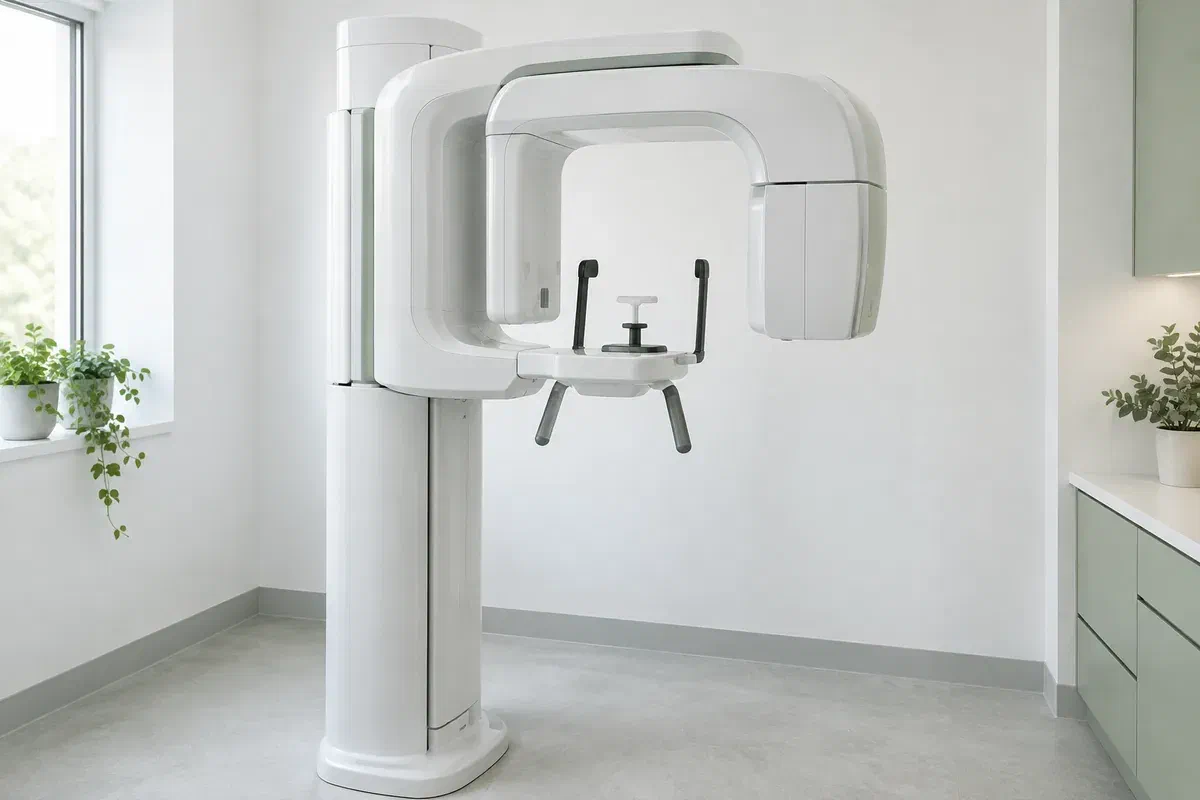
Illustrative discussion near generic panoramic imaging equipment, not actual clinic facilities
General & Family Dentistry

Panoramic Dental X-rays in Brampton

A child’s adult teeth seem slow to arrive, or braces are being discussed, and a wide X-ray is mentioned. For Brampton parents, here is how a panoramic image helps track developing teeth, what it involves for a child, and what it cannot settle.

Growing smiles, Brampton households

Where are the teeth that haven’t shown up yet?

Between baby teeth falling out and adult teeth arriving, parents often notice gaps that linger or teeth coming in at odd angles. A panoramic X-ray can help a dentist see what is developing beneath the gums. It records the teeth and both jaws in one broad, flat image, unlike the small X-rays that look closely at a handful of teeth.

Even for children, a wide view should answer a real question. The dentist weighs what the examination shows, your child’s dental history and any images taken before. Age alone, or the start of a new school year, is not a reason. Ask what the X-ray is expected to reveal and how it could shape the advice you get.

We can discuss whether a panoramic image fits your child’s situation and explain how the imaging would be set up. Let us know about previous X-rays, especially from an orthodontist, and about anything that might make it hard for your child to stand still or follow instructions. If a parent is booking imaging of their own at the same time, mention pregnancy or the possibility of it.

Ask about imaging for your child
Illustrative unbranded panoramic dental X-ray unit in an empty imaging room
Questions a parent might be facing

Late teeth, crowded teeth, or something unexplained.

The overview suits particular questions about where teeth sit and how the jaws look as a whole. Your child’s symptoms and examination determine whether it is the right investigation, or whether another approach would make more sense.

An adult tooth that seems overdue

When a baby tooth hangs on or a gap stays open, the dentist may want to see whether the adult tooth is forming and where it lies. Ask what the image can confirm and whether more detail could be needed later. The picture alone does not decide on treatment.

Orthodontic planning

Braces or other orthodontic care involves the whole arrangement of teeth, so one broad record can help. It is a single part of the assessment, alongside other records and the examination. Ask which decisions it informs and what remains to be evaluated.

A bump, fall or swelling

Children knock their faces playing, and swelling or ongoing discomfort can raise an imaging question. Describe what happened and what you have noticed rather than asking for a particular X-ray. The dentist should choose the investigation that fits.

Because the jaw is curved and the image is flat, a panoramic X-ray shows some overlap and slight distortion. It misses certain fine details and does not replace an examination, focused X-rays or other tests when your child needs them.

What the image can show a parent

Teeth above the gum and teeth still waiting below.

One panoramic image can capture both jaws and the overall spread of teeth, including many that have not yet come through. Nothing needs to sit far inside the mouth, which can suit children who find small X-ray sensors uncomfortable. Detailed questions about a single tooth may still need another view.

Understanding the picture is the real benefit. Ask what in the image relates to your concern, whether anything deserves follow-up, and what the view cannot tell you. A large image of your child’s mouth is a helpful guide, not a guarantee that every dental issue has been checked.

Patient information: RadiologyInfo — panoramic dental X-ray

Development seen in context

Seeing a single developing tooth against the rest of the jaw can make advice about timing or treatment easier to follow. Ask why the overview matters now. More coverage is useful only when the question needs it.

Something to share with an orthodontist

If your child is referred, the image and relevant notes may be sent along where appropriate. Ask how this is handled and whether the orthodontist will accept it. They will still assess your child in person.

A clearer reason for any next step

The image may answer the question or show that another investigation is warranted. Before agreeing to more, ask what is still uncertain. Further imaging should address a specific gap rather than follow by routine.

For your child’s appointment

Preparing a young patient, one step at a time.

Equipment and procedures vary between providers. Ask where the image will be taken and mention anything that may affect your child’s positioning before booking.

  1. Talk through why it is needed

    The dentist reviews your child’s history, the examination and earlier records before suggesting the view. Ask what it will add and whether an existing image covers the question. If an adult in the family also needs imaging, pregnancy or possible pregnancy should be mentioned.

  2. Remove anything metal

    Earrings, necklaces, hair clips, glasses and removable retainers or appliances usually need to come off. The operator shows your child where to rest their chin and hands. Mention any difficulty with balance, movement or following directions so the setup can be adjusted.

  3. Keep very still for a short time

    The arm moves around your child’s head while the image is captured. The operator explains how to hold the lips and tongue and reminds them to stay still. If your child cannot manage the position, say so before the exposure.

  4. Hear what the image shows

    The picture needs review and explanation before it guides any decision. Ask who will go over the result and whether a referral to an orthodontist or other specialist may follow. If another provider took it, confirm how it reaches your dentist.

Once your child is done

Back to the day, with a few questions to ask.

There is usually no recovery time or special care needed after a panoramic X-ray. If other treatment happened during the same visit, follow those instructions.

Find out what the result means

Ask whether the image supports the plan, raises a new question or shows nothing further is needed for now. Have any unfamiliar terms explained in simple language. The result helps most when you know how it affects the next decision.

Keep follow-up appointments

Attend any recommended assessment or orthodontic consultation and confirm how you will hear about results. An incidental finding needs explanation, not assumptions in either direction. Ask what is known and what needs more information.

Track your child’s imaging

Let future dentists or orthodontists know when and where the image was taken. A recent record can sometimes avoid a repeat, depending on quality, the question being asked and how much your child’s teeth have changed since.

Choosing the right picture

Broad, close-up, or three-dimensional?

Different imaging methods give different information. Ask why one is recommended for your child and how its expected benefit weighs against the exposure.

To see development across both jaws

A panoramic overview

Useful for certain questions about how teeth are arranged and developing. It uses ionizing radiation and should have a clinical purpose. It does not replace every other dental image your child might need.

To examine one area more closely

Targeted intraoral radiographs

A smaller image may answer a question about specific teeth or the bone around them more clearly. The dentist should explain why that detail matters. A panoramic does not automatically mean bitewings are no longer needed.

When a specific question remains

Other imaging only when justified

In some situations, a different method such as CBCT may be indicated. It is a separate examination, not a standard next step. The recommendation should explain what is still unknown and why more information is necessary.

Parents’ questions

Panoramic X-rays and children.

Imaging decisions should follow the examination and what your child’s care needs. Let the team know about earlier images and ask your questions before the X-ray begins.

(905) 876-4488
At what age might a child have a first panoramic X-ray?
There is no fixed age. A dentist may suggest one when a question about developing teeth or the jaws arises. Ask why it is being recommended for your child now and whether it could reasonably wait.
Can I stay with my child while the image is taken?
Practices handle this differently, and adults nearby may need to step back during the exposure. Ask the operator in advance so your child knows what to expect. They can explain each step to help your child feel settled.
My child has trouble staying still. What can we do?
Mention it when booking. The operator can explain things slowly, use a practice run, or suggest another approach if the image is unlikely to work. Movement can blur the picture, so it is better to plan ahead than to repeat it.
Will the orthodontist need a separate X-ray?
Sometimes. If a recent panoramic image is available and suitable, it may be shared with your consent. Some orthodontists prefer their own records. Ask both offices so your child is not imaged twice without need.
Does a panoramic image check my child for cavities too?
Not fully. It shows less detail for some tooth surfaces, particularly between teeth. An examination and bitewing X-rays may still be needed for decay. Ask what the wide view is expected to cover.
Should we book the X-ray around Brampton school schedules?
If imaging is recommended, ask whether it can be grouped with your child’s check-up or another appointment to reduce time off school. Confirm where it will be taken so you can plan the trip.
Children’s panoramic X-rays · Brampton

Bring your questions about your child’s teeth.

Call our Bronte Street practice to talk about what you have noticed and whether imaging would help. Tell us about earlier X-rays and anything that affects your child’s positioning. We will explain the reason for any image, confirm arrangements and show how results guide care.

We only suggest X-rays when there is a clinical reason. Equipment images here are illustrative; they do not show our own unit or confirm a particular appointment setup.

Visit Milton Dental Clinic
Unit 1, 342 Bronte St. S, Milton, ON L9T 5B7
Get directions Clinic hours
Monday–Thursday
11am–7pm
Friday–Sunday
By appointment only

Areas we serve

  • Milton
  • Oakville
  • Mississauga
  • Georgetown
  • Halton Hills
  • Acton
  • Campbellville
  • Brampton
  • Burlington
  • Puslinch
  • Rockwood
  • Erin
  • Caledon
  • Etobicoke
  • Old Milton
  • Bronte Meadows
  • Timberlea
  • Dorset Park
  • Dempsey
  • Clarke
  • Beaty
  • Coates
  • Harrison
  • Scott
  • Willmott
  • Ford
  • Bowes
  • Cobden
  • Walker
  • Mountain View
  • Milton Heights
  • Hawthorne Village
  • Valley View
  • Fallingbrook
  • Nassagaweya
  • Trafalgar
  • Esquesing
  • Nelson
  • Brookville
  • Moffat
  • Glen Williams
  • Norval
  • Limehouse
  • Stewarttown
  • Ashgrove
  • Hornby
  • Silver Creek
  • Speyside
  • Scotch Block
  • North Oakville
  • River Oaks
  • Glen Abbey
  • West Oak Trails
  • Palermo
  • Bronte Creek
  • College Park
  • Joshua Creek
  • Uptown Core
  • Preserve
  • Iroquois Ridge
  • Lisgar
  • Meadowvale
  • Meadowvale Village
  • Churchill Meadows
  • Erin Mills
  • Central Erin Mills
  • Streetsville
  • East Credit
  • Creditview
  • Heartland
  • Sheridan
  • Mount Pleasant
  • Credit Valley
  • Huttonville
  • Churchville
  • Springbrook
  • Northwest Brampton
  • Bram West
  • Fletcher's Meadow
  • Fletcher's Creek South
  • Alton Village
  • Orchard
  • Millcroft
  • Headon Forest
  • Tansley
  • Brant Hills
  • Tyandaga
  • Kilbride
  • Lowville
  • Aberfoyle
  • Morriston
  • Arkell
  • Hillsburgh
  • Freelton
  • Carlisle
  • Waterdown
  • Flamborough
  • Mountsberg

How can we help?

Milton Dental Clinic

Have a question about your smile? Choose the option that works best for you.

For urgent dental concerns, please call.
Messages are reviewed during clinic hours.