

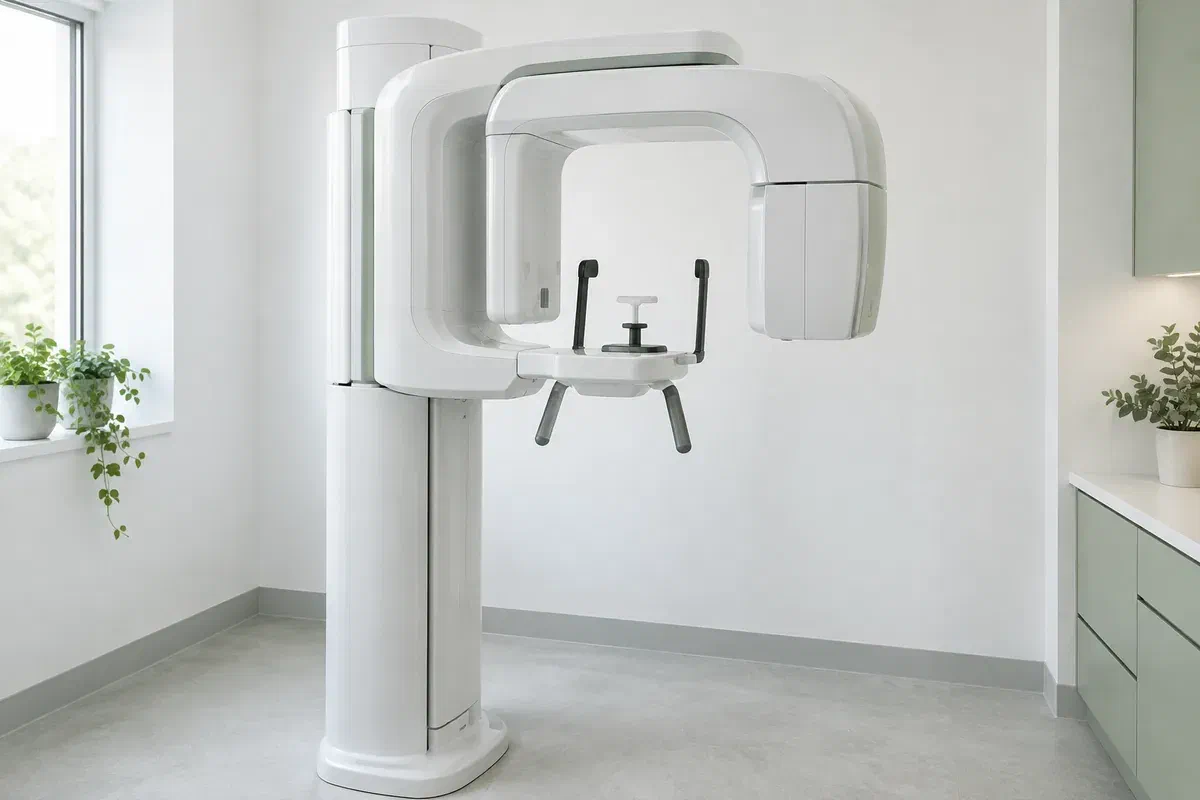
Illustrative discussion near generic panoramic imaging equipment, not actual clinic facilities
General & Family Dentistry

Panoramic Dental X-rays in Georgetown

Hesitating over another X-ray is reasonable. For people coming from Georgetown, here is how a dentist weighs the benefit of a panoramic image against its exposure, what the wide view can contribute, and which questions to ask before agreeing.

Weighing the X-ray · Georgetown

Is this image worth taking?

Plenty of people pause when a dentist suggests a wide X-ray, wondering about radiation and whether the picture will make any difference. That instinct is healthy. A panoramic X-ray records one broad, flat image of the teeth along with the upper and lower jaws, which serves different purposes from the small films aimed at a few teeth at a time.

Justification is the core idea in dental imaging: an X-ray should be taken because it can answer a question that matters for your care. Your dentist draws on your history, the examination and any records already available. Arriving as a new patient, or a set interval passing, is not enough. Ask what the image could change about the plan.

Our team will gladly talk through whether a panoramic view is warranted for your assessment and how it would be arranged. Tell us about recent X-rays from anywhere, pregnancy or the chance of it, and any difficulty with balance or staying still. Asking questions before the image is part of good care, not an inconvenience.

Ask us to explain an imaging recommendation
Illustrative unbranded panoramic dental X-ray unit in an empty imaging room
Questions that can justify the exposure

Three situations where the wide view may pay off.

Panoramic imaging is suited to certain questions about how teeth are positioned and how the jaws look in general. Your symptoms and examination findings determine whether this is the appropriate test or whether another option suits you better.

A tooth below the surface

An impacted wisdom tooth, or another tooth that has not emerged, may need locating. The wide image can show its approximate position. Ask whether finer detail will be needed before any treatment; the picture does not decide on extraction by itself.

Treatment covering a larger area

Planning work on several teeth, or across both jaws, may benefit from one broad record. It adds to the discussion without replacing other records. Ask which decision it supports and what will still have to be assessed.

A symptom worth exploring

Pain, swelling, an injury, or a change in how the jaw moves may lead to an imaging question. Describe what you feel rather than requesting a particular picture. The dentist should choose the test that answers the question with the least necessary exposure.

A panoramic image is a flattened projection, so overlapping anatomy and some distortion are part of the method. It cannot reveal every fine detail and is not a replacement for examination, targeted X-rays or other investigations when those are indicated.

On the benefit side

What one wide image can give you.

In a single record, the dentist sees both jaws and how your teeth are distributed across them. The detector stays outside the mouth, unlike certain smaller dental X-rays. When a question needs that breadth, one wide image may be more useful than several narrow ones, although close detail can still require another view.

The benefit only becomes real through interpretation. Ask what part of the image relates to your concern, whether anything needs further review, and what remains unknown. Having a large image of your mouth is not a reason to assume every dental condition has been checked.

Patient information: RadiologyInfo — panoramic dental X-ray

Context for a specific decision

Seeing one tooth or finding within the whole jaw can make treatment options easier to weigh. Ask why that context matters for you. Broader coverage is valuable when the question requires it, not as a default.

A record that can be reused

Where appropriate, the image and relevant notes can be shared with a specialist, which may avoid a second exposure. Ask how that would work and whether they will accept it. A specialist still makes their own assessment.

Grounds for or against more imaging

The overview may answer the question, or show why another test is needed. Ask what is still uncertain before agreeing to additional X-rays. Any further image should address a specific limitation of the first.

If you decide to go ahead

A short procedure with a clear purpose.

Equipment and procedures differ between imaging providers. Confirm where the image will be taken, and raise anything that may affect your positioning ahead of the appointment.

  1. Agree on the clinical need

    The dentist reviews your examination, history and earlier records before recommending the view. Ask what it will add and whether an existing image would serve. Tell them if you are pregnant or could be, so the need and any precautions can be discussed.

  2. Prepare so the image works first time

    Removing jewellery, glasses and removable appliances helps avoid shadows that might mean a retake. The operator explains how to position yourself. Mention neck pain, balance trouble or limited movement so the setup can be adjusted.

  3. Stay still during the brief rotation

    The arm moves around your head to capture the image. Follow instructions on lip, tongue and head position. Movement can blur the result, so if you cannot hold steady, say so before the exposure begins.

  4. Hear how the result affects your care

    The image must be read and explained to be useful. Ask who will review it with you and whether a referral or further test is likely. If another provider took it, confirm how it will reach your dentist.

After the image

Make sure the exposure led somewhere useful.

No recovery time or special aftercare is generally needed after a panoramic X-ray. Other treatment at the same visit may come with its own instructions.

Ask what the image changed

Find out whether the result confirms the plan, raises a new question or shows nothing further is needed for now. Ask for explanations in everyday words. The X-ray justified itself if you understand its effect on your next step.

Follow recommended next steps

Attend any further assessment or referral and confirm how results will reach you. Incidental findings should be explained rather than dismissed or feared. Your dentist should be clear about what is certain and what still needs clarifying.

Keep records to avoid repeats

Tell future dentists when and where the image was taken. If it is still suitable, it may save you another exposure, though that depends on image quality, the new question and changes since.

Benefit and exposure, side by side

Choose only what the question needs.

Each imaging method provides different information. Ask why a particular view is recommended and how its expected value weighs against the exposure it involves.

For broad questions about the jaws

A panoramic overview

Appropriate for selected questions about tooth position and jaw structure. It uses ionizing radiation, so a clinical reason should be clear. It is not a replacement for every other kind of dental view.

For detail in a small area

Targeted intraoral radiographs

A close-up X-ray may better answer a question about specific teeth or nearby bone. Ask why that detail matters. A panoramic image does not automatically mean bitewings or other focused images are no longer needed.

For a question the first image left open

Further imaging if clearly justified

Some situations may call for CBCT or another method where indicated. CBCT is a distinct examination, not a routine upgrade. The dentist should explain the unanswered question and why more information is needed.

Exposure and safety questions

Ask these before you agree.

Imaging choices should follow your examination and the information your care needs. Mention prior X-rays and raise any concern before the image is taken.

(905) 876-4488
How does a dentist decide an X-ray is worth the exposure?
They consider whether the image could answer a question that affects your care, and whether existing records already do. If the answer would not change anything, the image may not be needed. Ask them to walk you through their reasoning.
Will I be given a lead apron or thyroid collar?
Practices follow current guidance on shielding, which has changed in recent years and can vary with the equipment. Ask the operator what precautions they use and why.
Can I decline a panoramic X-ray?
Yes. You can ask questions or decline. Your dentist should explain what information would be missing and how that might affect their advice, so you can make an informed choice.
Is the exposure from a panoramic the same as from a CT scan?
No. A panoramic is a two-dimensional dental image. CBCT and medical CT scans are different examinations with different purposes. Ask your dentist which method is suitable and why.
If I might be pregnant, should I postpone the X-ray?
Tell the dentist and operator before anything starts. They will weigh the clinical need and suitable precautions with you. Some imaging can be deferred, while other situations need an answer sooner.
Does a digital system mean the image carries no radiation risk?
No. Digital panoramic units still use ionizing radiation, though the dose is generally small. The image should still be clinically justified. ‘Digital’ refers to how it is recorded, not to zero exposure.
Panoramic X-rays for Georgetown

Questions first. Imaging only if it helps.

From Georgetown, speak with our Bronte Street practice about your concern and any X-ray that has been suggested. Share details of recent images and any positioning needs. We will explain the clinical reason, confirm how imaging would be arranged and show how the result could shape your care.

Each X-ray recommendation rests on clinical need. Equipment photography on this page is illustrative only and does not confirm our own unit or a particular booking arrangement.

Visit Milton Dental Clinic
Unit 1, 342 Bronte St. S, Milton, ON L9T 5B7
Get directions Clinic hours
Monday–Thursday
11am–7pm
Friday–Sunday
By appointment only

Areas we serve

  • Milton
  • Oakville
  • Mississauga
  • Georgetown
  • Halton Hills
  • Acton
  • Campbellville
  • Brampton
  • Burlington
  • Puslinch
  • Rockwood
  • Erin
  • Caledon
  • Etobicoke
  • Old Milton
  • Bronte Meadows
  • Timberlea
  • Dorset Park
  • Dempsey
  • Clarke
  • Beaty
  • Coates
  • Harrison
  • Scott
  • Willmott
  • Ford
  • Bowes
  • Cobden
  • Walker
  • Mountain View
  • Milton Heights
  • Hawthorne Village
  • Valley View
  • Fallingbrook
  • Nassagaweya
  • Trafalgar
  • Esquesing
  • Nelson
  • Brookville
  • Moffat
  • Glen Williams
  • Norval
  • Limehouse
  • Stewarttown
  • Ashgrove
  • Hornby
  • Silver Creek
  • Speyside
  • Scotch Block
  • North Oakville
  • River Oaks
  • Glen Abbey
  • West Oak Trails
  • Palermo
  • Bronte Creek
  • College Park
  • Joshua Creek
  • Uptown Core
  • Preserve
  • Iroquois Ridge
  • Lisgar
  • Meadowvale
  • Meadowvale Village
  • Churchill Meadows
  • Erin Mills
  • Central Erin Mills
  • Streetsville
  • East Credit
  • Creditview
  • Heartland
  • Sheridan
  • Mount Pleasant
  • Credit Valley
  • Huttonville
  • Churchville
  • Springbrook
  • Northwest Brampton
  • Bram West
  • Fletcher's Meadow
  • Fletcher's Creek South
  • Alton Village
  • Orchard
  • Millcroft
  • Headon Forest
  • Tansley
  • Brant Hills
  • Tyandaga
  • Kilbride
  • Lowville
  • Aberfoyle
  • Morriston
  • Arkell
  • Hillsburgh
  • Freelton
  • Carlisle
  • Waterdown
  • Flamborough
  • Mountsberg

How can we help?

Milton Dental Clinic

Have a question about your smile? Choose the option that works best for you.

For urgent dental concerns, please call.
Messages are reviewed during clinic hours.