

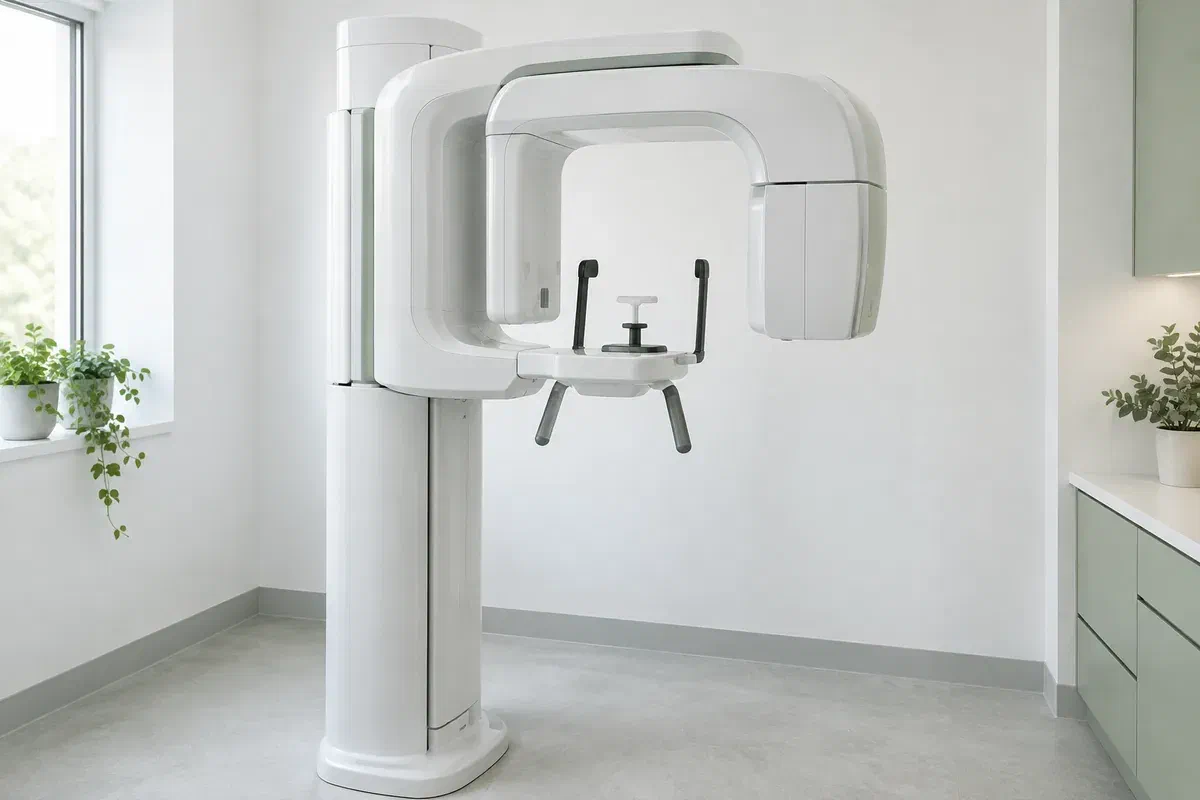
Illustrative discussion near generic panoramic imaging equipment, not actual clinic facilities
General & Family Dentistry

Panoramic Dental X-rays in Milton

Wisdom teeth come up at a teenager’s check-up, and suddenly a wider X-ray is on the table. Talk through panoramic imaging in Milton: what the picture is meant to show, why it was suggested, and how it shapes what happens next.

Wide-view imaging for Milton households

One picture of both jaws, taken for a reason you can name.

Many parents first hear the word “panoramic” when a dentist wants to see where a teenager’s wisdom teeth are sitting. The image captures the upper and lower jaws and the teeth within them in one flat, two-dimensional view. It answers different questions from the small X-rays that focus on a few teeth at a time.

That wider coverage is useful only when there is something specific to look at. A dentist should base the suggestion on what the examination shows, the history you give, and any suitable images already on file, not on a birthday or a calendar reminder. It is fair to ask, “What are you hoping to see, and what might change once you see it?”

Our team can talk through whether this view suits your situation and explain how the imaging would be arranged. Tell us about recent X-rays from another office, any chance of pregnancy, and anything that makes standing or holding still difficult. Knowing those details early helps the appointment stay clear and comfortable.

Ask whether a panoramic view fits your concern
Illustrative unbranded panoramic dental X-ray unit in an empty imaging room
Reasons a wider view comes up

What is the dentist trying to find out?

A panoramic image suits a limited set of questions about where teeth sit and how the jaws look overall. What you describe and what the examination finds decide whether it is the right tool, or whether something else would answer the question better.

A tooth that seems late or out of place

Wisdom teeth and other teeth that have not come through can be hard to judge from the chair alone. An overview may show their position relative to neighbouring teeth. Ask whether more detail would be needed later, since the image does not by itself settle whether a tooth comes out.

Treatment that spans several teeth

When a plan touches more than one area of the mouth, a single broad record can add context. It is one piece of the planning, not every piece. Ask which decision the image informs and which questions will still need other records or an examination.

Something new that needs explaining

Swelling, an injury, a lingering ache or a change in how the jaw moves can lead to an imaging question. Describe what you notice and when it started rather than asking for a specific X-ray. The dentist can then match the investigation to the problem.

A panoramic picture flattens curved structures onto one plane, so some parts overlap and some proportions shift. It cannot show every fine detail of every tooth, and it does not stand in for an examination, close-up X-rays or other tests when they are needed.

Why the broad record helps

Context first, close detail when it matters.

Because it records both jaws at once, a panoramic image lets a dentist see how the teeth are spread out and how one area relates to another. Nothing has to be held inside your mouth to capture it, which is different from several smaller dental X-ray methods. Finer questions about a single tooth may still call for another type of picture.

An image has value once someone explains what it shows for your concern. Ask which part of the picture matters, whether anything needs a second look, and what the view simply cannot tell you. A big image of the whole mouth is not proof that every possible dental problem has been ruled out.

Patient information: RadiologyInfo — panoramic dental X-ray

Placing one tooth in the bigger picture

Seeing a single tooth or finding alongside the rest of the jaw can make a treatment conversation easier to follow. Ask how that context affects your options. Wider is not automatically better; it is useful when the question needs it.

Something to send with a referral

If another dental professional becomes involved, the image may be shared along with relevant notes when appropriate. Ask how that happens and whether a recent record will be accepted. A specialist will still do their own assessment.

A clearer reason for any next test

Sometimes the overview answers the question. Other times it shows exactly why another view is needed. Before agreeing to more imaging, ask what the first picture left uncertain and how the next one would address that gap.

How the visit unfolds

From the reason, to the machine, to the explanation.

Equipment and arrangements vary between imaging providers. Ask where the picture will be taken, and mention anything that could affect how you stand or sit before the time is booked.

  1. Agree on why the image is needed

    The dentist weighs your history, the examination and any useful earlier records before suggesting the view. Ask what the picture will add, and whether an X-ray you already have could do the job. Let the team know about pregnancy or the chance of it.

  2. Take off anything that could block the view

    Earrings, necklaces, glasses, hairpins and removable dental appliances may need to come off first. The operator shows you the chin rest, bite guide and handles. Mention a sore neck, unsteady balance or limited movement so the setup can be adjusted.

  3. Hold still while the arm circles your head

    The unit moves around you for a short time to build the wide image. You will be told where to rest your lips and tongue and how to keep steady. If the position feels unmanageable, say so before the exposure begins.

  4. Hear what the image shows

    Someone needs to review the picture and explain it; capturing it is only half the job. Ask who will go over the result and whether a referral or further test follows. If the image was taken elsewhere, confirm how it will reach your dentist.

Once the picture is done

Turn the result into a decision.

Having a panoramic X-ray does not normally call for recovery time or special care afterwards. If other treatment happened at the same appointment, follow the instructions for that.

Find out what has changed

Ask whether the result confirms the plan you discussed, raises a new question, or means no further action is needed for now. Request plain explanations of any unfamiliar words. The image earns its place when you understand how it affects your next step.

Keep the follow-up on track

Book any further assessment or referral that is advised, and confirm how you will hear about results. An unexpected finding should be explained, not assumed to be trivial or alarming. Your dentist should separate what is known from what still needs checking.

Note where the image was taken

Let future dentists know when and where the X-ray was done so they can judge whether it is still useful. An existing record can sometimes avoid repeating an exposure, depending on its quality, the new question and what has changed in your mouth since.

Which X-ray answers the question?

Pick the view that fits, and no more than needed.

Each imaging method shows something different. Ask why a particular view has been suggested and how what it could reveal compares with the exposure it involves.

For questions that need the whole arrangement

A panoramic overview

Useful for selected questions about where teeth sit and how the jaws look overall. It uses ionizing radiation, so it should have a clear purpose. A wide image does not replace every other kind of dental view.

For finer detail in one area

Close-up intraoral X-rays

A smaller, focused image may answer a question about specific teeth or the bone around them more precisely. Ask why that detail matters. Having a panoramic image does not automatically cancel the need for bitewings or other targeted views.

When a question remains open

Additional imaging when justified

Occasionally another method, such as three-dimensional CBCT, is indicated. It is a different examination, not a standard step up. Any recommendation should name the question still unanswered and why more information is needed.

Panoramic X-ray questions

Straight answers before the machine starts moving.

Good imaging choices come from the examination and the information your care actually needs. Share any earlier X-rays and raise concerns before the picture is taken.

(905) 876-4488
Is a panoramic X-ray the usual way to check a teenager’s wisdom teeth?
It is one common way to see where wisdom teeth are developing, but it is not automatic at a certain age. The dentist considers symptoms, the examination and existing records first. Ask what the image would help decide and whether waiting is reasonable.
Will my child need to bite on anything during the image?
Many units use a small bite guide held gently between the front teeth to line up the jaws. Nothing is placed far back in the mouth. The operator explains each step and can pause if your child is unsure or uncomfortable.
Can a panoramic X-ray replace the small X-rays I get at check-ups?
Not usually. The wide view is less detailed for some surfaces between teeth, where decay often starts. Close-up views and a clinical examination may still be needed. Ask which question each image is meant to answer.
How does a panoramic view differ from a CBCT scan?
The panoramic picture is a flat, two-dimensional projection. CBCT produces three-dimensional information and has its own reasons for use. More dimensions are not always better; the clinical question should guide the choice.
Does a digital panoramic image still expose me to radiation?
Yes. Digital systems still use ionizing radiation, usually at a low level. The image should be justified by a clinical need. “Digital” refers to how the picture is captured and stored, not to the absence of radiation.
What happens if I might be pregnant on the day of the X-ray?
Tell the dentist and the person taking the image before anything starts. They can weigh the clinical need and suitable precautions with you. Avoid relying on general online rules; ask how the recommendation applies to your situation.
Panoramic X-rays in Milton

Start with the question, then decide on the picture.

Get in touch with our Bronte Street practice to talk about your concern and any imaging that has been suggested. Mention recent X-rays and anything that affects positioning. We can go over the purpose, confirm how imaging would be arranged, and explain how the result fits into your care.

Imaging is suggested only when there is a clinical reason. The equipment photos are illustrative and do not confirm an on-site machine or any particular appointment arrangement.

Visit Milton Dental Clinic
Unit 1, 342 Bronte St. S, Milton, ON L9T 5B7
Get directions Clinic hours
Monday–Thursday
11am–7pm
Friday–Sunday
By appointment only

Areas we serve

  • Milton
  • Oakville
  • Mississauga
  • Georgetown
  • Halton Hills
  • Acton
  • Campbellville
  • Brampton
  • Burlington
  • Puslinch
  • Rockwood
  • Erin
  • Caledon
  • Etobicoke
  • Old Milton
  • Bronte Meadows
  • Timberlea
  • Dorset Park
  • Dempsey
  • Clarke
  • Beaty
  • Coates
  • Harrison
  • Scott
  • Willmott
  • Ford
  • Bowes
  • Cobden
  • Walker
  • Mountain View
  • Milton Heights
  • Hawthorne Village
  • Valley View
  • Fallingbrook
  • Nassagaweya
  • Trafalgar
  • Esquesing
  • Nelson
  • Brookville
  • Moffat
  • Glen Williams
  • Norval
  • Limehouse
  • Stewarttown
  • Ashgrove
  • Hornby
  • Silver Creek
  • Speyside
  • Scotch Block
  • North Oakville
  • River Oaks
  • Glen Abbey
  • West Oak Trails
  • Palermo
  • Bronte Creek
  • College Park
  • Joshua Creek
  • Uptown Core
  • Preserve
  • Iroquois Ridge
  • Lisgar
  • Meadowvale
  • Meadowvale Village
  • Churchill Meadows
  • Erin Mills
  • Central Erin Mills
  • Streetsville
  • East Credit
  • Creditview
  • Heartland
  • Sheridan
  • Mount Pleasant
  • Credit Valley
  • Huttonville
  • Churchville
  • Springbrook
  • Northwest Brampton
  • Bram West
  • Fletcher's Meadow
  • Fletcher's Creek South
  • Alton Village
  • Orchard
  • Millcroft
  • Headon Forest
  • Tansley
  • Brant Hills
  • Tyandaga
  • Kilbride
  • Lowville
  • Aberfoyle
  • Morriston
  • Arkell
  • Hillsburgh
  • Freelton
  • Carlisle
  • Waterdown
  • Flamborough
  • Mountsberg

How can we help?

Milton Dental Clinic

Have a question about your smile? Choose the option that works best for you.

For urgent dental concerns, please call.
Messages are reviewed during clinic hours.