

Illustrative conversation before a professional teeth-cleaning appointment
General & Family Dentistry

Professional Teeth Cleaning in Erin

Most of your dental care happens at home, in two minutes at the sink. For households in Erin and Hillsburgh, a professional cleaning resets the surfaces and gives you a routine that keeps them that way.

The months between cleanings

A reset in the chair, a routine at the sink

You see a hygienist a few times a year at most. The rest of the time it is you, a toothbrush and whatever you use between your teeth. Plaque that slips past that routine can harden into tartar, and from then on only professional instruments will remove it. A cleaning clears the slate, but the habits afterward decide how long it stays clear.

Bring your routine with you, in a sense. Tell us what brush and floss you use, where buildup seems to come back first, and whether your gums bleed, ache or react to cold. That helps us judge whether a routine maintenance visit is right, or whether gum disease needs separate assessment and treatment. Living out in Erin, it also helps to sort that out in as few trips as possible.

Comfort is part of good care. Mention it if a past cleaning was hard, and settle on a way to stop us before anything begins. Ask about any instrument at any time. Most of all, ask us to show you the technique for your trickiest spot, so you go home with something you can actually use.

Book a cleaning and home-care review
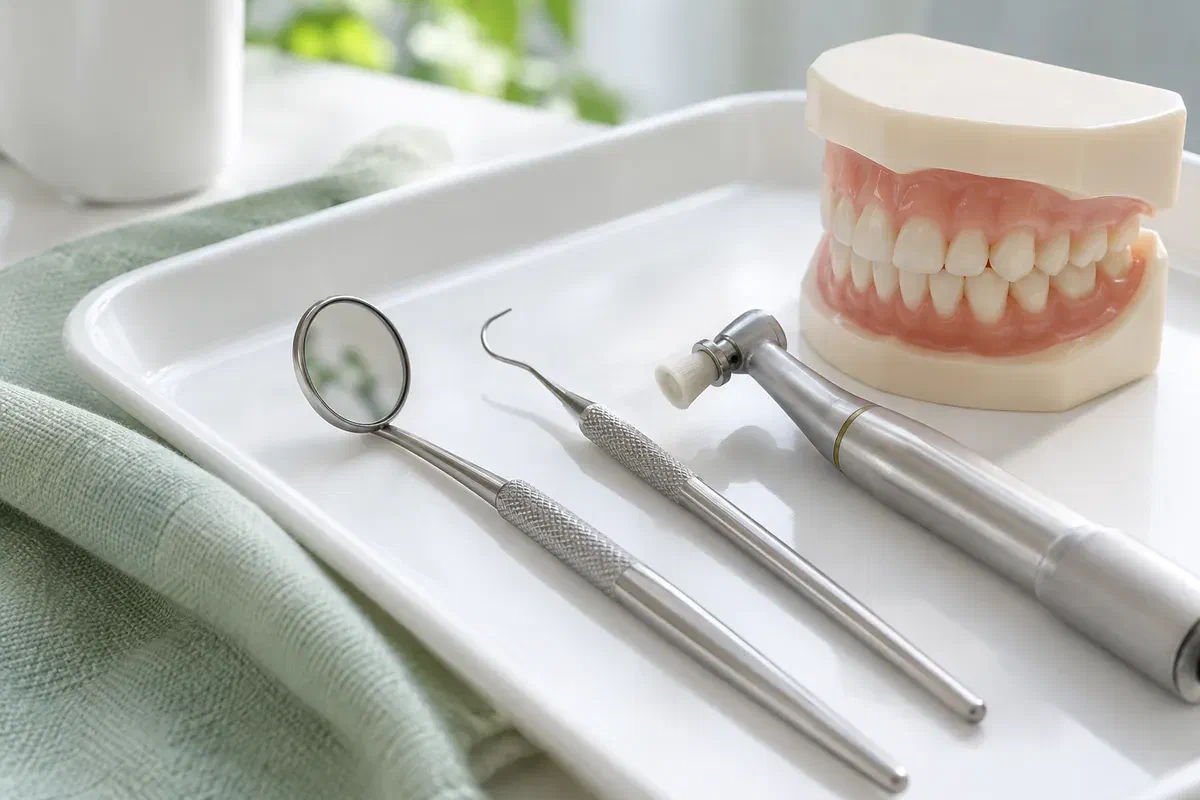
Illustrative dental mirror, scaler, polishing instrument, and teaching model
Clues from your daily routine

Which spot do you always miss?

Stain tells us something, but your routine, your gums, your dental work and your past visits tell us much more.

Buildup in the same place each time

Tartar that keeps forming behind the lower front teeth or on the cheek side of the upper molars usually points to an access problem. Show us where. Do not scrape at it with metal picks, which can damage gums and enamel.

Bleeding while you floss

Gums that bleed, feel tender or teeth that twinge with cold are worth describing before we start. They shape our gum check and comfort planning, and may indicate whether a standard cleaning is appropriate or gum care should be discussed.

Stain your brush can’t lift

Surface stain may come off during cleaning. Discolouration from fillings, crowns, natural shade or deeper changes will not. We can explain which you have and whether anything in your routine is contributing.

Update us on your health and medications, including blood thinners, recent medical advice and any new diagnoses. Keep taking prescribed medicines as directed, and do not change them on your own ahead of a cleaning.

What professional care adds to yours

Two kinds of cleaning, one goal

Professional instruments remove the hardened deposits that your own brushing and flossing cannot shift. Plaque and tartar are closely linked to gum inflammation, so clearing them supports healthier gums, not just a smooth finish. How your gums look and respond tells us how thorough to be today and when to see you again.

A cleaning may lighten surface stain, but it is not a promise of uniformly white teeth. It does not repair decay, replace a damaged filling or restore bone that has been lost. We will tell you which findings the cleaning dealt with and which need a different conversation.

Patient information: NIDCR — plaque, tartar, and gum health

Care aimed at the right surfaces

We locate deposits and use techniques that suit each surface and the tissue around it. Tell us about crowns, bridges or implants not already in your record, so your home routine can be adapted for them too.

Hands-on coaching

Rather than a general reminder to floss, we can show you the size of interdental brush, floss holder or angle that suits a particular gap. Seeing it done in your own mouth is often what makes it stick.

Feedback at the next visit

When you return, we can see whether that tricky area has improved. The next appointment might be routine upkeep or a closer review. Ask how we chose the interval and what would make an earlier visit worthwhile.

During your cleaning

Check, clear, polish if needed, coach

The appointment length depends on the findings. Ask what is planned and whether further assessment or another cleaning session might be suggested.

  1. Talk about your routine and health

    We review symptoms, health information and the products you use at home, then examine buildup and gum condition. Additional records may be needed. Before we start, you choose a signal for a break.

  2. Remove the hardened deposits

    Hand scalers, an ultrasonic instrument or both may be used, depending on the area. Pressure, a buzzing sensation and water are common. Speak up if something is uncomfortable so we can stop and adjust.

  3. Polish selected surfaces

    Polishing may help with some surface stain. Don’t mistake it for whitening; it usually matters less than the scaling. If we suggest fluoride or another preventive product, you will hear why and how to care for your teeth afterward.

  4. Practise the technique together

    We show you how to reach the areas that build up, explain what you might feel later, and suggest the next visit. If gum treatment is advised, we explain how it differs from today’s cleaning.

Back at your own sink

Small changes, done daily

Follow any product-specific or treatment-specific instructions first. Advice can change if freezing, gum therapy or another procedure was included.

Use what we showed you

Brush with fluoride toothpaste and use the interdental aid we chose for your spacing. A metal pick or scraper from the drugstore is not a substitute for scaling. If the tricky area still feels rough, mention it.

Some tenderness can be normal

Gums may be sore and teeth a little sensitive for a short time, especially where there was inflammation. Stay gentle and keep cleaning. Phone us if discomfort worsens, becomes significant or does not settle, and do not assume a new symptom is from the cleaning.

Product instructions and your review

After fluoride varnish or another applied product, follow its own advice about eating and drinking. Keep your review, and if your gums are still bleeding by then, say so, so we can adjust the plan.

Different needs, different care

When home care plus cleaning is enough, and when it isn’t

Good habits carry a lot, but they cannot treat disease or change a tooth’s shade. The exam sorts which of these three applies, and we will tell you plainly what each recommendation is for.

When maintenance is the goal

Routine professional cleaning

Care focuses on the deposits and areas found, together with a home routine that suits your mouth and a sensible return date. The extent differs between people and should rest on current findings.

When gums need more than upkeep

Treatment for gum disease

If disease affects the supporting tissues, scaling beneath the gumline and reassessment may be recommended. We explain the diagnosis, visits and comfort options. Home care stays important, but polishing alone is not a substitute.

When colour still bothers you

Separate cosmetic advice

Discolouration that a brush and a polish cannot touch has a cause worth identifying first, and then the options can be weighed. Whitening and restoration changes each have limits and suitability requirements. Cleaning may help prepare but cannot guarantee a look.

Home-care questions from Erin

What should I be doing between cleanings?

Ask about brushes, floss, rinses or anything else in your routine. The best answer depends on your own teeth and gums.

(905) 876-4488
Is an interdental brush better than floss?
It depends on the size of the gaps between your teeth and how easy each tool is for you. Some people do best with a mix. Ask us to check which sizes fit and show you how to use them.
How long should I brush for, really?
Two minutes, twice a day, is common advice, but technique matters as much as time. Reaching the gumline gently and covering every surface is what counts. We can watch you brush and suggest changes.
Do tartar-control toothpastes work?
Some may help slow new tartar from forming, but they cannot remove tartar that has already hardened. Ask whether one suits you, especially if you have sensitivity, because some formulas feel harsher on exposed roots than an ordinary fluoride toothpaste.
Should I clean my tongue?
Cleaning the tongue gently can help some people with breath freshness. It does not replace brushing and cleaning between teeth. Ask if a tongue cleaner would be useful for you, and mention breath that stays unpleasant despite good care, since that can have other causes worth checking.
What can I do if my hands make flossing difficult?
Floss holders, interdental brushes with longer handles, a water flosser or a power toothbrush may be easier. Tell us what is difficult, and we can suggest tools to try.
Should a rural household like ours in Erin book everyone at once?
Many families find it easier to group visits. Let us know who needs a cleaning and any time limits. We will try to arrange appointments close together, while assessing each person separately.
Professional cleaning for Erin

Come in for a clean slate and a better routine.

Call our Bronte Street practice to arrange a cleaning, discuss buildup or stain, or ask for a home-care review. Mention bleeding, sensitivity or any difficult past visits. We will assess your teeth and gums and show you what will help between visits.

We set the length and type of cleaning once we have looked. A new ache or swollen area changes the plan, so please tell us and we will book an examination too.

Visit Milton Dental Clinic
Unit 1, 342 Bronte St. S, Milton, ON L9T 5B7
Get directions Clinic hours
Monday–Thursday
11am–7pm
Friday–Sunday
By appointment only

Areas we serve

  • Milton
  • Oakville
  • Mississauga
  • Georgetown
  • Halton Hills
  • Acton
  • Campbellville
  • Brampton
  • Burlington
  • Puslinch
  • Rockwood
  • Erin
  • Caledon
  • Etobicoke
  • Old Milton
  • Bronte Meadows
  • Timberlea
  • Dorset Park
  • Dempsey
  • Clarke
  • Beaty
  • Coates
  • Harrison
  • Scott
  • Willmott
  • Ford
  • Bowes
  • Cobden
  • Walker
  • Mountain View
  • Milton Heights
  • Hawthorne Village
  • Valley View
  • Fallingbrook
  • Nassagaweya
  • Trafalgar
  • Esquesing
  • Nelson
  • Brookville
  • Moffat
  • Glen Williams
  • Norval
  • Limehouse
  • Stewarttown
  • Ashgrove
  • Hornby
  • Silver Creek
  • Speyside
  • Scotch Block
  • North Oakville
  • River Oaks
  • Glen Abbey
  • West Oak Trails
  • Palermo
  • Bronte Creek
  • College Park
  • Joshua Creek
  • Uptown Core
  • Preserve
  • Iroquois Ridge
  • Lisgar
  • Meadowvale
  • Meadowvale Village
  • Churchill Meadows
  • Erin Mills
  • Central Erin Mills
  • Streetsville
  • East Credit
  • Creditview
  • Heartland
  • Sheridan
  • Mount Pleasant
  • Credit Valley
  • Huttonville
  • Churchville
  • Springbrook
  • Northwest Brampton
  • Bram West
  • Fletcher's Meadow
  • Fletcher's Creek South
  • Alton Village
  • Orchard
  • Millcroft
  • Headon Forest
  • Tansley
  • Brant Hills
  • Tyandaga
  • Kilbride
  • Lowville
  • Aberfoyle
  • Morriston
  • Arkell
  • Hillsburgh
  • Freelton
  • Carlisle
  • Waterdown
  • Flamborough
  • Mountsberg

How can we help?

Milton Dental Clinic

Have a question about your smile? Choose the option that works best for you.

For urgent dental concerns, please call.
Messages are reviewed during clinic hours.