
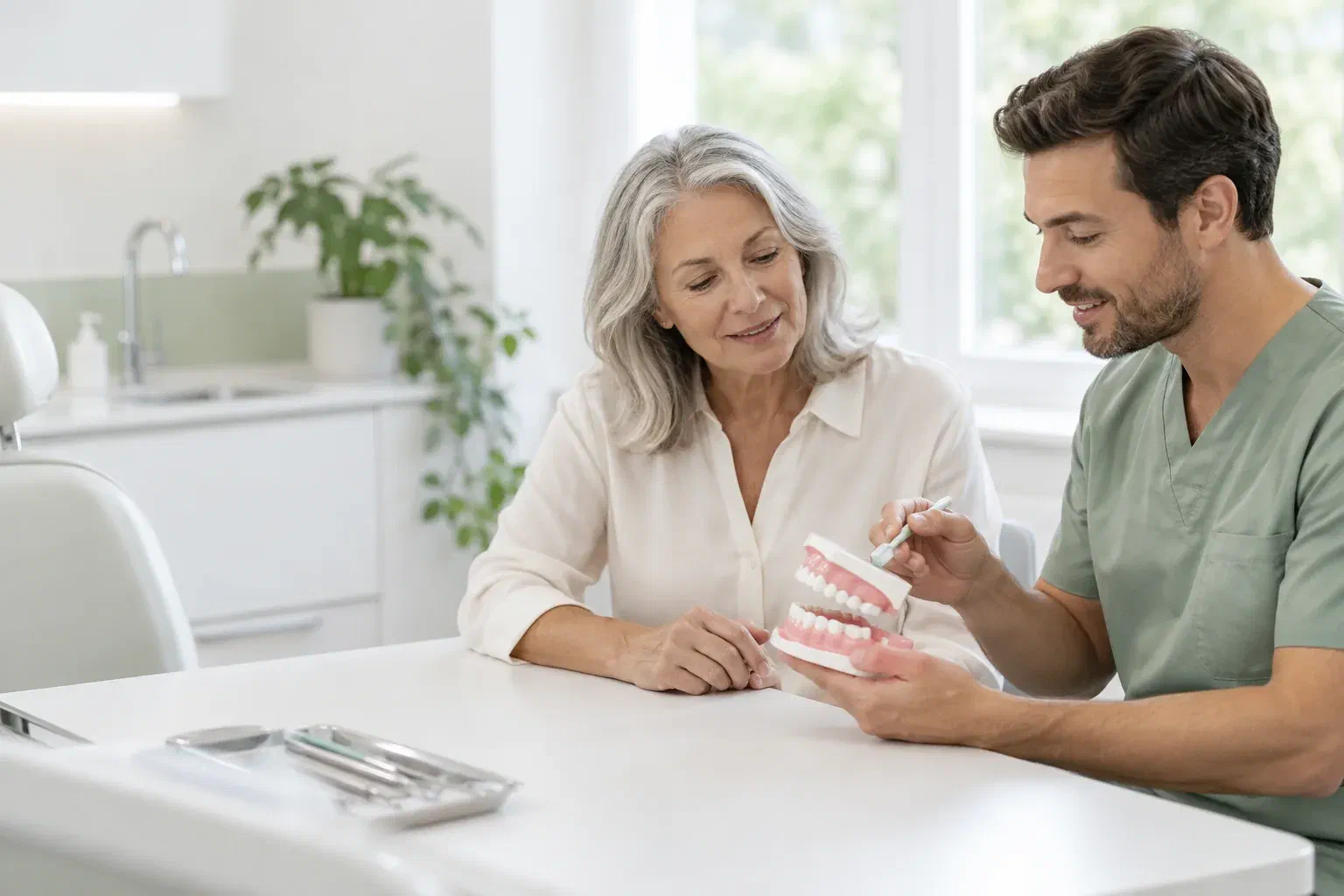
Illustrative conversation about caring for exposed root surfaces
General & Family Dentistry

Root-Cavity Prevention in Erin

A sweetened coffee sipped from breakfast to lunch, a few mints in the truck, a cookie with every break: for exposed roots, how often matters as much as how much. From Erin or Hillsburgh, plan a visit to check those roots and rethink the daily rhythm.

Everyday rhythms in Erin

The mug that lasts all morning.

Each time something sweet reaches your teeth, the plaque on them makes acid for a while. One treat is a short episode; a sweetened drink sipped over hours keeps it going. Roots exposed by receding gum lack the enamel layer of the crown, so they can be more sensitive to that pattern. An exposed root is not a cavity, but your daily rhythm is worth discussing.

For a household in rural Erin, the first appointment at our Bronte Street practice covers both the teeth and the routine around them. The dentist examines exposed roots, and we ask what a normal day looks like: when you eat and drink, what you keep handy at work or in the car, and where food collects. That helps us separate protection needs from anything needing repair.

The resulting advice is meant to be realistic. It might be finishing a drink in one sitting, swapping a habit or two, a fluoride product with clear directions, and a gentler cleaning approach at the gum. No single change can promise that a root stays sound, so we look at the plan again whenever your health, medicines, or habits shift.

Talk about daily habits and root risk
Illustrative soft toothbrush and interdental brush for a preventive routine
Patterns we ask about

It’s often the small, frequent things.

Four things shape decay risk on a root: the surface itself, saliva, cleaning, and how often sugar turns up. Describe your day honestly, including the bits you would rather skip, and let the exam decide whether decay is present.

A tooth that stings with sweets

A twinge near the gum with something sweet or cold can point to an exposed root. Note when it started and what sets it off. Other causes are possible, so the dentist examines first rather than reaching for a sensitivity paste.

Reaching for drinks because you feel dry

Sometimes the frequent sipping is a response to dryness, perhaps after a medicine change. Tell us, and bring your medication list. Keep taking prescribed treatment; the dryness itself can be raised with your doctor or pharmacist.

Food that lingers in one spot

Crowded teeth or a filling edge can trap snack residue near the gum. Show us where. Learning to clean that spot with the right small brush often helps more than an extra mouthwash.

Discolouration at the gumline cannot, by itself, confirm root decay. Avoid scraping it. Ask for an assessment if it changes, keeps catching food, or becomes sore.

Small changes, real effect

You do not have to give up coffee.

Prevention balances cleaning, fluoride, saliva, and how often sugar reaches the teeth. For many people, frequency is the easiest factor to adjust. A dry mouth or a past root cavity may call for more, while slight recession and a clean history may need less.

Changing habits cannot rebuild lost structure or ensure a root stays sound, and having exposed roots does not mean you need fillings. With each recommendation, ask what it is for: keeping healthy surfaces that way, settling an early change, or treating damage the exam has found.

Patient information: ADA — aging, exposed roots, and caries risk

Habits you can actually keep

Rather than banning things, we look for the changes that matter most: finishing a sweet drink in one go, choosing a different work-day snack, or keeping water handy. Small, consistent shifts tend to last.

Fluoride with a reason

Any fluoride product we suggest comes with what it is for, how and when to use it, and whether a pharmacist dispenses it. Tell us what is already on your bathroom counter so the routine stays short.

A plan that moves with you

Seasonal work, a new medicine, or a change in who cooks can all alter your pattern. Mention these at reviews. We would rather adjust the advice than see you stick with an old plan that no longer fits.

The appointment in four parts

Talk, look, plan, review.

The dentist works out whether exposed roots are sound or showing decay, then shapes the advice around those findings and your real daily routine.

  1. Walk us through a typical day

    Start from the alarm clock: when you eat, what you drink and how long it lasts, and when you clean. We also cover earlier cavities, recession, dryness, and medicines. Mention anyone who helps. The real pattern, not the ideal one, is what lets us suggest useful changes.

  2. Check the roots

    The dentist examines exposed surfaces and gums and decides whether additional records would add anything. You will learn which areas are healthy, which are being watched, and what, if anything, needs care, with each spot pointed out.

  3. Choose the changes

    We agree on cleaning aids, fluoride, and one or two habit changes around sugar or dryness. Any prescription product or in-chair application comes with clear directions. If decay needs treatment, the dentist explains that option, including its limits, as a separate step.

  4. Check in later

    Set a date to recheck the roots and know what the dentist will look at. Phone us sooner if a change is hard to manage. Prevention improves as it is adapted to findings and to how you are getting on.

Making the changes stick

Steady sips, gentle brushing.

Follow the guidance agreed for your mouth. Keep any prescribed fluoride product in a safe place out of children’s reach and use it as directed.

Brush softly near the gum

Use the brush and angle we demonstrated rather than scrubbing exposed roots. We can show a gentle way to clean between teeth too. If brushing is painful, let us know so we can look into the cause and the method.

Group the sweet moments

Having sweet food or drink with meals rather than spread through the day can reduce how often teeth are exposed. Tell us about mints, candies, or lozenges too, especially if you use them for dryness.

Keep an eye, but don’t poke

New pain, a rough surface, or food trapping should be mentioned, rather than tested with ice water or a toothpick. Keep your reviews even if things feel fine, since comfort cannot show a root surface is stable.

Depending on what we find

Habits first, then more if needed.

Start with the findings. A sound but exposed root, a surface with the beginnings of a lesion, and a tooth that decay has already hollowed each lead to different care.

Roots that need protecting

Habit and home prevention

Gentle cleaning, suitable fluoride, and a change or two in snacking and sipping form the core. We keep a record of the roots to watch and when to see them again. This route still includes review of any diagnosed concern.

Higher risk or an early lesion

Added fluoride or lesion care

If risk is higher, the dentist might discuss a fluoride treatment in the chair or a stronger product for home, or another approach for an early lesion. Make sure you understand its aim, what it cannot do, any effect on looks, and how it will be followed.

When a cavity has formed

Filling or other repair

The depth, position, access, and condition of the tooth guide how a cavity is repaired, and the dentist will explain the choices. Habit changes still matter afterward, because a repair does not change the daily pattern behind the decay.

Patient information: ADA — fluoride and caries prevention

Diet and root questions

Coffee, snacks and exposed roots

Ask about sugar, drinks, recession, fluoride, and dryness. Answers depend on an examination and on your own routine.

(905) 876-4488
Is black coffee a problem for exposed roots?
Unsweetened coffee is less of a decay concern than sweetened versions, though it can stain. Added sugar and syrups sipped over a long time are the bigger issue. Tell us how you take yours.
Does it matter whether I eat sweets with meals or between them?
It can. Sweet foods eaten with meals usually mean fewer separate exposures than snacks spread through the day. We can help you find a pattern that suits your schedule.
Are sugar-free mints a good alternative?
They may be a better choice than sugary ones, but check the ingredients and how many you use. Bring the packet to your visit if you are unsure, and we can discuss it alongside your plan.
Should I brush right after every snack?
Not necessarily. Timing advice can depend on what you ate and drank, and over-brushing can irritate exposed areas. Ask what makes sense for you; sometimes rinsing with water or waiting is suggested.
Can I plan my visits from Erin around seasonal work?
Ask the front desk about timing that suits busier and quieter parts of your year. Our weekday hours are 11am to 7pm Monday to Thursday, and Friday to Sunday is by appointment only.
If I cut down on sugar, can I skip fluoride?
Diet and fluoride work together, and one does not usually replace the other. The dentist will recommend a fluoride approach based on your overall risk. Ask whether it can change as your habits improve.
From Erin and Hillsburgh

Bring your routine, not a perfect one.

Phone or book online with our Bronte Street practice when exposed roots, sweet-drink habits, or dryness are on your mind. The dentist will examine the area, explain the findings, and help you choose prevention or treatment that fits your day.

Exposed root surface does not mean decay. If something starts to hurt or a surface changes, have it examined rather than relying on habit changes alone.

Visit Milton Dental Clinic
Unit 1, 342 Bronte St. S, Milton, ON L9T 5B7
Get directions Clinic hours
Monday–Thursday
11am–7pm
Friday–Sunday
By appointment only

Areas we serve

  • Milton
  • Oakville
  • Mississauga
  • Georgetown
  • Halton Hills
  • Acton
  • Campbellville
  • Brampton
  • Burlington
  • Puslinch
  • Rockwood
  • Erin
  • Caledon
  • Etobicoke
  • Old Milton
  • Bronte Meadows
  • Timberlea
  • Dorset Park
  • Dempsey
  • Clarke
  • Beaty
  • Coates
  • Harrison
  • Scott
  • Willmott
  • Ford
  • Bowes
  • Cobden
  • Walker
  • Mountain View
  • Milton Heights
  • Hawthorne Village
  • Valley View
  • Fallingbrook
  • Nassagaweya
  • Trafalgar
  • Esquesing
  • Nelson
  • Brookville
  • Moffat
  • Glen Williams
  • Norval
  • Limehouse
  • Stewarttown
  • Ashgrove
  • Hornby
  • Silver Creek
  • Speyside
  • Scotch Block
  • North Oakville
  • River Oaks
  • Glen Abbey
  • West Oak Trails
  • Palermo
  • Bronte Creek
  • College Park
  • Joshua Creek
  • Uptown Core
  • Preserve
  • Iroquois Ridge
  • Lisgar
  • Meadowvale
  • Meadowvale Village
  • Churchill Meadows
  • Erin Mills
  • Central Erin Mills
  • Streetsville
  • East Credit
  • Creditview
  • Heartland
  • Sheridan
  • Mount Pleasant
  • Credit Valley
  • Huttonville
  • Churchville
  • Springbrook
  • Northwest Brampton
  • Bram West
  • Fletcher's Meadow
  • Fletcher's Creek South
  • Alton Village
  • Orchard
  • Millcroft
  • Headon Forest
  • Tansley
  • Brant Hills
  • Tyandaga
  • Kilbride
  • Lowville
  • Aberfoyle
  • Morriston
  • Arkell
  • Hillsburgh
  • Freelton
  • Carlisle
  • Waterdown
  • Flamborough
  • Mountsberg

How can we help?

Milton Dental Clinic

Have a question about your smile? Choose the option that works best for you.

For urgent dental concerns, please call.
Messages are reviewed during clinic hours.