

Illustrative older adult speaking with a hygienist before a cleaning visit
General & Family Dentistry

Teeth Cleaning for Seniors in Caledon

When memory changes, brushing can quietly slip, and a spouse or caregiver may start helping. Households in Caledon can plan a seniors’ cleaning that supports the person receiving care and the person helping at home.

Memory, routine and support

Two people, one toothbrush

Forgetting whether teeth were brushed this morning, losing track of where the partial was left, or rinsing and skipping the floss altogether: small lapses like these often appear before anyone names them. In many homes, a husband, wife or adult child gradually steps in. A cleaning visit can help both people find a workable rhythm.

Still, the starting point is the mouth itself. Natural teeth, crowns, bridges, implants and removable partials each need their own approach, and the condition of the gums guides whether routine cleaning or more involved care is appropriate. Age on its own does not decide that. Comfort, hearing and how the person prefers to be helped matter too.

A professional cleaning removes deposits that home care leaves behind and shows where daily brushing is missing. It is not an examination and cannot repair a damaged tooth. Everyone involved should leave knowing what was done, what needs separate attention, and a simple routine that can continue at home in Caledon.

Plan a supported cleaning
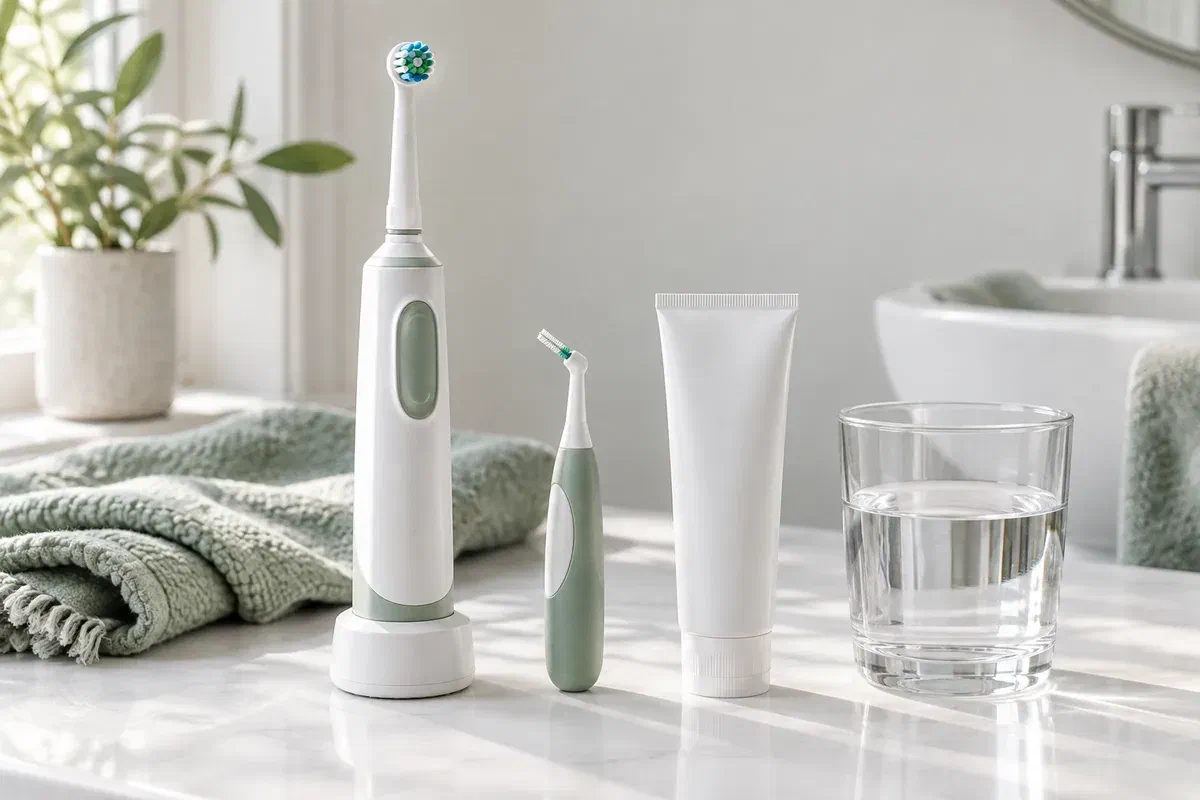
Illustrative easy-grip toothbrush and oral-care tools on a bright counter
Before the appointment

Information that helps everyone

Practical needs can be arranged more easily when they are raised at booking. A caregiver can help gather health details and dental history, with the patient’s knowledge.

What the mouth is showing

Note bleeding gums, a tooth that seems sore when eating, food left in one area, or a broken edge. Bring the partial or denture, if there is one. Wobbly teeth and chipped crowns need their own assessment on top of cleaning, so raise them when booking.

How daily care happens now

Explain who brushes, how often, and which steps are being missed or resisted. If memory, grip or eyesight is part of the picture, say so. That helps the team suggest a routine that suits both the person and whoever assists.

Health, consent and comfort

Bring a full medication list and relevant advice from the doctor. Mention swallowing problems, breathing concerns, distress when lying back, and any substitute decision-making arrangements. Ask about access or communication support ahead of time.

Medicines, including blood thinners, should be given as usual on the day of the cleaning unless the prescribing clinician has said otherwise. Please bring the full list so dental care can be planned around it.

Why it helps the whole household

A clean start for a shared routine

Removing hardened deposits gives a fresh starting point, and the hygienist can show exactly which areas are being missed at home. That is valuable for a caregiver who is brushing someone else’s teeth and cannot easily see inside. Gum health and the state of older fillings and crowns are noted as well.

A cleaning cannot ensure teeth or dental work will last for good. It cannot reverse all gum and bone changes or explain pain that has no identified cause, and a person with memory changes may not describe discomfort clearly. Ask which findings are maintenance and which need an examination or separate plan.

Patient information: CDA — dental examinations and oral care as you age

Advice for each type of dental work

Implants, bridges, partials and natural teeth are cleaned differently. If work was done elsewhere and is not on file, share what is known. Ask the hygienist to explain how each area should be handled at home.

Keeping as much independence as possible

Some people can keep brushing with a larger handle, a simple prompt or a caregiver finishing the hard-to-reach areas. Try approaches during the visit. The best plan lets the person do what they can and get help with the rest.

A caregiver role that respects the patient

A helper can learn brushing techniques and how to clean an appliance. Their role should be discussed openly. Care should still respect the patient’s preferences, with consent and any decision-making arrangements confirmed with the team.

During the cleaning

Calm, clear and unhurried

The instruments, the time needed and the amount of cleaning depend on the person. Ask at the start what can be done today and whether a follow-up or another short visit may help.

  1. Settle in and agree on support

    We review health updates, medicines and recent dental work with the patient and their helper. Agree how explanations will be given, whether the helper stays in the room, and how a pause will be signalled. Mention any worry about lying back first.

  2. Look at the gums and deposits

    The hygienist checks build-up and gum condition to judge whether routine cleaning suits or gum treatment should be discussed. Note any bleeding or tenderness the caregiver has seen at home. Some findings may need an examination.

  3. Clean at a comfortable pace

    Instruments are chosen to match the build-up and the person’s clinical needs. The clinician can stop for breaks, explain again, or help with water. If the person becomes uncomfortable or unsettled, the approach can be reconsidered.

  4. Teach the routine to both of you

    Ask for a demonstration of brushing someone else’s teeth, and of cleaning around any bridge, implant or partial. Confirm what the next visit is for. With permission, written steps can be provided for whoever helps at home.

Supporting care at home

Make it part of the day

Follow the aftercare instructions for the treatment provided. If a step is hard for the patient or the helper, perhaps because of memory, vision, grip or swallowing, contact the team so the routine can be adjusted.

Use the same tools at the same time

Keep the practised brush and interdental aid in one place and use them at a set time each day. A powered brush or larger handle may help, but neither is essential. Ask for an alternative if the person resists or the tool is awkward.

Watch for signs that need reporting

A persistently dry mouth, new sores, refusing food on one side or touching the face may signal a problem. Changes like these should not be assumed to be part of ageing. Call the team to ask whether an assessment is needed.

Keep appliance care straightforward

Follow the specific instructions for any partial denture, bridge or implant restoration. Avoid harsh cleaners on every surface. A labelled container and a routine for removing and cleaning the appliance can help.

Patient information: ADA — oral care considerations for older adults

Planning the next step

What level of care makes sense?

Ask the purpose of each recommendation, and whether a visit focuses on cleaning, gum disease, repairs or several needs together.

When prevention and deposit removal fit

Routine maintenance

This visit removes identified deposits and supports the home routine. Frequency depends on the person’s mouth and how well home care is going. Ask why a particular interval is suggested instead of assuming every older adult is seen equally often.

When the gums and bone need more

Gum treatment and recheck

Established gum disease may call for a more involved plan with reassessment. Ask how it differs from routine cleaning, how many visits may be needed, how comfort and calm will be supported, and what will be checked later.

When other health needs shape the visit

Coordinated care

Pain, a broken restoration, medical issues or complex support needs may require extra planning, sometimes with the family doctor or care team. Cleaning should be one part of that wider plan rather than a replacement for it.

Caledon caregivers ask

Supporting someone through cleaning

Bring the questions that come up while you help someone at home, however ordinary they seem. Practical questions help us plan suitable treatment.

(905) 876-4488
How do I brush someone else’s teeth properly?
Ask the hygienist for a demonstration during the visit, then try it with guidance. Position, lighting and a small brush head can make a difference. Report back if the technique is still difficult at home, and ask for written steps to keep by the sink.
My mother sometimes refuses to have her teeth brushed. What can help?
Mention it at the visit. The team may suggest approaches such as a calmer time of day, a simpler routine or letting her do part of it herself. Ask for ideas suited to her mouth and dental work, and say if a particular step seems to upset her.
Can I stay with my husband during his cleaning?
Discuss it with him first if possible, then mention it when booking. Many people find a familiar person reassuring. The team will still speak directly to him and respect his wishes and any decision-making arrangements.
What paperwork should I bring if I make decisions for my parent?
Bring any documents relating to substitute decision-making, along with the medication list and dental history. Mention the arrangement when booking so the team can follow the appropriate consent process.
How will I know if something is wrong between visits?
Watch for changes in eating, touching the face, new swelling, bleeding or a reluctance to wear an appliance. These can be signs of discomfort. Call the clinic to describe what you have noticed and ask whether an assessment is needed.
Can visits be planned around our travel from Caledon?
Mention scheduling or travel limits when booking so the appointment can be organised sensibly. For severe symptoms, seek emergency care close to home rather than delaying for the drive.
Seniors’ cleaning for Bolton and the rest of Caledon

Care that supports both of you

Speak with our Bronte Street practice to arrange a cleaning assessment. Let us know about dental work, sore areas, memory or communication needs and the support you provide, so the visit can be discussed before you arrive.

Please confirm access, consent and support arrangements when booking. Treatment and appointment length depend on individual assessment.

Visit Milton Dental Clinic
Unit 1, 342 Bronte St. S, Milton, ON L9T 5B7
Get directions Clinic hours
Monday–Thursday
11am–7pm
Friday–Sunday
By appointment only

Areas we serve

  • Milton
  • Oakville
  • Mississauga
  • Georgetown
  • Halton Hills
  • Acton
  • Campbellville
  • Brampton
  • Burlington
  • Puslinch
  • Rockwood
  • Erin
  • Caledon
  • Etobicoke
  • Old Milton
  • Bronte Meadows
  • Timberlea
  • Dorset Park
  • Dempsey
  • Clarke
  • Beaty
  • Coates
  • Harrison
  • Scott
  • Willmott
  • Ford
  • Bowes
  • Cobden
  • Walker
  • Mountain View
  • Milton Heights
  • Hawthorne Village
  • Valley View
  • Fallingbrook
  • Nassagaweya
  • Trafalgar
  • Esquesing
  • Nelson
  • Brookville
  • Moffat
  • Glen Williams
  • Norval
  • Limehouse
  • Stewarttown
  • Ashgrove
  • Hornby
  • Silver Creek
  • Speyside
  • Scotch Block
  • North Oakville
  • River Oaks
  • Glen Abbey
  • West Oak Trails
  • Palermo
  • Bronte Creek
  • College Park
  • Joshua Creek
  • Uptown Core
  • Preserve
  • Iroquois Ridge
  • Lisgar
  • Meadowvale
  • Meadowvale Village
  • Churchill Meadows
  • Erin Mills
  • Central Erin Mills
  • Streetsville
  • East Credit
  • Creditview
  • Heartland
  • Sheridan
  • Mount Pleasant
  • Credit Valley
  • Huttonville
  • Churchville
  • Springbrook
  • Northwest Brampton
  • Bram West
  • Fletcher's Meadow
  • Fletcher's Creek South
  • Alton Village
  • Orchard
  • Millcroft
  • Headon Forest
  • Tansley
  • Brant Hills
  • Tyandaga
  • Kilbride
  • Lowville
  • Aberfoyle
  • Morriston
  • Arkell
  • Hillsburgh
  • Freelton
  • Carlisle
  • Waterdown
  • Flamborough
  • Mountsberg

How can we help?

Milton Dental Clinic

Have a question about your smile? Choose the option that works best for you.

For urgent dental concerns, please call.
Messages are reviewed during clinic hours.