

Illustrative older adult speaking with a hygienist before a cleaning visit
General & Family Dentistry

Teeth Cleaning for Seniors in Erin

A drawer of brushes, picks and gadgets that never quite worked? Older adults from Erin and Hillsburgh can bring them along, and leave a cleaning visit with a short home routine that suits their hands and their dental work.

Erin · The routine at the bathroom sink

Bring the toothbrush you actually use

Most bathroom cabinets hold a small history of good intentions: an electric brush that felt too heavy, floss picks that snapped, a water flosser used twice. None of that is wasted if it tells us what does not suit you. Bringing your own tools to a cleaning visit lets the hygienist see your routine as it really is.

The routine has to fit the mouth as well as the hands. A full set of original teeth is cleaned differently from a mouth with crowns, a bridge, an implant or a partial denture, each with its own awkward corners. Gum findings and the dental work in place matter far more than age when deciding what to clean and how.

During the visit, the hygienist removes deposits that brushing has missed and shows you where they gathered. A cleaning is not an examination and cannot mend a damaged tooth. Expect to leave knowing what was done, what needs a separate look, and a short daily routine you can carry on in Erin without a drawer full of gadgets.

Book a cleaning and routine review
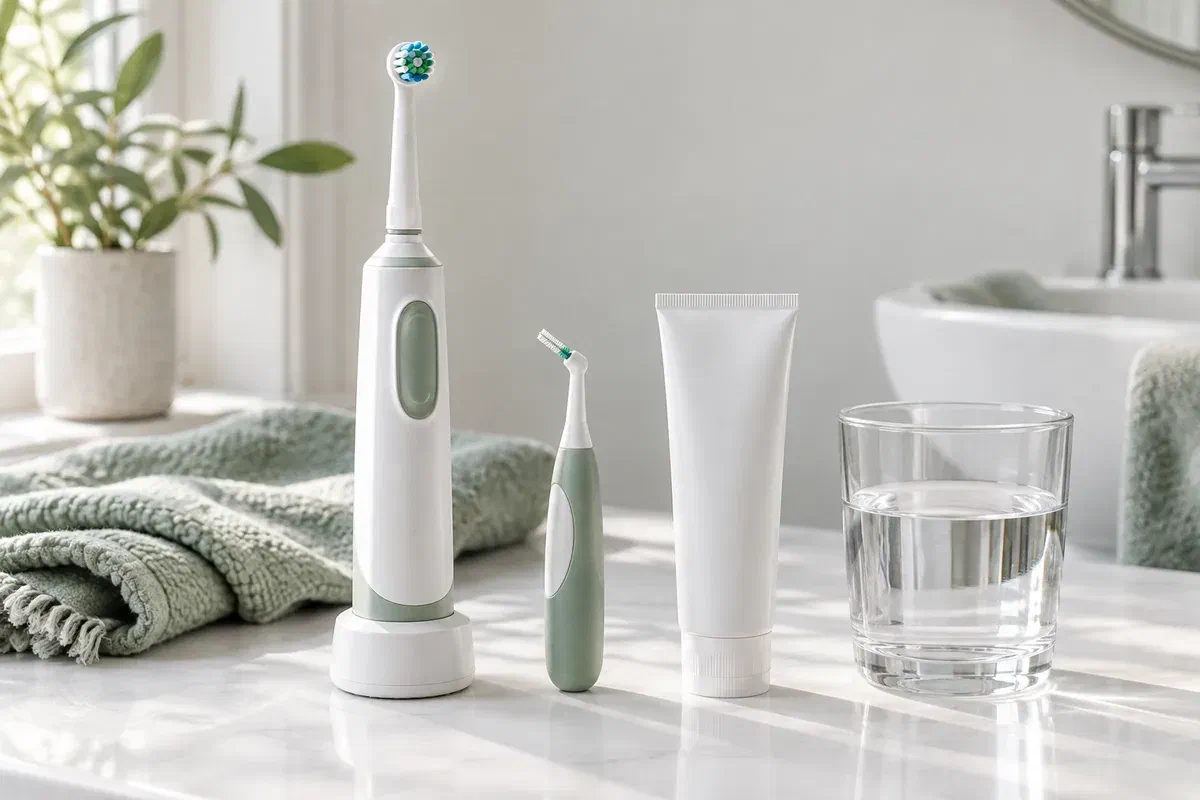
Illustrative easy-grip toothbrush and oral-care tools on a bright counter
Useful to mention

Your mouth, your hands, your health

Practical needs are easier to plan for when you raise them at booking. Bring your health details, a note of past dental work, and the oral-care tools you use most.

Areas that bleed, ache or trap food

Point out gums that bleed when brushed, a sore tooth, a spot where food always lodges, or an edge that catches your tongue. Bring dentures or partials along. Teeth that wobble and fillings that have cracked fall outside a routine cleaning, so flag them early.

Tools that frustrate you

Tell us which brush is hard to hold, which floss you gave up on, and which part of your mouth you cannot see or reach. If memory makes the order of steps confusing, say so. The aim is a routine that works with your abilities rather than against them.

Health and appointment comfort

Bring a current medicine list and any instructions from your doctor. Let us know if swallowing is hard, if you have a breathing condition, or if being tipped back in the chair is uncomfortable. Ask about access or communication needs before the day, so suitable arrangements can be discussed.

Don’t interrupt a blood thinner or any other prescribed treatment to prepare for your cleaning. Only the clinician who manages that medicine should change it. Bring the details and we will plan the visit accordingly.

What you gain from the visit

Proof of what is working at home

When the hygienist finds deposits in the same spots each time, those spots point straight to the gaps in your routine. Cleaning them away is one benefit; learning how to reach them yourself is the other. Gum health and the condition of older restorations round out the picture.

A cleaning has its limits. It cannot promise that natural teeth or dental work will last indefinitely, turn back changes in the gum and bone, or explain discomfort with no clear source. Ask which findings your routine can address and which need an examination or another plan.

Patient information: CDA — dental examinations and oral care as you age

Tools chosen for your surfaces

Implants, bridges and natural teeth each call for suitable aids. Describe any work done by another dentist that may be missing from our records. The hygienist can then recommend tools that fit each area rather than a general kit.

Fewer gadgets, better results

One well-chosen brush and one interdental aid used properly may do more than a cupboard of products used occasionally. A larger handle or different head can help some people. Try it in the chair and pick the option you can manage daily.

A helper who knows the routine

If someone assists you at home, they can learn the same steps, with your agreement. Decide together how much they will do. Their job is to back up your independence and your choices; any consent or substitute decision-making questions can be settled with the team.

Inside the visit

Clean first, then coach

The cleaning needed, the instruments and the length of your appointment depend on your mouth and health. It is fair to ask at the outset how much fits into today and whether a follow-up may be suggested.

  1. Show us your routine

    After reviewing health changes, medicines and recent dental work, we may ask you to show how you brush and clean between teeth. Say how you like instructions to be given. Agree on a pause signal, and mention any concern about reclining before starting.

  2. Check where deposits gather

    The hygienist maps where plaque and tartar have settled and how the gums look, which shows whether a standard clean is enough or gum treatment is worth discussing. Ask to see the areas that bleed or collect deposits. An examination may be advised for findings cleaning cannot explain.

  3. Carry out the cleaning

    Instruments are picked according to what has built up, where it sits and what your mouth needs clinically. Ask for a rest, an explanation or help with water whenever you like. The approach can be adapted where clinically appropriate.

  4. Practise with your chosen tools

    Try the recommended brush or aid in the chair, focusing on any bridge, implant or root surface that gives you trouble. Check why the next appointment is being booked and whether anything used today has special instructions. A helper can learn alongside you, with your permission.

Daily care made simpler

Three habits instead of ten products

Follow the aftercare advice for the treatment provided. If a step turns out to be hard, whether because of sight, grip, swallowing or remembering, phone the team so the routine can be simplified.

Keep to the tools you tested

Use the brush and interdental aid you practised with, using the motion shown. A powered brush or wide handle suits some people but is not essential. If a tool becomes uncomfortable or awkward, ask for something else.

Pay attention to dryness and soreness

Tell us if your mouth stays dry, a tender spot appears, or chewing starts to feel different. Getting older does not explain these away. We can say whether you should come in and how to tweak your routine until then.

Give appliances their own routine

A partial, a fixed bridge and an implant crown are each looked after in their own way. A harsh cleaner is not right for every surface. Keep the removable piece and your own teeth as two separate jobs at the sink.

Patient information: ADA — oral care considerations for older adults

What comes after the cleaning

Not every visit is the same visit

Ask what each recommendation is designed to do, and whether future appointments are aimed at cleaning, gum disease, repairs, or more than one of these.

If prevention and deposit removal are what’s needed

Routine maintenance

This visit clears identified deposits and backs up your home routine. How often you return is set by your gums and teeth. Ask why a particular interval is proposed instead of assuming every older adult is seen on the same timetable.

If the supporting tissues need extra care

Gum treatment with follow-up

Where gum disease is established, a more involved plan and later reassessment may be suggested. Ask what makes it different from maintenance, how many visits are likely, how comfort will be arranged, and what will be checked.

If another concern is affecting care

Additional assessment

A sore tooth, a chipped filling, health conditions or heavier support needs can mean more preparation, sometimes with another clinician. A cleaning should fit inside that broader plan rather than standing in for it.

Home-care questions from Erin

Getting the routine right

No question about brushes, floss or routines is too small. Practical details are part of planning suitable treatment.

(905) 876-4488
Should I bring my own toothbrush and floss to the appointment?
Yes, if you can. Seeing your actual tools helps the hygienist understand your routine and suggest practical changes. Bring any interdental aids or gadgets you use, or have given up on, as well. They can tell the team a lot about what suits your hands.
Is an electric toothbrush better for older adults?
It can help some people, particularly with reduced grip, but it is not right for everyone. Weight, handle size and vibration all matter. Ask to try the technique with guidance, and compare it with a manual brush fitted with a larger handle before deciding.
What can I use if regular floss is too fiddly?
Options include floss holders, small interdental brushes and other aids, depending on the spaces between your teeth and any dental work. Ask the hygienist to suggest one or two and let you practise them. Report back if the chosen aid is still difficult.
How many products do I really need?
Often fewer than people expect. A suitable brush, an interdental aid and any specific product the team recommends may be enough. Ask what each item is for, so you can drop the ones that do not add anything for your mouth.
How do I remember all the steps?
Ask for a short written list, or a simplified routine with fewer steps. Keeping tools in the same order by the sink can help too. A helper can learn the routine with your permission if you would find that useful.
Can I combine my cleaning with other errands when coming from Erin?
That is up to you, but mention any time limits when booking so the appointment can be planned. If you develop severe symptoms between visits, seek care nearby rather than waiting to make the trip.
Seniors’ cleaning for Erin and Hillsburgh

Bring your tools, leave with a plan

Contact our Bronte Street practice and ask about a seniors’ cleaning with a routine review. Describe your dental work, tender spots and the kind of help that makes appointments easier, and we can talk the visit through ahead of time.

Mention access or support arrangements as you book. What is done, and for how long, follows from your own assessment.

Visit Milton Dental Clinic
Unit 1, 342 Bronte St. S, Milton, ON L9T 5B7
Get directions Clinic hours
Monday–Thursday
11am–7pm
Friday–Sunday
By appointment only

Areas we serve

  • Milton
  • Oakville
  • Mississauga
  • Georgetown
  • Halton Hills
  • Acton
  • Campbellville
  • Brampton
  • Burlington
  • Puslinch
  • Rockwood
  • Erin
  • Caledon
  • Etobicoke
  • Old Milton
  • Bronte Meadows
  • Timberlea
  • Dorset Park
  • Dempsey
  • Clarke
  • Beaty
  • Coates
  • Harrison
  • Scott
  • Willmott
  • Ford
  • Bowes
  • Cobden
  • Walker
  • Mountain View
  • Milton Heights
  • Hawthorne Village
  • Valley View
  • Fallingbrook
  • Nassagaweya
  • Trafalgar
  • Esquesing
  • Nelson
  • Brookville
  • Moffat
  • Glen Williams
  • Norval
  • Limehouse
  • Stewarttown
  • Ashgrove
  • Hornby
  • Silver Creek
  • Speyside
  • Scotch Block
  • North Oakville
  • River Oaks
  • Glen Abbey
  • West Oak Trails
  • Palermo
  • Bronte Creek
  • College Park
  • Joshua Creek
  • Uptown Core
  • Preserve
  • Iroquois Ridge
  • Lisgar
  • Meadowvale
  • Meadowvale Village
  • Churchill Meadows
  • Erin Mills
  • Central Erin Mills
  • Streetsville
  • East Credit
  • Creditview
  • Heartland
  • Sheridan
  • Mount Pleasant
  • Credit Valley
  • Huttonville
  • Churchville
  • Springbrook
  • Northwest Brampton
  • Bram West
  • Fletcher's Meadow
  • Fletcher's Creek South
  • Alton Village
  • Orchard
  • Millcroft
  • Headon Forest
  • Tansley
  • Brant Hills
  • Tyandaga
  • Kilbride
  • Lowville
  • Aberfoyle
  • Morriston
  • Arkell
  • Hillsburgh
  • Freelton
  • Carlisle
  • Waterdown
  • Flamborough
  • Mountsberg

How can we help?

Milton Dental Clinic

Have a question about your smile? Choose the option that works best for you.

For urgent dental concerns, please call.
Messages are reviewed during clinic hours.