
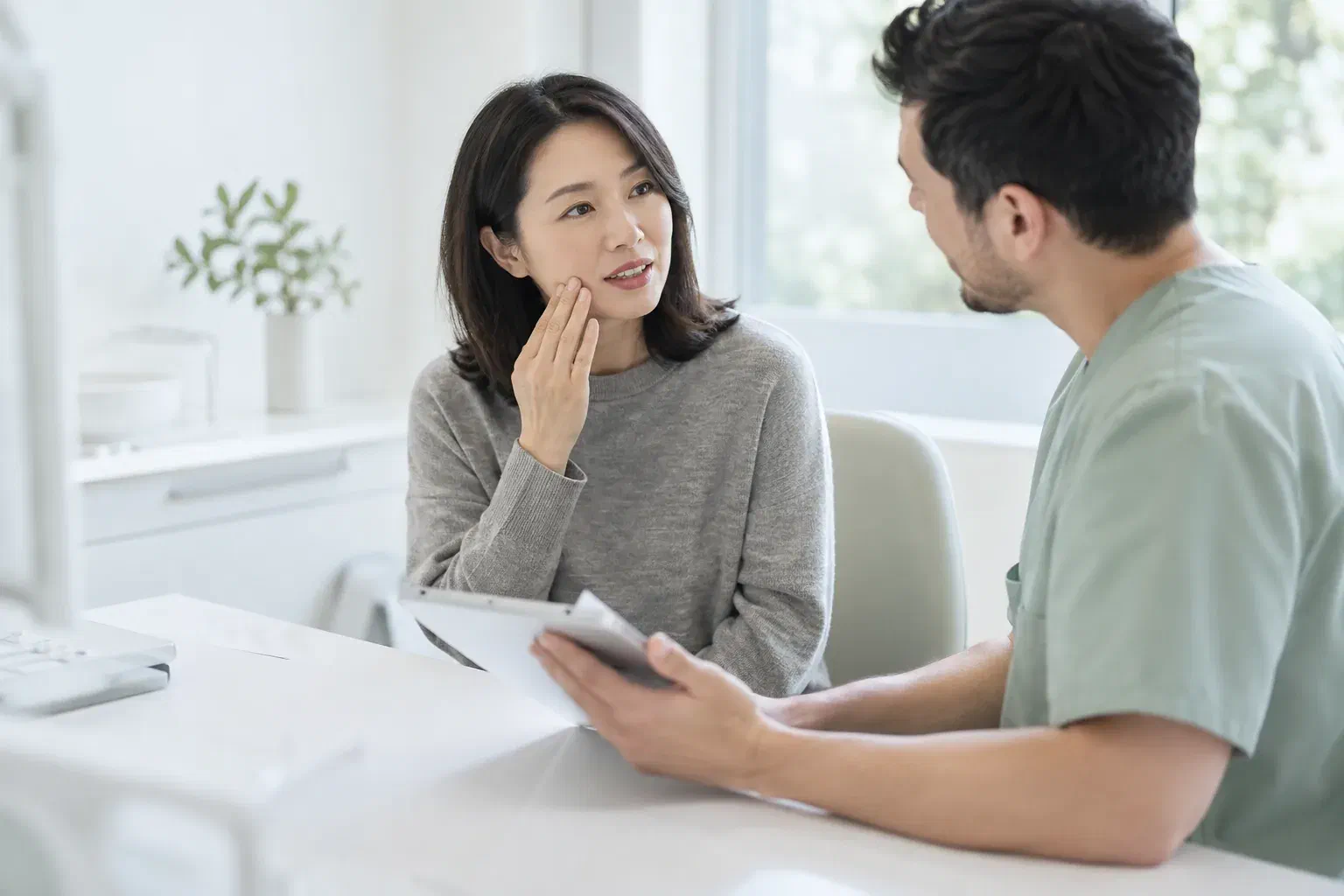
Illustrative patient describing tooth sensitivity during a dental conversation
General & Family Dentistry

Treatment for Sensitive Teeth in Burlington

Three tubes of sensitivity toothpaste later, the cold still bites. For people coming from Burlington, we start where the products left off: a careful look at what is actually causing the reaction, followed by care chosen for that cause.

Past the toothpaste aisle

When the shelf has run out of answers

Buying a sensitivity toothpaste is a reasonable first instinct. It is what the packaging suggests, and for some people with exposed dentin it may help. But when one brand gives way to another and the cold still catches you, the product is probably not the missing piece. The question that needs answering is why the tooth reacts in the first place.

Our Bronte Street team approaches it in that order. We listen to how the sensitivity behaves, then examine the teeth, fillings, and gums for the source. Exposed root surface is one option, yet decay, a fracture, a leaking restoration, and other conditions can produce a similar feeling, and none of those are solved by switching brands.

It helps to bring the products you have used, or at least their names, and describe what changed with each. You do not need to set the tooth off to prove anything. With that history and the findings, the dentist can explain the likely cause, suggest care that matches it, and agree on how improvement will be judged.

Get past the guesswork
Illustrative soft toothbrush, toothpaste, and drinking water for gentle daily care
Three common patterns

Which description sounds like yours?

Note what sets it off, where you feel it, and how long it lasts. Then report those observations as they are, rather than deciding what the condition must be.

Quick and predictable

The same cold drink, gust of air, or brush stroke sets it off each time, and it fades fast. Tell us how many teeth are involved. A predictable twinge still merits attention when it is new, increasing, or getting in the way of brushing properly.

Lingering or spontaneous

The ache stays after the trigger is gone, wakes you, or begins without one. That shift can alter both the urgency and the tests that are useful. Reaching for yet another toothpaste is not the right response to a pattern like this.

Linked to something new

Sensitivity that began after dental work, whitening, a different oral-care product, an injury, or a change in your bite is worth flagging. The connection may be meaningful, though it is not proof, and the tooth still needs to be examined.

Phone us right away about swelling, a broken tooth, significant pain on biting, or symptoms that keep getting worse. If a checkup is already booked, tell us about the change so we can decide whether you should be seen earlier or for a separate visit.

What an assessment adds

A reason behind every recommendation

Sensitivity often involves dentin, the layer under enamel, losing some of its protective cover so that cold or touch reaches the nerve more readily. Similar sensations can come from entirely different problems, which is why a product that suits one person may do little for another. After the examination, care might be a home product, an in-office treatment, or treatment for a particular dental issue.

Even with the right approach, relief can take time and is not guaranteed to be permanent. Ask what the treatment should change, how to use it, and when your progress will be reviewed. The plan should also cover what happens if the sensitivity continues or starts to feel different.

Patient information: ADA MouthHealthy — sensitive teeth and possible causes

Your product history, put to use

Knowing what you have already tried, for how long, and what happened is genuinely useful. It keeps you from repeating something unhelpful, and the dentist can explain whether a new recommendation works in a different way or should be used differently.

Treatment for what was found

If the examination reveals decay, a failing filling, or another problem, that can be addressed directly instead of numbing the symptom. Ask how each recommendation connects to a specific finding so the plan makes sense.

Brushing that does not hurt to keep up

Many people start brushing around a sore area, and that makes daily care harder. Let us know where it hurts to clean so technique and tools can be reviewed. The aim is a routine you can sustain while the cause and response are followed.

During your appointment

Four steps from symptom to plan

Tests are chosen to fit the findings. If you are worried about discomfort during an examination, say so, and the dentist can explain each relevant step before starting it.

  1. Start with what you have noticed

    Describe the first time it happened, the usual triggers, where it seems to be, and how long it lasts. Include any night pain and recent dental treatment. You are welcome to come in without knowing exactly which tooth is responsible.

  2. A thorough look at the area

    The dentist checks the surfaces, restorations, and gum tissue involved. X-rays or other suitable tests may be discussed to pinpoint the source. Ask what each one can reveal, and let the clinician know straight away if you need a break.

  3. Explain the findings and choices

    The dentist covers what is established and what is still uncertain. If conservative care is suitable, the dentist walks you through using it and says when it will be rechecked. If a tooth needs treatment, ask about the options, limitations, and timing.

  4. Set a routine and a review

    Confirm your home care, any treatment done that day, and when to check in. Ask which changes mean you should call before then. Any product trial should have a clear purpose and an end date rather than continue while symptoms go unexplained.

Between appointments

Patience, a soft brush, and a short list of rules

Follow the advice that fits your diagnosis and the treatment you actually received. Instructions after a repair may be quite different from those for a desensitizing toothpaste.

Stop checking with cold

Repeatedly testing the tooth with ice or a cold drink keeps provoking it. Use a soft brush and the technique discussed, and avoid pressing harder on the sensitive spot. Let us know if you still find that area hard to clean.

One product, used properly

Desensitizing toothpaste may need repeated, regular use before you can tell whether it helps. Stick with the instructions instead of mixing several treatments or applying them more often. Ask what to do about whitening if it seems connected.

Track what is changing

A short record of the trigger, how long the discomfort lasts, and whether daily life is easier can be helpful. You do not need to test on purpose. Call if pain increases, starts without a trigger, or does not improve as expected.

Treatment choices

Three directions, depending on the cause

Ask what each option is intended to achieve. Care for exposed dentin, for a structural problem, and for a problem inside the tooth involves quite different decisions.

When conservative care fits the findings

A targeted desensitizing plan

The dentist may suggest a specific home product or a professional application for a suitable surface. Discuss how to use it, its limits, and when to review it. This should follow an assessment, not stand in for one when pain is changing.

When a tooth or filling needs attention

A repair where one is needed

Decay, damage, or a problem with a restoration may require a repair or another protective measure. The choice depends on the condition and how much tooth structure is involved. Ask why the treatment is recommended and what alternatives make sense.

When the diagnosis needs further care

Next-level gum or tooth treatment

Some findings lead to a separate discussion of gum treatment or care inside the tooth, and referral may be considered. Root canal treatment is not an automatic response to sensitivity; it depends on the diagnosis and the options available.

Burlington questions

Answers for people who have already tried the obvious

Ask about the products you have used, the triggers you notice, and how the response will be reviewed. Sensitivity can be a symptom of more than one problem.

(905) 876-4488
How long should a sensitivity toothpaste be given before I call?
Follow the product directions and any advice you have been given, but do not wait out a trial if the discomfort is new, worsening, or lingering. If several weeks of regular use bring little change, ask for an assessment rather than trying another brand.
Is a professional desensitizing treatment just a stronger toothpaste?
Not exactly. An in-office application is placed by the dental team on a suitable surface, and whether it is appropriate depends on the examination. Ask what the treatment is meant to do and how its effect will be reviewed.
Should I stop my current toothpaste before the visit?
There is usually no need to change your routine before the appointment unless you have been advised to. Bring the product or its name and describe how long you have used it and what happened, so the dentist has the full picture.
If a toothpaste eased it, could there still be a cavity?
Yes, an improvement does not rule out decay or another cause. Have new or unexplained sensitivity examined and explain which product you used and how much it helped. The findings determine whether further care is needed.
Why does the timing of the pain after cold matter?
How long discomfort lasts is part of the pattern the dentist uses to decide what to investigate. A quick twinge and pain that stays may raise different questions. Describe it as accurately as you can without testing the tooth over and over.
Could I end up needing a root canal for this?
Sensitivity alone does not mean root canal treatment is required. That decision depends on the history, examination, and test results. Ask what has been diagnosed and why any proposed treatment is right for that tooth.
Sensitivity treatment for Burlington

Bring the tubes, and we will look for the reason.

Call our Bronte Street practice to describe your sensitivity and arrange an assessment. Mention if the pain lingers, appears without a trigger, or started after recent treatment, and we will help you plan the visit from Burlington.

Treatment depends on the cause. Report new swelling or significant, worsening pain promptly rather than relying on toothpaste alone.

Visit Milton Dental Clinic
Unit 1, 342 Bronte St. S, Milton, ON L9T 5B7
Get directions Clinic hours
Monday–Thursday
11am–7pm
Friday–Sunday
By appointment only

Areas we serve

  • Milton
  • Oakville
  • Mississauga
  • Georgetown
  • Halton Hills
  • Acton
  • Campbellville
  • Brampton
  • Burlington
  • Puslinch
  • Rockwood
  • Erin
  • Caledon
  • Etobicoke
  • Old Milton
  • Bronte Meadows
  • Timberlea
  • Dorset Park
  • Dempsey
  • Clarke
  • Beaty
  • Coates
  • Harrison
  • Scott
  • Willmott
  • Ford
  • Bowes
  • Cobden
  • Walker
  • Mountain View
  • Milton Heights
  • Hawthorne Village
  • Valley View
  • Fallingbrook
  • Nassagaweya
  • Trafalgar
  • Esquesing
  • Nelson
  • Brookville
  • Moffat
  • Glen Williams
  • Norval
  • Limehouse
  • Stewarttown
  • Ashgrove
  • Hornby
  • Silver Creek
  • Speyside
  • Scotch Block
  • North Oakville
  • River Oaks
  • Glen Abbey
  • West Oak Trails
  • Palermo
  • Bronte Creek
  • College Park
  • Joshua Creek
  • Uptown Core
  • Preserve
  • Iroquois Ridge
  • Lisgar
  • Meadowvale
  • Meadowvale Village
  • Churchill Meadows
  • Erin Mills
  • Central Erin Mills
  • Streetsville
  • East Credit
  • Creditview
  • Heartland
  • Sheridan
  • Mount Pleasant
  • Credit Valley
  • Huttonville
  • Churchville
  • Springbrook
  • Northwest Brampton
  • Bram West
  • Fletcher's Meadow
  • Fletcher's Creek South
  • Alton Village
  • Orchard
  • Millcroft
  • Headon Forest
  • Tansley
  • Brant Hills
  • Tyandaga
  • Kilbride
  • Lowville
  • Aberfoyle
  • Morriston
  • Arkell
  • Hillsburgh
  • Freelton
  • Carlisle
  • Waterdown
  • Flamborough
  • Mountsberg

How can we help?

Milton Dental Clinic

Have a question about your smile? Choose the option that works best for you.

For urgent dental concerns, please call.
Messages are reviewed during clinic hours.