
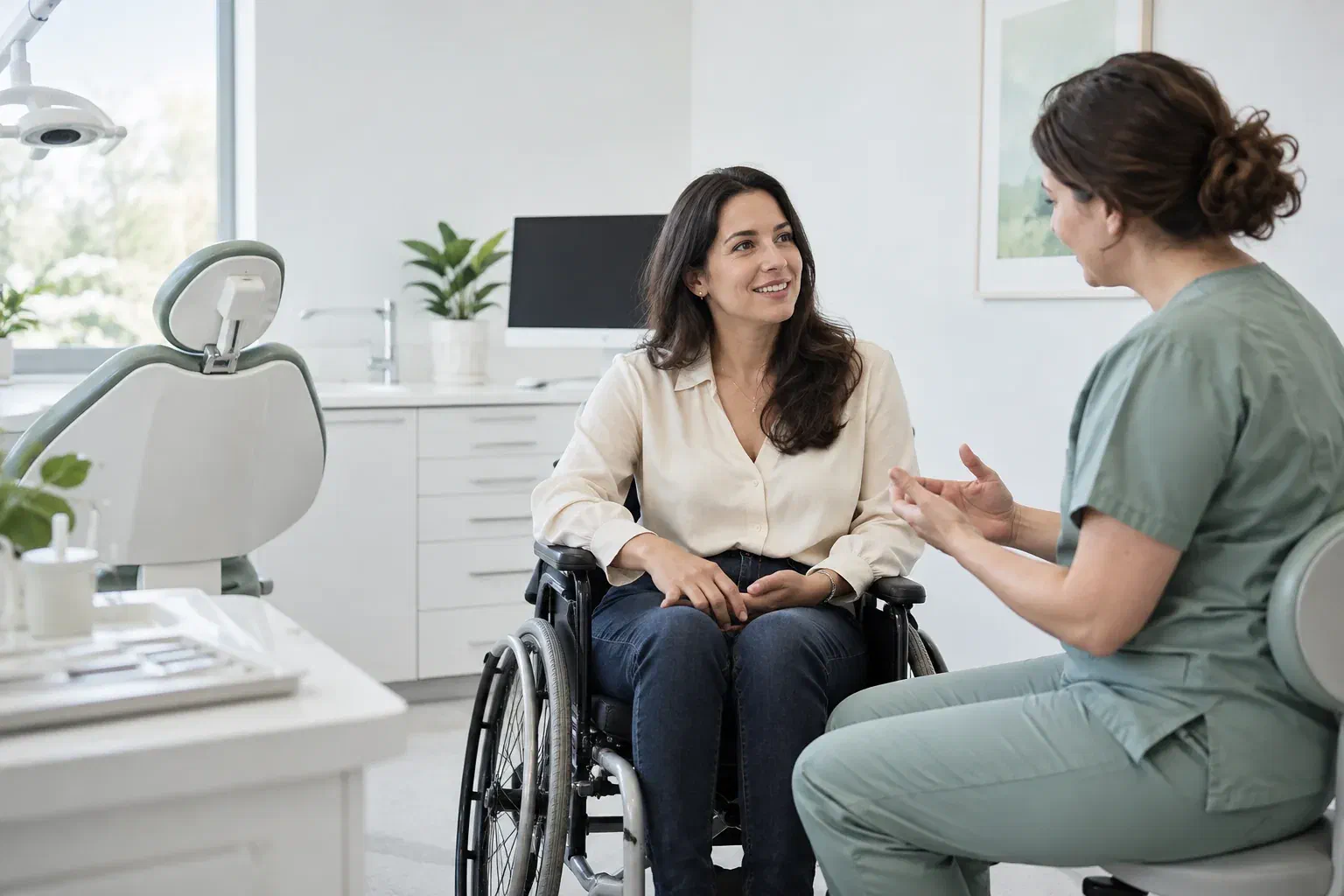

Illustrative wheelchair user speaking directly with a seated dental clinician
General & Family Dentistry

Wheelchair-Accessible Dental Care in Campbellville

Living out in the countryside, you probably plan trips into town carefully. Do the same with an accessible dental visit: settle the seating, support and access with us, and agree on a backup in case something doesn't suit you on the day.

Rural planning, from Campbellville

What's the backup if something doesn't work?

Rural households tend to bundle errands, line up rides and leave little room for wasted journeys. So it's worth asking a question many people skip: if the arrangement we agree turns out not to suit you once you arrive, what then? Knowing the fallback in advance makes an accessible dental appointment much less of a gamble.

Building that plan starts with you. Explain the dental reason for the visit and how you prefer to be seated, whether that means moving yourself across, staying in your wheelchair, or working with a helper and a familiar aid. Nobody should decide that on your behalf. Ask about the path to the treatment room and the room to turn inside, because both affect whether the visit can go ahead as hoped.

From there, the team can be open about what's realistic, where the limits sit and whether some care might be better provided elsewhere. Use this page as a list of things to raise. It doesn't promise particular door sizes, lifting equipment, a hand with transfers or treatment from your own chair.

Talk through a backup plan
Illustrative close view of a wheelchair user's hands resting beside a push rim
Sort these out before the trip

Access, seating and a say in your care

The clearer your information, the more reliable the answers. Ask what applies to your own visit rather than accepting a generic accessibility statement.

Getting from the car to the treatment chair

Mention your chair type and any dimensions worth checking. Ask about the entrance, thresholds, turning room and the space around the treatment area. If errands are being grouped around the appointment, ask about washroom access and where to wait.

Transfers, recline and their limits

Describe how you normally move between seats and any restriction on lying back or turning. Check that the planned care can be provided with the space and equipment available. Nobody should plan on staff lifting you or a family member managing the transfer.

Speaking for yourself

Say how you want information explained and whether anyone should come in with you. Using a wheelchair implies nothing about how you understand or choose. The team should direct the conversation to you, with extra help arranged on your terms.

Have everything confirmed before setting up a ride. If your chair, health, method of transferring or helpers change, phone again so the plan can be checked.

Why the backup matters

Fewer surprises, fewer wasted trips

Mobility can affect how you reach the treatment space and the position dental care needs. Discussing it in advance means the team prepares for the actual appointment, not only the front door. Sometimes the better answer turns out to be more preparation, or a site with other facilities.

A fallback keeps control in your hands. Know who will help, what's been agreed and what will happen if the plan doesn't suit you that day. When the alternative is already understood, a hiccup doesn't have to mean an unsafe compromise or a lost trip.

Patient information: NIDCR — mobility considerations in dental care

No assumptions about who helps

You know your equipment and routine. Make clear which help is welcome and what shouldn't be tried. Transfers require an agreed method; good intentions at the time can't confirm that the approach or resources are right.

Making each trip into town worthwhile

A consultation, an examination and longer treatment can each call for different time, seating and space. Ask what the booked appointment will include. If treatment needs a separate visit, know the next step before lining up another ride.

Using what your supports already know

A support worker or a clinician involved in your care may help explain a particular requirement. Agree what to share and how. A companion shouldn't be left guessing which details will matter.

Planning, step by step

Agree the plan, and the plan B.

One conversation should cover the dental concern and the access arrangements. For detailed or urgent needs, a call to the practice works better than a form.

  1. Explain what you need done

    Tell us if you're due for a checkup or cleaning, or if something hurts or has cracked. Mention urgent symptoms first. That lets the team propose a suitable appointment and talk about what it may require.

  2. Go over chair, seating and transfers

    Share the relevant details of your chair, your usual way of transferring and whether you need to stay seated. Learn what's possible and what remains unconfirmed. For any specific device or form of help, ask for a clear answer.

  3. Agree on support and a fallback

    Decide who'll be with you and how instructions or pauses will work. Share health details affecting safe positioning through a proper channel. Ask, too, what happens if an arrangement proves unsuitable, so you know the alternative before you travel.

  4. Check once more at the clinic

    Before anyone helps you move or care begins, confirm the approach still works and mention any changes. If something can't be accommodated, switch to the agreed alternative. An improvised transfer is never the fallback.

Getting home

Aftercare that suits rural life

Instructions depend on what treatment you had. Ask how temporary effects might affect eating, speaking, the drive home, transfers and the support you have.

Plan for the rest of your day

If treatment involved freezing, medicine or another change to your routine, ask for specific guidance before leaving. Confirm transport and help for the journey. Arrangements fine after a checkup may not suit a different procedure.

A brushing routine you can manage

Discuss brushing and cleaning between teeth with your grip, reach and favourite position in mind. Your chair doesn't determine whether a helper should assist with oral care. Ask about the movement or tool you find tricky.

Note what to keep for next time

Pass on which arrangements worked and what you'd change. If your chair or helpers change, reconfirm the key details. An earlier visit that went well is useful, but new treatment needs fresh planning.

Your possible routes

Which arrangement fits this visit?

Talk over the options before committing. A first assessment and later treatment might suit different setups.

When the practice can meet your requirements

Care here with arrangements agreed

Proceed knowing how access, positioning, support and the visit's purpose have been settled, along with the fallback. Ask any outstanding questions before travelling. Both you and the team should share the same picture of the plan.

When treatment needs are still unclear

An assessment to inform what comes next

An initial conversation or assessment may show what future care would involve. Ask what can be done this time and what's left open. That's no guarantee that all later care will happen in the same place.

When other resources are needed

A different setting for some care

Certain needs are better met where particular equipment or clinical support exists. Where that's the case, the team can talk about a referral: who sets it up, and which notes travel with you.

Campbellville questions about accessible dental visits

Plans, fallbacks and practical details

Phone the team about your chair and the visit you need. Please don't rely on the illustrative photos on this website to judge facilities or transfer help.

(905) 876-4488
What happens if the agreed arrangement doesn't work when I arrive?
Tell the team straight away. Care should pause while you discuss an alternative, which may mean adjusting the visit, rescheduling or planning care in another setting. It helps to agree on a fallback before you travel.
Can I schedule my dental visit around other appointments in town?
Yes, mention it when you book. The team can tell you roughly how long the planned care should take, which helps you line up errands or other appointments. Allow some flexibility in case treatment runs differently.
Which days can I book an appointment?
The clinic is open Monday to Thursday from 11am to 7pm, with Friday to Sunday by appointment only. Call to discuss which times suit your access and transport needs.
Do I need to tell you if I'm bringing a service animal?
Yes, please mention it when you plan your visit so the team knows to expect you both and can talk through any arrangements for the treatment room.
Can the dental team assist with lifting me out of my chair?
Don’t plan around lifting help that hasn’t been confirmed. Explain your usual transfer and whatever equipment or trained assistance it involves. The practice needs to establish what’s appropriate and available beforehand, and a family member shouldn’t be expected to step in.
Will I need to stay in one place the whole time I'm there?
Ask the team about the flow of your visit, including waiting, any move to a different room and access to washrooms. Knowing this ahead of time helps you plan a comfortable day.
Wheelchair-accessible dental care for Campbellville

A trip worth making

Phone our Bronte Street practice to talk about the dental care you need, how you prefer to be seated and who supports you. The team will go through what can be arranged, the fallback if it can't, and what still needs confirming.

Confirm specific facilities and help with the team directly. Pictures here are artwork chosen to illustrate the topic, not a view of our rooms, our equipment or any transfer help we've confirmed.

Visit Milton Dental Clinic
Unit 1, 342 Bronte St. S, Milton, ON L9T 5B7
Get directions Clinic hours
Monday–Thursday
11am–7pm
Friday–Sunday
By appointment only

Areas we serve

  • Milton
  • Oakville
  • Mississauga
  • Georgetown
  • Halton Hills
  • Acton
  • Campbellville
  • Brampton
  • Burlington
  • Puslinch
  • Rockwood
  • Erin
  • Caledon
  • Etobicoke
  • Old Milton
  • Bronte Meadows
  • Timberlea
  • Dorset Park
  • Dempsey
  • Clarke
  • Beaty
  • Coates
  • Harrison
  • Scott
  • Willmott
  • Ford
  • Bowes
  • Cobden
  • Walker
  • Mountain View
  • Milton Heights
  • Hawthorne Village
  • Valley View
  • Fallingbrook
  • Nassagaweya
  • Trafalgar
  • Esquesing
  • Nelson
  • Brookville
  • Moffat
  • Glen Williams
  • Norval
  • Limehouse
  • Stewarttown
  • Ashgrove
  • Hornby
  • Silver Creek
  • Speyside
  • Scotch Block
  • North Oakville
  • River Oaks
  • Glen Abbey
  • West Oak Trails
  • Palermo
  • Bronte Creek
  • College Park
  • Joshua Creek
  • Uptown Core
  • Preserve
  • Iroquois Ridge
  • Lisgar
  • Meadowvale
  • Meadowvale Village
  • Churchill Meadows
  • Erin Mills
  • Central Erin Mills
  • Streetsville
  • East Credit
  • Creditview
  • Heartland
  • Sheridan
  • Mount Pleasant
  • Credit Valley
  • Huttonville
  • Churchville
  • Springbrook
  • Northwest Brampton
  • Bram West
  • Fletcher's Meadow
  • Fletcher's Creek South
  • Alton Village
  • Orchard
  • Millcroft
  • Headon Forest
  • Tansley
  • Brant Hills
  • Tyandaga
  • Kilbride
  • Lowville
  • Aberfoyle
  • Morriston
  • Arkell
  • Hillsburgh
  • Freelton
  • Carlisle
  • Waterdown
  • Flamborough
  • Mountsberg

How can we help?

Milton Dental Clinic

Have a question about your smile? Choose the option that works best for you.

For urgent dental concerns, please call.
Messages are reviewed during clinic hours.