

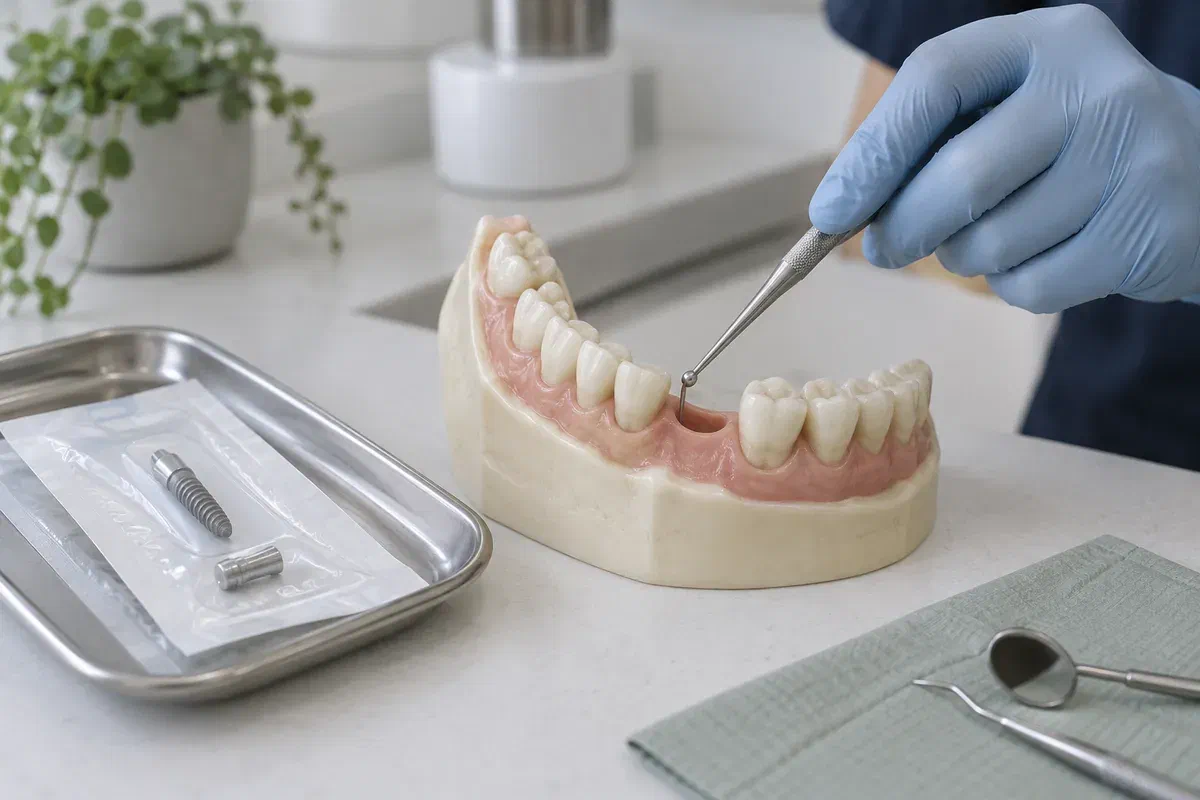
Illustrative discussion of tooth extraction and future replacement planning
Restorative Dentistry

Alveolar Ridge Preservation in Old Milton

When a tooth that has carried old crowns and fillings for decades finally has to go, the site it leaves deserves a plan. Ask about ridge preservation close to Old Milton.

When a long-serving tooth reaches its limit

A tooth with a long history leaves a site with a future.

Some teeth have been repaired so many times that there is little left to rebuild. A crack under an old crown, a root canal that has failed, or decay beneath a large filling can bring you to the point where removal is the sensible choice. What is easy to overlook is the bone that has held that root for years.

After extraction, the empty socket fills in and the jaw ridge above it tends to shrink in width and height. Ridge preservation places graft material in the socket to limit some of that change. Whether it suits your site depends on the tissues around it, your health and the replacement you might want.

Many long-time Old Milton residents have known the same teeth, and the same dental history, for decades. Bring that history with you. Telling us what you would like next, from an implant to a removable tooth or no replacement at all, helps decide whether preservation belongs in the plan.

Plan for the site after removal
Dental study model showing a missing molar space for a ridge-preservation discussion
Questions worth asking now

Before the old tooth comes out, talk about the bone beneath it.

The fresh socket is the moment preservation is usually done, so the subject is best raised in advance. Your dentist can tell you whether the site looks suitable and whether a surgical colleague should weigh in.

You may want an implant one day

Implants need a solid base of bone and healthy gum. Preserving the socket can be part of keeping that possibility realistic, but it is no promise that an implant will work, and later grafting is sometimes still required.

Neighbouring teeth and gum contour

A collapsing ridge can leave a hollow in the gum and less space for a crown, bridge or denture tooth to sit naturally. The tooth's position and the replacement in mind determine how much this would matter.

You need time to choose

Removing a troublesome tooth and picking its replacement do not have to happen together. A conversation first can explain what preservation offers, where it falls short, and how it connects to a step-by-step plan.

If the tooth came out some time ago, the ridge can still be evaluated. Rebuilding a healed site is generally a separate procedure from grafting a fresh socket.

Why some sites are grafted

Holding shape while healing happens.

The graft gives the body a structure to heal around, with the goal of keeping more ridge volume than an untreated socket often retains. It does not replace the tooth, and some natural remodelling of the bone continues regardless.

It is also an added procedure with its own fee, surgical care and recovery. Problems such as the graft becoming exposed, infection or less bone forming than hoped are possible. You should hear clearly why the expected gain at your site outweighs those.

Patient information: AAP — ridge modification

One conversation, two decisions

Discussing the extraction and a possible replacement together keeps the choice about the socket tied to where you want to end up.

Better odds for a natural-looking result

Retaining more bone and gum can help a later replacement blend in. How much it helps depends on your starting anatomy and how the site heals.

A fresh look after healing

Once the area has healed, it is re-examined, and you will learn whether more imaging, treatment or a referral is needed first.

What to expect

Examine, agree, graft, review.

No single technique fits every tooth. Feel free to ask who would do the work, what graft material is suggested, and how removal and any replacement visits would be spaced.

  1. Understand the old tooth

    We look at why the tooth is failing, how the gum is doing and what the X-rays show, including the remains of past dental work. Health conditions, medications, smoking and how you have healed before all factor in.

  2. Settle on a plan

    You hear about the proposed material, likely benefits, other options, fees and recovery before giving consent. Infection, bone loss or a tricky root shape may call for a specialist or a change in sequence.

  3. Remove and graft

    Where appropriate, the tooth is taken out and the cleaned socket receives graft material while the area is numbed. A membrane, covering or stitches may follow, depending on the method and the tissues.

  4. Wait, then recheck

    Review appointments follow the gum and the site's progress. Decisions about an implant or restoration wait for a further assessment, since a healed-looking surface tells you little about the bone below.

Caring for the graft

Gentle habits for the weeks after.

Follow the written directions you are given, because methods differ between procedures. Questions about brushing, rinsing, what to eat or wearing a partial denture are best asked before you leave.

Hands and tongue away

Resist the urge to explore the site. Choose the foods recommended, keep pressure off the area and confirm whether an existing partial or denture should be adjusted or left out for a time.

Rinse and brush as directed

Keep the rest of your mouth clean and use any prescribed rinse as instructed. Check when and how to clean near the graft rather than returning to your usual brushing there straight away.

Keep follow-up appointments

These visits allow the wound to be checked and progress discussed. Report any new discomfort, unusual discharge or difficulty with the instructions before the next stage of treatment.

Weighing the options

Three ways a socket can be handled.

Ask how each route would likely play out for this tooth, including leaving the socket to heal untreated. A full explanation should cover both the first few weeks and what may follow.

Socket left to heal by itself

Unassisted healing

If you and your dentist agree, the site can heal without graft material. The ridge will likely change shape, so ask what that would mean for replacing this particular tooth.

When the socket is suitable

Graft at the time of removal

Placing material straight after extraction may reduce shrinkage. It depends on the site and the overall plan, and an implant would still need separate assessment.

For a ridge that has already resorbed

Augmentation at a later date

If a healed ridge is too narrow or low for the planned restoration, bone augmentation may be discussed. It can be a larger surgery with its own healing time.

Questions from Old Milton

What people ask before an old tooth is removed.

Many of these come up when someone has lived with a problem tooth for years and is ready to deal with it. They are a good starting point for a talk about timing and expectations.

(905) 876-4488
My tooth has a crown and a root canal. Can the socket still be preserved?
Often, yes. What matters is the condition of the socket and surrounding bone once the tooth is removed, not the dental work it carried. Infection or a fractured root can change the approach, which is why an examination comes first.
Does preservation mean I am committing to an implant?
No. Preserving the site helps keep options open but does not lock you into an implant. You could later choose a bridge, a partial denture or no replacement, and an implant would still need its own assessment.
Can my current partial denture be used while the site heals?
Sometimes, but it must not press on the graft. Bring the appliance with you so the clinician can decide whether it needs relining, trimming or a break from wear. Follow the advice given for your site.
Is age a reason not to graft the socket?
Age alone is not usually the deciding factor. General health, medications, how well you heal and what you want for the space matter more. Share your full medical history so the recommendation fits you.
What is the graft actually made of?
Grafts can be donor bone, animal-derived material, synthetic substitutes or your own bone. Ask which one is proposed and why, and raise any medical, personal or religious concerns before agreeing to it.
Will the site need more work before a replacement?
It might. Healing differs from person to person, and some preserved sites still need additional grafting before an implant. Preservation aims to improve the starting point rather than guarantee a set amount of bone.
Near Old Milton

Bring the tooth's story to your first visit.

Our Bronte Street practice is close to Milton's historic downtown. Book before a planned extraction, or bring an existing treatment plan so we can review it with you, examine the site and say whether a specialist should be part of your care.

For concerns after surgery, contact the clinician who treated you. Please phone with urgent problems instead of using an online request.

Visit Milton Dental Clinic
Unit 1, 342 Bronte St. S, Milton, ON L9T 5B7
Get directions Clinic hours
Monday–Thursday
11am–7pm
Friday–Sunday
By appointment only

Areas we serve

  • Milton
  • Oakville
  • Mississauga
  • Georgetown
  • Halton Hills
  • Acton
  • Campbellville
  • Brampton
  • Burlington
  • Puslinch
  • Rockwood
  • Erin
  • Caledon
  • Etobicoke
  • Old Milton
  • Bronte Meadows
  • Timberlea
  • Dorset Park
  • Dempsey
  • Clarke
  • Beaty
  • Coates
  • Harrison
  • Scott
  • Willmott
  • Ford
  • Bowes
  • Cobden
  • Walker
  • Mountain View
  • Milton Heights
  • Hawthorne Village
  • Valley View
  • Fallingbrook
  • Nassagaweya
  • Trafalgar
  • Esquesing
  • Nelson
  • Brookville
  • Moffat
  • Glen Williams
  • Norval
  • Limehouse
  • Stewarttown
  • Ashgrove
  • Hornby
  • Silver Creek
  • Speyside
  • Scotch Block
  • North Oakville
  • River Oaks
  • Glen Abbey
  • West Oak Trails
  • Palermo
  • Bronte Creek
  • College Park
  • Joshua Creek
  • Uptown Core
  • Preserve
  • Iroquois Ridge
  • Lisgar
  • Meadowvale
  • Meadowvale Village
  • Churchill Meadows
  • Erin Mills
  • Central Erin Mills
  • Streetsville
  • East Credit
  • Creditview
  • Heartland
  • Sheridan
  • Mount Pleasant
  • Credit Valley
  • Huttonville
  • Churchville
  • Springbrook
  • Northwest Brampton
  • Bram West
  • Fletcher's Meadow
  • Fletcher's Creek South
  • Alton Village
  • Orchard
  • Millcroft
  • Headon Forest
  • Tansley
  • Brant Hills
  • Tyandaga
  • Kilbride
  • Lowville
  • Aberfoyle
  • Morriston
  • Arkell
  • Hillsburgh
  • Freelton
  • Carlisle
  • Waterdown
  • Flamborough
  • Mountsberg

How can we help?

Milton Dental Clinic

Have a question about your smile? Choose the option that works best for you.

For urgent dental concerns, please call.
Messages are reviewed during clinic hours.