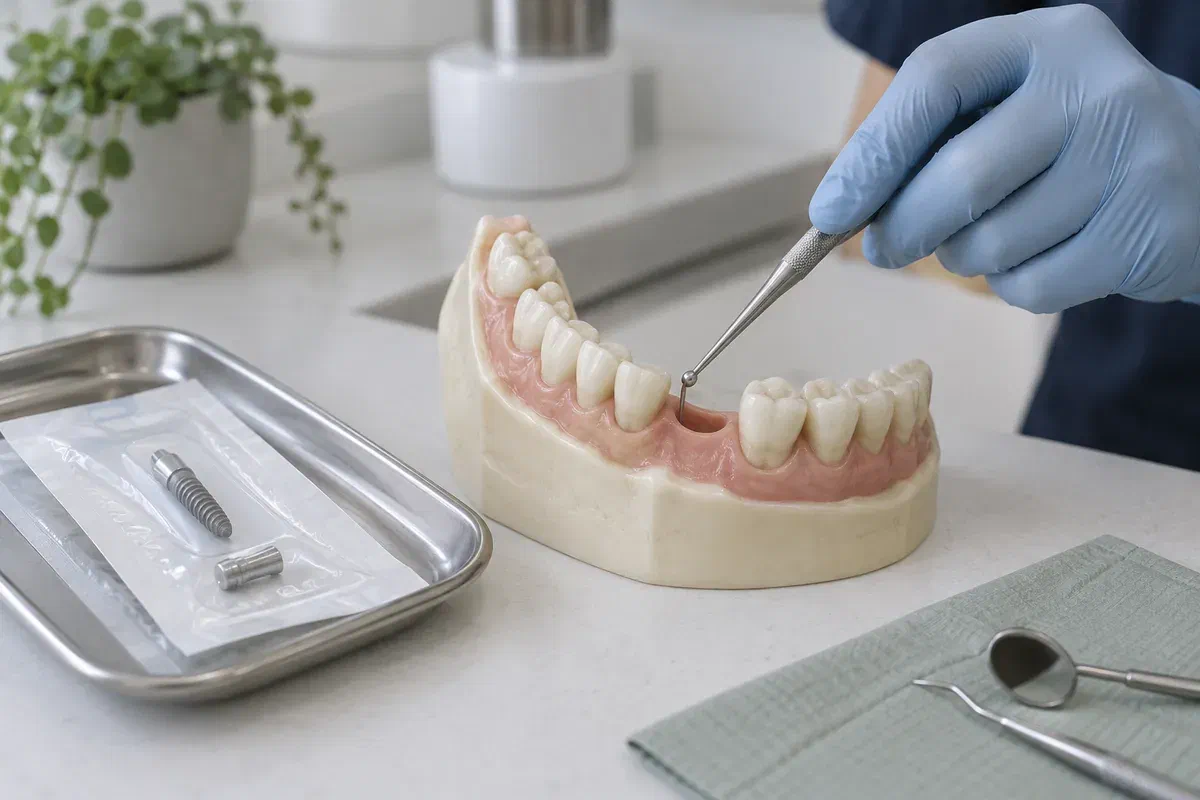
Illustrative discussion of tooth extraction and future replacement planning
Restorative Dentistry

Alveolar Ridge Preservation in Puslinch

Noticed a dip in the gum where a tooth was pulled years ago? If another extraction is coming, people from Puslinch can ask whether preserving the socket this time would help.

Learning from the last extraction

That hollow in your gum has an explanation.

Run your tongue over a spot where a tooth was taken out years ago and you may feel a dip or a narrow edge. That is the alveolar ridge after it has healed without a root. Some loss of width and height is a normal part of socket healing, and it can affect what kind of replacement fits there later.

Ridge preservation is an attempt to limit that change at the moment of extraction by filling the socket with graft material. It is not needed for every tooth. The socket's walls, the gum, your health and the replacement you have in mind decide whether it is worthwhile.

If another tooth now needs to come out, you have a chance to plan differently. From Puslinch, you can book a consultation to compare the old site with the new one, talk about what you would like this time, and learn whether grafting would suit the tooth in question.

Plan this extraction differently
Dental study model showing a missing molar space for a ridge-preservation discussion
Before the next tooth comes out

Ask about the socket while there is still a socket to treat.

Preservation only works in a fresh extraction site. Discussing it ahead of time lets your dentist decide whether the site is suitable and whether a periodontist or oral surgeon should be involved.

This time, you might want an implant

An implant needs enough bone and healthy gum to anchor it. Grafting the fresh socket may help when that is assessed, though it cannot promise an implant will fit, and some sites still need more grafting.


Gum contour you can feel and see

A ridge that flattens can leave a gum dip and less room for a replacement. Its effect depends on where the tooth is and whether you plan a crown, bridge, denture or nothing.

A decision you can make in stages

You do not have to choose a replacement before the tooth comes out. A conversation first explains what preservation may add, what it cannot do, and how it fits a plan built over time.

The older site can be assessed too. Treating a ridge that has already healed usually involves a different procedure from fresh-socket preservation, often with its own healing period.

What grafting tries to change

A different outcome for the new site.

The graft works as a frame inside the socket, giving new bone something to form around so that more of the ridge may be kept. It is not a tooth, and it does not stop every change; some remodelling is still expected.

It is also an extra procedure. There is a fee, surgical care and recovery, and risks such as the graft becoming exposed, infection or less bone developing than intended. Ask why the likely gain at this particular site is worth those.

Patient information: AAP — ridge modification

Extraction with a goal

Talking about the replacement before removal means the socket is treated with an outcome in mind, unlike an extraction done in isolation.

Shape that may support a restoration

Holding onto bone and gum form may help a later replacement sit and look more natural. Anatomy and healing still affect the result.

A check once it heals

After healing, the site is looked at again to see whether more imaging, further care or a specialist opinion should come before replacement.

How we approach it

Plan, preserve, heal, review.

Techniques vary by tooth and tissue. Feel free to ask who will do the procedure, which graft is recommended and how the extraction would connect with any later replacement work.

  1. Compare and examine

    We look at the tooth to be removed and, if you wish, the older healed site, along with gums and imaging. Your health, prescriptions, tobacco use and past healing all inform the plan.

  2. Talk it over

    Before you consent, we explain the proposed graft, what it may do, the alternatives, the fee and the recovery. Infection, bone loss or anatomy may call for a specialist or a revised order of treatment.

  3. Extract and graft

    If appropriate, the tooth is removed with local anaesthetic and graft material fills the socket. A barrier membrane, dressing or a few sutures may protect it, depending on the method.

  4. Follow the healing

    Reviews check the gum and progress. Replacement decisions follow another look at the bone, because a gum that looks healed does not confirm what is underneath.

Recovering well

Different from a simple extraction in a few small ways.

Use your written instructions as the guide, since grafting methods differ. Ask about cleaning, rinses, food or a temporary appliance before you leave if anything is unclear.

Protect the graft

Avoid poking the site with your tongue or fingers. Choose the foods recommended, keep pressure off the area and check whether a partial denture should be adjusted or left out.

Gentle cleaning

Brush and floss elsewhere as normal and use any prescribed rinse the way you were shown. Find out when the area right beside the graft can be cleaned again, rather than returning to your usual routine there immediately.

Return for reviews

Follow-up visits let the clinician check how the site is closing. Mention discomfort that changes, unusual discharge or trouble with the instructions as soon as you notice it.

Choices for the new site

Graft it, let it heal, or rebuild later.

Ask what each approach would likely mean for you, including leaving the socket untreated as before. A clear explanation covers recovery now and the stages that might follow.

As with an ordinary extraction

Healing without help

The socket can heal on its own if that is the plan. Expect some ridge change, similar to what you may have noticed before, and ask how it would affect replacement here.

When the fresh socket suits it

Graft at extraction

Preserving the site during removal may help reduce bone loss. Whether this socket qualifies comes down to its walls, the gum and what you intend to replace it with, and any implant would be evaluated separately later.

For older or narrowed sites

Reconstruction of a healed ridge

If a healed ridge, new or old, is not enough for the planned restoration, augmentation may be discussed. It can be a larger surgery with a separate recovery.

Questions about old and new sites

What people ask after noticing a gum dip.

These questions often come from people who have lost a tooth before and want a different result this time. They help you plan the next extraction with more information.

(905) 876-4488
Why does my gum dip where a tooth was removed years ago?
After extraction, the bone that supported the tooth reshapes as it heals and often loses width and height. The gum follows that change, which can leave a hollow or narrow ridge. It is common and not usually a sign that anything went wrong, but it can matter if you later want an implant or a natural-looking bridge.
Can the old healed site still be treated?
Often, yes, but with a different procedure, such as bone augmentation. Whether it is needed depends on the replacement you want. An assessment, usually with imaging, shows what is possible.
Would both sites be treated at the same appointment?
Sometimes, depending on their location and what each needs. Often they are handled separately. Ask whether combining them is sensible, especially if you want to limit trips from Puslinch.
Is preservation the same as placing an implant?
No. Preservation helps the fresh socket heal with more of its shape. An implant is a separate post placed later to carry a replacement tooth, and it still needs its own assessment. You can preserve a socket and still decide against an implant.
Is a graft used every time a tooth comes out?
No. It depends on the site, your plans for replacement and your health. Ask why grafting is or is not recommended for this tooth and what the difference might be.
Can a preserved socket still end up needing more bone?
Yes. Healing varies, and some sites need more grafting before an implant. Preservation is meant to improve the starting point, not promise a certain amount of bone.
From Puslinch

Plan the next extraction with what you know now.

See us at our Bronte Street practice before your extraction, or bring a recommendation you have received. We will examine the new site and any older ones, explain your choices and tell you whether a specialist should be involved.

Questions after surgery should go to the clinician who treated you. Please call about urgent problems rather than using an online request.

Visit Milton Dental Clinic
Unit 1, 342 Bronte St. S, Milton, ON L9T 5B7
Get directions Clinic hours
Monday–Thursday
11am–7pm
Friday–Sunday
By appointment only

Areas we serve

  • Milton
  • Oakville
  • Mississauga
  • Georgetown
  • Halton Hills
  • Acton
  • Campbellville
  • Brampton
  • Burlington
  • Puslinch
  • Rockwood
  • Erin
  • Caledon
  • Etobicoke
  • Old Milton
  • Bronte Meadows
  • Timberlea
  • Dorset Park
  • Dempsey
  • Clarke
  • Beaty
  • Coates
  • Harrison
  • Scott
  • Willmott
  • Ford
  • Bowes
  • Cobden
  • Walker
  • Mountain View
  • Milton Heights
  • Hawthorne Village
  • Valley View
  • Fallingbrook
  • Nassagaweya
  • Trafalgar
  • Esquesing
  • Nelson
  • Brookville
  • Moffat
  • Glen Williams
  • Norval
  • Limehouse
  • Stewarttown
  • Ashgrove
  • Hornby
  • Silver Creek
  • Speyside
  • Scotch Block
  • North Oakville
  • River Oaks
  • Glen Abbey
  • West Oak Trails
  • Palermo
  • Bronte Creek
  • College Park
  • Joshua Creek
  • Uptown Core
  • Preserve
  • Iroquois Ridge
  • Lisgar
  • Meadowvale
  • Meadowvale Village
  • Churchill Meadows
  • Erin Mills
  • Central Erin Mills
  • Streetsville
  • East Credit
  • Creditview
  • Heartland
  • Sheridan
  • Mount Pleasant
  • Credit Valley
  • Huttonville
  • Churchville
  • Springbrook
  • Northwest Brampton
  • Bram West
  • Fletcher's Meadow
  • Fletcher's Creek South
  • Alton Village
  • Orchard
  • Millcroft
  • Headon Forest
  • Tansley
  • Brant Hills
  • Tyandaga
  • Kilbride
  • Lowville
  • Aberfoyle
  • Morriston
  • Arkell
  • Hillsburgh
  • Freelton
  • Carlisle
  • Waterdown
  • Flamborough
  • Mountsberg

How can we help?

Milton Dental Clinic

Have a question about your smile? Choose the option that works best for you.

For urgent dental concerns, please call.
Messages are reviewed during clinic hours.