An injury you had forgotten
Many quiet pulp problems trace back to trauma. Think back to falls, sports knocks or dental accidents, including events decades ago, and share them with the dentist.


An X-ray at a routine check-up showed a shadow at the tip of a front tooth that has never bothered you. What now? From Acton, understand why a painless tooth may still need root canal care, and how that decision is made.
It is surprising to learn that a comfortable front tooth may have a problem. Each incisor and canine holds pulp, a core of nerves and blood vessels. If that tissue has died or become infected, changes can develop around the root quietly, and root canal treatment may be suggested to keep a tooth that is still restorable.
How does a tooth get there without warning? Sometimes deep decay or a crack was involved; often an injury from long ago quietly damaged the pulp. Because pain and appearance can both be misleading, the recommendation should rest on test results, imaging and a careful examination.
If you are coming from Acton, northwest of Milton, a single well-planned consultation at our Bronte Street practice can give you the full explanation before you commit. Ask about the evidence, and about the visible tooth too: likely colour, where the access filling goes, how much structure remains and what restoration would follow.
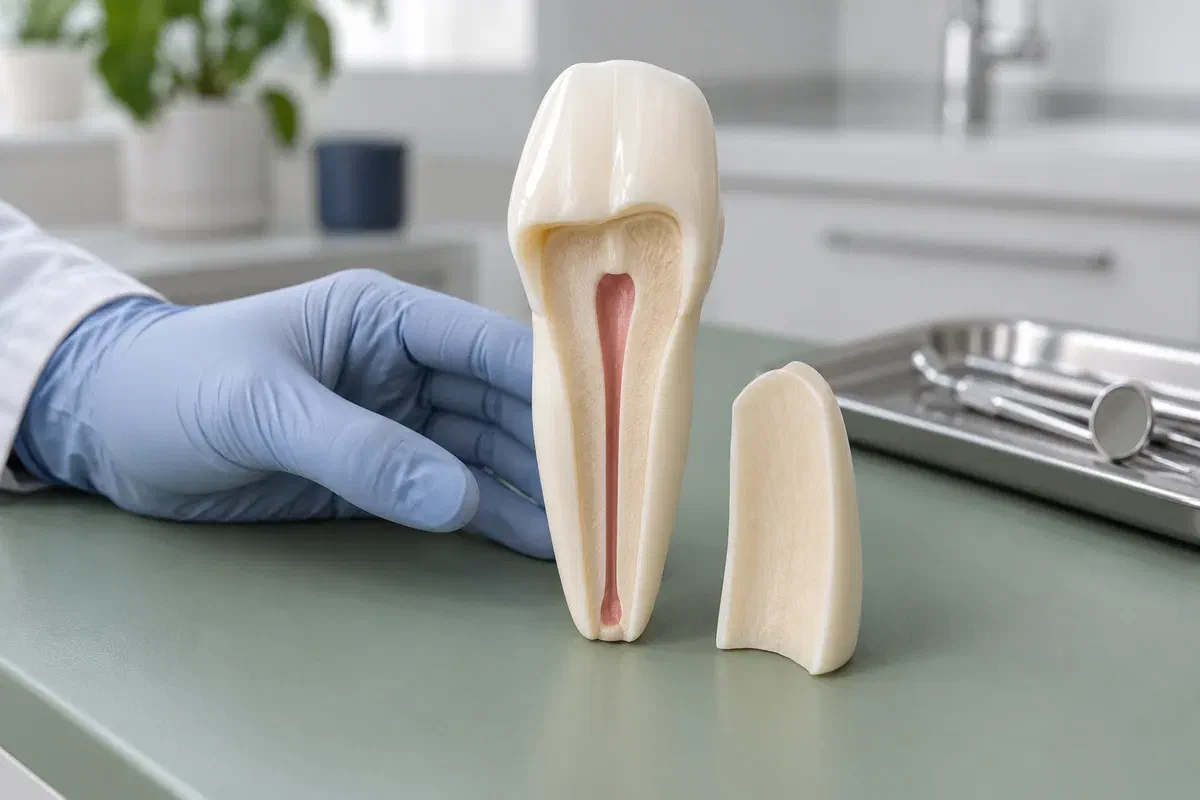
Some pulp problems cause discomfort; others turn up during check-ups. An examination determines whether the pulp is really involved and whether a root canal is the appropriate response.
Many quiet pulp problems trace back to trauma. Think back to falls, sports knocks or dental accidents, including events decades ago, and share them with the dentist.
Even mild, brief discomfort can be useful information. Mention any lingering reaction to temperature, unprompted aching or tenderness when biting, because overlapping conditions need sorting out.
A dark area on an X-ray, a recurring gum bump or a tooth gradually turning grey can all prompt assessment. None alone confirms the diagnosis, and being painless does not show the tissue is healthy.
An adult tooth knocked out entirely needs immediate advice. Call promptly about any recent injury rather than requesting a regular consultation.
Root canal treatment removes the affected pulp, disinfects and shapes the canal, then fills and seals it. In a tooth that can be restored, this addresses the problem inside so the tooth can carry on working once a suitable final restoration is in place.
Success relies on a correct diagnosis, root anatomy, any cracks, the remaining structure and the quality of the final seal. Long-standing trauma can narrow or calcify a canal, and previous treatment adds complexity; an endodontist may be suggested when that would improve planning.
Patient information: AAE — root canal treatment
For a suitable tooth, retaining it means no gap to manage and lets care concentrate on restoring what is already part of your smile.
Colour, shape, the access opening and existing restorations are discussed together, tying the internal treatment to the outcome you will see.
Testing helps tell a pulp problem from a crack, gum disease or a harmless finding, so treatment follows evidence rather than a single image or sensation.
Ask how many visits are likely, whether a temporary filling will be needed and who will place the final restoration. Seeing the full sequence helps you plan trips and keeps the tooth protected throughout.
The dentist reviews your history, examines the tooth and gums and carries out appropriate tests. Imaging is assessed, sometimes compared with earlier X-rays, and restorability is checked before deciding.
Local anaesthetic is used as appropriate, even for a tooth that does not hurt, and a dental dam isolates the area. Ask for a break whenever you need one.
Access is normally gained from the back of the front tooth. The pulp space is cleaned and shaped and then sealed, with a temporary filling between appointments if the work is staged.
The access opening and any weakened areas are restored. Follow-up imaging and examination check healing around the root, and the recommended restoration is explained.
Use the instructions from your dentist or endodontist. A tooth that felt fine before may be tender for a little while, and any temporary filling needs gentle handling until the final restoration is placed.
Avoid biting into very hard foods or tearing packaging with a temporarily filled front tooth. Ask what you can chew and when it is safe to resume normally.
Keep your recommended routine going and be careful around tender gum. Let the team know if the temporary loosens, breaks or comes out.
Root canal care and the final restoration are linked but separate. Arrange the restoration and later reviews so the opening is sealed and healing can be tracked on imaging.
Comfort and appearance are both fair topics, and so is asking to see the images. The root, the visible tooth and any old injury guide the recommendation.
Bring your X-ray questions, an old injury or a tooth that just seems different to our Bronte Street practice. We will review the evidence with you, explain whether root canal care is warranted, and outline the restoration or referral that would complete it.
For a new injury, sharp pain or swelling, phone the clinic promptly. Online requests are for non-urgent appointments.
