

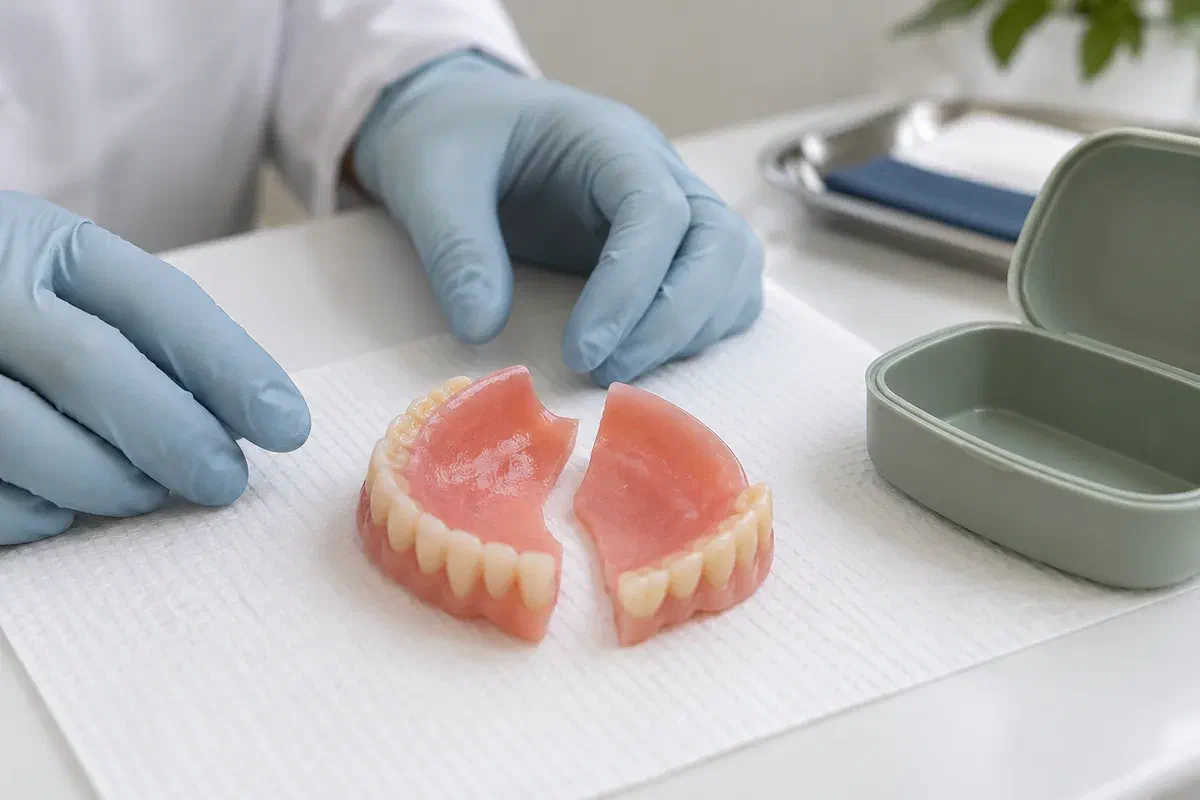
Illustrative consultation about restoring the use of a damaged denture
Restorative Dentistry

Broken Denture Repair in Old Milton

A denture you have worn for years can break without warning. For anyone in Old Milton, our nearby team can examine the damage, see how well the appliance still suits your mouth, and help you decide what comes next.

An old friend in pieces

Is a long-worn denture still worth mending?

That is often the first thing people wonder when a familiar denture finally gives way. Maybe it slipped from your hand while cleaning, or a tooth popped off at dinner. You know how it felt and how you chewed with it, and starting over can seem like a lot.

The honest answer depends on why it broke. An appliance that has served well and cracked once in a fall is a different case from one that keeps fracturing along the same line. Years of wear on the teeth, gradual changes in the ridge beneath, and shifts in how your bite meets can all mean a repair only treats the surface problem.

Phone us first and describe what happened, rather than putting it back in or attempting a fix. For many people around Old Milton, that call is the easy part. Collect every fragment, the stray tooth too, and store them side by side in a small container. The original pieces tell the clinician a great deal and make an honest comparison of repair and replacement possible.

Talk to us about your denture
A broken acrylic denture placed in matching pieces for professional assessment
What kind of break is it?

Age, material and fit all play a part.

Our advice depends on what the denture is made of, how much is damaged and how it has held up overall. Part of the visit is judging whether it still sits in your mouth well enough to be worth repairing.

A fracture across the plate

When the acrylic plate cracks or splits, a repair is often possible if the pieces fit back together precisely. The clinician also considers whether the fracture came from an accident or from an ongoing fit or pressure issue.

A missing artificial tooth

One tooth can come loose while the plate stays intact. Its location, its condition and the state of the surrounding acrylic help decide whether to reattach it or fit a replacement.

Damage to a partial’s metalwork

When a clasp snaps or the metal frame of a partial cracks, the appliance can start to shift. These repairs work differently from acrylic repairs and may involve a lab or a fresh look at how the partial is designed.

Resist the urge to glue, bend or file anything. Even careful home repairs can throw off the fit, weaken the material and complicate the work a professional repair needs.

The case for a proper repair

Sometimes the familiar denture is the right one to keep.

Provided the remainder of the appliance holds up, a repair can fix the specific damage and spare you the process of having an entirely new denture made. The clinician judges how accurately the parts can be reunited and whether the result will sit and work as it should.

Still, no repair can turn back years of change. Flattened teeth, a loose fit or repeated cracking may suggest a reline, a rebase or a new denture instead. It helps to ask two questions: can the parts be joined, and will the joined denture actually serve you well?

Patient information: ADA — caring for partial dentures

A look at fit as well as the fracture

Checking your gums and bite alongside the appliance can reveal sore patches or instability likely to cause problems after the break is mended.

Clarity about what repair solves

You come away knowing which issues the repair will fix and which ones will remain, making it simpler to weigh up a new denture.

Ways to avoid a repeat

Guidance on handling, cleaning and storage can protect the appliance. If it gave way during chewing, the review also looks for causes other than an accidental drop.

Step by step

From the first look to the final fitting.

Repair timing varies with the type of damage, the material, whether a lab is needed and our appointment schedule. If going without your teeth makes meals or conversation hard, say so early and we’ll factor that in.

  1. Examine the damage

    Bring the appliance, any loose parts and details of earlier repairs if you have them. The clinician studies the material and the fracture line, then wants to know whether it fell or failed while you were wearing it.

  2. Check the mouth it serves

    Your gums, any remaining natural teeth and the opposing bite are examined. An impression or other record may be needed so the repair matches your mouth accurately.

  3. Make the repair

    Depending on what you agree, the work may rejoin the plate, replace a tooth or deal with a component. Where lab work is involved, you’ll be told roughly when the denture should be ready.

  4. Try it in together

    The repaired appliance is checked for fit, hold, bite and sharp spots. Tell the clinician about any pressure or movement, and come back for any suggested review rather than adjusting it at home.

Once it’s back in your mouth

A few habits that help a repair last.

Follow the instructions given for your particular denture. Discomfort or wobbling that carries on is worth mentioning; don’t assume it will settle by itself.

Give it a soft landing

Lay a towel in the sink, or run a little water into the basin, before you start cleaning; a dropped denture then has something to land on. Pick cleaning products made for your appliance and skip very hot water, which can warp some dentures.

Clean what supports it

Care for your gums and any natural teeth as well as the denture itself. Ask whether it should come out overnight and how it should be stored.

Report a sore patch that stays

Get in touch if the repaired appliance keeps pressing in one spot or rocks. Adding adhesive isn’t a replacement for checking a denture that no longer fits.

Weighing the options

Mend it, support it better, or begin again.

For a denture with plenty of useful life left, repair is often reasonable. Ask how the clinician rates its general condition, and what would make another treatment the wiser pick.

For contained damage

Repair what you already wear

A tidy fracture or a lost tooth may be fixed if the remaining appliance is still serviceable. What it’s made of, whether any fragment is missing and how it sits now all shape the outcome.

When the gums have changed

Pair the repair with a reline

Refitting the underside, where the denture meets your gums, may be recommended as well. That targets a different issue from rejoining pieces, so it deserves its own explanation.

When age has caught up with it

Choose a new denture

Significant wear, repeated breaks, an outdated design or widespread damage can make a replacement more sensible. Ask about the appointments, interim arrangements and what getting used to a new denture involves.

Your questions, answered

Common concerns about an older, broken denture.

Tell us what has broken and whether you can safely go without the denture for now. The visit helps separate what needs quick attention from the type of repair the appliance can take.

(905) 876-4488
My denture is many years old. Is repairing it still sensible?
It can be, if the base is sound and the fit is still good. Age by itself doesn’t decide it. The clinician looks at tooth wear, the way it sits and any history of breaks before suggesting repair, a reline or a new appliance.
Will the repaired section look different from the rest of the denture?
The aim is a repair that blends in reasonably well, but older acrylic may have changed colour over time. Ask the clinician how closely a repair or replacement tooth is likely to match your existing denture.
Is a broken partial denture harder to fix than a full one?
Sometimes the work is more involved, especially if metal clasps or framework are damaged. Those parts affect how the partial grips your natural teeth, so the repair may need lab work or a review of the design.
Can adhesive hold a cracked denture together until my visit?
No. Denture adhesive is meant to help a sound denture stay in place, not to hold broken parts together. Keep the pieces safe in a container and call for advice about managing until your appointment.
How should I store the broken pieces before my appointment?
Place them together in a clean, closed container so nothing gets lost or chipped further. Follow any storage advice you were given for your denture’s material, and avoid hot water. Bring everything, including any tooth that came loose.
Is there a way to tell whether my denture has stopped fitting?
Possible signs include rocking, needing more adhesive, food catching underneath, or new sore spots. Many people notice these changes gradually. The clinician can check how the base meets your gums and explain whether fit is part of the problem.
Old Milton denture repair

Close to home, and here to help.

From Milton’s historic downtown, get in touch with our Bronte Street practice about a cracked plate, a missing tooth or a damaged clasp. Pack the denture with all its pieces, and we’ll look at what can be mended, how it fits and how long the work is likely to take.

If the appliance is rubbing your gums raw or going without it isn’t workable, call rather than book online. When the repair can be done will depend on what we find and on scheduling.

Visit Milton Dental Clinic
Unit 1, 342 Bronte St. S, Milton, ON L9T 5B7
Get directions Clinic hours
Monday–Thursday
11am–7pm
Friday–Sunday
By appointment only

Areas we serve

  • Milton
  • Oakville
  • Mississauga
  • Georgetown
  • Halton Hills
  • Acton
  • Campbellville
  • Brampton
  • Burlington
  • Puslinch
  • Rockwood
  • Erin
  • Caledon
  • Etobicoke
  • Old Milton
  • Bronte Meadows
  • Timberlea
  • Dorset Park
  • Dempsey
  • Clarke
  • Beaty
  • Coates
  • Harrison
  • Scott
  • Willmott
  • Ford
  • Bowes
  • Cobden
  • Walker
  • Mountain View
  • Milton Heights
  • Hawthorne Village
  • Valley View
  • Fallingbrook
  • Nassagaweya
  • Trafalgar
  • Esquesing
  • Nelson
  • Brookville
  • Moffat
  • Glen Williams
  • Norval
  • Limehouse
  • Stewarttown
  • Ashgrove
  • Hornby
  • Silver Creek
  • Speyside
  • Scotch Block
  • North Oakville
  • River Oaks
  • Glen Abbey
  • West Oak Trails
  • Palermo
  • Bronte Creek
  • College Park
  • Joshua Creek
  • Uptown Core
  • Preserve
  • Iroquois Ridge
  • Lisgar
  • Meadowvale
  • Meadowvale Village
  • Churchill Meadows
  • Erin Mills
  • Central Erin Mills
  • Streetsville
  • East Credit
  • Creditview
  • Heartland
  • Sheridan
  • Mount Pleasant
  • Credit Valley
  • Huttonville
  • Churchville
  • Springbrook
  • Northwest Brampton
  • Bram West
  • Fletcher's Meadow
  • Fletcher's Creek South
  • Alton Village
  • Orchard
  • Millcroft
  • Headon Forest
  • Tansley
  • Brant Hills
  • Tyandaga
  • Kilbride
  • Lowville
  • Aberfoyle
  • Morriston
  • Arkell
  • Hillsburgh
  • Freelton
  • Carlisle
  • Waterdown
  • Flamborough
  • Mountsberg

How can we help?

Milton Dental Clinic

Have a question about your smile? Choose the option that works best for you.

For urgent dental concerns, please call.
Messages are reviewed during clinic hours.