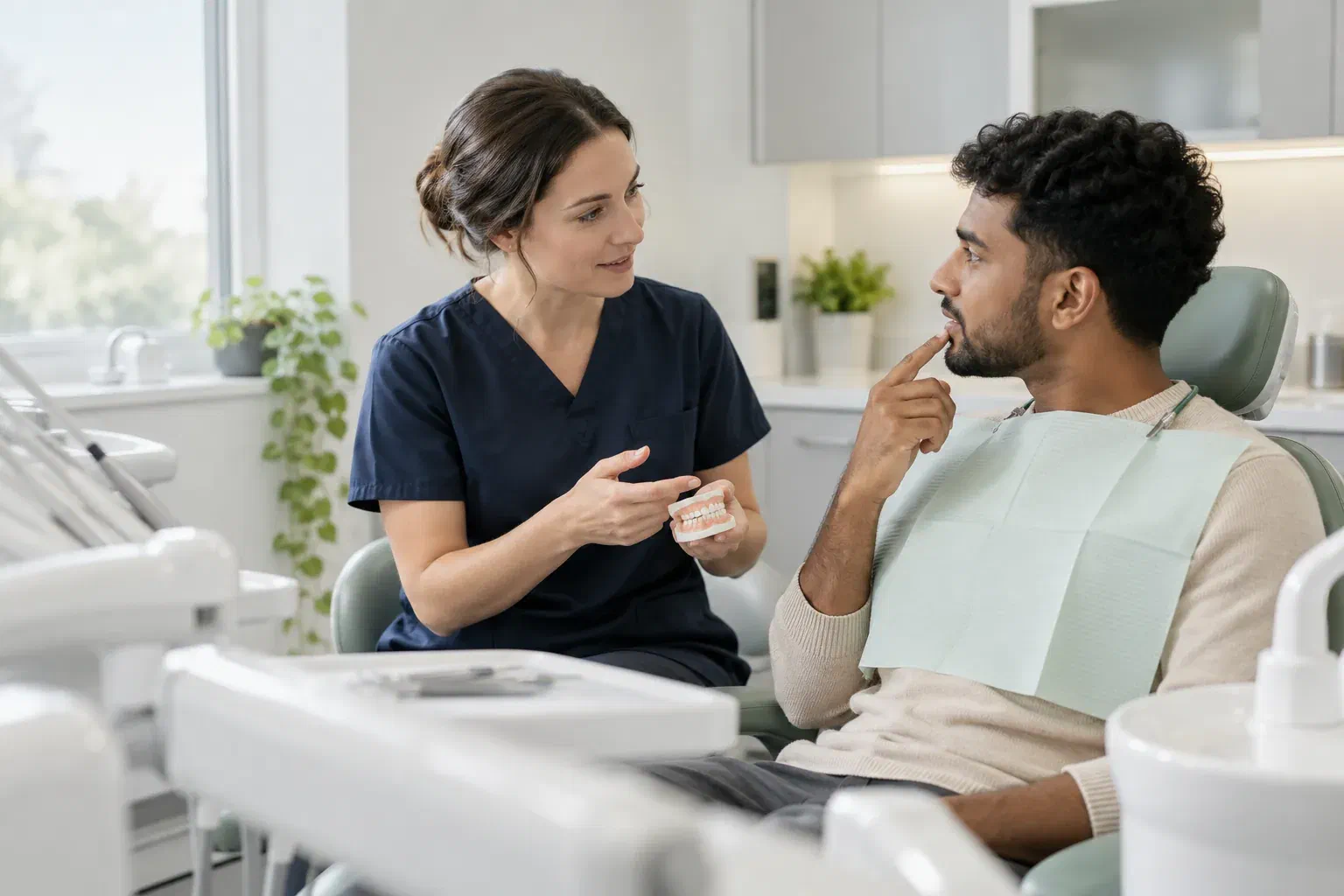
Illustrative conversation about assessing a recently broken tooth
Restorative Dentistry

Broken Tooth Repair in Milton

A piece of tooth can come away at dinner with barely a twinge. Have it looked at in Milton so the dentist can judge how deep the break goes and which repair the remaining tooth can hold.

A quiet break is still a break

No pain does not mean no problem.

Many people find a broken tooth with their tongue first: a rough corner, a gap where a cusp used to be, a hard crumb that turns out to be enamel. Because it often doesn’t hurt, the instinct is to leave it. But what you feel is only the edge of the damage. The crack beneath, the root and the nerve all need a proper look.

Once the dentist knows how far the fracture runs, the options get clearer. A shallow chip may be rebuilt with bonded composite, and occasionally the original piece can go back on. Deeper damage might call for a restoration that covers the tooth, care for the pulp, or a frank talk about whether it can be saved.

For anyone in Milton, the simplest first step is a call to our Bronte Street practice. Tell us when it happened and whether you notice pain, swelling, looseness or a bite that feels different. Those details decide how soon you should come in, so don’t assume a comfortable break can wait.

Book a check for your broken tooth
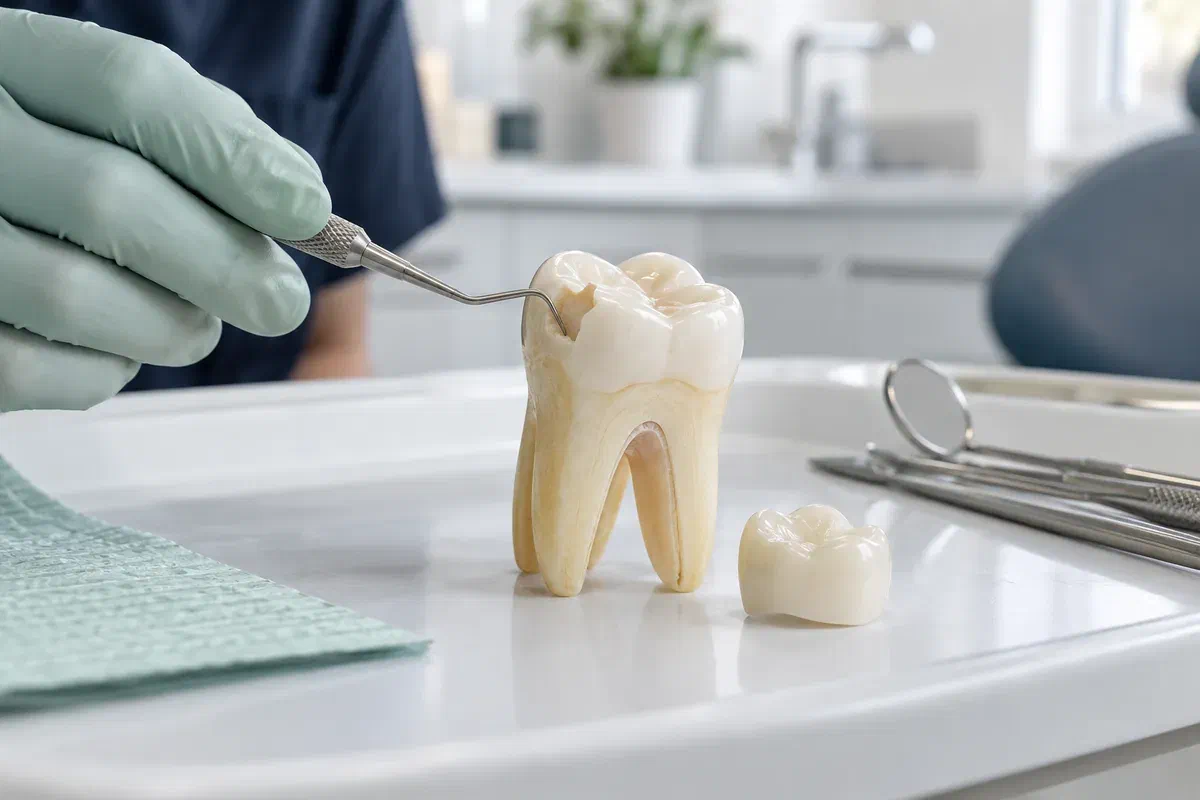
An educational molar model with a broken cusp beside a ceramic crown
Clues the dentist weighs

How a tooth breaks says as much as how much is missing.

A tiny chip can uncover a layer that reacts to cold, while a big fracture can feel oddly calm. Depth, position, the walls left standing and any sign of injury or infection are read together.

A cusp that snapped off a molar

Back teeth with large fillings or thin walls can lose a corner during chewing. The dentist checks whether what remains can hold a repair, and whether the fracture line runs further than you can see.

Damage from a knock or fall

An impact rarely affects one tooth only. Neighbouring teeth and the gums can be involved too, so tell us how it happened and whether anything feels loose, your teeth meet differently, or your lip was cut.

New aching, sensitivity or puffiness

Symptoms point to the tissues that need attention. Say whether a twinge fades quickly or hangs on, whether chewing sets it off, and whether swelling or a bad taste has appeared since.

Found the broken piece? Put it in a small container with milk, or with some of your own saliva, and bring it along. Leave it unscrubbed, and don’t try to stick it back on at home.

Why it helps not to wait

Keep the healthy tooth, and plan the repair around it.

A well-chosen repair can rebuild the damaged surface and make the tooth comfortable to chew with again. An early visit also brings to light what a quick cosmetic fix would miss, such as a deeper crack, decay under an old filling, or an affected nerve.

No repair can promise that a badly broken tooth will last forever. The outlook depends on the fracture and the tissue still present. Ask whether the suggested care is the final step, a temporary measure, or one stage of a longer effort to keep the tooth.

Patient information: NHS — chipped, broken or cracked teeth

A smoother, less irritating surface

Covering a sharp, exposed area can protect it and stop it rubbing your tongue. The right measure depends on the examination, and it doesn’t replace treating an infection underneath.

A repair sized to what is left

The material follows what the tooth can genuinely support. Quick placement or a close colour match with nearby enamel are not reasons on their own to choose it.

Thinking about the next break

Where relevant, we can talk about other heavily filled teeth, grinding, or protection for sport. Knowing why the tooth broke helps guide how you look after it.

What happens when you come in

Four steps, from your call to a finished tooth

Your first visit may be about working out what is wrong and handling anything urgent. Ask what can be done that day, what needs a return visit, and how to protect the tooth meanwhile.

  1. Tell us the story

    Share when the tooth broke, whether you were hit or simply biting, and what you’ve felt since. Bring the fragment and mention earlier root canal work or big fillings in that tooth.

  2. A close look at what remains

    The dentist checks the fracture, your bite, the gums, and how the nerve responds where appropriate. X-rays or other tests may be needed for things that can’t be seen by eye.

  3. Protect it and weigh the choices

    A temporary cover may be placed while the longer-term plan is decided. Go over the benefits, limits, fees and alternatives before you settle on a restoration.

  4. Complete the work and follow up

    The chosen treatment is carried out or arranged with other care. Your bite is checked, and you’ll hear what follow-up is needed, especially after trauma, deep damage or doubt about the nerve.

Looking after it at home

What you can eat depends on where you are in treatment

A tooth with a temporary cover and one with its final restoration need slightly different care. Follow the instructions given for that tooth, and phone if anything loosens or feels different.

Chew on the other side for now

Until we say it’s fine, keep hard or sticky foods away from the damaged tooth. Try not to keep biting on it to see whether it, or the temporary material, will hold.

Keep brushing, gently

Carry on brushing and cleaning between teeth, going softly around anything tender. If a sharp edge makes that awkward, ask us how to manage it instead of skipping the area.

Return for the final step

A temporary repair can feel fine long before treatment is finished. Keep your appointment for the permanent restoration, nerve check or referral so the tooth isn’t left halfway.

Matching repair to damage

Shallow, moderate or deep: each break points to different care.

Ask the dentist to show where the damage ends and which parts of the tooth are still sound. That explains why one broken tooth needs a quick repair while another needs more.

Small, contained breaks

Reattaching the piece or bonding

An available fragment can sometimes be bonded back on, or composite can rebuild the missing part. The break surface, keeping the area dry, the tooth left and your bite all affect suitability.

When the walls need protecting

Onlay or crown coverage

If a filling alone would leave the remaining tooth open to further breaks, an onlay or crown may be suggested. It rests on how much is missing and how hard that tooth works.

Breaks that reach deeper

Nerve treatment, or a different route

A rebuildable tooth with an affected nerve may need root canal treatment first. If the fracture rules out a reliable repair, removal and replacement may become part of the conversation.

Broken tooth questions

Answers for the first few days after a break

Every break is different, so good advice starts with what happened. Get in touch, describe the injury and how it feels, and the team will help you book a suitable appointment.

(905) 876-4488
My tooth chipped but it feels completely normal. Is a check really needed?
It is worth it. Feeling fine tells you nothing about how deep the crack goes or whether the rest of the tooth is stable. Book an assessment so the dentist can look and advise on timing instead of leaving it to symptoms.
What should I do with a piece of tooth I found?
Keep it moist in a little milk or your own saliva and bring it with you. Sometimes it can be bonded back on, depending on its condition and the shape of the break. Don’t let it dry out or try any home glue.
Is a break more likely in a tooth that already has a big filling?
Large fillings can leave thinner walls, which may make a corner more likely to give way. Still, a filling doesn’t automatically explain a break. The dentist checks the filling, the remaining walls, and for decay or a deeper crack.
Can the dentist tell straight away whether my tooth can be saved?
Often there is a good indication at the first visit, but sometimes X-rays, testing or a period of watching are needed. It depends on what is left, the root, the gums and the nerve. Ask which finding the decision hinges on.
Can I eat normally before my repair appointment?
Favour soft foods and chew on the opposite side. Avoid hard or sticky foods on the broken tooth, and don’t test it by biting down. Call if eating becomes painful or the area starts to swell.
I work long days in Milton. Can a broken tooth be fixed in one visit?
A small break sometimes can. Larger repairs, crowns or nerve treatment usually take more than one appointment. We’re open Monday to Thursday, 11 to 7, with Friday to Sunday by appointment, so ask what fits once the dentist knows what’s needed.
Broken teeth, seen in Milton

Bring the tooth, and the piece if you have it.

Call our Bronte Street clinic about a tooth that has fractured or lost a piece. Tell us how it feels and bring any fragment, so we can check the damage, talk through a suitable repair and plan anything further.

For a fresh injury, strong pain or swelling, please phone rather than booking online. Online requests aren’t monitored around the clock for emergencies.

Visit Milton Dental Clinic
Unit 1, 342 Bronte St. S, Milton, ON L9T 5B7
Get directions Clinic hours
Monday–Thursday
11am–7pm
Friday–Sunday
By appointment only

Areas we serve

  • Milton
  • Oakville
  • Mississauga
  • Georgetown
  • Halton Hills
  • Acton
  • Campbellville
  • Brampton
  • Burlington
  • Puslinch
  • Rockwood
  • Erin
  • Caledon
  • Etobicoke
  • Old Milton
  • Bronte Meadows
  • Timberlea
  • Dorset Park
  • Dempsey
  • Clarke
  • Beaty
  • Coates
  • Harrison
  • Scott
  • Willmott
  • Ford
  • Bowes
  • Cobden
  • Walker
  • Mountain View
  • Milton Heights
  • Hawthorne Village
  • Valley View
  • Fallingbrook
  • Nassagaweya
  • Trafalgar
  • Esquesing
  • Nelson
  • Brookville
  • Moffat
  • Glen Williams
  • Norval
  • Limehouse
  • Stewarttown
  • Ashgrove
  • Hornby
  • Silver Creek
  • Speyside
  • Scotch Block
  • North Oakville
  • River Oaks
  • Glen Abbey
  • West Oak Trails
  • Palermo
  • Bronte Creek
  • College Park
  • Joshua Creek
  • Uptown Core
  • Preserve
  • Iroquois Ridge
  • Lisgar
  • Meadowvale
  • Meadowvale Village
  • Churchill Meadows
  • Erin Mills
  • Central Erin Mills
  • Streetsville
  • East Credit
  • Creditview
  • Heartland
  • Sheridan
  • Mount Pleasant
  • Credit Valley
  • Huttonville
  • Churchville
  • Springbrook
  • Northwest Brampton
  • Bram West
  • Fletcher's Meadow
  • Fletcher's Creek South
  • Alton Village
  • Orchard
  • Millcroft
  • Headon Forest
  • Tansley
  • Brant Hills
  • Tyandaga
  • Kilbride
  • Lowville
  • Aberfoyle
  • Morriston
  • Arkell
  • Hillsburgh
  • Freelton
  • Carlisle
  • Waterdown
  • Flamborough
  • Mountsberg

How can we help?

Milton Dental Clinic

Have a question about your smile? Choose the option that works best for you.

For urgent dental concerns, please call.
Messages are reviewed during clinic hours.