Illustrative dental consultation with a patient discussing her care
Restorative Dentistry

Composite Fillings in Old Milton

Many mouths carry fillings placed decades ago. For people in Old Milton, we look at how those repairs are holding up and explain when a tooth-coloured composite makes sense and when leaving well alone is wiser.

Fillings with a history

Is it time to redo that old repair?

Plenty of adults have a filling they barely remember getting. Most of the time it simply keeps working. Now and then, though, an edge wears, a small piece breaks, or new decay starts beside it, and the question becomes whether to repair, replace or watch.

Composite is one answer. It is a resin in shades that resemble natural enamel, bonded to the prepared tooth and shaped in place, so it can rebuild a damaged area without the grey of older metal. That does not make it the automatic choice; an X-ray and close examination show whether the existing work is still sound.

Around Milton’s historic downtown, long-time residents and recent arrivals ask us the same thing: what is actually wrong, and does it need fixing now? That is where we begin.

Have an older filling checked
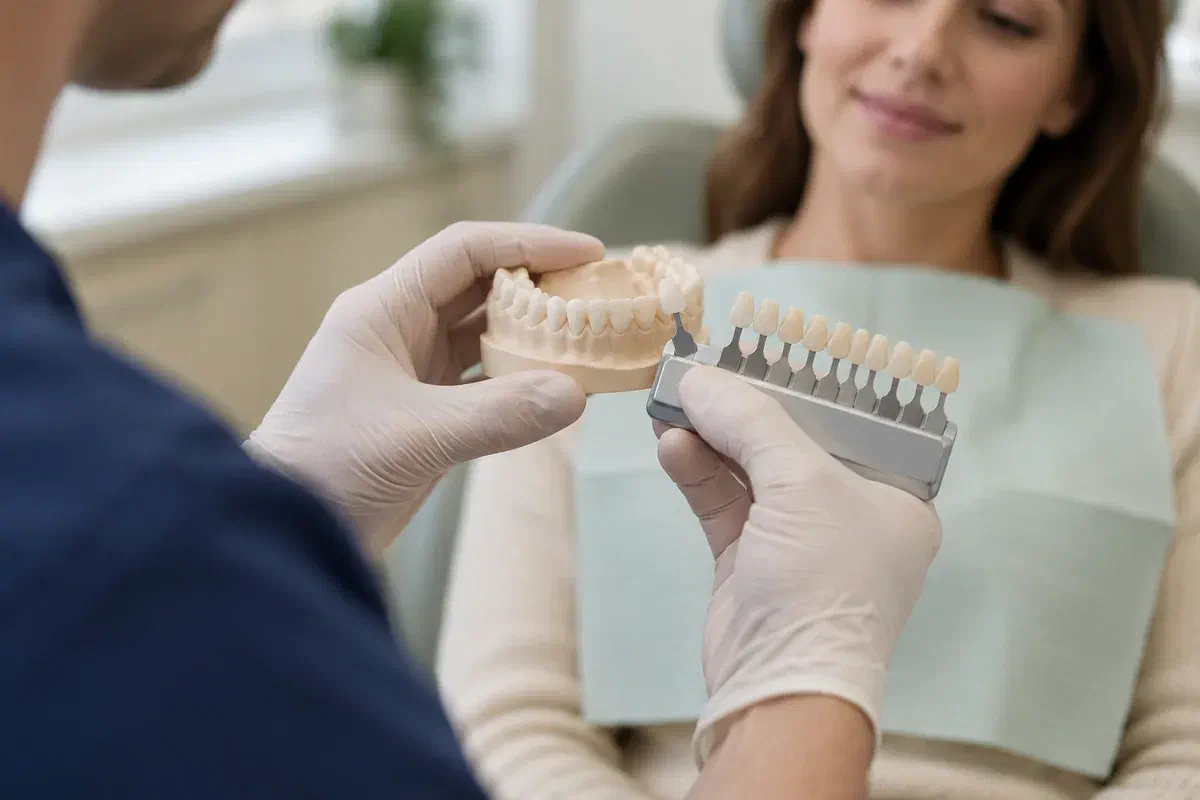
A dental model and shade guide illustrating tooth-colour selection
Reasons to look again

Not every change means trouble

A filling might be suggested for new decay, a break, or a problem at the margin of earlier work. The exam also confirms whether enough healthy tooth remains to anchor a direct repair.

New decay, old tooth

Cavities can develop next to or under an earlier filling, often without pain. If decay is found, the affected area is cleaned out and rebuilt.


A piece that has broken off

Teeth with large older fillings sometimes chip at the edges. Whether composite is enough depends on the size of the break, the bite pressure on that tooth and any crack below the surface.

A margin that has worn

A gap you can feel with your tongue, or staining along the border of a filling, should be examined. It may call for a small repair, a full replacement, or simply monitoring at future visits.

Sensitivity alone is not proof that a filling has failed. Notice what triggers it and how long it lingers; those details help the dentist find the cause.

Why patients choose it

A repair in your own tooth colour

People often ask for composite when a tooth is visible, since the shade can be matched to the enamel around it. It is also used for carefully selected cavities on molars and premolars, as long as the filling’s size and the pressure of chewing are taken into account.

It is not suited to every situation. Bonding needs a dry working field, and a sizeable or high-stress restoration may do better with another option. What works well on one tooth can be the wrong call for the tooth next to it.

Patient information: ADA — tooth-coloured fillings · FDA — filling materials

Colour selected tooth by tooth

The goal is a filling that sits comfortably beside your own enamel, not a single stock shade.

Conserving natural structure

Bonding can let the dentist keep more of the healthy tooth intact, depending on its condition.

Commonly done in one appointment

A direct filling can often be placed in a single treatment visit, while the exam or other care may be scheduled apart.

In the chair

Four stages, start to finish

It can help to know the sequence ahead of time. Let us know if you feel uneasy or want to stop for a moment, and ask questions whenever they come up.

  1. Assess what is there

    We listen to your concern and examine the tooth and any earlier work on it. X-rays may be advised if they would clarify decay or the condition of nearby structures. Before treatment, you can discuss the plan, the alternatives and the expected fee.

  2. Numb and clean out

    A local anaesthetic may be offered to numb the tooth. Old material or decay is removed as needed, and the area is kept dry so the new composite bonds well.

  3. Rebuild in layers

    Composite is added and shaped a layer at a time, with a blue curing light hardening each one. The dentist recreates the tooth’s natural form and how it meets its neighbour.

  4. Fine-tune the result

    After polishing, your bite is checked and adjusted where needed. There is time to ask about chewing, cleaning, or any part of the tooth that feels new to you.

Once you are home

Simple steps for the first days

Follow the advice you were given for your tooth. If anything seems wrong, call us; you do not have to wait for your next cleaning.

Hold off while numb

Skip chewing until sensation comes back, and sip hot drinks cautiously so you do not bite or scald your lip, tongue or cheek without noticing.

Check how teeth meet

Brief sensitivity is possible. Call if discomfort is increasing, sensitivity is not easing, or the treated tooth feels as though it hits first.

Keep the routine going

Twice-daily brushing with fluoride toothpaste and daily cleaning between teeth still matter. Decay can begin again at the edges of any filling.

Patient information: Cleveland Clinic — dental fillings

Repair, replace or rebuild

When composite isn’t the whole answer

A good recommendation explains its purpose. Ask what each option would do for the tooth and what the alternatives involve, so the choice rests on the tooth’s condition.

For a suitable direct filling

Composite or another material

Position in the mouth, how well the area stays dry, the size of the repair and bite pressure all affect which material fits. Talk through the trade-offs before you decide.

When the tooth is weakened

Crown or onlay

Teeth that have been filled several times may have little original structure left. In that case, a crown or partial-coverage restoration can give support that a filling cannot.

When the nerve is inflamed or infected

Root canal therapy

If the pulp is infected, a filling alone will not resolve it. Root canal treatment and an appropriate final restoration may then be discussed.

Patient information: ADA — crowns · ADA — root canals

What people ask us

Straight answers about older fillings

No question is too basic. If you cannot quite describe the problem, start with what you have seen or felt.

(905) 876-4488
Should I swap my silver fillings for composite?
Not just for the sake of it. A sound amalgam filling with no decay underneath may be best left in place, since removing it takes away some healthy tooth as well. If a specific filling worries you, ask the dentist to look at it and explain the trade-offs.
Can one part of an old filling be repaired instead of redone?
Sometimes. If only a small edge is worn or chipped and the rest is sound, a limited repair may be possible. The dentist will check what the examination and X-rays show before suggesting it.
Is a dark line beside a filling always decay?
No. Staining at the border can be surface discolouration, while in other cases it signals leakage or a new cavity. An examination, sometimes with X-rays, helps tell the difference.
How many fillings can be done in one appointment?
It depends on where the teeth are, how much work each needs and what is comfortable for you. Several small fillings on the same side are sometimes grouped; larger repairs may be spread out. Ask what would be practical.
Is there a way to make the visit easier on my nerves?
Let us know when you book. We can walk through each step beforehand, agree on a hand signal for a break, and hear about anything from past visits that made treatment harder for you.
Can I come in from Old Milton just for an opinion?
Yes. An assessment is a reasonable first step if you are unsure. Mention what you have noticed, such as a rough edge, food trapping or a missing piece, and we will explain what we find and what the options are.

Patient information: CDA — tooth-coloured fillings · FDA — existing amalgam fillings

Old Milton smiles

Start with an honest look at the tooth.

Bring a question about a worn filling, a new cavity or a chipped edge from Old Milton to our Bronte Street practice. We will assess first and explain the choices plainly.

If pain or swelling is significant, please phone. Online booking is meant for non-urgent requests.

Visit Milton Dental Clinic
Unit 1, 342 Bronte St. S, Milton, ON L9T 5B7
Get directions Clinic hours
Monday–Thursday
11am–7pm
Friday–Sunday
By appointment only

Areas we serve

  • Milton
  • Oakville
  • Mississauga
  • Georgetown
  • Halton Hills
  • Acton
  • Campbellville
  • Brampton
  • Burlington
  • Puslinch
  • Rockwood
  • Erin
  • Caledon
  • Etobicoke
  • Old Milton
  • Bronte Meadows
  • Timberlea
  • Dorset Park
  • Dempsey
  • Clarke
  • Beaty
  • Coates
  • Harrison
  • Scott
  • Willmott
  • Ford
  • Bowes
  • Cobden
  • Walker
  • Mountain View
  • Milton Heights
  • Hawthorne Village
  • Valley View
  • Fallingbrook
  • Nassagaweya
  • Trafalgar
  • Esquesing
  • Nelson
  • Brookville
  • Moffat
  • Glen Williams
  • Norval
  • Limehouse
  • Stewarttown
  • Ashgrove
  • Hornby
  • Silver Creek
  • Speyside
  • Scotch Block
  • North Oakville
  • River Oaks
  • Glen Abbey
  • West Oak Trails
  • Palermo
  • Bronte Creek
  • College Park
  • Joshua Creek
  • Uptown Core
  • Preserve
  • Iroquois Ridge
  • Lisgar
  • Meadowvale
  • Meadowvale Village
  • Churchill Meadows
  • Erin Mills
  • Central Erin Mills
  • Streetsville
  • East Credit
  • Creditview
  • Heartland
  • Sheridan
  • Mount Pleasant
  • Credit Valley
  • Huttonville
  • Churchville
  • Springbrook
  • Northwest Brampton
  • Bram West
  • Fletcher's Meadow
  • Fletcher's Creek South
  • Alton Village
  • Orchard
  • Millcroft
  • Headon Forest
  • Tansley
  • Brant Hills
  • Tyandaga
  • Kilbride
  • Lowville
  • Aberfoyle
  • Morriston
  • Arkell
  • Hillsburgh
  • Freelton
  • Carlisle
  • Waterdown
  • Flamborough
  • Mountsberg

How can we help?

Milton Dental Clinic

Have a question about your smile? Choose the option that works best for you.

For urgent dental concerns, please call.
Messages are reviewed during clinic hours.