
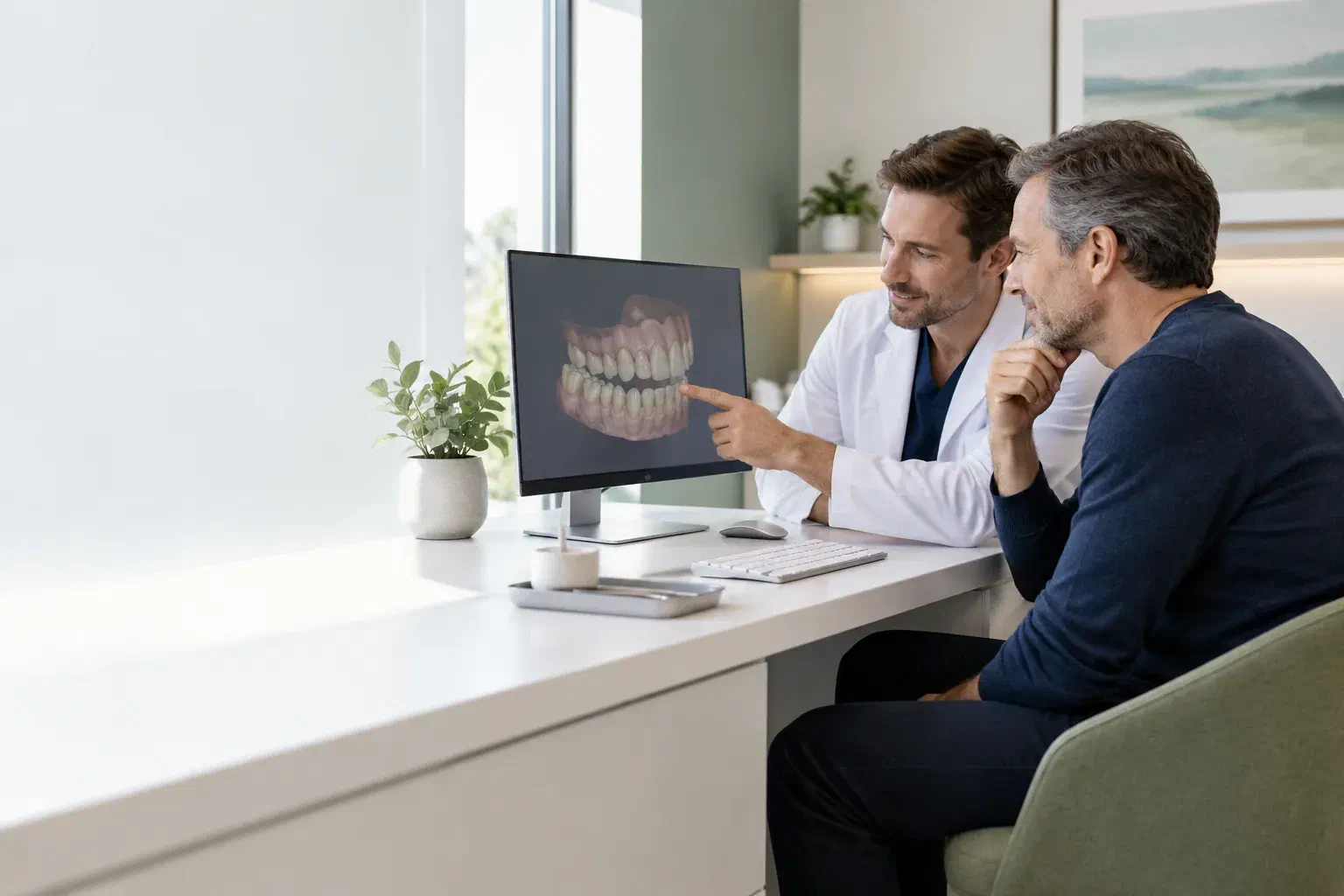
Illustrative consultation about digital planning for a dental implant
Restorative Dentistry

Computer-Planned Implant Placement in Milton

Been told you need a scan before an implant? Talk it through at our Milton clinic, where we explain what digital records show, what they leave out, and how a careful plan for your missing tooth comes together.

Digital implant planning in Milton

Start with the tooth, then find the right spot for its root.

Many people first hear the phrase when a dentist mentions a 3D scan. Computer planning means using digital records to work out where an implant might sit so that it supports a sensible replacement tooth. That calls for thinking about bone, nearby roots and nerves, the bite, and how you will keep the area clean for years. A tidy picture on a monitor is the starting point of that thinking, not its conclusion.

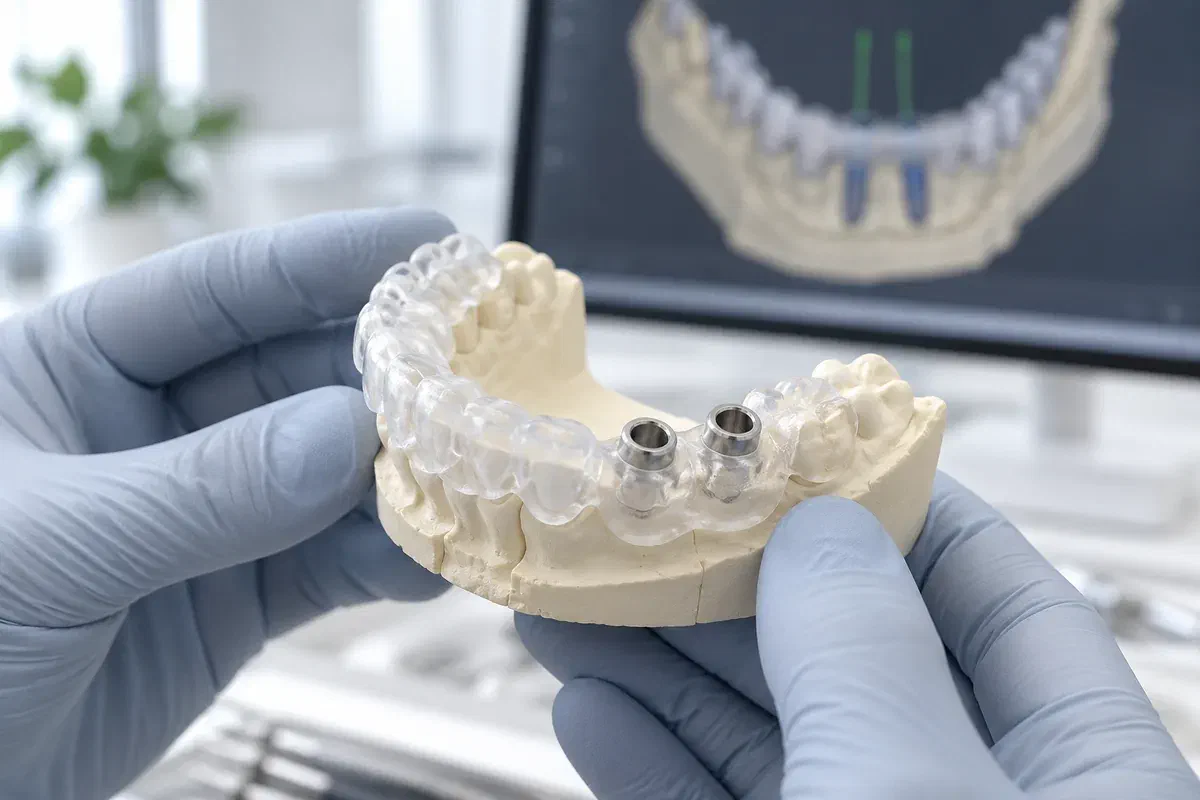
Scans, virtual planning software and printed surgical guides are separate pieces. A case might use one, two or all three of them, or a different workflow altogether. It is fair to ask which pieces are proposed for you, what each adds, and which clinician handles each stage.

For people here in Milton, a first visit is simply a conversation about the gap and the realistic ways to fill it. Before anyone talks about software, the question is whether an implant suits your mouth at all. If imaging, a referral, surgery or several restorative visits are involved, you should see how they fit together.

Talk through an implant plan
Dental implant planning model and illustrative surgical guide
What shapes the plan

Your mouth decides the approach, not the gadget.

The implant itself is small, but it holds up a tooth you will chew, smile and clean around. Good planning links the site to that finished tooth instead of hunting for any place a post could squeeze in.

Nearby roots, nerves and sinus

Some gaps sit close to structures that need careful respect. Your clinician chooses the records that are actually justified and tells you how the findings change the suggested position, or why a different kind of replacement might be wiser.

A narrow or crowded gap

What you see above the gum is only half the picture. The width and depth of bone underneath also matter, along with the shape of the new tooth, how it meets its neighbours, and whether you can floss or brush around it without a struggle.

More than one clinician involved

Sometimes a specialist places the implant while your general dentist builds the tooth. If so, find out how records travel between offices and who answers which questions, so you are never unsure where to call.

A scan cannot tell anyone on its own that you are a good candidate. Your medical history, the examination, what you hope for and how well you can care for the result all count.

Where software earns its place

Better information, more honest choices.

Digital records can let the team look at a proposed implant alongside the planned crown and the surrounding anatomy at the same time. When the case suits it, that plan may be turned into a guide that helps transfer the position during surgery. Which method is used depends on your situation and the treating team’s judgement.

Software sharpens judgement; it does not stand in for it. Surgical risk remains, results are not guaranteed, and the plan is only as reliable as the records behind it. Clinicians still have to respond to whatever they find on the day.

Patient information: ITI — computer-guided implant surgery

The crown comes first

Picturing the finished tooth keeps the discussion grounded. You can ask how its size, the way your teeth meet, and the room needed for cleaning steer the implant’s angle and depth.

Reasons you can follow

Looking at the records together often explains why a graft, extra healing time or a specialist opinion is suggested first. It can also show why a quick advertised option may not fit your mouth.

A fair look at alternatives

Even a detailed implant consultation should leave room to weigh a bridge, a removable partial or another suitable choice. You deserve to know what the technology adds here and what it cannot fix.

From first visit to finished tooth

Four stages, each with its own questions.

Appointment numbers and tools differ from one case to the next. Before agreeing to anything, ask for a written outline that covers the assessment, any preparation, the surgery, the final tooth and ongoing care, plus where each step will happen.

  1. Talk about the gap and your health

    We go over the missing tooth or teeth, your medical history, earlier dental work and what matters most to you day to day. The exam shows which replacements are worth exploring and whether decay or gum problems need care first.

  2. Collect only the records that help

    You might need photos, an intraoral scan or impressions, and suitable X-ray imaging. It is reasonable to ask what each one is meant to reveal, whether older images can be reused, and why any new imaging is needed.

  3. Review the position and the order of care

    The proposed implant site is shown alongside the future tooth. Go over the benefits, limits, fees and alternatives, and whether a guide, bone graft, referral or temporary tooth is included in the plan.

  4. Carry out the treatment and follow up

    If you go ahead, the team confirms surgical arrangements and check-ups. The permanent tooth is designed around how the site heals, and you leave with cleaning instructions and a schedule for future reviews.

After the implant goes in

Recovery and upkeep matter as much as the plan.

Even the most precise digital plan comes with personal instructions after surgery. Follow what the clinician who performed your procedure tells you, and be clear about whom to contact if healing does not go as described.

Use the instructions you were given

Your directions may cover brushing near the site, what to eat, physical activity and any medicine prescribed. They reflect the work actually done, including any graft, so ask questions before you leave instead of leaning on general advice found online.

Look after any temporary tooth

Going home with a temporary crown or appliance? Learn how to wear and clean it. Tell the team about wobbling, a bite that feels off or any breakage so they can check it before you carry on as usual.

Keep coming back for reviews

When the final tooth is in place, ask someone to show you how to clean around it, and agree on regular check-ups. Mention discomfort, trouble reaching the area or changes in the gum around it.

Comparing your choices

The best plan is the whole plan.

Comparing complete treatment plans is more useful than comparing technique names. Look at the visits, preparation, final tooth and long-term upkeep each option involves.

If a guide suits the case

Digital plan with a surgical guide

A guide can help carry a planned position into surgery. Whether it fits depends on your records, how it can be supported, mouth opening and other clinical factors. Your clinician should explain what it will and will not do for you.

Another placement method

A different implant workflow

Implant cases do not all follow one route. Ask why a certain method is recommended, how your site was assessed, and whether grafting or a specialist referral alters the order of treatment.

Non-implant options

Replacing the tooth without surgery

A bridge or a removable partial denture may deserve a fair comparison. The health of neighbouring teeth, the size of the space, your preferences and the upkeep each choice needs all guide that conversation.

Milton implant planning questions

Plain answers about scans, guides and timing.

Implant consultations can fill up with jargon quickly. Ask us to tie every proposed step back to your own mouth and the replacement tooth you have in mind.

(905) 876-4488
Is the 3D scan itself the treatment plan?
No. The scan is a set of images that gives the clinician information. The plan is the decision made from those images together with your exam, health history and goals. Two people could have similar scans and still receive quite different recommendations.
Why might I need new imaging if I had X-rays last year?
Standard X-rays and three-dimensional images show different things, and your mouth may have changed since then. Bring or request your previous records, and ask the team to explain whether they can be used and what any new image would add.
Do I have to decide on an implant at the first appointment?
No. A consultation is a chance to gather information, ask questions and understand your options. Taking time to think, compare a bridge or partial denture, or talk it over with family is entirely reasonable.
What happens if the guide does not fit as expected on surgery day?
A guide is a tool, not a requirement. If something about the fit or the site is not as planned, the clinician uses their judgement and may adjust the approach. Ask beforehand how such situations are usually handled and how they would be explained to you.
Does a guided approach mean I will get a tooth the same day?
Not necessarily. How the implant is planned and when a tooth goes on it are separate decisions. Healing, bone quality and what is found during placement all influence whether a temporary or final tooth can be fitted, and when.
What should my written estimate list?
Look for the consultation, imaging, planning, any guide, the surgery, temporary teeth and the final crown or appliance. Specialist fees and follow-up care should be noted too, along with any costs that depend on what is found later.
Book in Milton

Bring your questions about the gap.

Visit our Bronte Street practice to talk about the missing tooth, what you are hoping for, and the assessment that would come next. We can walk you through the likely pathway and help you prepare questions about planning, who does what, and long-term care.

If you have had an implant consultation before, or have scans or X-rays on file elsewhere, mention them so we can discuss which might be useful.

Visit Milton Dental Clinic
Unit 1, 342 Bronte St. S, Milton, ON L9T 5B7
Get directions Clinic hours
Monday–Thursday
11am–7pm
Friday–Sunday
By appointment only

Areas we serve

  • Milton
  • Oakville
  • Mississauga
  • Georgetown
  • Halton Hills
  • Acton
  • Campbellville
  • Brampton
  • Burlington
  • Puslinch
  • Rockwood
  • Erin
  • Caledon
  • Etobicoke
  • Old Milton
  • Bronte Meadows
  • Timberlea
  • Dorset Park
  • Dempsey
  • Clarke
  • Beaty
  • Coates
  • Harrison
  • Scott
  • Willmott
  • Ford
  • Bowes
  • Cobden
  • Walker
  • Mountain View
  • Milton Heights
  • Hawthorne Village
  • Valley View
  • Fallingbrook
  • Nassagaweya
  • Trafalgar
  • Esquesing
  • Nelson
  • Brookville
  • Moffat
  • Glen Williams
  • Norval
  • Limehouse
  • Stewarttown
  • Ashgrove
  • Hornby
  • Silver Creek
  • Speyside
  • Scotch Block
  • North Oakville
  • River Oaks
  • Glen Abbey
  • West Oak Trails
  • Palermo
  • Bronte Creek
  • College Park
  • Joshua Creek
  • Uptown Core
  • Preserve
  • Iroquois Ridge
  • Lisgar
  • Meadowvale
  • Meadowvale Village
  • Churchill Meadows
  • Erin Mills
  • Central Erin Mills
  • Streetsville
  • East Credit
  • Creditview
  • Heartland
  • Sheridan
  • Mount Pleasant
  • Credit Valley
  • Huttonville
  • Churchville
  • Springbrook
  • Northwest Brampton
  • Bram West
  • Fletcher's Meadow
  • Fletcher's Creek South
  • Alton Village
  • Orchard
  • Millcroft
  • Headon Forest
  • Tansley
  • Brant Hills
  • Tyandaga
  • Kilbride
  • Lowville
  • Aberfoyle
  • Morriston
  • Arkell
  • Hillsburgh
  • Freelton
  • Carlisle
  • Waterdown
  • Flamborough
  • Mountsberg

How can we help?

Milton Dental Clinic

Have a question about your smile? Choose the option that works best for you.

For urgent dental concerns, please call.
Messages are reviewed during clinic hours.