
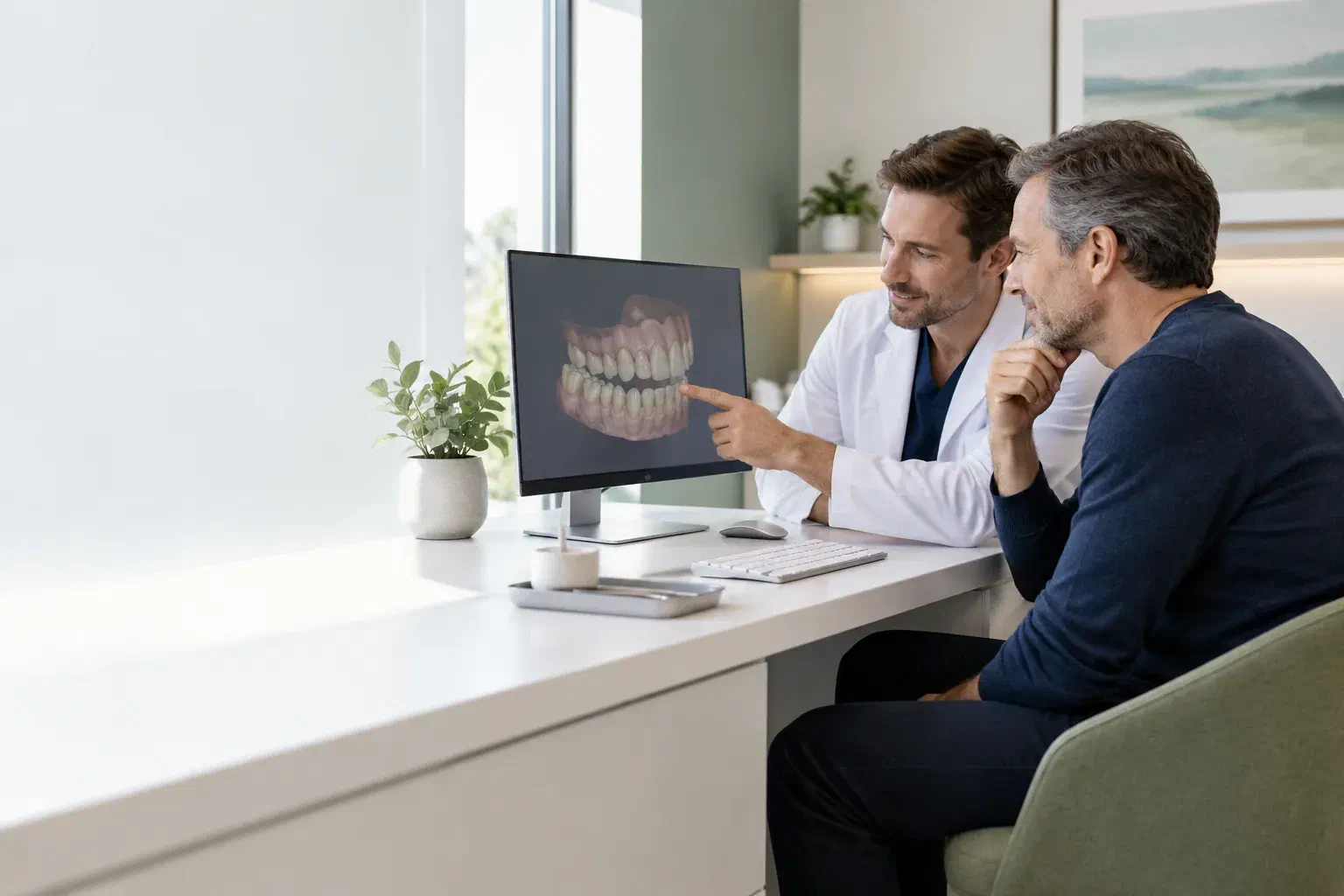
Illustrative consultation about digital planning for a dental implant
Restorative Dentistry

Computer-Planned Implant Placement in Rockwood

An implant is planned once and cleaned every day afterward. From Rockwood, book a consultation to learn how digital planning takes your future cleaning routine into account, and what keeping an implant healthy really involves.

Planning for the years ahead

Think about the toothbrush before the surgery.

Picture yourself a few years from now, standing at the sink with floss in hand. Can you reach every side of the new tooth? That everyday question is part of what good implant planning considers. Digital records and planning software help a clinician explore an implant position that supports the crown, respects the bone and the anatomy around it, and leaves an area you can realistically keep clean. The on-screen model is a helpful tool rather than the answer.

Scans, planning programs and surgical guides each serve a separate purpose, and a plan may use any combination of them or none. Ask which ones are recommended for you, what each contributes, and who carries out each part of the work.

For anyone travelling from Rockwood, the first conversation is about the missing tooth, your daily routine and the replacements that suit you. Whether an implant is right comes before any choice of technique. Imaging, referrals, surgery and restorative visits are then described as one connected plan.

Plan an implant you can maintain
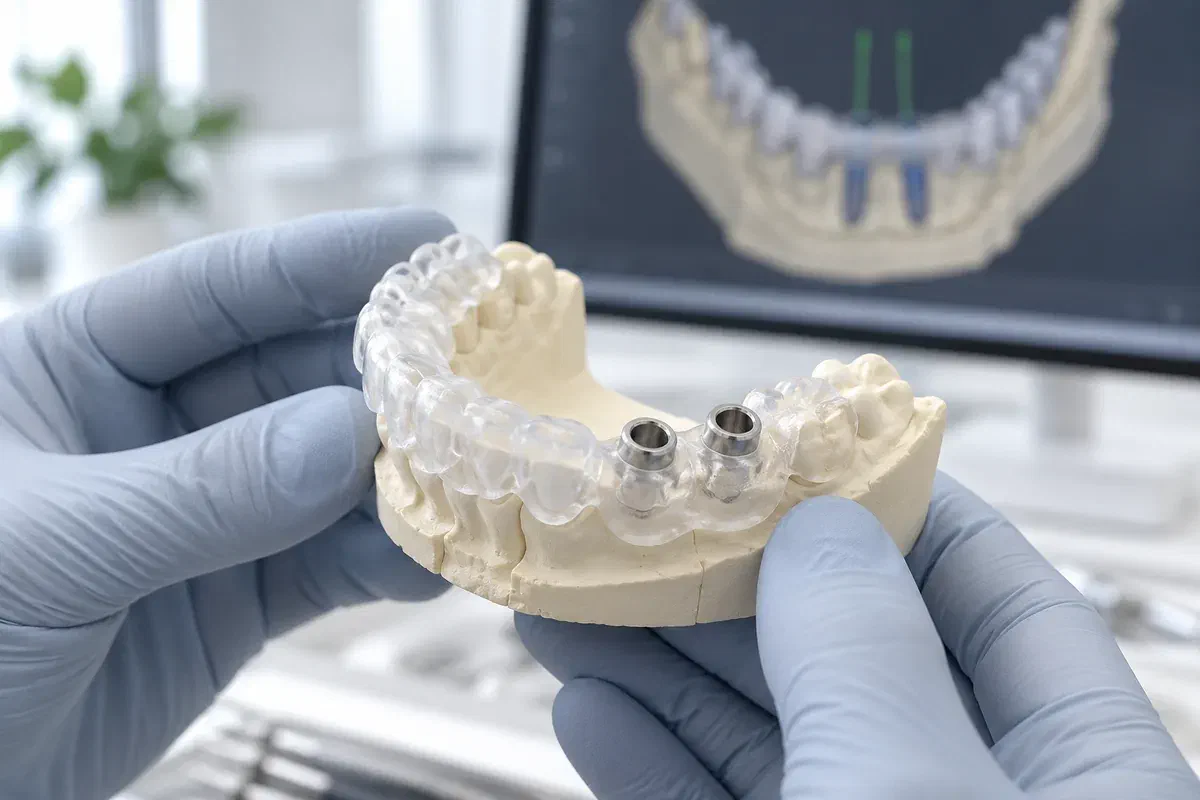
Dental implant planning model and illustrative surgical guide
Questions that affect long-term care

Will this tooth be easy to live with?

The implant is hidden, but the crown it supports needs daily attention. Planning links the condition of your mouth to a replacement you can comfortably maintain, not just to the space available.

Anatomy that limits the position

Nerves, the sinus and neighbouring roots can restrict where an implant can safely go, which in turn affects the crown’s shape. The clinician chooses which records are needed and explains how they influence the plan or point to an alternative.

A crown that is hard to reach

If the space is tight or the implant would sit at an awkward angle, the crown can be harder to clean. The plan considers the final shape, how it meets the teeth beside it and whether brushes and floss will reach.

Knowing who looks after it later

Different clinicians may place the implant, make the crown and provide routine cleanings. Ask who is responsible for long-term reviews and how records will be shared between offices.

Digital planning cannot decide alone whether you are a candidate. Your health history, exam findings, expectations and commitment to ongoing care are all part of that decision.

How planning supports upkeep

Easier cleaning starts on the screen.

With digital records, the treating clinician can look at a proposed implant together with the planned crown and surrounding structures. That makes it easier to discuss whether the final tooth will have a cleanable shape. For suitable cases, the plan may also lead to a guide for placement, depending on the clinical situation.

No plan removes the risks that come with surgery, and none can guarantee how an implant will do over time. Accurate records and a sensible position help, but the team will still respond to findings during treatment, and daily care remains your part.

Patient information: ITI — computer-guided implant surgery

A crown shaped for cleaning

Planning around the final tooth lets the team talk about contours that allow brushing and flossing. Ask how the proposed position affects access around the gum.

Steps that protect the site

Records may show why a graft, extra healing or a specialist opinion would help create a healthier foundation. They can also explain why a rushed approach might make maintenance harder later.

Comparing upkeep across options

Bridges and removable partials have their own cleaning needs. You should know what each option asks of you every day and what technology cannot change.

From planning to maintenance

The pathway does not end at the crown.

Visits and tools vary between cases. Before treatment, ask for a summary that covers assessment, preparation, placement, the final tooth and long-term maintenance, and where each stage takes place.

  1. Review your mouth and your habits

    We discuss the missing tooth, your health, past dental treatment and your usual cleaning routine. The exam shows which replacements are worth exploring and whether gum disease or decay needs treatment first.

  2. Record the site carefully

    Photos, a scan or impressions, and suitable X-ray imaging may be recommended. Ask what each will reveal and whether previous records are recent enough to use.

  3. Check the plan for cleaning access

    The proposed implant site is shown with the future crown in view. Discuss the benefits, limits, costs and alternatives, and whether grafting, a guide, a specialist or a temporary tooth is involved.

  4. Treat, then build a review routine

    Choosing to proceed means booking the surgery and early check-ups with whoever is placing the implant. Once healing allows, the final crown is fitted, and you are shown how to clean it, which tools to use and how often to come back. From then on, reviews become a regular part of your dental care.

Daily care after placement

Small habits protect a big investment.

Recovery instructions are individual and come from the clinician who performed your procedure. Follow them closely, and be clear about whom to call if healing differs from what you were told.

Start with the healing instructions

Early guidance may cover gentle cleaning, diet, activity and any prescribed medication. It reflects the work done, including grafts, so ask for clarification before leaving instead of relying on a general description.

Keep any temporary tooth clean

A temporary crown or appliance can trap food. Ask how to wear and clean it, and report looseness, bite changes or damage so it can be checked.

Make reviews part of your routine

Once the final crown is fitted, ask for hands-on practice with the cleaning tools that suit it and agree on a review schedule. Mention bleeding gums, food trapping or tenderness near the implant.

Choosing with upkeep in mind

Every option comes with a routine.

Comparing complete treatment plans is more helpful than comparing technique names. Consider the visits, preparation, restoration and long-term care each one asks of you.

If a guide suits your case

A guided implant from a digital plan

A guide may help carry a planned position into surgery. Its usefulness depends on records, support, access and clinical factors, and its role and limits should be explained.

Another workflow

An implant by a different method

Implants can be placed in more than one sound way. Ask why a particular method is recommended, how the site was assessed and whether grafting or specialist care alters the plan.

No implant surgery

A bridge or removable partial

These options need their own cleaning habits. Neighbouring teeth, gap size, your preferences and the maintenance each requires all shape the comparison.

Rockwood questions about implant care

Keeping an implant healthy for the long haul.

Maintenance questions are worth asking before treatment begins. We will relate each answer to your mouth and the replacement you are considering.

(905) 876-4488
Can the gum around an implant become diseased?
Yes. Inflammation around an implant, sometimes called peri-implant disease, can affect the gum and bone. Daily cleaning and regular reviews help the team spot early signs such as bleeding or swelling.
Which cleaning tools work best around an implant crown?
It depends on the crown’s shape and position. Soft brushes, floss, small interdental brushes or water flossers may be suggested. Ask for a demonstration with the tools recommended for your tooth.
Can an implant crown get a cavity?
The crown itself does not decay like a natural tooth, but the gum and bone around it still need care, and neighbouring teeth can still develop cavities. Regular cleaning remains important.
How often should an implant be checked?
Your clinician will suggest a review schedule based on your gum health and the restoration. Ask how often you should be seen and what will be checked at each visit.
What should I do if the crown on my implant feels loose?
Call the team rather than waiting for your next review. A loose crown or component should be assessed so the cause can be found and addressed. Until it is checked, chew on the other side and keep the area clean gently, and mention any pain or swelling when you phone.
Is computer planning the same as a computer doing the surgery?
No. Planning uses digital records to prepare the treatment. A clinician performs the procedure and remains responsible for it. If another technology is mentioned, ask exactly what it does.
Rockwood to Bronte Street

Plan for the tooth you will care for.

Arrange a time with our team on Bronte Street to discuss the missing tooth, your cleaning routine and what an assessment would involve. We will explain the possible pathway and what to ask about planning, responsibilities and ongoing maintenance.

Let us know about previous implant consultations or imaging held elsewhere so we can consider which records may help.

Visit Milton Dental Clinic
Unit 1, 342 Bronte St. S, Milton, ON L9T 5B7
Get directions Clinic hours
Monday–Thursday
11am–7pm
Friday–Sunday
By appointment only

Areas we serve

  • Milton
  • Oakville
  • Mississauga
  • Georgetown
  • Halton Hills
  • Acton
  • Campbellville
  • Brampton
  • Burlington
  • Puslinch
  • Rockwood
  • Erin
  • Caledon
  • Etobicoke
  • Old Milton
  • Bronte Meadows
  • Timberlea
  • Dorset Park
  • Dempsey
  • Clarke
  • Beaty
  • Coates
  • Harrison
  • Scott
  • Willmott
  • Ford
  • Bowes
  • Cobden
  • Walker
  • Mountain View
  • Milton Heights
  • Hawthorne Village
  • Valley View
  • Fallingbrook
  • Nassagaweya
  • Trafalgar
  • Esquesing
  • Nelson
  • Brookville
  • Moffat
  • Glen Williams
  • Norval
  • Limehouse
  • Stewarttown
  • Ashgrove
  • Hornby
  • Silver Creek
  • Speyside
  • Scotch Block
  • North Oakville
  • River Oaks
  • Glen Abbey
  • West Oak Trails
  • Palermo
  • Bronte Creek
  • College Park
  • Joshua Creek
  • Uptown Core
  • Preserve
  • Iroquois Ridge
  • Lisgar
  • Meadowvale
  • Meadowvale Village
  • Churchill Meadows
  • Erin Mills
  • Central Erin Mills
  • Streetsville
  • East Credit
  • Creditview
  • Heartland
  • Sheridan
  • Mount Pleasant
  • Credit Valley
  • Huttonville
  • Churchville
  • Springbrook
  • Northwest Brampton
  • Bram West
  • Fletcher's Meadow
  • Fletcher's Creek South
  • Alton Village
  • Orchard
  • Millcroft
  • Headon Forest
  • Tansley
  • Brant Hills
  • Tyandaga
  • Kilbride
  • Lowville
  • Aberfoyle
  • Morriston
  • Arkell
  • Hillsburgh
  • Freelton
  • Carlisle
  • Waterdown
  • Flamborough
  • Mountsberg

How can we help?

Milton Dental Clinic

Have a question about your smile? Choose the option that works best for you.

For urgent dental concerns, please call.
Messages are reviewed during clinic hours.