

Illustrative dentist and patient consultation about a suspected cracked tooth
Restorative Dentistry

Cracked Tooth Assessment in Georgetown

Told a tooth might be cracked and unsure what to do with that? An assessment for people in Georgetown turns a vague worry into specific findings, so you can weigh monitoring, repair or referral with real information.

From worry to decision

Monitor it, fix it, or find out more?

Sooner or later, anyone with a suspected crack faces a choice. Leave it and keep an eye on it? Repair it now? Seek a specialist’s view? Making that call well depends on understanding the tooth first, and that is what a cracked-tooth assessment is for: finding out whether there is structural damage and how much it matters.

The decision starts with your experience of the tooth. Tell us what triggers discomfort, how long each episode lasts, whether it is becoming more frequent and whether you have changed how you eat. A tooth can behave perfectly on the day of the visit; your description still counts, and there is no need to provoke it.

For people travelling down from Georgetown, the appointment is designed to end with something you can act on. We tie your account to the examination, mark clearly which findings are solid and which are provisional, and explain the reasoning if a further test or a referral would sharpen the picture.

Get the facts before deciding
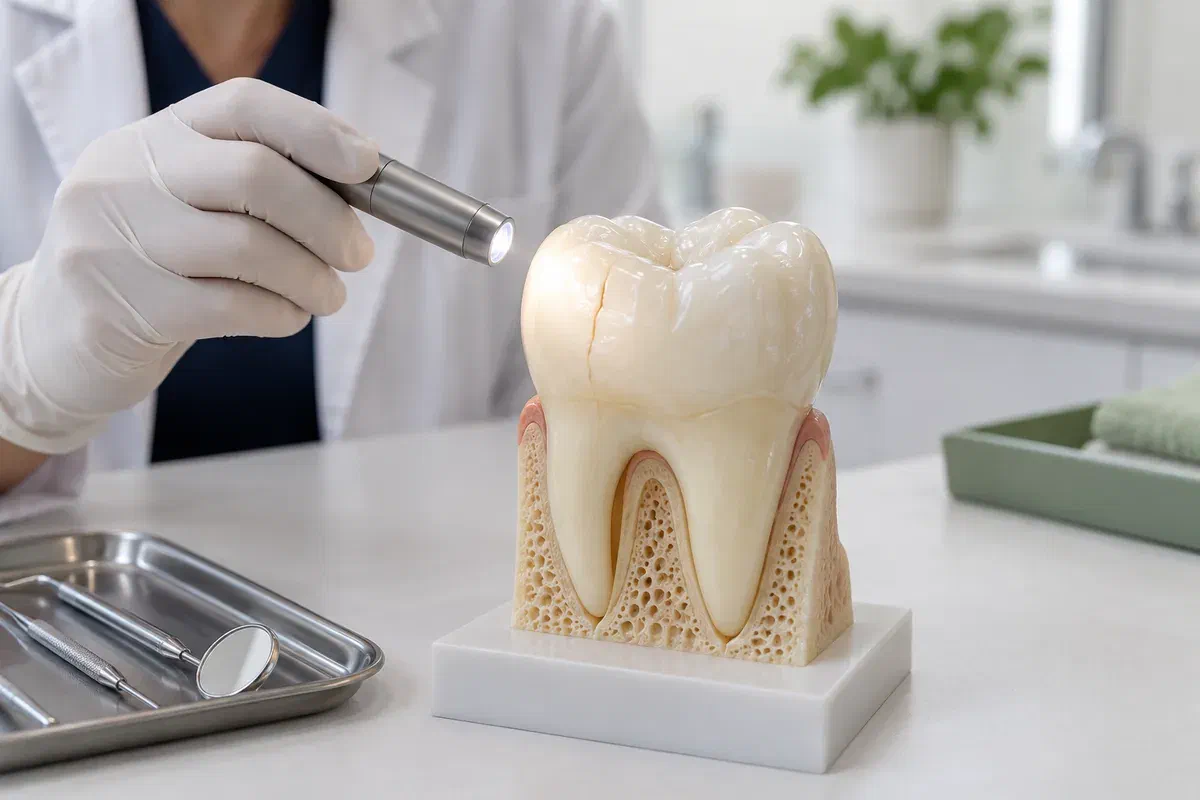
Illustrative tooth examination model with a fine visible crack
Inputs to the decision

What shapes the recommendation

Several pieces of information feed into the advice you receive. Your observations are among the most important, even when the symptom is irregular or hard to describe.

How the tooth responds to chewing

Sharp on pressure, sharp on release, or only with certain foods? When did it begin, and are you now avoiding that side? This pattern guides the examination, although other conditions can produce something very similar.

Whether a line is visible

Many visible lines are confined to the enamel. A line’s darkness or length is not a reliable measure of how far it reaches. The dentist weighs it with everything else the tooth shows.

What the tooth has been through

Large fillings, crowns, root treatment and past injuries all affect the options. Mention recent roughness, sensitivity or a broken fragment, and share what you know about earlier treatment.

Some situations need a quicker conversation: swelling, strong or escalating pain, a recent injury, or a tooth that has loosened. Phone the clinic so the team can judge urgency with you before you book.

Why the assessment comes first

Good choices need good information.

Treatment decisions for a cracked tooth hinge on details: which tooth is responsible, how deep the problem appears, whether the tooth is restorable and what remains unclear. The assessment exists to gather those details before anything is recommended.

Sometimes the evidence points one way at the first visit. Sometimes it needs another test or a review in a few months, and you deserve to know that rather than be rushed. Saying honestly what is uncertain is worth more than a confident prediction about the tooth’s future.

Treatment matched to the problem

A twinge on biting may come from a crack, a cavity, the gum or the bite. Looking at each possibility keeps you from committing to a treatment chosen only because the symptom sounded typical.

Reasons you can follow

Each check should have a purpose you can understand. Ask what it is looking for and how the answer might move the recommendation, so you can follow the logic and speak up if anything hurts.

A decision you own

Whatever is proposed, from watchful waiting to repair or referral, confirm what happens next, the timeframe and which changes should bring you back early. You can take time to consider larger decisions.

How we get there

Gathering the evidence, one stage at a time

The specific checks are chosen for your tooth and symptoms. If you are nervous about discomfort, say so at the outset and we will describe each step before doing it and agree on how to pause.

  1. Start with what you know

    We talk through when the problem began, what sets it off, earlier dental work and any accident. Mention if pain persists once the trigger is gone, if you have seen swelling, or if your bite feels different.

  2. Examine the tooth and area

    The dentist checks the tooth surface, existing restorations, gums and neighbouring teeth. Depending on what appears, the tooth’s reaction to biting or cold and the health of the surrounding tissues may be assessed.

  3. Fill gaps with imaging or tests

    X-rays can help identify decay, infection and other related issues, but hairline cracks are often invisible on them. Ask what the images show, and whether a second opinion would reduce uncertainty.

  4. Lay out the options

    We explain the most likely diagnosis, what is still unknown and each realistic approach, including the case for and against. Any further investigative procedure is explained fully, with its possible results, before you consent.

While you consider the options

Protect your choices by protecting the tooth

Instructions after the visit reflect the findings and any temporary protection placed. Ask what applies to your tooth, especially if you are waiting on further tests, a specialist or time to decide.

Go easy on that side

Testing the tooth with hard food to see if it still hurts can add stress to a tooth that may be weakened, and may narrow your options. Mention what you have noticed and ask how to eat in the meantime.

Write down changes that matter

New swelling, pain that lasts longer or episodes becoming constant are worth noting. If the tooth clearly worsens, call promptly rather than holding the information until your next appointment.

Keep the review on the calendar

A calmer tooth may tempt you to cancel. Check with the clinic first, since improvement does not reveal the tooth’s condition and does not stand in for the review you agreed.

The three main paths

Weighing what each one involves

Different findings lead to different advice. For each option, ask what evidence supports it, what is still uncertain and what choosing it would mean for the tooth now and later.

When the finding looks superficial

Watchful waiting

Monitoring is an active plan, not a shrug. Agree on what will be compared at the next visit, when it will happen and which new symptoms would change the plan.

When the tooth is damaged but restorable

Repair or reinforcement

If the crack appears to weaken the tooth, a restoration may help hold it together. How much healthy structure remains and where the crack runs guide what type of restoration makes sense.

When the diagnosis needs more certainty

A specialist’s opinion

If the problem may reach the nerve or root, or the findings conflict, a referral can add expertise. Ask what the specialist will be asked to decide and how their answer will feed into your plan.

Decision questions

Things to ask before you choose

Having questions is a sign of a good process, not a nuisance. These answers may help you think through the options from Georgetown.

(905) 876-4488
Can I take time to think before agreeing to treatment?
Yes, in most non-urgent situations. Ask how long it is reasonable to wait, what signs would mean the decision should be made sooner, and how to protect the tooth in the meantime.
Does monitoring mean nothing is being done?
No. Monitoring is a deliberate choice when the findings do not justify treatment yet. It involves a review date, a clear idea of what will be checked and a list of symptoms that should bring you back sooner.
What happens if a cracked tooth cannot be saved?
Sometimes a crack extends too far for the tooth to be restored. If that seems possible, the dentist should explain how that conclusion was reached and discuss the options for replacing the tooth, so you can plan.
Are teeth that have had a root canal more prone to cracking?
Teeth that have had root canal treatment can be more vulnerable, particularly if a lot of structure was lost, which is one reason a protective restoration is often discussed afterwards. Tell the dentist if the sore tooth has had this treatment.
Could a night guard help a tooth that may be cracked?
If grinding or clenching seems to play a part, a night guard may be discussed as one way to reduce stress on the teeth. Whether it suits you depends on the findings. Ask what it would and would not do for your tooth.
Should I get a second opinion on the recommendation?
You are always welcome to. Ask for a summary of the findings and any relevant records so the next clinician has the full history. A second opinion will still need to examine the tooth as it is at that time.
Georgetown cracked-tooth assessments

Decide with the findings in hand.

Book a visit at our Bronte Street practice and bring your questions along with your symptoms. We will examine the tooth, explain what we see and go through each option until the choice makes sense to you.

Please call rather than book online if there is swelling, a recent injury, or pain that is intense or getting steadily worse, so we can discuss what you need right away.

Visit Milton Dental Clinic
Unit 1, 342 Bronte St. S, Milton, ON L9T 5B7
Get directions Clinic hours
Monday–Thursday
11am–7pm
Friday–Sunday
By appointment only

Areas we serve

  • Milton
  • Oakville
  • Mississauga
  • Georgetown
  • Halton Hills
  • Acton
  • Campbellville
  • Brampton
  • Burlington
  • Puslinch
  • Rockwood
  • Erin
  • Caledon
  • Etobicoke
  • Old Milton
  • Bronte Meadows
  • Timberlea
  • Dorset Park
  • Dempsey
  • Clarke
  • Beaty
  • Coates
  • Harrison
  • Scott
  • Willmott
  • Ford
  • Bowes
  • Cobden
  • Walker
  • Mountain View
  • Milton Heights
  • Hawthorne Village
  • Valley View
  • Fallingbrook
  • Nassagaweya
  • Trafalgar
  • Esquesing
  • Nelson
  • Brookville
  • Moffat
  • Glen Williams
  • Norval
  • Limehouse
  • Stewarttown
  • Ashgrove
  • Hornby
  • Silver Creek
  • Speyside
  • Scotch Block
  • North Oakville
  • River Oaks
  • Glen Abbey
  • West Oak Trails
  • Palermo
  • Bronte Creek
  • College Park
  • Joshua Creek
  • Uptown Core
  • Preserve
  • Iroquois Ridge
  • Lisgar
  • Meadowvale
  • Meadowvale Village
  • Churchill Meadows
  • Erin Mills
  • Central Erin Mills
  • Streetsville
  • East Credit
  • Creditview
  • Heartland
  • Sheridan
  • Mount Pleasant
  • Credit Valley
  • Huttonville
  • Churchville
  • Springbrook
  • Northwest Brampton
  • Bram West
  • Fletcher's Meadow
  • Fletcher's Creek South
  • Alton Village
  • Orchard
  • Millcroft
  • Headon Forest
  • Tansley
  • Brant Hills
  • Tyandaga
  • Kilbride
  • Lowville
  • Aberfoyle
  • Morriston
  • Arkell
  • Hillsburgh
  • Freelton
  • Carlisle
  • Waterdown
  • Flamborough
  • Mountsberg

How can we help?

Milton Dental Clinic

Have a question about your smile? Choose the option that works best for you.

For urgent dental concerns, please call.
Messages are reviewed during clinic hours.