

Illustrative dentist and patient consultation about a suspected cracked tooth
Restorative Dentistry

Cracked Tooth Assessment in Mississauga

It hurt on Monday, felt fine by Wednesday, and the week got busy. Symptoms that flicker like that are easy to postpone. Book from Mississauga for an assessment that makes sense of the pattern and sets out next steps.

The symptom you keep postponing

On one day, off the next

A tooth that hurts only now and then rarely feels urgent enough to interrupt a busy week. Yet that stop-start pattern is one of the reasons people eventually come in for a cracked-tooth assessment. The visit examines whether the tooth has a structural problem or whether another cause fits better.

Life in Mississauga can be full, so it helps that you do not have to wait for a bad day to book. Keep a rough idea of when the twinge appears, what you were eating and how quickly it settled. If it has become more frequent, mention that too. You never need to set the pain off deliberately for the examination.

Our task is to tie that pattern to what we find in the mouth, then tell you which conclusions are firm and which are still tentative. Where an additional test or a specialist opinion would make a difference, we explain the reason so you can decide with the full picture.

Book before the next flare-up
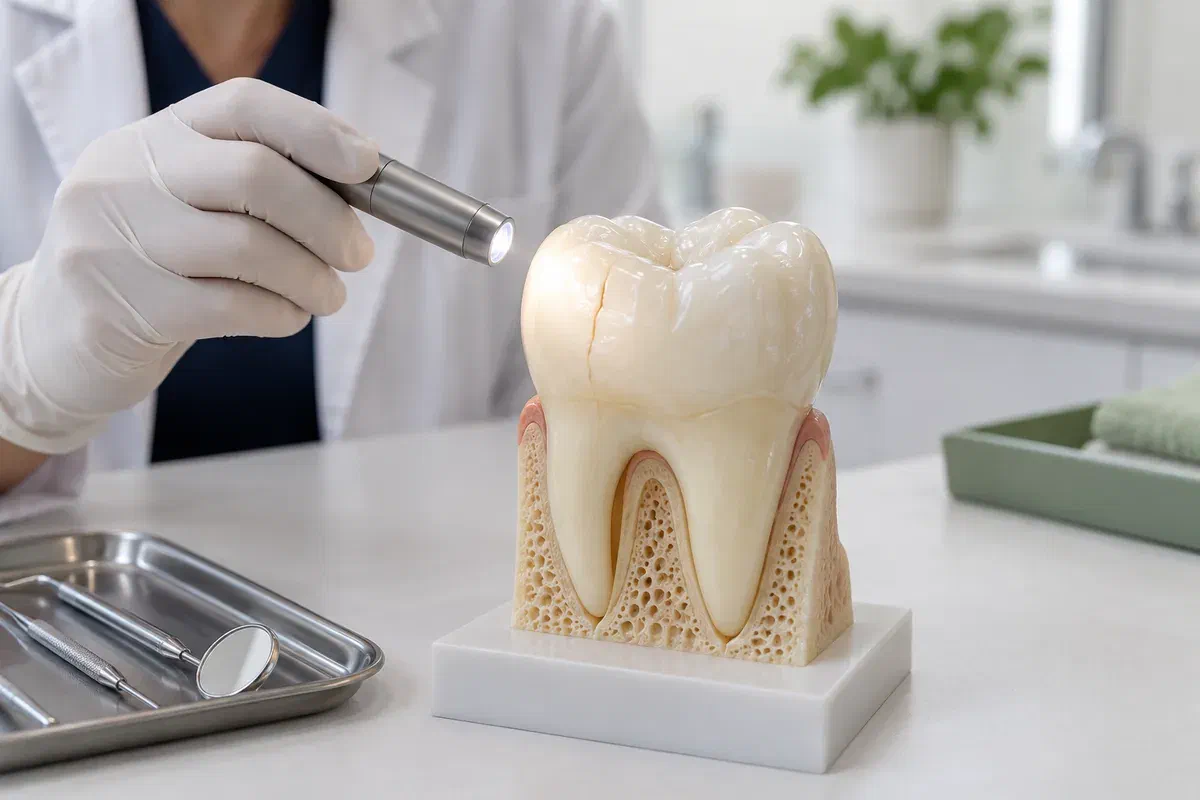
Illustrative tooth examination model with a fine visible crack
Easy-to-miss signs

Patterns that are worth mentioning

Short, irregular symptoms are still meaningful. The circumstances in which a twinge turns up, and how it fades, can be as telling as how strong it is.

A twinge with some meals but not others

Note whether it hits when you bite down, when you let go, or only with certain textures. Say roughly when it began and whether you have quietly shifted chewing to the other side. Different problems can feel alike.

A mark you happened to notice

A thin line seen in a mirror may only be in the enamel. Its appearance does not tell you how far it extends. The dentist weighs it against the condition of the tooth and any symptoms you describe.

An older filling acting up

If a filling, crown or past repair has started to feel rough or sensitive, or a sliver has broken off, mention it. Any information you have about when that work was done can help.

A swollen gum, pain that keeps intensifying, a fall or blow to the face, or a tooth that wobbles are reasons to phone before booking. The team will discuss with you how soon you should be seen.

Why not just wait?

Answers you can plan around

Waiting can feel easier, but it leaves the question open. An assessment tries to identify which tooth or tissue explains the symptom, whether the tooth looks restorable, and what still needs to be learned before care is recommended.

Sometimes that becomes clear in one appointment. In other cases, further tests or a review are needed, and you should be told why. Honest uncertainty is more useful than a confident promise about saving the tooth before its condition is known.

Biting pain, considered fairly

Discomfort when chewing is not automatic proof of a crack. Looking at other possible causes keeps the recommendation tied to findings rather than to how familiar the symptom sounds.

Knowing what each check is for

You can ask what a test is looking for and how its result would affect the plan. When the reason is clear, the appointment feels less like a mystery, and speaking up about discomfort comes more naturally.

A step you can schedule

The outcome may be monitoring, protection, more assessment or treatment. Confirm what happens next and how soon, along with any changes that should prompt you to call before then.

What the appointment covers

Clear steps, adjusted to your tooth

The checks used depend on your symptoms and the tooth involved. If you are worried about triggering pain, tell us at the start so each part can be explained and a pause agreed.

  1. Your timeline of symptoms

    We ask when the twinge started, how often it returns, what sets it off, and about earlier dental work or injuries. Mention any pain that lingers, any swelling, and whether your teeth seem to meet differently.

  2. A look at the tooth and surroundings

    The dentist examines the surface, any restorations, the gums and nearby teeth. Checks of how the tooth responds to biting or temperature, and of its supporting tissues, are chosen based on what appears.

  3. Images and tests when they help

    X-rays or other investigations may reveal related issues, though a fine crack can be invisible on them. Ask what any images show and whether another opinion could resolve lingering uncertainty.

  4. Findings and the next decision

    We explain the likely cause, what is still unknown and the options that fit. If a further procedure is suggested to investigate, its purpose and implications are discussed before you agree to it.

Once you are home

Small habits help until the next step.

Advice afterwards depends on what was found and on any temporary care. Ask for instructions that fit your tooth, particularly if further testing or a specialist appointment is pending.

Chew carefully, not experimentally

Biting hard to see if the twinge is still there can add strain to a tooth that may be weakened. You have already learned what sets it off; tell us, and we will suggest which meals and textures are sensible until you are back.

Notice when things shift

Make a quick note if swelling appears, pain lasts longer, or occasional twinges become constant. If the tooth is clearly getting worse, call promptly instead of waiting to collect more detail.

Protect the review date

A good week can tempt you to cancel. Check with the clinic first, because feeling better does not explain the state of the tooth or replace the follow-up you agreed.

What may follow

Where the findings could lead

Recommendations vary with what the assessment shows. Ask what supports the suggested path, what uncertainty remains and how each alternative would affect the tooth.

When treatment is not needed yet

A planned review

A superficial finding is handled differently from a structural crack. If monitoring is suggested, ask what will be rechecked, when you should come back and which symptoms mean returning sooner.

When the tooth needs reinforcement

Repair to support the tooth

If damage appears restorable, an appropriate repair can be discussed. The remaining tooth and the location of the problem influence whether a filling or a larger restoration makes sense.

When the cause is not yet settled

More tests or a specialist

A difficult diagnosis, or one involving the nerve or root, may warrant further assessment. Ask what the next step is expected to answer and how the result will shape treatment.

Practical questions

Fitting an assessment into real life

Being unsure is a fine reason to book. Skim the answers below before your visit from Mississauga, and leave the diagnosing to the examination.

(905) 876-4488
Can a cracked tooth get worse if I leave it?
A crack can sometimes progress, particularly under heavy chewing forces, but not every line or twinge behaves that way. Because it is hard to tell from home, an assessment is the practical way to understand your tooth and whether it needs protection.
When is the clinic open for an assessment?
The clinic is open Monday to Thursday from 11 am to 7 pm, with Friday to Sunday visits by appointment only. When you call, the team can suggest a time and ask a few questions about your symptoms.
My tooth has been fine for a week. Should I still come in?
Yes, if you had a pattern of twinges. Quiet spells are common with intermittent symptoms, and the history you describe is still useful. The examination may show signs, or the dentist may suggest a sensible next step.
Is it okay to keep eating on that side?
Until the tooth has been examined, it is reasonable to be gentle with it and avoid very hard or sticky foods there. After the assessment, ask for advice that applies to your specific findings.
How long does a cracked-tooth assessment usually take?
It depends on the tooth and on which checks are needed. When booking, ask the team how much time to allow. If imaging or further tests are recommended, the dentist will explain whether they happen on the day or later.
What if the dentist cannot find the cause right away?
That can happen with intermittent symptoms. The dentist should explain what was ruled out, what remains uncertain, and what comes next, whether that is a review, another test or a referral.
Mississauga cracked-tooth visits

Book it now, while you remember the details.

Arrange a visit at our Bronte Street practice to talk about a twinge that comes and goes, a line on a tooth or a bite that feels off. We will examine the tooth, explain what we find and plan the next step with you.

Severe or worsening pain, swelling or a recent injury call for a phone call instead of an online booking, so we can talk through what you need first.

Visit Milton Dental Clinic
Unit 1, 342 Bronte St. S, Milton, ON L9T 5B7
Get directions Clinic hours
Monday–Thursday
11am–7pm
Friday–Sunday
By appointment only

Areas we serve

  • Milton
  • Oakville
  • Mississauga
  • Georgetown
  • Halton Hills
  • Acton
  • Campbellville
  • Brampton
  • Burlington
  • Puslinch
  • Rockwood
  • Erin
  • Caledon
  • Etobicoke
  • Old Milton
  • Bronte Meadows
  • Timberlea
  • Dorset Park
  • Dempsey
  • Clarke
  • Beaty
  • Coates
  • Harrison
  • Scott
  • Willmott
  • Ford
  • Bowes
  • Cobden
  • Walker
  • Mountain View
  • Milton Heights
  • Hawthorne Village
  • Valley View
  • Fallingbrook
  • Nassagaweya
  • Trafalgar
  • Esquesing
  • Nelson
  • Brookville
  • Moffat
  • Glen Williams
  • Norval
  • Limehouse
  • Stewarttown
  • Ashgrove
  • Hornby
  • Silver Creek
  • Speyside
  • Scotch Block
  • North Oakville
  • River Oaks
  • Glen Abbey
  • West Oak Trails
  • Palermo
  • Bronte Creek
  • College Park
  • Joshua Creek
  • Uptown Core
  • Preserve
  • Iroquois Ridge
  • Lisgar
  • Meadowvale
  • Meadowvale Village
  • Churchill Meadows
  • Erin Mills
  • Central Erin Mills
  • Streetsville
  • East Credit
  • Creditview
  • Heartland
  • Sheridan
  • Mount Pleasant
  • Credit Valley
  • Huttonville
  • Churchville
  • Springbrook
  • Northwest Brampton
  • Bram West
  • Fletcher's Meadow
  • Fletcher's Creek South
  • Alton Village
  • Orchard
  • Millcroft
  • Headon Forest
  • Tansley
  • Brant Hills
  • Tyandaga
  • Kilbride
  • Lowville
  • Aberfoyle
  • Morriston
  • Arkell
  • Hillsburgh
  • Freelton
  • Carlisle
  • Waterdown
  • Flamborough
  • Mountsberg

How can we help?

Milton Dental Clinic

Have a question about your smile? Choose the option that works best for you.

For urgent dental concerns, please call.
Messages are reviewed during clinic hours.