

Illustrative conversation about treatment options for a cracked tooth
Restorative Dentistry

Cracked Tooth Treatment in Erin

Repairing a cracked tooth is only part of the job; the weeks afterwards matter as well. From Erin, we plan the repair carefully and make sure you know what is normal, what isn’t and when to call.

Beyond the repair itself

Planning for the days after the appointment

The drive home after a crown or filling on a cracked tooth is often when the questions start. Is this tenderness normal? Should the bite feel like this? What if it still twinges next week? Having those answers before you leave saves worry, and it saves an unnecessary trip when the tooth is simply settling.

The kind of recovery you can expect depends on the crack and the repair. A tooth with a small fracture in one cusp, rebuilt in one visit, tends to settle quickly. A deeper crack that needed root canal care, or one that reached closer to the root, may take longer and need closer follow-up. Some details only come to light once treatment is underway.

So we’ll explain what was found, what was done and what the repair can and cannot achieve. Ask about comfort, timing, costs and alternatives before treatment, and about recovery afterwards. Clear expectations make it much easier to tell normal healing from a problem worth reporting.

Plan a repair for a cracked tooth
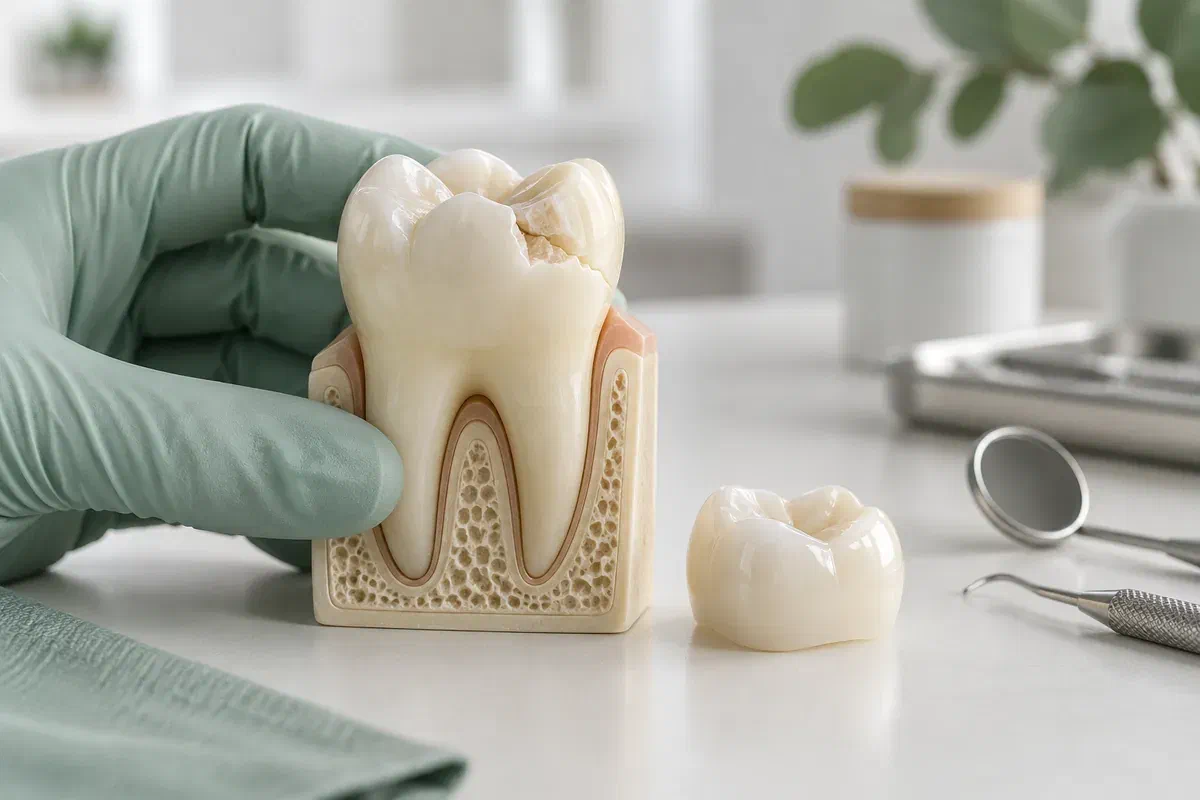
Illustrative tooth model and crown showing a restorative treatment concept
Choosing the repair for Erin households

What the diagnosis tells us

Some cracks call for a minor repair, others a complex one. The dentist examines how much healthy tooth surrounds the damage, whether the pulp is affected and how deep the fracture goes, and this also shapes what recovery looks like.

Weakness around a cusp or filling

Cracks often start where a cusp meets an old filling. A modest repair may suffice, or the tooth may need an onlay or crown over the biting surface. Covering restorations sometimes take a little longer to feel natural.

A pulp under pressure

Lingering sensitivity, aching without a trigger and test results help judge the pulp’s health. If it needs treatment, recovery includes that step too, and a surface repair alone would not have resolved the symptoms.

Damage that reaches too far

Some fractures extend below the gumline or into the root, making a dependable repair unlikely. Ask which findings suggest that and whether a specialist’s assessment would be worthwhile before deciding.

What is found during treatment can change the plan, and with it the recovery. Ask how new findings would be handled and when you would be consulted before the next step.

What a repair can deliver

A working tooth and a clear recovery plan

When the tooth can be saved, treatment rebuilds the damaged section and supports the rest in proportion to its strength. Root canal care is added if the pulp needs it. A good outcome also depends on what happens next: settling, a bite check and review over time.

Cracked teeth don’t heal on their own, and no restoration can promise that a crack will stop where it is. A crown or onlay reduces flexing and protects the tooth, but symptoms can still return later. Knowing that from the outset helps you watch the tooth sensibly rather than anxiously.

Patient information: American Association of Endodontists — cracked teeth

Understanding each piece of work

Ask which visit addresses the crack, which treats the pulp and which places the final restoration. Knowing this also tells you what kind of recovery to expect after each one.

Holding on to a sound tooth

If the evidence supports it, saving your tooth can be the right decision. The dentist should explain why and highlight anything that makes the long-term picture less certain.

Knowing when to call and when to wait

Clear guidance on normal recovery, warning signs and review dates helps you avoid both unnecessary trips and leaving a real problem too long.

The treatment journey

From diagnosis to a settled tooth

Some cracks are repaired in a single appointment; others need stages or a specialist. Ask how the steps relate to your diagnosis, how to protect the tooth in between, and what recovery to expect after each.

  1. Diagnose and explain

    We review your symptoms, examine the tooth and take any images needed. The dentist explains where the crack appears to run, whether the tooth seems restorable and which questions are still open.

  2. Agree the plan

    You hear the goals, limits, stages and fees of each reasonable option, along with what recovery typically involves. We also settle how a surprise finding would be dealt with.

  3. Repair the tooth

    The work could be a filling, an onlay or crown, root canal care, or a mix. We explain how comfort will be managed and how to look after any temporary restoration in the meantime.

  4. Check the bite before you go

    We test how the tooth meets the others and adjust where needed. Ask what tenderness is normal, how long it should last, what symptoms need a call and when your review is due.

Recovering at home

Normal settling, and the signs that aren’t

Recovery depends on the work done and whether the final restoration is in yet. Keep the written aftercare sheet and our number handy, so you can check before deciding whether to come in.

Give a temporary an easy time

Temporaries are more fragile than final restorations. Avoid chewy, sticky and hard food on that side, clean gently around the edges and call if it loosens or chips rather than waiting for your next booking.

Check how your bite feels

Some tenderness can be expected for a few days, but if the tooth hits first, hurts with normal chewing or feels worse instead of better, let us know. A small adjustment is often simple; please don’t grind it down yourself.

Ask about clenching and hard foods

Grinding, clenching and biting on hard objects stress repaired teeth. The dentist can talk about a night guard or other protection, while being clear that it lowers risk rather than ruling out future cracks.

Repair options

The right repair depends on the tooth

Each choice has benefits, limits and its own recovery. Ask how well each one suits where the crack lies, what structure is left and what the pulp tests showed.

If enough sound tooth is left

Filling, onlay or crown

A contained crack may be managed with a bonded filling. Weakened walls may call for an onlay or crown capping the cusps, which usually means wearing a temporary for a short while first.

Where the pulp needs attention

Root canal care, then a final restoration

Root canal treatment may be recommended when the pulp diagnosis supports it and the tooth is still restorable. It addresses the inner tissue only, so a protective restoration is planned afterwards.

If repair is unlikely to last

Extraction and planning a replacement

Removal may be the wiser route when the fracture is unfavourable. Ask what makes repair a poor bet, what the gap could mean for your bite and which replacement options and timings fit.

Questions from Erin

Recovery, follow-up and long-term care

Most questions after a repair are about what is normal. These answers give general guidance; your aftercare instructions will be specific to the work done.

(905) 876-4488
Is it normal for a repaired cracked tooth to feel tender for a few days?
Mild tenderness or sensitivity for a few days is common, especially after a crown or root canal care. It should gradually ease. Call if it worsens, lasts well beyond what you were told to expect or comes with swelling.
My new crown feels high. Will it settle on its own?
Usually not. A crown that touches before the other teeth can make the tooth sore and should be adjusted. It is often a quick appointment. Avoid chewing hard on it until it has been checked.
How do I decide whether to call before driving in?
Call us first in almost every case. We can ask about your symptoms and advise whether you need to come in, can wait for your review or should seek urgent care closer to home if the situation is serious.
How often should a repaired cracked tooth be reviewed?
This depends on the repair and the outlook. Many teeth are reviewed at regular checkups, with an earlier visit if root canal care was involved. Ask the dentist what interval suits your tooth.
Can a crowned tooth still get a cavity?
Yes. Decay can form where the crown meets the natural tooth, especially if cleaning there is difficult. Brushing, flossing around the margin and regular checkups help protect the tooth underneath.
Why might a crowned cracked tooth hurt months later?
A crack can progress, the pulp can become inflamed later or the bite may change. A crown protects the tooth but can’t guarantee it will stay trouble-free. Report new pain so the cause can be checked.
Visiting from Erin

A repair you understand, start to finish

Come to our Bronte Street practice for an assessment of the cracked tooth. We’ll explain the findings and options, carry out the agreed repair and make sure you know exactly what recovery should look like.

For severe pain, swelling or a new break, please call so we can advise on timing before you set out. Online requests are for non-urgent matters.

Visit Milton Dental Clinic
Unit 1, 342 Bronte St. S, Milton, ON L9T 5B7
Get directions Clinic hours
Monday–Thursday
11am–7pm
Friday–Sunday
By appointment only

Areas we serve

  • Milton
  • Oakville
  • Mississauga
  • Georgetown
  • Halton Hills
  • Acton
  • Campbellville
  • Brampton
  • Burlington
  • Puslinch
  • Rockwood
  • Erin
  • Caledon
  • Etobicoke
  • Old Milton
  • Bronte Meadows
  • Timberlea
  • Dorset Park
  • Dempsey
  • Clarke
  • Beaty
  • Coates
  • Harrison
  • Scott
  • Willmott
  • Ford
  • Bowes
  • Cobden
  • Walker
  • Mountain View
  • Milton Heights
  • Hawthorne Village
  • Valley View
  • Fallingbrook
  • Nassagaweya
  • Trafalgar
  • Esquesing
  • Nelson
  • Brookville
  • Moffat
  • Glen Williams
  • Norval
  • Limehouse
  • Stewarttown
  • Ashgrove
  • Hornby
  • Silver Creek
  • Speyside
  • Scotch Block
  • North Oakville
  • River Oaks
  • Glen Abbey
  • West Oak Trails
  • Palermo
  • Bronte Creek
  • College Park
  • Joshua Creek
  • Uptown Core
  • Preserve
  • Iroquois Ridge
  • Lisgar
  • Meadowvale
  • Meadowvale Village
  • Churchill Meadows
  • Erin Mills
  • Central Erin Mills
  • Streetsville
  • East Credit
  • Creditview
  • Heartland
  • Sheridan
  • Mount Pleasant
  • Credit Valley
  • Huttonville
  • Churchville
  • Springbrook
  • Northwest Brampton
  • Bram West
  • Fletcher's Meadow
  • Fletcher's Creek South
  • Alton Village
  • Orchard
  • Millcroft
  • Headon Forest
  • Tansley
  • Brant Hills
  • Tyandaga
  • Kilbride
  • Lowville
  • Aberfoyle
  • Morriston
  • Arkell
  • Hillsburgh
  • Freelton
  • Carlisle
  • Waterdown
  • Flamborough
  • Mountsberg

How can we help?

Milton Dental Clinic

Have a question about your smile? Choose the option that works best for you.

For urgent dental concerns, please call.
Messages are reviewed during clinic hours.