

Illustrative conversation about treatment options for a cracked tooth
Restorative Dentistry

Cracked Tooth Treatment in Etobicoke

When the trip from Etobicoke is part of the plan, it helps to make each appointment count. We assess the cracked tooth carefully, organise the stages sensibly and explain when closer urgent care makes more sense.

Making each visit count

Fewer trips, better organised

Travelling a longer distance for dental care changes how you think about a treatment plan. Rather than a string of short, loosely planned visits, most people want to know up front how many appointments are likely, what each involves and what to do if the tooth acts up between them.

With a cracked tooth, that plan depends on the damage. A crack limited to one cusp may be repaired in a single sitting, while one that heads toward the pulp or the root may need stages or a specialist. Sometimes the extent becomes clear only during treatment, so it makes sense to discuss that possibility at the start.

Our aim is to give you an honest outline: what we know, what we don’t yet, and what each step is supposed to achieve. Ask about comfort, timing, fees and alternatives. Good planning cannot remove every uncertainty, but it can make each trip worthwhile.

Plan care for a cracked tooth
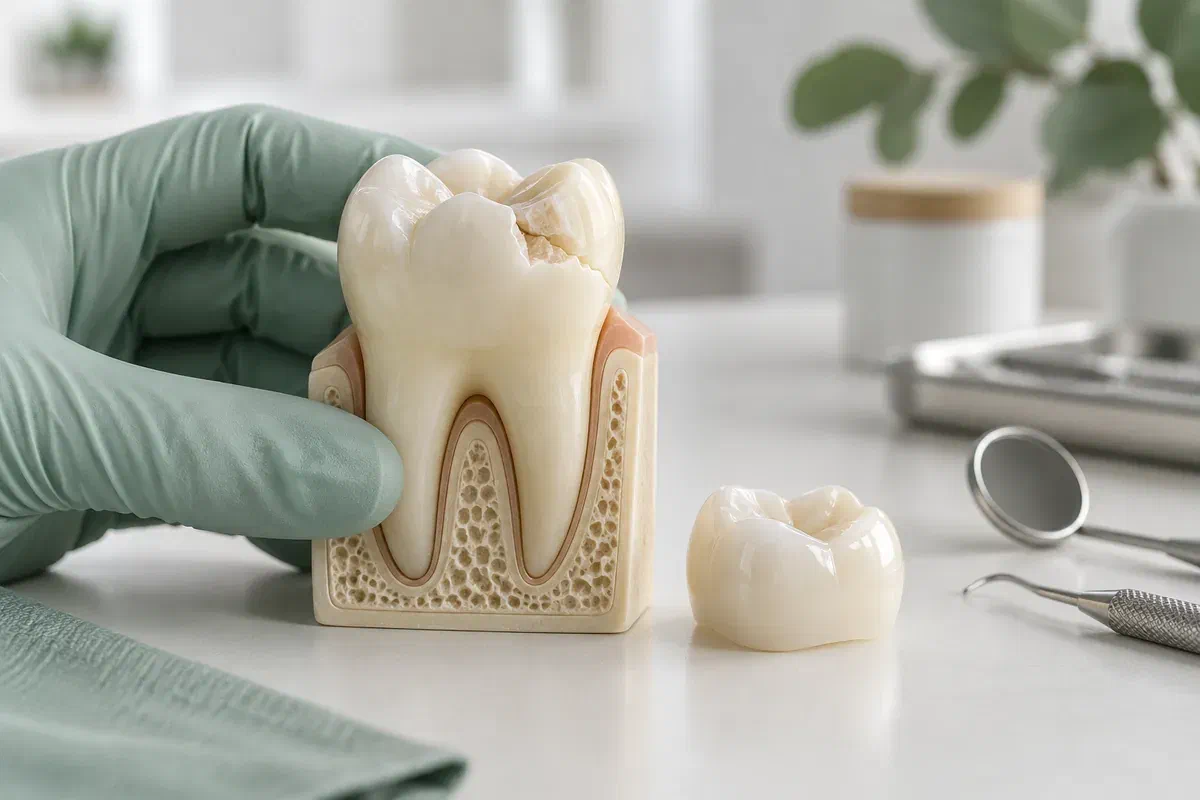
Illustrative tooth model and crown showing a restorative treatment concept
What shapes an Etobicoke plan

Three questions about the tooth

The word crack covers a wide range. Before recommending treatment or estimating visits, the dentist weighs how much sound tooth remains, the state of the pulp and how far the fracture runs.

How strong is the biting surface?

A crack beside a large filling or under a cusp can leave part of the tooth fragile. The answer decides whether a contained repair is enough or whether the whole chewing surface needs covering, which often means an extra appointment.

Is the inside of the tooth healthy?

Lingering pain, sensitivity to temperature and simple tests help assess the pulp. If it needs root canal treatment, that adds a stage, and a surface repair alone would leave the underlying problem untouched.

Can the tooth be restored at all?

A fracture that splits the tooth or runs deep below the gum may rule out a lasting repair. Ask which findings point that way and whether a specialist opinion, perhaps closer to home, is worth arranging.

Even careful planning can be changed by what treatment uncovers. Ask how a surprise finding would affect the number of visits, and when we would stop to discuss it with you.

What treatment is for

Save a tooth that can be saved, and be clear about the rest

For a restorable tooth, the work typically rebuilds the damaged section and adds support matched to the remaining structure. If the pulp is involved, root canal treatment may be part of the plan as well. These steps share a goal but do different jobs.

Teeth don’t heal a fracture the way bone does. A carefully chosen restoration can protect the tooth, yet it cannot promise the crack will stay put. Knowing this helps you decide whether the travel, time and cost of treatment are justified by the likely benefit.

Patient information: American Association of Endodontists — cracked teeth

Purpose behind each appointment

Ask what every visit is meant to accomplish. An assessment, a temporary stage, pulp treatment and the final restoration are separate steps, and knowing which is which helps you plan your travel.

A real chance to keep your tooth

Where the findings support it, retaining the tooth may be worth the effort. The dentist should explain why and what makes the outcome less predictable in your situation.

A clear plan for afterwards

Reviews and straightforward contact instructions help you respond if symptoms return or your bite shifts. That matters all the more when the clinic is not around the corner.

How we organise it

A sequence planned around your trips

Some cracks need one appointment and some need several or a referral. Ask how the order matches the diagnosis, how visits might be grouped and how to care for the tooth in between.

  1. A thorough first assessment

    We review symptoms, examine the tooth and take any images needed in one visit where possible. The dentist explains where the crack appears to run, whether the tooth seems restorable and what remains uncertain.

  2. A plan with realistic timing

    Each option is explained with its purpose, limits, costs and likely number of visits. We agree how unexpected findings would be handled and look at grouping steps where that is clinically sensible.

  3. Treatment as agreed

    This could be a filling, a crown or onlay with a temporary in between, or root canal care. You’ll hear how we manage comfort and how a temporary should be protected on the journey home and beyond.

  4. Bite check and next steps

    We confirm the tooth meets the others comfortably and explain what comes next. Ask when you can chew normally, what symptoms warrant a call and which appointments are still to be booked.

At home after treatment

Know what to watch for, and who to call

Your instructions depend on the treatment and whether the final restoration is in place. Keep the written advice and our number handy, and ask what to do if you need help outside our hours.

Protect any temporary

A temporary restoration isn’t built for full chewing forces. Ask which foods to avoid and how to keep it clean. If it loosens or breaks, phone us for advice rather than waiting for the next scheduled appointment.

Report bite changes early

Tell us if the treated tooth contacts first, aches during normal chewing or starts to feel different. A quick call can often settle whether you need to come in. Avoid biting hard on a high spot to wear it down.

Raise grinding and hard-food habits

Clenching, grinding and chewing hard objects put cracked and restored teeth under strain. The dentist can discuss a night guard or other measure, while being honest that protection reduces risk without removing it.

Repair options

What can be done depends on what is left

Each approach has benefits, limits and a typical number of visits. Ask how it fits the position of the crack, the remaining tooth and the condition of the pulp before you decide.

When the tooth is restorable

Filling, onlay or crown

A small crack may be repaired with a filling in one visit. A weakened tooth may need an onlay or crown to brace the cusps, which usually involves a temporary and a second appointment.

Where the pulp needs treatment

Root canal treatment and a final restoration

When testing shows the pulp needs care and the tooth can still be restored, root canal treatment may be advised. The protective restoration that follows is planned separately and may add another visit.

Should repair be unlikely to last

Removal and replacement planning

An unfavourable fracture may make extraction the better option. Ask why repair is not expected to hold, what a gap could mean and how replacement choices and their timing would fit around travel.

Etobicoke planning questions

Practical questions before you make the trip

Travelling for care raises its own questions about timing and what to do between visits. These answers are general; your examination will shape the actual plan.

(905) 876-4488
What should I do if the tooth flares up at night and you’re closed?
For severe pain, swelling, fever or difficulty swallowing, seek urgent dental or medical care nearer home rather than waiting. For milder discomfort, call us when we open and we can advise on the next step.
Which records are worth bringing to a first appointment?
A list of your medications and health conditions, any recent dental X-rays or records from another clinic, and notes on when the pain happens. That helps us make the most of a single visit.
Can pain relievers help while I wait for treatment?
Over-the-counter pain relief may ease discomfort for some people, used as directed on the package or by a pharmacist. It doesn’t treat the crack, so it’s not a reason to delay an assessment.
Can a phone call tell you whether my cracked tooth is urgent?
A call can help us judge how soon you should be seen, based on your symptoms. It can’t replace an examination, but it can help you decide whether to book with us or seek closer urgent care.
Is removing a cracked tooth simpler than trying to save it?
Extraction may involve fewer visits at first, but replacing the tooth usually brings its own appointments, costs and upkeep. Leaving a gap has consequences too. The dentist should compare both paths honestly.
Can a tooth that already had a root canal crack?
Yes. Root-treated back teeth can be more prone to fracture, which is one reason a crown is often recommended after root canal treatment. Mention any history of treatment on the tooth when you’re seen.
Planning a visit from Etobicoke

Bring your questions and leave with a plan

Visit our Bronte Street practice for a thorough look at the cracked tooth. We’ll explain the findings, outline the reasonable options and set out a sequence of appointments that respects your travel time.

If you have severe pain, swelling or a fresh break, call us first. When prompt care is needed and you can’t reach us, seek urgent care closer to home. Online requests are for non-urgent matters.

Visit Milton Dental Clinic
Unit 1, 342 Bronte St. S, Milton, ON L9T 5B7
Get directions Clinic hours
Monday–Thursday
11am–7pm
Friday–Sunday
By appointment only

Areas we serve

  • Milton
  • Oakville
  • Mississauga
  • Georgetown
  • Halton Hills
  • Acton
  • Campbellville
  • Brampton
  • Burlington
  • Puslinch
  • Rockwood
  • Erin
  • Caledon
  • Etobicoke
  • Old Milton
  • Bronte Meadows
  • Timberlea
  • Dorset Park
  • Dempsey
  • Clarke
  • Beaty
  • Coates
  • Harrison
  • Scott
  • Willmott
  • Ford
  • Bowes
  • Cobden
  • Walker
  • Mountain View
  • Milton Heights
  • Hawthorne Village
  • Valley View
  • Fallingbrook
  • Nassagaweya
  • Trafalgar
  • Esquesing
  • Nelson
  • Brookville
  • Moffat
  • Glen Williams
  • Norval
  • Limehouse
  • Stewarttown
  • Ashgrove
  • Hornby
  • Silver Creek
  • Speyside
  • Scotch Block
  • North Oakville
  • River Oaks
  • Glen Abbey
  • West Oak Trails
  • Palermo
  • Bronte Creek
  • College Park
  • Joshua Creek
  • Uptown Core
  • Preserve
  • Iroquois Ridge
  • Lisgar
  • Meadowvale
  • Meadowvale Village
  • Churchill Meadows
  • Erin Mills
  • Central Erin Mills
  • Streetsville
  • East Credit
  • Creditview
  • Heartland
  • Sheridan
  • Mount Pleasant
  • Credit Valley
  • Huttonville
  • Churchville
  • Springbrook
  • Northwest Brampton
  • Bram West
  • Fletcher's Meadow
  • Fletcher's Creek South
  • Alton Village
  • Orchard
  • Millcroft
  • Headon Forest
  • Tansley
  • Brant Hills
  • Tyandaga
  • Kilbride
  • Lowville
  • Aberfoyle
  • Morriston
  • Arkell
  • Hillsburgh
  • Freelton
  • Carlisle
  • Waterdown
  • Flamborough
  • Mountsberg

How can we help?

Milton Dental Clinic

Have a question about your smile? Choose the option that works best for you.

For urgent dental concerns, please call.
Messages are reviewed during clinic hours.