

Illustrative conversation about treatment options for a cracked tooth
Restorative Dentistry

Cracked Tooth Treatment in Halton Hills

A twinge with cold drinks is often blamed on sensitive teeth, yet a crack can cause it too. For people across Halton Hills, we find the source of the pain first, then explain the repairs that fit.

Sensitive tooth or cracked tooth?

Finding the real reason behind a cold twinge

An iced drink on a warm afternoon, a spoonful of ice cream, and one tooth complains sharply. Many people reach for sensitivity toothpaste and move on. Sometimes that is the right answer. Other times the cause is a crack that lets temperature changes reach the inner tooth, and the toothpaste only blunts the warning.

Telling the two apart takes a proper look. A crack might involve a single cusp, extend toward the centre of the tooth or reach the root, and each possibility leads to a different discussion. Worn enamel, a cavity or receding gums can produce similar sensations, which is why the examination matters before any repair is chosen.

We will explain what we find, which parts are still uncertain and what each option is meant to achieve. Feel free to ask about comfort, timing, fees and alternatives. It is much easier to decide on care when the diagnosis and the limits of treatment are laid out together.

Have a sensitive tooth checked
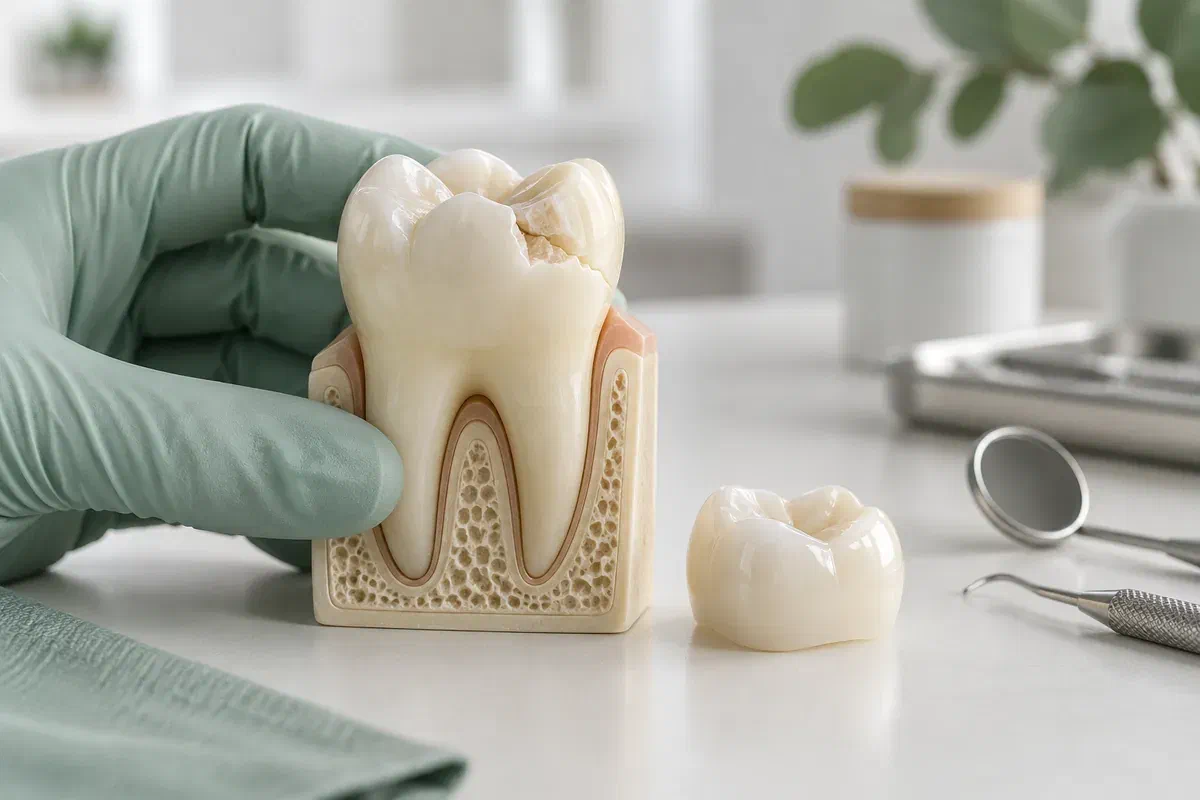
Illustrative tooth model and crown showing a restorative treatment concept
Narrowing it down in Halton Hills

Is it the surface, the inside or the root?

A crack can be shallow or serious. The dentist considers the remaining sound structure, the health of the pulp and how far the fracture reaches, and rules out other causes of sensitivity, before recommending anything.

A crack in the chewing surface

Fine fractures near a cusp or old filling can let cold reach sensitive dentine. The dentist weighs whether sealing and rebuilding that area will be enough or whether the tooth needs a restoration that covers and supports it.

Sensitivity that lingers

Cold pain that fades in a second or two is different from an ache that hangs on. Lingering pain and test results help show whether the pulp is irritated or damaged, and whether care inside the tooth may be needed.

A fracture that limits the options

Some cracks extend deep under the gum or split the tooth, making a durable repair unlikely. Ask which findings suggest this and whether a specialist opinion would help before you make a significant decision.

Sometimes the source of sensitivity is not fully clear after one visit. Ask what the next step would show and how the plan would change if a crack proves deeper than expected.

What treatment can offer

Seal the problem, protect the tooth, set fair expectations

Where a cracked tooth can be kept, treatment usually rebuilds the affected area and gives the rest of the tooth suitable support. If the pulp is involved, root canal treatment may be part of the plan too. These are related aims, but each is its own procedure.

Unfortunately, a crack will not close up by itself. A restoration may calm sensitivity and protect the tooth, yet it cannot guarantee the crack will never travel further. Holding both of those facts in mind makes it easier to judge what level of treatment is worthwhile.

Patient information: American Association of Endodontists — cracked teeth

The why behind each step

Ask what each proposed stage is for. Desensitising measures, a temporary, pulp treatment and the final restoration each target a different part of the problem.

Keeping a tooth that’s worth it

If the findings are favourable, saving your tooth may be a sound choice. The dentist should explain the reasons and point out anything that makes the long-term result less predictable.

What to do if things change

Follow-up visits and simple instructions help you act if sensitivity returns or the bite changes. Comfort straight after treatment is welcome, though reviews remain important.

How it’s handled

Pin down the cause, then treat it

Some cracks are repaired in one visit, others in stages or with a specialist. Ask how the steps tie to your diagnosis and how to look after the tooth in the meantime.

  1. Test and explain

    We ask when the sensitivity happens, examine the tooth and use appropriate tests and images. The dentist explains whether a crack seems likely, where it runs and what other causes have been considered.

  2. Choose the approach together

    You hear the purpose, limits, stages and costs of each reasonable option, including simpler measures where they fit. We also agree how an unexpected finding would be handled.

  3. Treat the tooth

    Treatment may be a bonded filling, an onlay or crown, or care inside the tooth where the pulp needs it. We explain how you’ll be kept comfortable and what to expect from any temporary.

  4. Recheck the bite and the sensitivity

    We confirm the tooth meets its neighbours correctly and ask how it feels. Find out when ordinary eating can resume, what symptoms are worth a call and which appointments remain.

After your visit

Less sensitivity is promising, not the end of the story

Aftercare depends on the treatment and whether the final restoration is finished. Keep your written advice and our number in reach, particularly when care involves more than one appointment.

Handle temporaries gently

A temporary filling or crown protects the tooth for a short time but isn’t as robust as the final one. Ask about foods to avoid and cleaning around it. Call if it loosens or breaks instead of waiting it out.

Pay attention to your bite

Let us know if the treated tooth feels high, hurts during ordinary chewing or develops new sensitivity. Please don’t bite down on a high spot repeatedly in an effort to wear it away.

Talk about grinding and hard foods

Clenching, grinding and crunching ice or hard sweets put cracked teeth under extra strain. The dentist can discuss protective options, while explaining that none can guarantee the tooth won’t crack again.

Treatment choices

A repair matched to the crack

Each option carries benefits and limits. Ask how it suits the location of the crack, the remaining tooth structure and the health of the pulp before you agree.

When the tooth can be restored

Bonded filling, onlay or crown

A shallow, contained crack may be sealed and rebuilt with a bonded filling. Weaker teeth may need an onlay or crown, capping the cusps so the tooth is held together.

Where the inner tissue is affected

Pulp care followed by a restoration

If the pulp diagnosis warrants it and the tooth can still be restored, root canal treatment may be recommended. It deals with the inside of the tooth, and a final restoration is planned as a further step.

If keeping the tooth isn’t realistic

Removal and replacement options

An unfavourable fracture may mean the tooth is better removed. Ask why repair is unlikely to last, what a space could mean for nearby teeth, and which replacements and timings are worth considering.

Halton Hills FAQs

Sensitivity, cracks and what comes next

Many questions start with working out what is causing the discomfort. These answers are general; the examination will guide the advice for your own tooth.

(905) 876-4488
Could cold sensitivity mean a crack rather than worn enamel?
It could be either, or something else, such as a cavity or receding gums. Cracks often cause sharp pain on biting as well as with cold. An examination helps identify the cause so the treatment fits the problem.
Will sensitivity toothpaste help if my tooth is cracked?
It may dull the sensation for a while, but it won’t repair a crack. If one tooth keeps reacting, especially when you bite, it’s worth having it examined rather than relying on toothpaste alone.
What happens during an examination for a cracked tooth?
The dentist asks about your symptoms, looks closely at the tooth, often with magnification, and may use bite tests, cold tests, a special light or dye, and X-rays. Not every crack is visible, so findings are combined.
Can a crack let bacteria into the tooth?
It can. A crack can allow bacteria to reach the inner tooth over time, which may irritate or infect the pulp. That is one reason a symptomatic crack should be assessed rather than left indefinitely.
Does every cracked tooth end up needing a crown?
No. Small, contained cracks may be managed with a bonded filling, and some shallow ones simply need monitoring. A crown or onlay is more often suggested when the cusps are weakened or the crack is larger.
Why might a temporary be placed before the final decision?
A temporary can protect the tooth while the dentist sees how symptoms respond or completes further assessment. Ask what it is meant to show in your case, how long it should stay and what to do if it comes loose.
Visiting from Halton Hills

Find out what that twinge really means

Our Bronte Street practice can examine the tooth, look for a crack and rule out other causes of sensitivity. We’ll explain the findings and the reasonable options before any treatment is arranged.

Please phone if you have significant pain, swelling or a new break so we can advise on availability. Online requests are for non-urgent concerns.

Visit Milton Dental Clinic
Unit 1, 342 Bronte St. S, Milton, ON L9T 5B7
Get directions Clinic hours
Monday–Thursday
11am–7pm
Friday–Sunday
By appointment only

Areas we serve

  • Milton
  • Oakville
  • Mississauga
  • Georgetown
  • Halton Hills
  • Acton
  • Campbellville
  • Brampton
  • Burlington
  • Puslinch
  • Rockwood
  • Erin
  • Caledon
  • Etobicoke
  • Old Milton
  • Bronte Meadows
  • Timberlea
  • Dorset Park
  • Dempsey
  • Clarke
  • Beaty
  • Coates
  • Harrison
  • Scott
  • Willmott
  • Ford
  • Bowes
  • Cobden
  • Walker
  • Mountain View
  • Milton Heights
  • Hawthorne Village
  • Valley View
  • Fallingbrook
  • Nassagaweya
  • Trafalgar
  • Esquesing
  • Nelson
  • Brookville
  • Moffat
  • Glen Williams
  • Norval
  • Limehouse
  • Stewarttown
  • Ashgrove
  • Hornby
  • Silver Creek
  • Speyside
  • Scotch Block
  • North Oakville
  • River Oaks
  • Glen Abbey
  • West Oak Trails
  • Palermo
  • Bronte Creek
  • College Park
  • Joshua Creek
  • Uptown Core
  • Preserve
  • Iroquois Ridge
  • Lisgar
  • Meadowvale
  • Meadowvale Village
  • Churchill Meadows
  • Erin Mills
  • Central Erin Mills
  • Streetsville
  • East Credit
  • Creditview
  • Heartland
  • Sheridan
  • Mount Pleasant
  • Credit Valley
  • Huttonville
  • Churchville
  • Springbrook
  • Northwest Brampton
  • Bram West
  • Fletcher's Meadow
  • Fletcher's Creek South
  • Alton Village
  • Orchard
  • Millcroft
  • Headon Forest
  • Tansley
  • Brant Hills
  • Tyandaga
  • Kilbride
  • Lowville
  • Aberfoyle
  • Morriston
  • Arkell
  • Hillsburgh
  • Freelton
  • Carlisle
  • Waterdown
  • Flamborough
  • Mountsberg

How can we help?

Milton Dental Clinic

Have a question about your smile? Choose the option that works best for you.

For urgent dental concerns, please call.
Messages are reviewed during clinic hours.