

Illustrative conversation about treatment options for a cracked tooth
Restorative Dentistry

Cracked Tooth Treatment in Old Milton

Teeth that have carried large fillings for decades can develop cracks around them. For people in Old Milton, we assess how much strong tooth is left and explain which repair, if any, suits it.

Old fillings, new cracks

Has a well-worn filling finally reached its limit?

A filling placed twenty or thirty years ago may still look intact, yet the tooth walls beside it have been flexing with every meal since. Over time, fine cracks can form at the edges, and a corner of the tooth may eventually give way. Many people first notice it as a rough edge under the tongue or a twinge with cold drinks.

Cracks differ a great deal. One might be confined to a single cusp next to the old filling; another could run toward the centre of the tooth or down toward the root. The difference matters for treatment, and it is not always visible until the old material is taken out and the tooth underneath can be inspected.

Our goal is to show you what we find in plain terms and explain what each possible repair can and cannot achieve. Raise any question about comfort, scheduling, fees or alternatives. Making a decision about a cracked tooth is easier when you can see both the likely benefit and the limits together.

Have an older filling checked
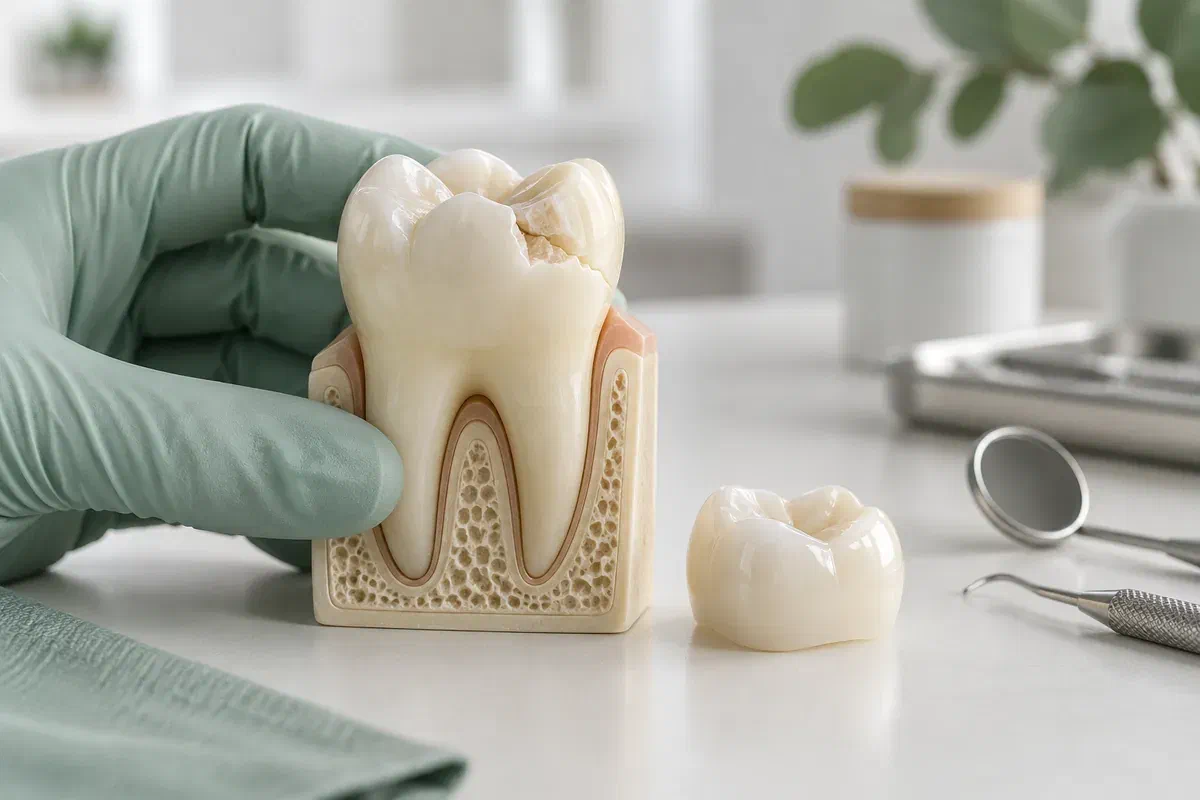
Illustrative tooth model and crown showing a restorative treatment concept
What we weigh up in Old Milton

Structure, nerve and depth

Calling something a crack says little about how to treat it. The dentist looks at how much healthy tooth surrounds the damage, how the pulp is responding and where the fracture ends before any recommendation is made.

Thin walls around a large filling

When most of a tooth is filling, the remaining enamel and dentine can be thin and brittle. The question is whether patching the cracked area is enough or whether the tooth needs a restoration that covers and holds it together.

How the inside of the tooth is coping

Lingering sensitivity, spontaneous aching and simple tests give clues about the pulp, the living tissue at the core of the tooth. If that tissue is inflamed or failing, an outer repair alone may not settle the problem.

Damage that runs beyond repair

Sometimes a crack extends deep under the gum or splits the tooth, leaving too little to restore with confidence. The dentist should tell you which findings suggest this and whether a second opinion is worth seeking first.

A careful examination does not always settle every question. Ask what would happen if more damage appeared during treatment and how you would be included in any change of plan.

The purpose of repair

Hold the tooth together and be honest about the odds

Where a tooth can be kept, treatment typically replaces weakened areas and adds support that suits what is left. If the pulp is involved, care inside the tooth may be part of the same plan. These aims are connected, but each is a distinct step with its own role.

Cracks in teeth do not heal. A restoration can make the tooth stronger in daily use, yet it cannot rule out a crack spreading later. Understanding this from the start lets you balance the expected gain against the uncertainty, including the chance that more treatment could be needed in future.

Patient information: American Association of Endodontists — cracked teeth

Knowing why each stage exists

Ask what each proposed appointment is meant to fix. A temporary, any root canal treatment and the final crown or onlay serve different purposes and should not blur into one vague repair.

Keeping a tooth worth keeping

If the findings are encouraging, holding on to your own tooth can be a good choice. The dentist should explain the reasons for that view and anything that makes the long-term outlook harder to predict.

A clear route if things change

Booked reviews and simple instructions help you act if symptoms come back or your bite feels different. Comfort after treatment is a good sign, and knowing what to report still matters.

Planning the work

Agree on the order first

A cracked tooth may need one visit or several, and sometimes a specialist. Ask how the steps connect to what was found and how the tooth should be treated while you wait between them.

  1. Look at the evidence together

    We review your symptoms, the examination and any images. The dentist describes where the crack appears to go, whether the tooth seems restorable and which questions remain open.

  2. Choose an approach and consent

    Each reasonable option is explained with its purpose, limits, stages and costs. We also agree what would happen if the old filling hides more damage than expected and which choices might need revisiting.

  3. Remove, inspect and restore

    Often the old filling is removed so the tooth can be examined directly. Care may then involve a new filling, a crown or onlay, pulp treatment or another suitable step, with comfort measures explained as we go.

  4. Confirm the bite and next steps

    The finished or temporary restoration is checked against your bite. Ask when you can eat normally, which symptoms call for a phone call and whether further visits or referrals are still planned.

Caring for the repaired tooth

Comfort is a good sign. Reviews still matter.

What you need to do afterwards depends on the treatment and whether the final restoration has been placed. Hold on to the written advice and contact details, especially during care that spans several appointments.

Go easy on a temporary

Temporary crowns and fillings protect the tooth for a while but are not as strong as the final version. Ask which foods to skip and how to clean around it. Call us if it comes loose or cracks, rather than waiting for your next booking.

Mention any change in your bite

If the tooth seems to land before the others, feels sore when you chew everyday foods or starts behaving differently, let us know. Avoid trying to adjust a high spot yourself by clenching on it.

Consider the forces on your teeth

Grinding, clenching and biting on very hard things put extra strain on restored teeth. The dentist can talk about whether a night guard or similar measure is sensible, while being clear that it reduces risk rather than removing it.

Repair choices

The remaining tooth decides what will work

Each approach has strengths and limits. Ask how it fits the location of the crack, the strength of the surrounding tooth and the state of the pulp before you commit.

When enough sound tooth remains

A new filling, onlay or crown

A small cracked area might be managed by replacing the old filling. Where the walls are thin, an onlay or crown that wraps over the chewing surface can spread biting forces and help brace the tooth.

When the pulp is affected

Root canal care plus a final restoration

If testing shows the pulp needs treatment and the tooth is still restorable, root canal treatment may be advised. That deals with the inside of the tooth; a crown or other final restoration is planned as a further step.

When keeping it isn’t realistic

Taking the tooth out and planning ahead

An unfavourable fracture may mean extraction is the better path. Ask why repair is unlikely to last, what a gap could mean for nearby teeth and which replacement options and timings you might consider.

Old Milton questions

What people ask about cracks and old fillings

Questions often focus on why a tooth cracked now and what the repair will involve. These answers give general guidance; your own examination fills in the specifics.

(905) 876-4488
Can an old silver filling make a tooth more likely to crack?
Large fillings of any material leave less natural tooth to carry biting forces, and the remaining walls can weaken over the years. That does not mean every old filling needs replacing. The dentist looks for signs of cracks or breakdown and explains whether action makes sense.
Should I replace my old fillings before they crack?
Not automatically. Replacing a sound filling also removes some tooth structure. If there are visible cracks, symptoms or breakdown at the edges, the dentist may discuss options. Otherwise, monitoring at regular checkups is often reasonable.
What are the fine lines I can see on my front teeth?
Many adults have craze lines, very shallow cracks in the outer enamel that usually cause no pain and often need no treatment. Mention them if they change or become uncomfortable, so the dentist can check that nothing deeper is going on.
Is root canal treatment needed whenever a crack reaches the nerve area?
It depends on the diagnosis of the pulp. If that tissue is irreversibly inflamed or infected, root canal treatment may be recommended, provided enough tooth remains to restore afterwards. A crack line on its own is not the deciding factor.
Will I need a temporary crown while the final one is made?
Often, yes, if a laboratory-made crown or onlay is planned. The temporary protects the tooth in the meantime. Ask how long it will stay, what to avoid eating and what to do if it loosens or breaks.
Can I ask for a specialist to look at the tooth first?
Yes. A referral to an endodontist or another specialist can help when the diagnosis or outlook is unclear. Ask how urgent the situation is and how to manage the tooth while you wait. A second view adds information but cannot remove every uncertainty.
Visit us from Old Milton

Have the tooth examined before it breaks further

Our Bronte Street practice is close to Milton’s historic downtown. We’ll look at the cracked tooth and any older fillings around it, explain the findings and talk through each reasonable option before you decide on treatment.

For severe pain, swelling or a tooth that has just broken, please call so we can advise on the earliest suitable time. Online forms suit non-urgent questions.

Visit Milton Dental Clinic
Unit 1, 342 Bronte St. S, Milton, ON L9T 5B7
Get directions Clinic hours
Monday–Thursday
11am–7pm
Friday–Sunday
By appointment only

Areas we serve

  • Milton
  • Oakville
  • Mississauga
  • Georgetown
  • Halton Hills
  • Acton
  • Campbellville
  • Brampton
  • Burlington
  • Puslinch
  • Rockwood
  • Erin
  • Caledon
  • Etobicoke
  • Old Milton
  • Bronte Meadows
  • Timberlea
  • Dorset Park
  • Dempsey
  • Clarke
  • Beaty
  • Coates
  • Harrison
  • Scott
  • Willmott
  • Ford
  • Bowes
  • Cobden
  • Walker
  • Mountain View
  • Milton Heights
  • Hawthorne Village
  • Valley View
  • Fallingbrook
  • Nassagaweya
  • Trafalgar
  • Esquesing
  • Nelson
  • Brookville
  • Moffat
  • Glen Williams
  • Norval
  • Limehouse
  • Stewarttown
  • Ashgrove
  • Hornby
  • Silver Creek
  • Speyside
  • Scotch Block
  • North Oakville
  • River Oaks
  • Glen Abbey
  • West Oak Trails
  • Palermo
  • Bronte Creek
  • College Park
  • Joshua Creek
  • Uptown Core
  • Preserve
  • Iroquois Ridge
  • Lisgar
  • Meadowvale
  • Meadowvale Village
  • Churchill Meadows
  • Erin Mills
  • Central Erin Mills
  • Streetsville
  • East Credit
  • Creditview
  • Heartland
  • Sheridan
  • Mount Pleasant
  • Credit Valley
  • Huttonville
  • Churchville
  • Springbrook
  • Northwest Brampton
  • Bram West
  • Fletcher's Meadow
  • Fletcher's Creek South
  • Alton Village
  • Orchard
  • Millcroft
  • Headon Forest
  • Tansley
  • Brant Hills
  • Tyandaga
  • Kilbride
  • Lowville
  • Aberfoyle
  • Morriston
  • Arkell
  • Hillsburgh
  • Freelton
  • Carlisle
  • Waterdown
  • Flamborough
  • Mountsberg

How can we help?

Milton Dental Clinic

Have a question about your smile? Choose the option that works best for you.

For urgent dental concerns, please call.
Messages are reviewed during clinic hours.