

Illustrative consultation about replacing an existing dental bridge
Restorative Dentistry

Dental Bridge Replacement in Milton

A bridge that has served you for years can still be sound, or it can be quietly letting a support down. Here in Milton, we check the restoration, its foundation and your daily habits before any talk of replacing it.

When a long-serving bridge raises questions

How many years is too many for a bridge?

People often ask that the first time a bridge feels slightly different. The honest answer is that there is no fixed expiry date. A bridge links one or more replacement teeth to neighbouring teeth or implants, and its usefulness depends on how well that whole unit, supports included, is holding up.

Some older bridges stay comfortable, clean easily and sit on healthy supports. Others develop decay at a margin, a failing cement seal or worn porcelain. The sign that brings you in, perhaps a rocking feeling, a bad taste or a chip, guides the examination, but it does not settle the answer on its own.

For people around Milton who already come to us for checkups, a bridge review can often sit alongside that routine. Tell us what has changed and what you have liked about the current one. If the supports can only be judged properly once the bridge is off, we will say so before you agree to anything.

Have your current bridge checked
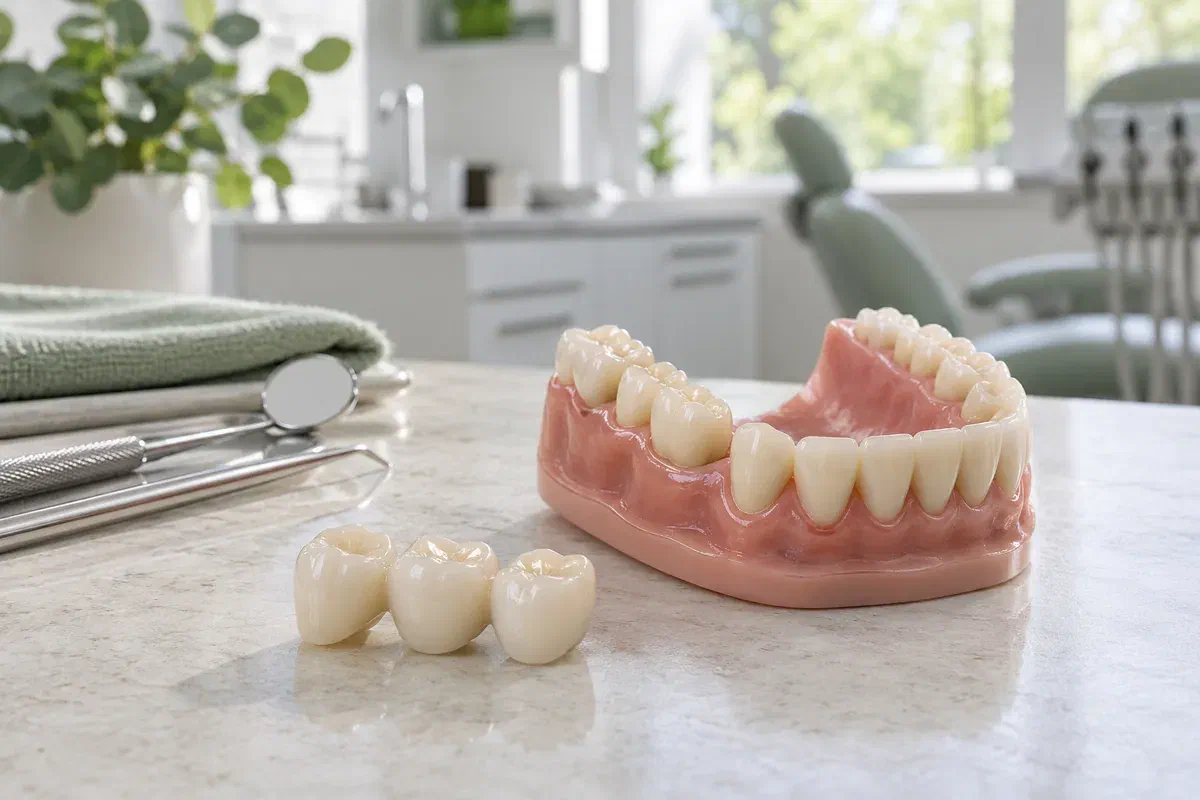
Ceramic three-unit bridge beside a dental teaching model
Signs worth mentioning

What prompts a second look at an older bridge

Not every change means failure, and not every failure shows from the outside. A careful examination keeps the advice in proportion to what is actually happening around the restoration.

Coming loose more than once

One recementation may solve a simple problem. When the same bridge has loosened or cracked more than once, mention each episode. A pattern can suggest that the fit, design, biting forces or a support tooth deserve attention before yet another repair is tried.

Tenderness near an anchor tooth

Sore gum, a dull ache on biting or new sensitivity at one end of the bridge can come from the tooth holding it. That tooth may need treatment of its own, and what is found can shape whether a similar bridge still makes sense.

Food packing under the span

Point out where food gathers or where a floss threader refuses to pass. Those details help the dentist judge the current shape and think about how easily a future design could be kept clean at home.

Call the clinic if your bridge moves, hurts or has a jagged edge. Please don’t try to pull it off or glue it back yourself while you wait to be seen.

Why replacement can be a reset

A chance to rethink fit, bite and upkeep

When a bridge is replaced, its contour, its contact with neighbouring teeth and the way it meets your bite can be reconsidered rather than simply copied. That only helps if the supporting teeth or implants, and the gums around them, suit the new design.

Be clear on one point: a new bridge does not cure decay or gum disease hiding under an old one. Those problems are diagnosed and treated in their own right. Ask how the supports were assessed and what their condition means for the replacement’s outlook.

Your history shapes the design

Tell us what felt right and what annoyed you about the old bridge. That feedback can guide decisions on shape, shade and cleaning access, while recognizing that some features are better changed than repeated.

Clarity about the foundation

Once the supports are reviewed, the dentist can explain why a similar bridge remains reasonable or why another route is being suggested. You are welcome to ask which findings carry the most weight.

Upkeep planned from day one

A replacement should arrive with clear guidance on looking after it. Talk through which cleaning aids you can manage and what review schedule will keep watch over the bridge and the teeth beneath it.

From first visit to fitting

Each stage explained before it starts

The order of appointments depends on the kind of bridge you have and how its supports look. Ask early about temporary teeth, what might be discovered once the old bridge is removed and how the plan would adapt.

  1. Examine the bridge and its surroundings

    Your symptoms, past repairs, bite and gum health are reviewed, and suitable X-rays help show the supporting structures. The dentist also explains what cannot be confirmed while the bridge is still cemented in place.

  2. Weigh repair against replacement

    Together you consider whether the current bridge can be kept, mended or recemented. If a new one is advised, ask for the reasons, and go over the proposed design, the alternatives, the number of stages, fees and any open questions.

  3. Remove, treat and record

    Should you decide to go ahead, removal and any needed treatment are carried out with appropriate comfort measures. The supports are checked again, impressions or scans are taken, and the team describes the temporary bridge you will wear between visits.

  4. Seat the new bridge and practise cleaning

    Fit, contacts, bite and appearance are checked before the bridge is finalized. Ask to be shown how to clean underneath it, and confirm when your review is due and which changes should lead you to call.

Living with the new bridge

Look after the anchors, not just the teeth you can see

Home care has to reach the gum edges around each support and the space under the replacement teeth. Ask for steps that match this particular design instead of assuming your old routine will transfer unchanged.

Learn the cleaning path

The team can suggest aids such as threaders or small brushes and show you exactly where they should go. Mention any trouble with grip or reach so the routine is one you can keep up.

Watch for soreness or trapped food

Let us know about a bite that feels high, tenderness that lingers or a new spot where food lodges. Some unfamiliarity is common at first, but discomfort that persists should be checked rather than endured.

Stay on the review schedule

Both the bridge and its supporting teeth need monitoring over time. Bring up cleaning problems, gum changes or any movement at your reviews, and get in touch sooner if something new appears.

Patient information: Cleveland Clinic — dental bridges

Options for the gap

Your next restoration can differ from the last

Which choices fit depends on the size of the gap, the health of the remaining teeth or implants and what matters to you. Compare whole plans, including preparation, temporaries, upkeep and likely future care.

If the anchor teeth are still healthy

A new tooth-supported bridge

A fresh bridge may rest on the same supports once any needed treatment is done. Ask how much work those teeth require and how their condition affects how long the new restoration is likely to stay useful.

If a different foundation deserves a look

Restoration on implants

Implants can be an alternative in a suitable mouth, but they need their own assessment and usually involve surgery and healing time. An existing implant bridge also needs compatible parts and a check of the implants beneath it.

If the overall plan should change

A partial denture or other approach

A removable partial denture or another option may be considered when the gap or remaining support makes a fixed bridge less suitable. Talk through comfort, handling, appearance and daily care as you compare.

Common bridge questions

Straight answers before you decide

Replacing a bridge involves more than the day it is fitted. These answers cover the questions we hear most often and the things the dentist needs to confirm before the final restoration is made.

(905) 876-4488
My bridge is twenty years old but feels fine. Should I replace it anyway?
Not on the basis of age alone. If examination and X-rays show healthy supports, a good seal and a bite that works, an older bridge can continue to serve you. Regular reviews are the way to catch changes early rather than replacing a restoration that is still doing its job.
Can my existing bridge simply be recemented?
Sometimes. If it came loose without damage and the supporting teeth are sound, recementing may be reasonable. If decay, a fracture or a poor fit is found, the dentist will explain why that option is less suitable and what the alternatives are.
Is taking an old bridge off uncomfortable?
Local anaesthetic is used where appropriate, and the team will explain what you may feel. Removal sometimes requires sectioning the bridge, which is one reason the old one usually cannot be reused. Tell us about any anxiety so comfort can be planned.
What will I wear while the new bridge is being made?
A temporary restoration is often placed, though the arrangement depends on the supports and planned work. Ask how to clean it and which foods to avoid, and let us know about upcoming events so timing can be discussed realistically.
Will the new bridge match my other teeth?
Shade and shape are part of the planning. If you are considering whitening, mention it early, because bridge materials do not change colour with whitening products. The final look still has to suit your bite, space and cleaning needs.
I already see Milton Dental Clinic for cleanings. Can the bridge review happen then?
Often it can be raised at a checkup, although a full replacement assessment may need its own appointment and additional imaging. Mention the bridge when booking so enough time is set aside.
Book in Milton

Bring the bridge, and its story, to us

Visit our Bronte Street practice with your questions about an older or damaged bridge. We will assess the restoration and the teeth or implants holding it, explain what can stay and walk you through replacement options that suit your comfort and routine.

If your bridge is loose or painful, please phone before booking a routine appointment online so we can advise on timing.

Visit Milton Dental Clinic
Unit 1, 342 Bronte St. S, Milton, ON L9T 5B7
Get directions Clinic hours
Monday–Thursday
11am–7pm
Friday–Sunday
By appointment only

Areas we serve

  • Milton
  • Oakville
  • Mississauga
  • Georgetown
  • Halton Hills
  • Acton
  • Campbellville
  • Brampton
  • Burlington
  • Puslinch
  • Rockwood
  • Erin
  • Caledon
  • Etobicoke
  • Old Milton
  • Bronte Meadows
  • Timberlea
  • Dorset Park
  • Dempsey
  • Clarke
  • Beaty
  • Coates
  • Harrison
  • Scott
  • Willmott
  • Ford
  • Bowes
  • Cobden
  • Walker
  • Mountain View
  • Milton Heights
  • Hawthorne Village
  • Valley View
  • Fallingbrook
  • Nassagaweya
  • Trafalgar
  • Esquesing
  • Nelson
  • Brookville
  • Moffat
  • Glen Williams
  • Norval
  • Limehouse
  • Stewarttown
  • Ashgrove
  • Hornby
  • Silver Creek
  • Speyside
  • Scotch Block
  • North Oakville
  • River Oaks
  • Glen Abbey
  • West Oak Trails
  • Palermo
  • Bronte Creek
  • College Park
  • Joshua Creek
  • Uptown Core
  • Preserve
  • Iroquois Ridge
  • Lisgar
  • Meadowvale
  • Meadowvale Village
  • Churchill Meadows
  • Erin Mills
  • Central Erin Mills
  • Streetsville
  • East Credit
  • Creditview
  • Heartland
  • Sheridan
  • Mount Pleasant
  • Credit Valley
  • Huttonville
  • Churchville
  • Springbrook
  • Northwest Brampton
  • Bram West
  • Fletcher's Meadow
  • Fletcher's Creek South
  • Alton Village
  • Orchard
  • Millcroft
  • Headon Forest
  • Tansley
  • Brant Hills
  • Tyandaga
  • Kilbride
  • Lowville
  • Aberfoyle
  • Morriston
  • Arkell
  • Hillsburgh
  • Freelton
  • Carlisle
  • Waterdown
  • Flamborough
  • Mountsberg

How can we help?

Milton Dental Clinic

Have a question about your smile? Choose the option that works best for you.

For urgent dental concerns, please call.
Messages are reviewed during clinic hours.