

Illustrative consultation about replacing an existing dental bridge
Restorative Dentistry

Dental Bridge Replacement in Old Milton

Some bridges in Old Milton were placed by a dentist who has long since retired. When yours starts to feel or look different, we piece together its history, examine what holds it up and explain the realistic paths forward.

Old Milton · bridges with a past

Dental work from another era, assessed today

Plenty of people living near Milton’s historic downtown carry a bridge made decades ago, sometimes with little memory of who placed it. That is no barrier to a good assessment. What matters is how the false teeth, the crowns or implants anchoring them and the gum around them are doing now.

Perhaps the porcelain has worn, a metal margin has become visible or the bridge feels faintly mobile. Each of those points in a different direction. An older restoration that remains stable and cleanable is not the same as one sitting on a weakening tooth, and the calendar is not the deciding factor.

Bring whatever records you have, even an old receipt or a note of the previous office, along with your own sense of what has changed. We can then talk about keeping, mending or replacing the bridge. When the supports cannot be fully judged until it is removed, you will hear that plainly beforehand.

Arrange an assessment of your bridge
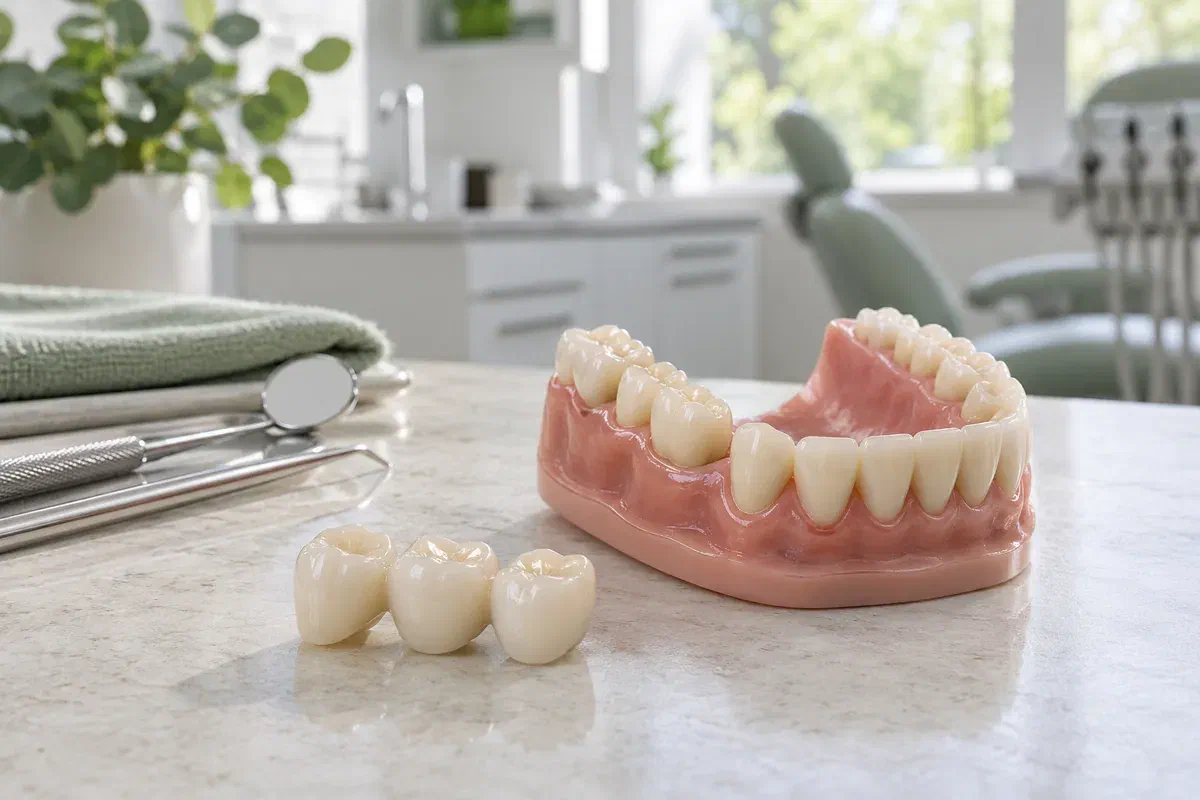
Ceramic three-unit bridge beside a dental teaching model
What older bridges tend to show

Small changes that are worth reporting

Appearance and health do not always move together. A bridge can look tired yet be sound, or look tidy while something underneath needs care. Examination helps match the response to what is really there.

Recurring repairs over the years

If you have had the bridge glued back or patched several times, share that record. Repeated trouble may be a single local issue, or it may point to a fit, design or bite problem that makes one more repair a weaker choice.

An anchor tooth that feels different

A tooth at either end that has become tender, sensitive or puffy at the gum line warrants a closer look. It may need care regardless of the bridge, and its condition can influence whether a similar design is sensible again.

Floss that catches or shreds

Describe where cleaning has become awkward or where food keeps lodging. Those observations help the dentist understand the current contours and keep home care in mind when discussing what could come next.

If a bridge shifts, aches or leaves a sharp broken edge, contact the clinic. Avoid prying at it or attempting a home repair while you wait for guidance.

What a fresh plan can offer

Today’s review, not yesterday’s design

A replacement allows shape, contacts and the way the teeth meet to be reconsidered with current findings in hand. That benefit depends on the supporting teeth or implants and the surrounding tissue being suitable for whatever design is proposed.

One caution applies to every older bridge: renewing it does not by itself treat decay or gum disease beneath it. Anything found there needs its own diagnosis and care. Ask how the foundation was evaluated and what that evaluation suggests about the new restoration.

Lessons from the old bridge

You have lived with this restoration for a long time. Your comments on comfort, appearance and cleaning can inform the next design, though not every feature of the old one will be worth repeating.

An honest picture of the supports

A review of the foundation explains whether a similar bridge still fits your situation or why something different is being raised. Ask which observations have shaped that view most.

Care instructions you can follow

Before the new bridge is finished, expect a practical walk-through of daily cleaning. Discuss tools that are comfortable for you and how often the bridge and its supports should be reviewed.

The route from old bridge to new

No surprises about removal day

Timing varies with the type of bridge and how its supports look. Ask in advance about a temporary, about what could be uncovered once the old bridge is off and about how the plan would shift if needed.

  1. Gather history and examine

    The dentist asks about symptoms and past repairs, checks your bite and gums and takes suitable images of the supports. You will also learn which questions cannot be answered while the bridge remains cemented.

  2. Discuss keeping it versus renewing it

    Options such as maintaining, repairing or recementing are compared first. If a replacement is advised, you can ask why and review the design, alternatives, appointments, fees and any uncertainties.

  3. Take off the old bridge with care

    When you decide to proceed, removal and any required treatment are planned with comfort measures suited to you. The supports are rechecked, records for the new bridge are taken and a temporary is explained if one is needed.

  4. Fit, adjust and teach

    The new bridge is assessed for fit, contacts, bite and appearance before it is cemented. Ask for a demonstration of cleaning beneath it and confirm when your follow-up is due and what should prompt a call.

Daily care after fitting

Supports first, appearance second

Cleaning has to reach under the replacement teeth and along the gum line of every anchor. Ask for guidance on this specific bridge, because the technique that suited your old one may not carry over.

Rehearse the routine with us

The team can recommend aids and show where each one needs to go. If arthritis, grip strength or reach make a method awkward, say so, and a more manageable approach can be considered.

Track comfort over the first weeks

Mention a bite that feels uneven, soreness that lingers or a new pocket where food collects. Feeling a new bridge is normal at first, but ongoing discomfort deserves a check rather than patience alone.

Return for reviews

Monitoring the bridge and its supports is an ongoing job. Raise cleaning trouble, gum changes or movement at each review, and contact us between visits if a fresh problem shows up.

Patient information: Cleveland Clinic — dental bridges

Paths for the next restoration

More than one way to fill the space

What suits you depends on the gap, the remaining teeth or implants and your own priorities. Compare full plans, including preparation, any temporary stage, upkeep and treatment you might need later.

Where the anchors remain dependable

A bridge on natural teeth again

A replacement may use the existing supporting teeth after any necessary treatment. Ask how much work those teeth need and how their condition affects the realistic lifespan of the new bridge.

Where a new foundation may be considered

Implant-supported teeth

Implants may suit some mouths but require a separate assessment and can involve surgery and healing time. If implants already hold your bridge, compatible components and the condition of those implants both need review.

Where a fixed bridge is less suitable

A removable partial or another plan

When the gap or remaining support makes a fixed bridge harder to justify, a removable partial denture or another approach may be discussed. Compare comfort, handling, appearance and care side by side.

Your questions, answered

What people ask about replacing older bridges

Around Old Milton, these answers address common concerns about removal, the in-between stage and what the dentist needs to confirm before a final bridge is made.

(905) 876-4488
I don’t know who made my bridge. Does that matter?
It is helpful but not essential. The examination and suitable X-rays show the current condition. If you can find the name of a previous office, we may be able to request records, which can fill in details such as when it was placed.
My old bridge has a grey line at the gum. Is that a problem?
It can be a cosmetic concern related to the materials used or to gum changes, and it is not always a sign of failure. The dentist can check whether there is decay or recession at that edge and explain whether it affects the decision.
Can a bridge that has lasted decades be left alone?
If it is stable, cleanable and the supports are healthy, continuing to monitor it can be reasonable. Ask which specific findings would change that advice so you know what to watch for between reviews.
What if an anchor tooth turns out to be weaker than expected once the bridge is off?
The plan may need to change. The dentist will explain whether that tooth can be treated and kept or whether a different design or approach is better, and how that affects the sequence and the alternatives.
Do I need to stop any medications before removal?
Do not stop anything on your own. Tell the team about all medications and health conditions, including blood thinners, so they can decide whether any coordination with your physician is appropriate before treatment.
Can a family member come with me to the consultation?
Yes. A second set of ears can help when comparing options, especially for longer plans. Let us know when booking if you would like someone with you during the discussion.
Old Milton and beyond

Let’s see how your bridge is really doing.

Our Bronte Street practice is a short way from Milton’s historic downtown. Bring the bridge you are unsure about, and we will examine it and its supports, discuss what can be kept and explain replacement choices with your comfort and daily routine in mind.

Phone the clinic first if the bridge is loose or sore, so we can advise you before you book a routine visit online.

Visit Milton Dental Clinic
Unit 1, 342 Bronte St. S, Milton, ON L9T 5B7
Get directions Clinic hours
Monday–Thursday
11am–7pm
Friday–Sunday
By appointment only

Areas we serve

  • Milton
  • Oakville
  • Mississauga
  • Georgetown
  • Halton Hills
  • Acton
  • Campbellville
  • Brampton
  • Burlington
  • Puslinch
  • Rockwood
  • Erin
  • Caledon
  • Etobicoke
  • Old Milton
  • Bronte Meadows
  • Timberlea
  • Dorset Park
  • Dempsey
  • Clarke
  • Beaty
  • Coates
  • Harrison
  • Scott
  • Willmott
  • Ford
  • Bowes
  • Cobden
  • Walker
  • Mountain View
  • Milton Heights
  • Hawthorne Village
  • Valley View
  • Fallingbrook
  • Nassagaweya
  • Trafalgar
  • Esquesing
  • Nelson
  • Brookville
  • Moffat
  • Glen Williams
  • Norval
  • Limehouse
  • Stewarttown
  • Ashgrove
  • Hornby
  • Silver Creek
  • Speyside
  • Scotch Block
  • North Oakville
  • River Oaks
  • Glen Abbey
  • West Oak Trails
  • Palermo
  • Bronte Creek
  • College Park
  • Joshua Creek
  • Uptown Core
  • Preserve
  • Iroquois Ridge
  • Lisgar
  • Meadowvale
  • Meadowvale Village
  • Churchill Meadows
  • Erin Mills
  • Central Erin Mills
  • Streetsville
  • East Credit
  • Creditview
  • Heartland
  • Sheridan
  • Mount Pleasant
  • Credit Valley
  • Huttonville
  • Churchville
  • Springbrook
  • Northwest Brampton
  • Bram West
  • Fletcher's Meadow
  • Fletcher's Creek South
  • Alton Village
  • Orchard
  • Millcroft
  • Headon Forest
  • Tansley
  • Brant Hills
  • Tyandaga
  • Kilbride
  • Lowville
  • Aberfoyle
  • Morriston
  • Arkell
  • Hillsburgh
  • Freelton
  • Carlisle
  • Waterdown
  • Flamborough
  • Mountsberg

How can we help?

Milton Dental Clinic

Have a question about your smile? Choose the option that works best for you.

For urgent dental concerns, please call.
Messages are reviewed during clinic hours.