

Illustrative patient consultation about damage to a dental crown
Restorative Dentistry

Dental Crown Repair in Oakville

A chip on a front crown is hard to stop noticing. If you are coming from Oakville, we can look at the damage, the crown material and the tooth under it, then explain whether a repair is likely to look and work the way you hope.

When the chip is in plain view

A missing corner in every photo.

Perhaps you caught it in a mirror, or a friend’s picture showed a notch you had never seen before. Crowns are strong, but their surfaces can still chip, wear or crack. A contained repair is sometimes possible, as long as the remainder of the crown is still suitable to keep.

How it looks is only one question. A cosmetic chip on a stable crown is not the same as a fracture through the restoration or a crown with something going wrong beneath it. A good repair never conceals a loose fit or decay, so the dentist looks at the whole crown and the tooth holding it.

For people travelling up from Oakville, it helps to share a few details when you call: when the chip appeared, whether it bothers you while eating and what you would like changed about its appearance. At the visit we compare polishing, a localized repair, replacement and other approaches, including what each can realistically achieve.

Arrange a look at the chip
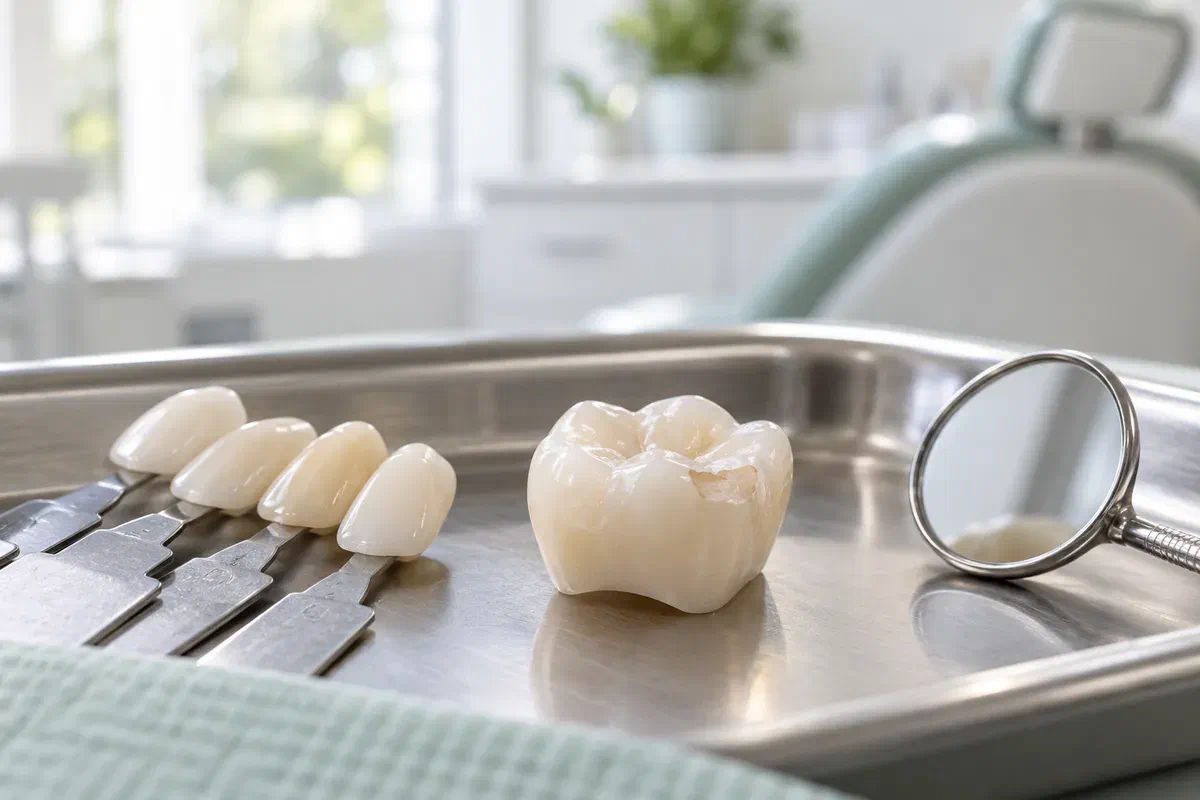
Ceramic crown with a small chipped area beside a shade guide
What tends to prompt a visit

Looks, comfort and bite all count.

Explain what you have noticed and what happens when you use that tooth. Even a slight defect can be worth attention if it scrapes your tongue, interferes with your bite, or is the surface sign of a deeper break.

A sharp spot your tongue keeps finding

Rough edges are tempting to ignore, but they deserve an examination. The dentist decides whether gentle refinement is safe, or whether it would take off too much material, change the crown’s profile or leave a more serious problem behind.

A notch you notice when you smile

On a front crown, a broken outer surface can be obvious. Tell the dentist exactly what bothers you, and ask how closely a repair may match the surrounding material today and how that match could change as it ages.

When the broken part does the biting

Front teeth cut and guide your bite, so damage along the biting edge faces different stresses than one near the gum. The dentist checks how the opposite teeth meet the crown before suggesting a local repair.

Mention any wobble, ache, swelling or knock to the mouth. Visible damage on a crown can occur alongside a problem in the tooth that supports it.

What a repair can offer

Sometimes the best change is a small one.

Where the damage is limited and in a workable spot, fixing just that section can save a crown that is otherwise doing well. It is most worth considering when the restoration still sits firmly and nothing under it calls for treatment that would rule out a surface repair.

Expect that a repaired area may look or wear slightly differently from the original crown. Durability and colour match depend on the details of your case, and some repairs are designed as a short-term step. Ask plainly whether you are getting a long-term solution or something to buy time before replacement.

A response sized to the chip

A minor flaw is not always a reason to remove the whole crown. Assessment helps show when a modest fix is reasonable and when the damage is too extensive, or poorly placed, for a repair to be of real use.

Realistic aesthetic expectations

You may want a crisper edge, a softer outline or a missing surface rebuilt. Ask how the proposed repair addresses that goal and which differences in gloss or shade could still be visible up close.

Insight into why it chipped

If this is not the first chip, ask what keeps stressing the area. Repair carries more value when the surrounding factors are considered too, instead of seeing each break as a random event.

Your crown repair visit

Look, talk it through, treat, then check.

The approach depends on the crown and on how it was damaged. Expect an examination first and a clear outline of your choices, which may include the advice that replacing the crown would be wiser than repairing it.

  1. Examine the crown and its support

    The dentist reviews the crown’s condition and stability, the surrounding gum and tissues, and any symptoms. Details about the material or previous work are helpful, yet the findings on the day drive the advice.

  2. Agree on how much to do

    Talk through smoothing, a bonded repair or a new crown. Ask about the finish you can expect, the purpose of the repair, how to maintain it and what the next step would be if it chips again.

  3. Restore or refine the surface

    When a repair is suitable, the area is prepared with a technique that suits the crown material. The dentist shapes and polishes the repair, or carefully refines an edge if adding material is not needed.

  4. Test the bite and confirm the plan

    Your bite and the treated surface are checked, and you can describe how it feels. Ask about early precautions and any review appointment, particularly if the repair is temporary or other treatment is still being discussed.

Living with the repair

Gentle on the edge, steady with cleaning.

What you can do afterwards depends on what was done. A light polish asks very little of you, while bonded material or a stopgap repair may come with a few days of extra care, so check before you return to normal.

Avoid biting into hard things with front teeth

Biting into hard objects or using your teeth as a tool puts focused stress on a small repaired area. If you clench or grind, mention it so the dentist can discuss whether more assessment or protection is worthwhile.

Keep the gumline around it clean

Keep up the brushing and flossing routine you were given. The edge where crown meets tooth still collects plaque after a repair, and the gum there needs the same daily attention. Ask for help if the shape makes cleaning tricky.

Report any rough patch early

Contact the clinic if the repaired area roughens, changes in appearance or chips again. Resist the urge to smooth it yourself. The team should assess whether the original plan still fits.

Patient information: Cleveland Clinic — dental crowns

Picking a level of repair

Start from what is still intact.

Each route solves a different problem. Before choosing, find out what the dentist thinks of the crown as a whole, because the quickest way to hide a chip is not always the one that serves the tooth.

When no build-up is needed

Light polishing of a rough edge

A small surface flaw might be polished if the shape and remaining thickness allow it. The dentist makes sure this will not leave an awkward contour or disguise damage that needs a different kind of care.

When a contained defect can be restored

Bonding a repair to a chipped area

A suitable repair material can be used for some chips. The crown material, the surface available to bond to, the appearance you want and the forces on the tooth all shape the advice and its limits.

When the damage is extensive

A new crown or care beneath it

Sometimes the chip is a symptom of a bigger story: a wide fracture, an edge that no longer seals, repeated breakage or trouble in the tooth itself. In those cases replacement may be wiser, with any care the tooth needs finished first.

Answers before you book

Questions about chips you can see

Most of these come down to one thing: matching what the chip allows with what you are hoping to see in the mirror. Use them to frame your own conversation with the dentist.

(905) 876-4488
Can a chipped front crown be repaired so it does not show in photos?
A repair may improve the appearance noticeably, but an invisible result cannot be promised. How light passes through the crown, its existing colour and exactly where the chip sits all play a part. Ask the dentist what is realistic for your crown and how it may look in different lighting.
Can whitening my other teeth help a repaired crown blend in?
Whitening does not change the colour of a crown or repair material. If you are thinking about whitening, mention it before the repair is planned, since the dentist may suggest an order of treatment that makes matching more predictable.
Does the type of crown affect whether a chip can be fixed?
Yes. Different materials respond differently to repair, and the surface available matters. The dentist assesses your crown directly. Bring any records you have about its material, but do not assume a method that worked on another crown will suit this one.
Coming from Oakville, can I keep the number of trips down?
Mention your situation when you book. A minor refinement may be possible at the first visit if it turns out to be suitable, while a new crown or treatment beneath it involves more appointments. The team can help you plan the timing once the crown has been examined.
Why might the dentist suggest a temporary fix first?
A temporary repair can make sense while another concern is investigated or a longer-term plan is arranged. Ask what it is meant to do, how to treat the tooth in the meantime and when the next decision is due. It should come with a clear follow-up plan.
If the repair chips again later, will I lose the tooth?
Not automatically. One failed repair says little about whether the tooth itself can be saved. The dentist looks again at the crown, at what is holding it up and at the reason it gave way twice, and from there a new crown or a different plan may be suggested.
Crown repair for Oakville

Bring the chip. We’ll bring the honest answers.

Your front crown deserves a proper look, not a guess. At our Bronte Street practice we examine the chip, the restoration around it and the supporting tooth, talk openly about how a repair is likely to look up close, and help you choose a next step.

If a fragment came away, bring it in a small sealed container. Phone ahead about strong pain, swelling or any looseness, since those can change how quickly you should be seen.

Visit Milton Dental Clinic
Unit 1, 342 Bronte St. S, Milton, ON L9T 5B7
Get directions Clinic hours
Monday–Thursday
11am–7pm
Friday–Sunday
By appointment only

Areas we serve

  • Milton
  • Oakville
  • Mississauga
  • Georgetown
  • Halton Hills
  • Acton
  • Campbellville
  • Brampton
  • Burlington
  • Puslinch
  • Rockwood
  • Erin
  • Caledon
  • Etobicoke
  • Old Milton
  • Bronte Meadows
  • Timberlea
  • Dorset Park
  • Dempsey
  • Clarke
  • Beaty
  • Coates
  • Harrison
  • Scott
  • Willmott
  • Ford
  • Bowes
  • Cobden
  • Walker
  • Mountain View
  • Milton Heights
  • Hawthorne Village
  • Valley View
  • Fallingbrook
  • Nassagaweya
  • Trafalgar
  • Esquesing
  • Nelson
  • Brookville
  • Moffat
  • Glen Williams
  • Norval
  • Limehouse
  • Stewarttown
  • Ashgrove
  • Hornby
  • Silver Creek
  • Speyside
  • Scotch Block
  • North Oakville
  • River Oaks
  • Glen Abbey
  • West Oak Trails
  • Palermo
  • Bronte Creek
  • College Park
  • Joshua Creek
  • Uptown Core
  • Preserve
  • Iroquois Ridge
  • Lisgar
  • Meadowvale
  • Meadowvale Village
  • Churchill Meadows
  • Erin Mills
  • Central Erin Mills
  • Streetsville
  • East Credit
  • Creditview
  • Heartland
  • Sheridan
  • Mount Pleasant
  • Credit Valley
  • Huttonville
  • Churchville
  • Springbrook
  • Northwest Brampton
  • Bram West
  • Fletcher's Meadow
  • Fletcher's Creek South
  • Alton Village
  • Orchard
  • Millcroft
  • Headon Forest
  • Tansley
  • Brant Hills
  • Tyandaga
  • Kilbride
  • Lowville
  • Aberfoyle
  • Morriston
  • Arkell
  • Hillsburgh
  • Freelton
  • Carlisle
  • Waterdown
  • Flamborough
  • Mountsberg

How can we help?

Milton Dental Clinic

Have a question about your smile? Choose the option that works best for you.

For urgent dental concerns, please call.
Messages are reviewed during clinic hours.