

Illustrative consultation about suitability for a dental implant
Restorative Dentistry

Dental Implant Assessment in Halton Hills

Your general health is as much a part of implant planning as the gap itself. For people across Halton Hills, our assessment starts with your medical history and medicines, then looks at the site and every sensible replacement.

Halton Hills implant planning

Your health history comes first.

People sometimes expect an implant consultation to be all about the tooth. In practice, a good part of it is about you: the conditions you manage, the medicines you take, and how you have healed after past treatment. Those details sit alongside an examination of the gap, the gums and the teeth around it.

That matters because an implant is a process with several phases. Support is placed in the jaw, the area heals, a crown or similar restoration goes on, and then the result has to be kept clean and reviewed. Health factors can influence any of those phases, so they belong in the comparison with a bridge or removable replacement.

You can come in still weighing things up. Bring your medication list and your questions. We will explain what the examination shows, whether input from another health professional might help, and what alternatives are available before anything is decided.

Request an implant assessment
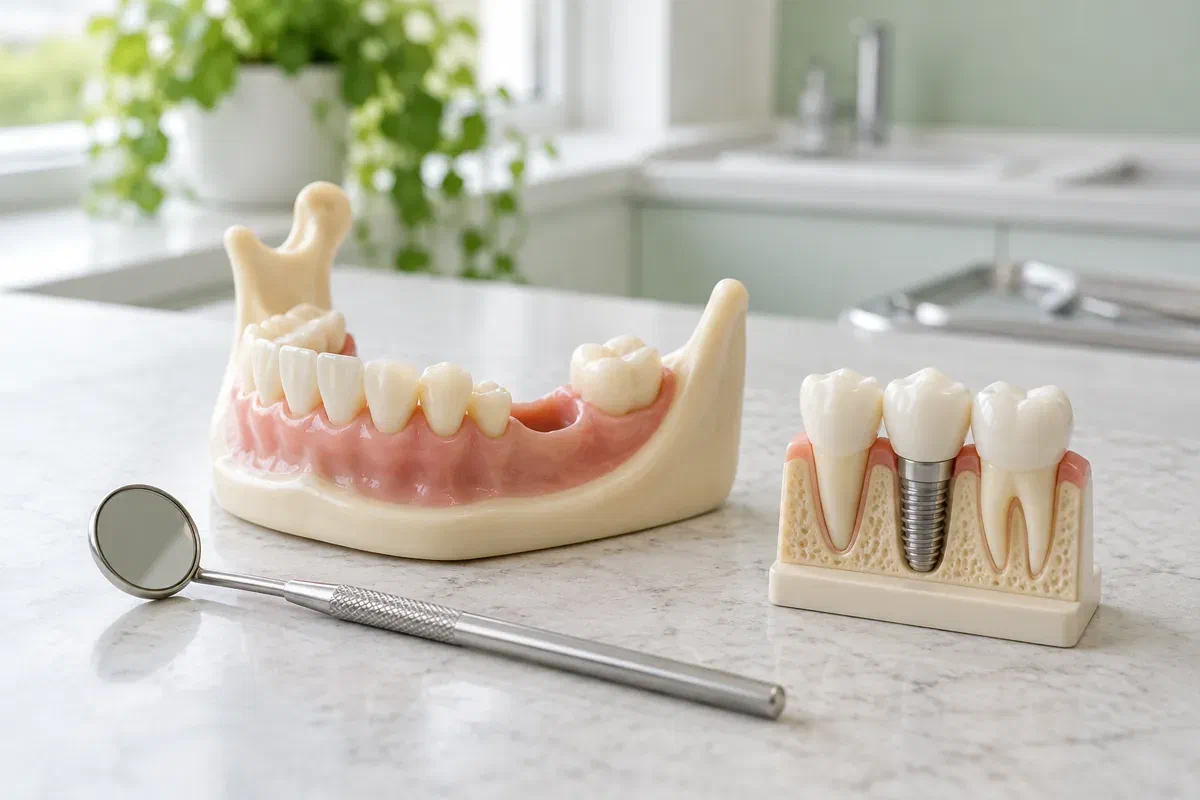
Dental teaching models showing a missing tooth and an implant-supported crown
Three areas we review

Mouth, medicine and routine.

A suitable replacement depends on more than the space. It needs proper support, a home-care routine you can maintain, and a treatment order that respects your overall health.

The current state of the tooth or site

Tell us if the tooth is missing or if removal has been suggested. When a natural tooth is still present, its condition and the realistic chances of keeping it should be looked at before replacement takes over the conversation.

Conditions, prescriptions and supplements

A complete, current list helps, including over-the-counter products and any significant treatment in the past. The clinician uses this to think about healing and planning, and may suggest checking with your physician or specialist.

Everyday care and practicalities

Consider how easy you find brushing and cleaning between teeth, how often you can attend, and what matters most to you in a replacement. A plan has to be manageable alongside the rest of your health care.

Never stop or change a prescribed medicine to prepare for an implant consultation. Any adjustment should be planned with the clinicians who prescribe and monitor it.

What a careful assessment offers

A plan that accounts for the whole person.

The assessment shows which questions need answering before implant care is pursued. Gum health, the site, neighbouring teeth and medical factors can each change what is advisable and in what order.

Occasionally the next step is a conversation with your doctor, a scan or a specialist opinion rather than a treatment plan. Ask what each is meant to clarify and how its result will be used in your decision.

Honesty about what is uncertain

You will learn which parts look feasible and which depend on further information. That is more useful than a typical timeline or the experience of someone with a different health picture.

Every option in view

Consider how an implant compares with a bridge or a removable tooth in terms of preparation, maintenance, number of appointments and the limits that apply to each.

Coordination you can follow

When more than one clinician is involved, whether dental or medical, it helps to know who is responsible for each part and who brings the information together.

The assessment, step by step

Medical context, then dental detail.

Some questions may stay open after the first visit. We will explain what can be judged on the day, which records or medical information might be needed, and when a fuller recommendation is realistic.

  1. Review your health and your goals

    We start with your medical history, current medicines and past experiences with dental treatment, then talk about the gap, any previous replacement and what you want to change.

  2. Examine teeth, gums and the site

    The dentist looks at the surrounding teeth, gum condition, bite and space. If gum disease or other problems need treating first, we explain how that fits into the overall sequence.

  3. Gather records and other opinions

    Imaging may be recommended to understand the bone and nearby structures, and sometimes information from your physician helps too. Ask why each is suggested and whether existing records could be used.

  4. Discuss findings and possible routes

    We go through what is known, what still needs clarifying and the possible next steps. Ask for a plain description of every proposed stage, any interim tooth, fees and long-term maintenance before deciding.

While you consider the plan

Stay in touch as things change.

An assessment is not a booking for surgery. Before leaving, be clear on what has been agreed, what the next appointment or request for information is, and how any current dental issue will be looked after.

Keep records together

Store your outline, estimates and any referral or medical correspondence in one place. Ask for anything unclear to be explained in everyday words before you agree to the next stage.

Follow any recommended groundwork

Gum treatment, care for other teeth or a check with your doctor may come first. Ask how progress will be reviewed and what must be confirmed before the site is considered ready.

Report health changes promptly

A new diagnosis, a change of medicine or a hospital stay can affect dental planning. Let us know, because the earlier assessment may need to be updated before treatment continues.

Your replacement choices

More than one way forward.

Implants are one group of replacements. Your teeth, the gap, your health and what you value will help determine which other options are worth considering.

If health and site both support it

A crown or appliance on an implant

Where appropriate, an implant can support a crown or other restoration. Weigh the surgery, healing period, preparation and lifelong upkeep, rather than focusing only on how the tooth will look.

A fixed choice with no implant surgery

A bridge between healthy teeth

If the neighbouring teeth and the gap are suitable, a bridge may work. Ask what preparation those teeth would need and how the design would affect cleaning.

When another approach suits your needs

A removable replacement or alternative

A removable option may be sensible, especially with several missing teeth or particular health considerations. Where clinically appropriate, monitoring a gap without immediate replacement can also be discussed.

Health-related implant questions

Ask about your health, too.

Health questions are welcome alongside dental ones. You do not need to understand the technical side before booking a first conversation.

(905) 876-4488
Can I have an implant assessment if I have diabetes?
Yes, you can be assessed. Mainstream patient information notes that how well diabetes is managed can affect healing and gum health, so the dentist will ask about it and may suggest coordinating with your doctor.
I take a blood thinner. Should I stop it before my visit?
No. Keep taking it as prescribed. Tell the dentist about it at the assessment. If treatment is later planned, any medication question will be discussed with the clinician who prescribes it.
Do bone or osteoporosis medicines matter for implants?
Some medicines that affect bone can be relevant to dental surgery planning. Bring the name, dose and how long you have taken it. The dentist will consider it and may consult your prescriber.
Is there any obligation once I have been assessed?
None. The appointment is for understanding your situation and options. You can explore alternatives and review the stages before deciding. Ask what the assessment and any further investigations would cost before they are arranged.
Why might my dentist want to speak with my doctor?
Information from your physician can clarify how a condition or medicine might affect planning or healing. Ask what will be shared and why. Your consent is needed, and the overall coordination should be clear to you.
Does coming from Halton Hills change how visits are planned?
It can help to ask early which appointments are likely and whether any could be combined with other care. Let us know your preferred days when you book so the stages can be arranged sensibly.
Implant assessment for Halton Hills

Start with a conversation about you.

From Halton Hills, visit our Bronte Street practice to talk about a missing tooth, your health and the assessment needed to compare replacements. We will explain where you are starting, what still needs answering and the practical stages of a suitable plan.

Please bring medical and medication information to your appointment and share it directly with the clinical team, rather than sending it in a general online enquiry.

Visit Milton Dental Clinic
Unit 1, 342 Bronte St. S, Milton, ON L9T 5B7
Get directions Clinic hours
Monday–Thursday
11am–7pm
Friday–Sunday
By appointment only

Areas we serve

  • Milton
  • Oakville
  • Mississauga
  • Georgetown
  • Halton Hills
  • Acton
  • Campbellville
  • Brampton
  • Burlington
  • Puslinch
  • Rockwood
  • Erin
  • Caledon
  • Etobicoke
  • Old Milton
  • Bronte Meadows
  • Timberlea
  • Dorset Park
  • Dempsey
  • Clarke
  • Beaty
  • Coates
  • Harrison
  • Scott
  • Willmott
  • Ford
  • Bowes
  • Cobden
  • Walker
  • Mountain View
  • Milton Heights
  • Hawthorne Village
  • Valley View
  • Fallingbrook
  • Nassagaweya
  • Trafalgar
  • Esquesing
  • Nelson
  • Brookville
  • Moffat
  • Glen Williams
  • Norval
  • Limehouse
  • Stewarttown
  • Ashgrove
  • Hornby
  • Silver Creek
  • Speyside
  • Scotch Block
  • North Oakville
  • River Oaks
  • Glen Abbey
  • West Oak Trails
  • Palermo
  • Bronte Creek
  • College Park
  • Joshua Creek
  • Uptown Core
  • Preserve
  • Iroquois Ridge
  • Lisgar
  • Meadowvale
  • Meadowvale Village
  • Churchill Meadows
  • Erin Mills
  • Central Erin Mills
  • Streetsville
  • East Credit
  • Creditview
  • Heartland
  • Sheridan
  • Mount Pleasant
  • Credit Valley
  • Huttonville
  • Churchville
  • Springbrook
  • Northwest Brampton
  • Bram West
  • Fletcher's Meadow
  • Fletcher's Creek South
  • Alton Village
  • Orchard
  • Millcroft
  • Headon Forest
  • Tansley
  • Brant Hills
  • Tyandaga
  • Kilbride
  • Lowville
  • Aberfoyle
  • Morriston
  • Arkell
  • Hillsburgh
  • Freelton
  • Carlisle
  • Waterdown
  • Flamborough
  • Mountsberg

How can we help?

Milton Dental Clinic

Have a question about your smile? Choose the option that works best for you.

For urgent dental concerns, please call.
Messages are reviewed during clinic hours.