

Illustrative consultation about suitability for a dental implant
Restorative Dentistry

Dental Implant Assessment in Old Milton

An ageing bridge, a partial that never felt right, or a gap you have worked around for years can all be revisited. Near Old Milton, an implant assessment reviews your mouth and health and sets every realistic replacement side by side.

Old Milton and older dental work

What worked twenty years ago deserves a fresh look.

Plenty of people around Milton's historic downtown have dental work that has quietly done its job for decades. A bridge starts to feel loose, a partial denture rubs, or a back tooth that was never replaced begins to bother you more. An implant assessment is a chance to step back and ask what would suit your mouth as it is today.

Think of an implant as a series of stages. Support is placed in the jaw, healing takes place, a crown or other restoration is attached, and the result needs ongoing cleaning and review. Looking at that full sequence lets you compare it honestly with repairing or remaking what you already have.

Nobody expects you to walk in with your mind made up. Tell us what has changed and what you would like to be easier. We will look at the starting point, explain what extra information might be useful, and talk through the alternatives before you commit to anything.

Request an assessment
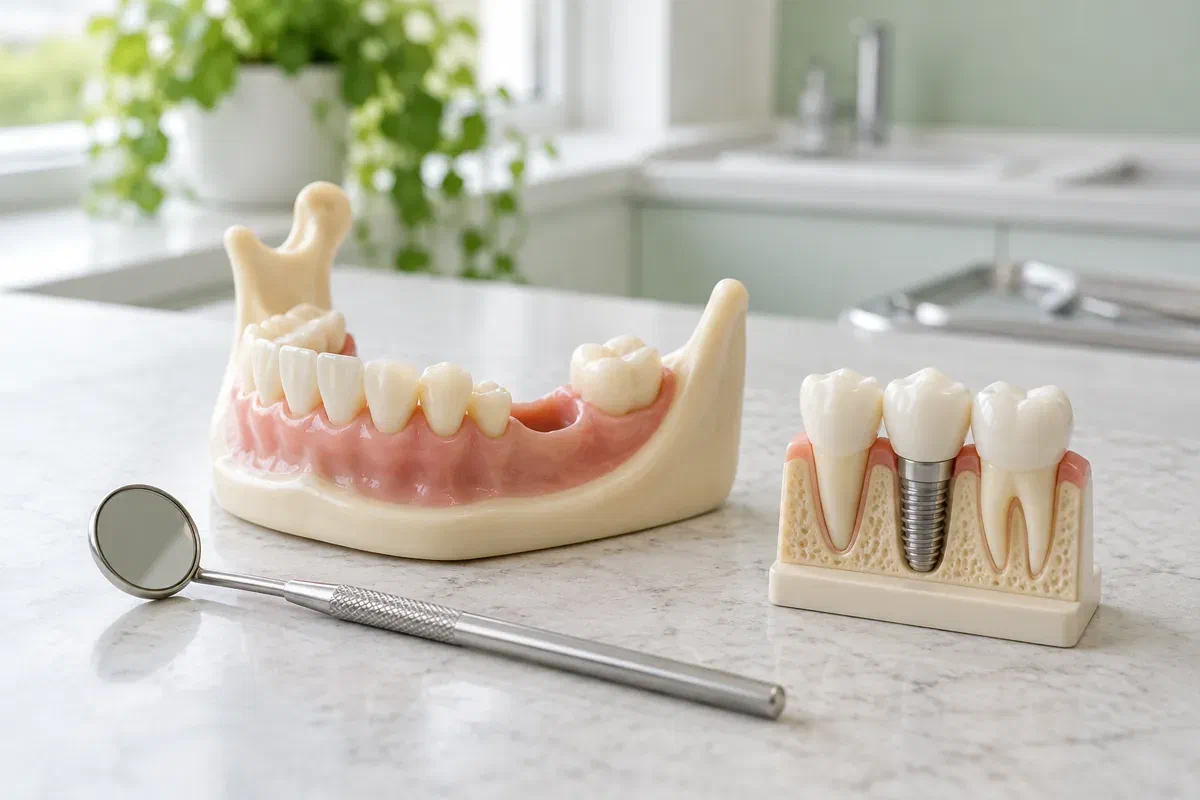
Dental teaching models showing a missing tooth and an implant-supported crown
Before we talk about implants

Start with the work already in your mouth.

When there is existing dental work, the assessment covers more than one empty space. Any new replacement has to be supported properly, cleaned easily and fitted into a sensible order of care.

The gap, the old restoration and the teeth beside it

Describe what is there now: a missing tooth, a bridge or crown that is failing, or a tooth you have been advised to remove. Natural teeth that remain should be assessed fairly before replacement is assumed to be the answer.

Health changes since your last big treatment

Health often shifts over the years. Bring a current list of medicines and supplements and mention past surgeries or significant treatment. These details help the clinician think about healing and whether to check with another health professional.

A routine that still suits you

Consider how comfortable you are cleaning around fixed work, how often you can attend, and what you most want back, whether that is chewing or appearance. A good plan has to be one you can keep looking after.

Keep taking your medicines as prescribed while you plan. Any change related to dental treatment should only be made with the clinicians responsible for that prescription.

What you gain from assessing first

An honest map from where you are now.

An assessment points out what must be understood before implant treatment is considered further. For someone with older dental work, that often includes the teeth supporting a bridge, the gums, the bone at the site, or a health condition that changes the order of care.

The outcome may be a request for more information instead of a firm recommendation. If a scan, further examination or referral is suggested, ask what it is expected to clarify and how it will help you choose.

A clear view of what is feasible

You learn which parts look achievable and which still need checking. That matters more than any general timeline, or the result a friend had with their own implant.

A fair comparison, including repair

Put an implant alongside a new bridge, a removable appliance, or repairing existing work. Weigh the preparation, maintenance, number of visits and limitations of each before deciding.

Roles spelled out early

Different clinicians may handle assessment, placement, the restoration or long-term care. Knowing who does what from the start makes referrals, fees and follow-up questions easier to manage.

Your first implant appointment

One careful step at a time.

You may not get every answer at the first visit. We will explain what can be judged straight away, what records could be needed, and when a more detailed recommendation is likely to be possible.

  1. Hear the history of the tooth

    We ask how long the gap or restoration has been there, what has been done before, and what you would like to change. Your medical history, medicines, earlier dental experiences and day-to-day concerns are part of this talk.

  2. Examine the teeth, gums and site

    The dentist assesses neighbouring teeth, gum health, your bite and the available space. If existing problems need attention before implant planning continues, we explain why and where they fit in the sequence.

  3. Agree on the records needed

    Imaging or other records may be advised to understand the site and nearby structures. Ask what is warranted in your case, whether older films can be used, and whether another clinician should be involved.

  4. Talk through options and a rough outline

    We go over the findings, any open questions and the possible next steps. Ask for a clear explanation of preparation, surgery, the restoration, any temporary tooth, fees and upkeep before deciding to go ahead.

After your assessment

Leave knowing what you agreed to.

An assessment is not the same as booking surgery. Before you go, confirm what you have said yes to, which visits or records come next, and what to do about any current dental issue in the meantime.

Keep the outline handy

Store your treatment outline, estimate and any referral letter where you can find them. Read them again at home, and ask for a simpler explanation of any term before you consent to the next stage.

Complete the groundwork first

Treatment for gums or other teeth may be advised before further implant decisions. Ask how that progress will be checked and what needs to be in place before the site is considered ready.

Keep us informed

Let us know if your medicines, medical care or dental symptoms change while you are still planning. New information can affect the order of care, and a past assessment should not be relied on forever.

Weighing the alternatives

Repair, replace or rethink?

Implants are just one way to replace teeth. The state of nearby teeth and existing work, the size of the gap, your health and your priorities all affect which other paths are worth exploring.

When your assessment supports it

An implant-supported crown or appliance

In a suitable case, an implant can support a crown or another restoration. Consider the preparation, surgery, healing and long-term care involved, not only the finished tooth.

Fixed replacement using nearby teeth

A new or remade bridge

If the supporting teeth and gap are suitable, a bridge may still be the right fit. Ask how those teeth would be prepared and how the design affects cleaning and future care.

When a different approach suits you

A removable option, or adjusting your plan

A removable replacement can be worth assessing, especially where several teeth are missing or a partial is already part of your routine. Where it is clinically reasonable, monitoring a gap for now can also be discussed.

Questions about replacing older work

Bring your questions, big or small.

The assessment is a place to ask about anything, from the basics to the details of your own mouth. You do not need any technical knowledge to start the conversation.

(905) 876-4488
My bridge is loose. Does that mean I need an implant?
Not necessarily. A loose bridge needs to be examined to find out why, which may involve the supporting teeth, the cement or the gums. Depending on the findings, repair, a new bridge, an implant or another option may be discussed. Please call if it is painful or comes off completely.
Can a partial denture be replaced with implants later?
In some cases implants can support a fixed or removable replacement, but suitability depends on the sites, gums, bone and your health. The assessment looks at these factors. Ask how any change would affect cleaning and appointments compared with your current partial.
Is there an age limit for having an implant assessed?
Age alone is not usually the deciding factor. General health, medicines, gum condition and your ability to look after the replacement matter more. Anyone considering an implant can be assessed, and the dentist will explain what is relevant to your situation.
Is an assessment possible after many years without the tooth?
Yes. How long the tooth has been gone is useful background, but what counts is the site and the mouth around it now. Ask whether support, the position of neighbouring teeth or the space available changes your options, and whether preparation would be needed.
Should I bring records from a dentist I saw years ago?
If you have them, details of past treatment or consultations can be helpful. Let us know where earlier records or images might be held so a transfer can be discussed. You do not need to arrange new imaging before your first visit.
Do assessment visits fit around a busy week?
Our Bronte Street practice is open Monday to Thursday from 11am to 7pm, with Friday to Sunday by appointment only. If you are planning from downtown, mention any timing limits when you book so the stages can be scheduled sensibly.
Implant assessment near Old Milton

Take a fresh look at your options.

From Old Milton, our Bronte Street practice is close at hand. Come in to discuss an old restoration, a long-standing gap or a tooth that is causing trouble, and we will help you understand where things stand and what a suitable plan could involve.

Sensitive health and medication information is best discussed with the clinical team at your visit rather than sent in a general online enquiry.

Visit Milton Dental Clinic
Unit 1, 342 Bronte St. S, Milton, ON L9T 5B7
Get directions Clinic hours
Monday–Thursday
11am–7pm
Friday–Sunday
By appointment only

Areas we serve

  • Milton
  • Oakville
  • Mississauga
  • Georgetown
  • Halton Hills
  • Acton
  • Campbellville
  • Brampton
  • Burlington
  • Puslinch
  • Rockwood
  • Erin
  • Caledon
  • Etobicoke
  • Old Milton
  • Bronte Meadows
  • Timberlea
  • Dorset Park
  • Dempsey
  • Clarke
  • Beaty
  • Coates
  • Harrison
  • Scott
  • Willmott
  • Ford
  • Bowes
  • Cobden
  • Walker
  • Mountain View
  • Milton Heights
  • Hawthorne Village
  • Valley View
  • Fallingbrook
  • Nassagaweya
  • Trafalgar
  • Esquesing
  • Nelson
  • Brookville
  • Moffat
  • Glen Williams
  • Norval
  • Limehouse
  • Stewarttown
  • Ashgrove
  • Hornby
  • Silver Creek
  • Speyside
  • Scotch Block
  • North Oakville
  • River Oaks
  • Glen Abbey
  • West Oak Trails
  • Palermo
  • Bronte Creek
  • College Park
  • Joshua Creek
  • Uptown Core
  • Preserve
  • Iroquois Ridge
  • Lisgar
  • Meadowvale
  • Meadowvale Village
  • Churchill Meadows
  • Erin Mills
  • Central Erin Mills
  • Streetsville
  • East Credit
  • Creditview
  • Heartland
  • Sheridan
  • Mount Pleasant
  • Credit Valley
  • Huttonville
  • Churchville
  • Springbrook
  • Northwest Brampton
  • Bram West
  • Fletcher's Meadow
  • Fletcher's Creek South
  • Alton Village
  • Orchard
  • Millcroft
  • Headon Forest
  • Tansley
  • Brant Hills
  • Tyandaga
  • Kilbride
  • Lowville
  • Aberfoyle
  • Morriston
  • Arkell
  • Hillsburgh
  • Freelton
  • Carlisle
  • Waterdown
  • Flamborough
  • Mountsberg

How can we help?

Milton Dental Clinic

Have a question about your smile? Choose the option that works best for you.

For urgent dental concerns, please call.
Messages are reviewed during clinic hours.