

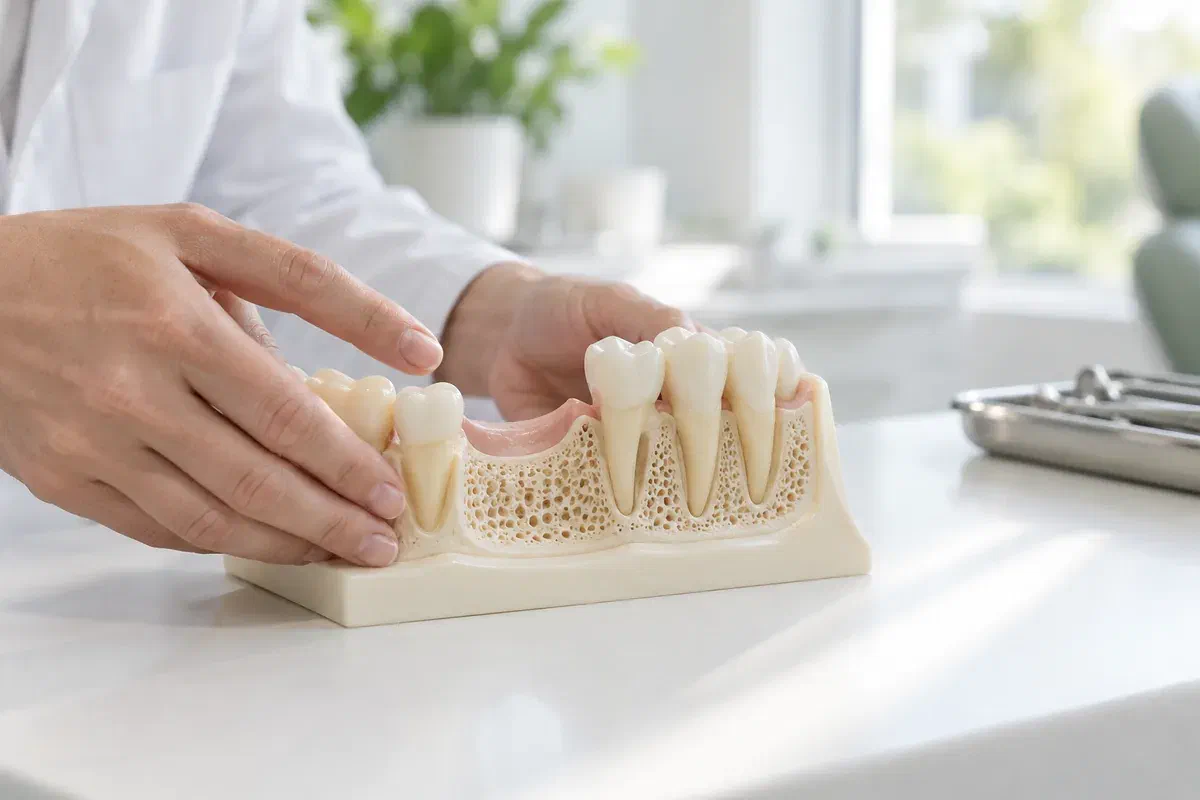
Illustrative consultation using a jaw model to discuss implant bone support
Restorative Dentistry

Dental Implant Bone Grafting in Milton

Heard the word “graft” during an implant conversation and wondered what it means for you? Book a Milton consultation to go over the proposed site, the material, the healing stages and the other ways forward.

When a graft comes up in Milton

A new word in the implant conversation.

Many people first hear about bone grafting partway through an implant consultation, often after imaging of the gap. It means adding material where the planned implant would need more bone around it. The goal is a sound position for the implant and the tooth that will sit on it, and whether that is needed depends on your site.

“Grafting” is a broad label. Some sites need a modest addition at the moment the implant goes in, while others call for a separate procedure and time to heal first. Ask which version is being suggested, because it shapes how many visits you book, what recovery looks like and how long the whole plan runs.

Here in Milton, our Bronte Street team can walk you through the findings behind a recommendation before you commit to anything. A clear plan names the expected benefit, the alternatives, who will carry out the graft and how the healed site will be checked before implant work continues.

Talk through a grafting recommendation
Educational jawbone model showing the contour beneath a missing tooth
What the imaging can show

What you see in the mirror is only part of the picture.

A gap can look simple from the outside. Planning an implant means looking at the bone underneath and thinking ahead to how the replacement tooth would be held, cleaned and maintained over time.

Bone that has reshaped since the extraction

After a tooth is lost, the area beneath it may no longer have the shape the implant position calls for. Share when the tooth came out and anything done there since; an up-to-date assessment still decides what the site looks like now.

Nearby structures that set limits

The width and height of the bone, and what sits close to it, can narrow the choices. Ask how your imaging shaped the recommendation and whether more records or a specialist’s view would help before a grafting method is chosen.

Treatment that unfolds in phases

Where a graft is suggested, ask how it lines up with any extraction, the implant itself and the final crown. Some stages wait on healing, which is why an exact finish date is not always possible to promise at the start.

Not every implant needs a graft, and a graft that heals well is still no promise that an implant will follow. Your site is looked at again at each step of the plan.

What a graft is meant to do

More support where the plan needs it.

When it suits the case, a graft is meant to build up the bone available for the planned implant. Your clinician should be able to point to the specific finding at your site that makes it worth considering, rather than presenting it as a standard extra.

That purpose has to be balanced against another procedure, more healing time, added cost and the chance of complications or a result that falls short. It is fair to ask what the fallback would be if the support is less than hoped, and whether a different route could meet your goals.

Patient information: Cambridge University Hospitals — bone grafting for dental implants

An implant position that serves the crown

The spot chosen for the implant should make sense for the tooth that will sit above it. Ask how the graft helps that restoration and which limitations could remain once everything has healed.

Time to heal and check in between

Working in stages can leave room for healing and a fresh look before the implant is placed. If that is the plan, ask what will be assessed at the review and what has to be true before moving ahead.

A clearer basis for comparing options

Seeing the full preparation involved makes it easier to weigh an implant against other replacements. Factor in the graft, its recovery and the extra visits when you decide whether the whole plan fits your life.

How the steps usually fit together

Four conversations, from first records to a healed site.

What happens on the day and during recovery depends on how much grafting is planned and what kind. You should hear the approach explained in plain language, including any referral and how follow-up will be arranged.

  1. Look at the site and your health history

    The team reviews your mouth, medical history, medications and suitable imaging. You hear which finding has raised the question of a graft, and whether gum or tooth problems elsewhere should be treated first.

  2. Settle on a method and a material

    Talk about where the graft material comes from, how much work is involved and whether a second site is needed. Cover benefits, risks, alternatives and comfort options, and accept that later findings could change the sequence.

  3. Carry out the graft

    The clinician performing it completes the agreed procedure and gives you aftercare instructions specific to it. Before you go home, check what is normal, which medicines or care steps to follow and who to call with a concern.

  4. Check the healing, then decide

    A follow-up visit looks at how the site is coming along and whether more information is needed. The implant or the restoration moves forward based on what is found, not because a set number of weeks has gone by.

The weeks after grafting

Your own instructions come first.

A general overview is no substitute for the directions you are given. Because grafts differ, keep the written guidance and contact numbers close, and ask about anything that seems hard to manage at home.

Keep the area protected

Check what you can eat, how to clean nearby, how active to be and how any temporary tooth or appliance should sit. Avoid tugging at stitches or poking the site. If something looks different from what you were told, call the team.

Take medicines as agreed

Stick to the prescribed directions and bring questions about side effects or interactions to the clinician or your pharmacist. Do not start, stop or adjust a medicine because of something you read about grafting recovery in general.

Go to every review and speak up early

Attend each scheduled check, even when the area feels fine. If symptoms are unexpected or getting worse, follow your postoperative instructions and call, rather than holding the question for your next implant appointment.

Grafting and other routes

Weigh the whole plan, graft included.

Any recommendation for a graft should come with an honest look at other reasonable approaches. A fair comparison considers the final replacement, the effort involved and how certain each option is.

If the site allows both at once

Graft placed with the implant

In some cases the graft can be done at the same visit as the implant. Ask why your site qualifies, what might change that decision during the procedure, and how the area will be protected and checked afterwards.

If the bone needs time to heal

Graft first, implant later

Sometimes a separate grafting procedure comes before the implant. Your clinician should describe the expected healing time, how progress will be judged and what happens if the site needs further preparation.

If a graft is not the right fit

Another way to replace the tooth

A bridge, a removable appliance or another suitable option may avoid grafting altogether. Ask what each would involve and whether it can genuinely address the reasons you came in for a consultation.

Grafting questions from Milton

What people ask once a graft is on the table.

Some of these details touch personal preferences, others touch practical planning. Leave time for them before you agree to a graft and to its place in your wider plan.

(905) 876-4488
Why would a graft be mentioned when the gap looks fine to me?
The surface of the gum does not show the width or height of the bone beneath it. Imaging and an examination reveal whether there is enough support for the planned implant position. Ask to see the findings and have them explained, so the recommendation makes sense to you.
What kind of material would be used in my graft?
Options include your own bone, processed donor material, animal-derived material and synthetic products, chosen according to the procedure and clinical judgement. Ask which is proposed and why. If you have personal or religious preferences, raise them early so suitable alternatives can be considered.
Is a graft ever done at the same time as removing a tooth?
Sometimes. In certain situations, material is placed into the socket when a tooth is taken out, with the aim of preserving the site for later. Whether that suits you depends on the tooth, the surrounding bone and your plan. Ask before the extraction so the option can be discussed.
Should I tell the team about my medications and health conditions?
Yes. Your medical history, medicines and habits such as smoking can affect healing and how a graft is planned. Bring an up-to-date list to the consultation. The team may suggest coordinating with your physician before a procedure is booked.
Could the plan change after the graft heals?
It can. Healing is reviewed before the implant stage, and the findings may lead to further preparation, a different timeline or another way of replacing the tooth. Talk about these possibilities beforehand so you know where the original plan has its limits.
How do I know if two implant quotes are really comparable?
Line up what each one covers: graft material, any second surgical site, imaging, reviews, temporary teeth, the implant and the final crown. A quote that looks lower at first may simply leave out stages that the other one includes.
Bone grafting for implants in Milton

Find out what your implant site may need.

Book a consultation at our Bronte Street practice to look at the planned implant site and any suggestion of added bone support. We will help you understand the reason, the order of steps and the questions worth settling before you choose a way forward.

If you have already had a graft and are worried about how it is healing, reach out to the clinician who performed it, using the aftercare contacts you were given.

Visit Milton Dental Clinic
Unit 1, 342 Bronte St. S, Milton, ON L9T 5B7
Get directions Clinic hours
Monday–Thursday
11am–7pm
Friday–Sunday
By appointment only

Areas we serve

  • Milton
  • Oakville
  • Mississauga
  • Georgetown
  • Halton Hills
  • Acton
  • Campbellville
  • Brampton
  • Burlington
  • Puslinch
  • Rockwood
  • Erin
  • Caledon
  • Etobicoke
  • Old Milton
  • Bronte Meadows
  • Timberlea
  • Dorset Park
  • Dempsey
  • Clarke
  • Beaty
  • Coates
  • Harrison
  • Scott
  • Willmott
  • Ford
  • Bowes
  • Cobden
  • Walker
  • Mountain View
  • Milton Heights
  • Hawthorne Village
  • Valley View
  • Fallingbrook
  • Nassagaweya
  • Trafalgar
  • Esquesing
  • Nelson
  • Brookville
  • Moffat
  • Glen Williams
  • Norval
  • Limehouse
  • Stewarttown
  • Ashgrove
  • Hornby
  • Silver Creek
  • Speyside
  • Scotch Block
  • North Oakville
  • River Oaks
  • Glen Abbey
  • West Oak Trails
  • Palermo
  • Bronte Creek
  • College Park
  • Joshua Creek
  • Uptown Core
  • Preserve
  • Iroquois Ridge
  • Lisgar
  • Meadowvale
  • Meadowvale Village
  • Churchill Meadows
  • Erin Mills
  • Central Erin Mills
  • Streetsville
  • East Credit
  • Creditview
  • Heartland
  • Sheridan
  • Mount Pleasant
  • Credit Valley
  • Huttonville
  • Churchville
  • Springbrook
  • Northwest Brampton
  • Bram West
  • Fletcher's Meadow
  • Fletcher's Creek South
  • Alton Village
  • Orchard
  • Millcroft
  • Headon Forest
  • Tansley
  • Brant Hills
  • Tyandaga
  • Kilbride
  • Lowville
  • Aberfoyle
  • Morriston
  • Arkell
  • Hillsburgh
  • Freelton
  • Carlisle
  • Waterdown
  • Flamborough
  • Mountsberg

How can we help?

Milton Dental Clinic

Have a question about your smile? Choose the option that works best for you.

For urgent dental concerns, please call.
Messages are reviewed during clinic hours.