

Illustrative dental hygienist demonstrating home care to an implant patient
Restorative Dentistry

Dental Implant Cleaning in Burlington

Standing in the oral-care aisle with no idea which brush fits your implant? Coming from Burlington, you can sort that out with our team: a professional cleaning, a look at the gum, and a routine matched to the restoration you actually have.

Too many products, one implant

A drawer full of brushes that never quite fit

Interdental brushes in six sizes, picks, tape, threaders, water flossers: the choice is enormous, and packaging rarely mentions implants. Buying a few and hoping one works is common, but it can leave the trickiest surfaces untouched while the easy ones get cleaned twice.

The reason any of this matters is the tissue. An implant restoration will not form a cavity, yet the gum and bone supporting it can still become inflamed when plaque is left behind. Which surfaces collect that plaque depends on whether you have a single crown, a bridge over several implants or attachments for a removable denture.

So bring the drawer, or at least a few favourites, to your appointment. Show us which spaces feel awkward and mention any bleeding, soreness or change in taste. We clean around the restoration, match aids to your spaces, and explain if anything we find needs treatment beyond maintenance.

Get your implant aids sorted
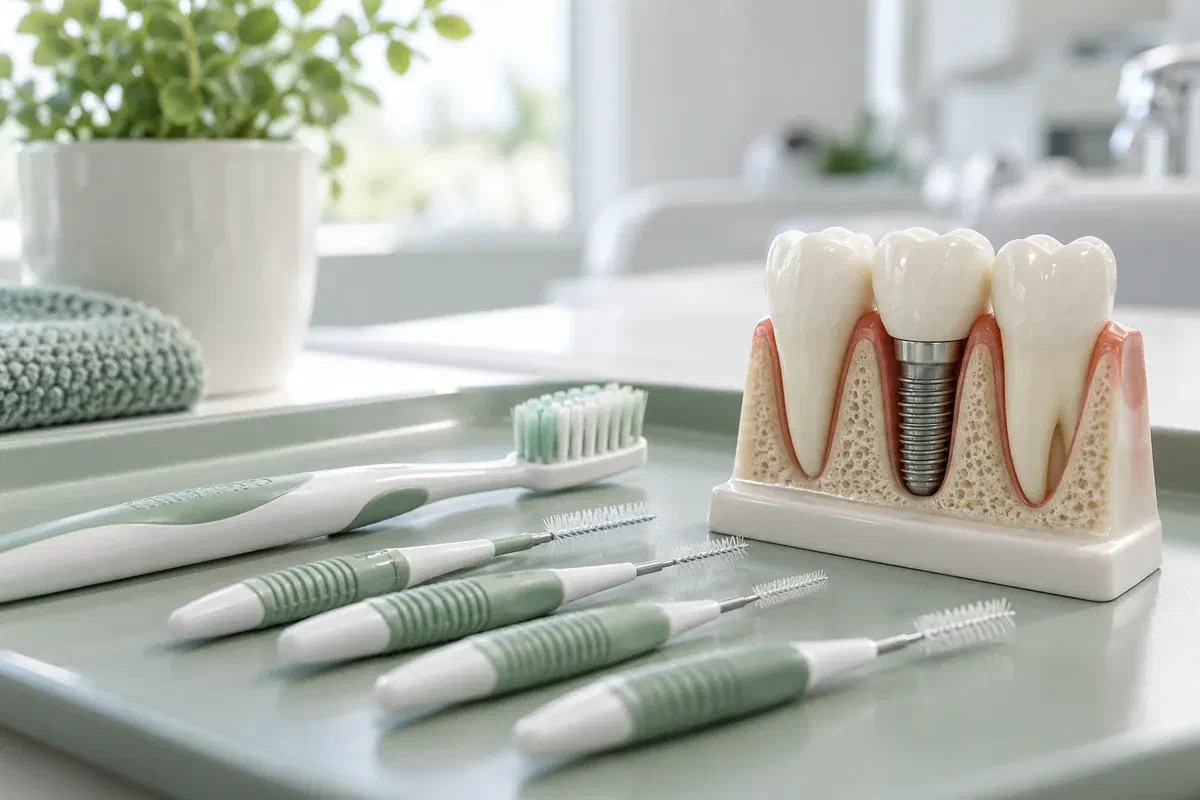
Soft toothbrush and interdental brushes beside an implant teaching model
Things to point out

Feeling fine is not the same as being checked

Your daily experience and a clinical exam answer different questions. Mention anything about the tissue or the restoration that seems off, even when meals on that side feel perfectly normal.

Blood or tenderness when you clean

Bleeding while brushing or using an interdental aid near the implant deserves mention. We can examine the tissue and help work out whether the cause is the tool, the technique or inflammation, rather than suggesting you skip that area.

An aid that will not pass

If a brush bends, frays or refuses to go through a space, tell us. The size of the gap and the restoration's shape set what will fit, and forcing a larger aid in is no substitute for being shown the right one.

Food traps or a restoration acting differently

Food that lodges in the same place, a gap that seems new or any movement in a crown or bridge should be checked. The restoration may be part of the cause, so the solution is not always another cleaning product.

Call promptly about swelling, discharge, a restoration that moves or pain that keeps getting worse. These need assessment, not a wait for the next routine cleaning.

Why professional visits help

The right tools, used the right way

During maintenance, the team removes buildup that home aids leave behind and evaluates the tissues around your implant. Just as useful, the visit shows whether the products you have chosen actually reach the surfaces you bought them to clean.

Even a thorough routine cannot guarantee an implant stays trouble-free, and established disease often needs more than maintenance. If something concerning appears, the team should explain it and whether further assessment, treatment or a specialist referral is advisable.

Patient information: American Academy of Periodontology — peri-implant diseases

Aids chosen for your restoration

Crowns, bridges and implant-supported dentures that come out each call for different tools. If your restoration was made at another office, bring whatever details you have so the team understands its design.

A demonstration, not just a list

Seeing a technique done on your own mouth is easier to follow than a shopping list. Mention if grip, eyesight or gagging makes a tool frustrating, and other options can be considered.

Records that show trends

Ongoing review lets the clinician compare today's findings with past notes when they are available. Ask what is being tracked and how your visit interval reflects your history and current needs.

Step by step

How a maintenance visit unfolds

The appointment follows your implant history and what the clinician sees. If you have had surgery near the implant recently, tell us so we can work in step with whoever is managing your recovery.

  1. Review your restoration and routine

    We go over the type of restoration, past maintenance, any history of gum disease and recent health changes. Show us the products you use and tell us where the routine breaks down.

  2. Examine the site

    The clinician assesses the tissue and restoration and decides whether X-rays or other records are needed. Signs of inflammation, reduced support or a restoration issue are discussed before routine cleaning is assumed to be enough.

  3. Clean around the implant

    Instruments and methods suit the implant surfaces, the restoration and today's findings. Mention any sensitive spot, and ask what any additional care suggested during the visit is meant to achieve.

  4. Fit the aids and plan the return

    You practise with the aids that suit each space and leave knowing which sizes to buy. We agree on a follow-up interval and list changes that should prompt you to call earlier.

Making the routine stick

Fewer products, better aimed

A short routine you can keep is better than a long one you abandon. If a step is not working, ask about technique before reaching for yet another product that may not suit your restoration.

Buy the sizes you were shown

Note the brush sizes and aids recommended for each space. Use them as demonstrated, and if one starts to catch or feels uncertain, ask for another demonstration rather than forcing it through.

Clean removable parts as directed

If your appliance comes out, learn how to clean both it and the attachments in your mouth. Check which cleaning products suit its materials, and leave household cleaners out of the routine.

Notice patterns, not just moments

Bleeding, soreness, repeated food trapping or a change in how the restoration feels deserves attention when it keeps happening. Contact the team if it persists, even with your next visit still some time off.

Beyond the cleaning

What the findings may lead to

The exam determines whether routine maintenance fits or a specific concern needs treatment. Ask what was found and which part of the plan addresses it.

Healthy, stable site

Routine implant maintenance

Review and cleaning can be scheduled for an implant that is healthy or well controlled. Intervals and home instructions should suit your history rather than a schedule used for everyone.

Tissue showing inflammation

Care for gum inflammation

First comes a look at how widespread the inflammation is and what is feeding it. You will hear whether improved plaque control and professional care are likely to be sufficient or further investigation and treatment are indicated.

Problems beyond hygiene

Restoration review or specialist care

A hard-to-clean design, a loose component or disease affecting support may need a broader approach. Ask whether changes to the restoration or a specialist opinion should accompany your hygiene routine.

Burlington questions about implant aids

Tools, technique and timing

There is no prize for guessing which aid fits which gap. Practise during the appointment and learn the signs that mean you should come back sooner.

(905) 876-4488
Are interdental brushes safe to use around implants?
They are often recommended, but size and type matter. The clinician can choose ones suited to your spaces and restoration and show you how to place them without forcing them through resistance.
Can a water flosser replace every other cleaning step for my implant?
It should not be assumed to cover everything. A water flosser may be useful for some restorations, but its role depends on access and technique. Ask for a demonstration of a full routine that suits your implant.
Should I avoid metal-core brushes or certain picks around an implant?
Ask the clinician which aids suit your implant and restoration materials. Recommendations vary with the design, so bring the products you use and the team can tell you which to keep and which to replace.
How often should I replace my implant cleaning aids?
Replace brushes and interdental aids when they become worn, bent or frayed, since damaged bristles clean less effectively. Ask the team how to recognize wear on the specific aids recommended for you.
Why does my implant need a different routine from my natural teeth?
The restoration and its connection to the gum have a different shape from a natural tooth, so plaque collects in different places. Your natural teeth still need their usual care, and the implant may need extra steps alongside it.
Is it worth the drive from Burlington for implant maintenance?
That depends on your preferences and needs. Many people plan maintenance well ahead so it fits their schedule. Mention the restoration when booking, and the team can suggest how to make the most of each visit.
Implant maintenance near Burlington

Let’s match the tools to your implant

Book time at our Bronte Street practice to review your implant restoration and the products you clean it with. We can check access, examine any concern and explain whether ongoing maintenance or further care is the right path.

When calling, mention swelling, discharge, movement or increasing pain, so the team can plan an assessment instead of treating the visit as routine maintenance.

Visit Milton Dental Clinic
Unit 1, 342 Bronte St. S, Milton, ON L9T 5B7
Get directions Clinic hours
Monday–Thursday
11am–7pm
Friday–Sunday
By appointment only

Areas we serve

  • Milton
  • Oakville
  • Mississauga
  • Georgetown
  • Halton Hills
  • Acton
  • Campbellville
  • Brampton
  • Burlington
  • Puslinch
  • Rockwood
  • Erin
  • Caledon
  • Etobicoke
  • Old Milton
  • Bronte Meadows
  • Timberlea
  • Dorset Park
  • Dempsey
  • Clarke
  • Beaty
  • Coates
  • Harrison
  • Scott
  • Willmott
  • Ford
  • Bowes
  • Cobden
  • Walker
  • Mountain View
  • Milton Heights
  • Hawthorne Village
  • Valley View
  • Fallingbrook
  • Nassagaweya
  • Trafalgar
  • Esquesing
  • Nelson
  • Brookville
  • Moffat
  • Glen Williams
  • Norval
  • Limehouse
  • Stewarttown
  • Ashgrove
  • Hornby
  • Silver Creek
  • Speyside
  • Scotch Block
  • North Oakville
  • River Oaks
  • Glen Abbey
  • West Oak Trails
  • Palermo
  • Bronte Creek
  • College Park
  • Joshua Creek
  • Uptown Core
  • Preserve
  • Iroquois Ridge
  • Lisgar
  • Meadowvale
  • Meadowvale Village
  • Churchill Meadows
  • Erin Mills
  • Central Erin Mills
  • Streetsville
  • East Credit
  • Creditview
  • Heartland
  • Sheridan
  • Mount Pleasant
  • Credit Valley
  • Huttonville
  • Churchville
  • Springbrook
  • Northwest Brampton
  • Bram West
  • Fletcher's Meadow
  • Fletcher's Creek South
  • Alton Village
  • Orchard
  • Millcroft
  • Headon Forest
  • Tansley
  • Brant Hills
  • Tyandaga
  • Kilbride
  • Lowville
  • Aberfoyle
  • Morriston
  • Arkell
  • Hillsburgh
  • Freelton
  • Carlisle
  • Waterdown
  • Flamborough
  • Mountsberg

How can we help?

Milton Dental Clinic

Have a question about your smile? Choose the option that works best for you.

For urgent dental concerns, please call.
Messages are reviewed during clinic hours.