

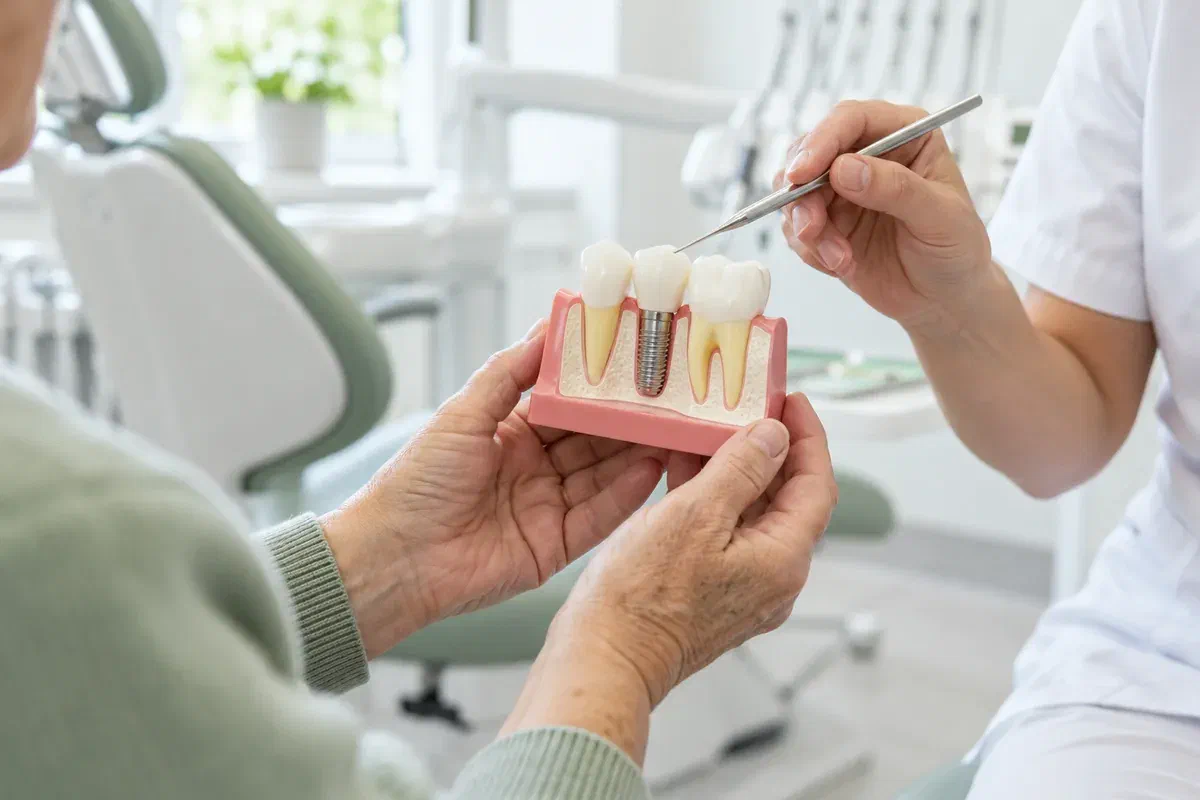
Illustrative older adult discussing implant options with a dentist
Restorative Dentistry

Dental Implant Consultations for Seniors

Explore tooth replacement with your health, independence, and daily routine in view. Dental implant consultations for seniors in Milton offer space to discuss existing dentures, treatment demands, maintenance, and personal priorities.

A closer look at implant choices later in life

Your priorities belong at the centre of the plan.

An implant consultation for an older adult starts with the same essential question as any other assessment: would the proposed treatment be suitable and worthwhile for this person? Age alone does not answer that question. Health, oral conditions, treatment demands, and the ability to maintain the replacement all deserve attention.

You may want to replace one missing tooth, improve the stability of a denture, or understand whether a larger treatment plan is worth pursuing. Tell us what is difficult now and what improvement would matter most. The goal is a useful conversation about your life, not an assumption that everyone wants the same restoration.

At Milton Dental Clinic, we can discuss the assessment needed and the practical details that influence your decision. You are welcome to bring a trusted person if you would find that helpful. Your preferences should remain central while the team explains possible benefits, limitations, alternatives, and continuing care.

Discuss your tooth replacement priorities
Older patient's hands holding an implant teaching model during a consultation
What matters in a later-life consultation

A good plan accounts for everyday realities.

Comfortable chewing is one consideration, but treatment also involves appointments, recovery, cleaning, and future maintenance. These practical demands should be discussed alongside the clinical assessment.

Changes in health or medication

Bring an up-to-date list of medicines and relevant medical treatments. The clinician needs this information to consider planning and healing factors and decide whether communication with another healthcare professional would help.

A denture that limits daily life

Explain whether the main concern is movement, soreness, appearance, or difficulty eating particular foods. Bring the denture you currently use so its condition can be considered before assuming implants are the only way to improve the situation.

Cleaning and attending future visits

Discuss hand strength, vision, mobility, transport, or help you already receive with daily care. These details do not define you, but they can affect which restoration is practical and how its maintenance should be organized.

Do not alter prescribed medicines because you are considering implants. Any changes related to dental treatment need an individualized plan agreed with the relevant treating clinicians.

The value of a thoughtful consultation

Weigh the expected improvement against the whole commitment.

The consultation can help connect a proposed replacement to a specific goal, such as improving a particular denture problem or filling a troublesome gap. A clear goal makes it easier to judge whether the expected benefit justifies the treatment being considered.

Implant care is not automatically the best choice because it is available, and it is not automatically unsuitable because someone is older. A balanced discussion considers your health and preferences, the clinical findings, and how the restoration could be maintained if circumstances change.

Patient information: ITI — advanced age and medical conditions in implant care

Your priorities guide the comparison

Describe what you would most like to improve and what you prefer to avoid. The team can then compare realistic choices in relation to those priorities rather than presenting the most extensive treatment as the default.

Practical needs are discussed early

Transport, appointment length, recovery arrangements, and help at home can influence how a plan is organized. Raising these matters before treatment gives the team an opportunity to explain what is required and what can reasonably be accommodated.

Future maintenance is part of the decision

Ask how the proposed restoration would be cleaned, repaired, and reviewed over time. Considering those questions now can help you choose an approach that remains manageable beyond the initial treatment period.

Your consultation

Take the discussion at a pace that lets you make a decision.

You can ask for explanations to be repeated, written down, or discussed with a support person of your choosing. The first visit should clarify the assessment pathway without creating pressure to commit to a procedure.

  1. Describe your goals and current experience

    Discuss the missing teeth, existing appliances, and the tasks that feel difficult. Explain any concerns about surgery, cost, recovery, or maintaining the result so those priorities are included from the beginning.

  2. Review health and examine the mouth

    The dentist considers your medical history, medicines, oral tissues, remaining teeth, and existing restorations. Appropriate records or additional information may be needed to understand the proposed implant site and the wider treatment context.

  3. Compare suitable approaches and their demands

    Review implant and non-implant choices, including the treatment stages, practical burden, and maintenance of each. If another clinician’s opinion is needed, ask what question the referral is intended to answer.

  4. Agree on the next step you want to take

    You may decide to gather more information, consider the options, or proceed with further planning. Ask for a clear outline of any agreed appointments and clarify which existing dental problems need attention independently of the replacement decision.

After the planning conversation

Make the information easy to use at home.

A consultation may cover unfamiliar terms and several possible pathways. Keep the written plan and contact details together so you can review them, compare options, and ask about anything that remains unclear.

Review the plan against your priorities

Consider whether the expected improvement addresses the concern that brought you to the appointment. Note questions about costs, recovery, temporary teeth, or maintenance rather than feeling you must decide from memory.

Arrange support only where you want or need it

If transport, communication, or postoperative help is required, discuss the details before booking treatment. A trusted person can assist with arrangements while your own preferences remain central to the decision.

Keep the team informed as circumstances change

New medicines, medical treatment, or changes in your ability to manage daily care may affect the plan. Update the clinician before procedures and during long-term follow-up so the recommendations remain appropriate.

Choosing a practical replacement

The right comparison starts with your particular concern.

Different approaches can offer different balances of stability, treatment burden, cleaning, and cost. Suitability requires assessment, and the most extensive option is not necessarily the one that best serves your priorities.

When the current appliance needs attention

Improve or replace an existing denture

An assessment may identify a fit or design problem that can be addressed without implant placement. Ask what adjustment, relining, or a new denture could reasonably improve and what limitations would remain.

When additional retention is worth assessing

An implant-retained removable appliance

Implants may help retain certain removable denture designs in suitable cases. Discuss surgery, attachment maintenance, and the ability to remove and clean the appliance, rather than considering retention alone.

When the mouth and maintenance needs support it

A fixed replacement or another suitable plan

An implant-supported crown or fixed restoration may be considered for appropriate gaps. A conventional bridge or another approach may also be relevant. Compare cleaning access, repair needs, and the complete sequence of care.

Questions about implants for older adults

Your concerns deserve individual answers.

A useful consultation respects different goals and levels of support. These questions can help you explore the practical side of treatment as well as the clinical assessment.

(905) 876-4488
Is there an upper age limit that automatically rules out dental implants?
Age alone is not an automatic exclusion. The assessment considers health, oral conditions, the proposed benefit, and the demands of treatment and maintenance. Ask how those factors apply to you personally rather than relying on an age-based answer.
Can I bring a family member or support person to an implant consultation?
You can ask the clinic to arrange this if you would find it helpful. A trusted person may help remember information or discuss practical arrangements. Let the team know your preferences about their involvement so the conversation and decisions continue to reflect your wishes.
Do blood thinners or osteoporosis medicines need to be mentioned?
Yes. Include all prescribed medicines, supplements, and relevant past treatments in your history. Some details may affect planning or require coordination with another clinician. Do not stop a medicine yourself; ask the dental team how any necessary medical advice will be obtained.
Could implants help if my main problem is a moving lower denture?
An implant-retained design may be worth assessing, but the existing denture and mouth should be reviewed first. Ask whether adjustment or replacement could address the concern without surgery and how an implant-based option would change handling, cleaning, maintenance, and cost.
What if my ability to clean the restoration changes in the future?
That is worth discussing before treatment. Ask how the design could be maintained with assistance and whether its components would be manageable if your circumstances changed. The plan should consider realistic future care needs as well as what you can comfortably do today.
Can treatment be planned around my energy levels and transport arrangements?
Raise these needs early so the team can explain appointment lengths, stages, and any postoperative support requirements. Some arrangements may be flexible, while others depend on clinical timing. A practical schedule should be agreed without shortening necessary healing or overlooking essential follow-up.
Dental implant consultations for seniors in Milton

Let’s discuss what would make a meaningful difference for you.

Visit our Bronte Street clinic to explore tooth replacement in the context of your health, preferences, and daily routine. Bring your current denture if you use one, your medication list, and the questions you want the consultation to answer.

Let the clinic know about communication, mobility, or support-person arrangements that would help you take part comfortably in the appointment.

Visit Milton Dental Clinic
Unit 1, 342 Bronte St. S, Milton, ON L9T 5B7
Get directions Clinic hours
Monday–Thursday
11am–7pm
Friday–Sunday
By appointment only

How can we help?

Milton Dental Clinic

Have a question about your smile? Choose the option that works best for you.

For urgent dental concerns, please call.
Messages are reviewed during clinic hours.