

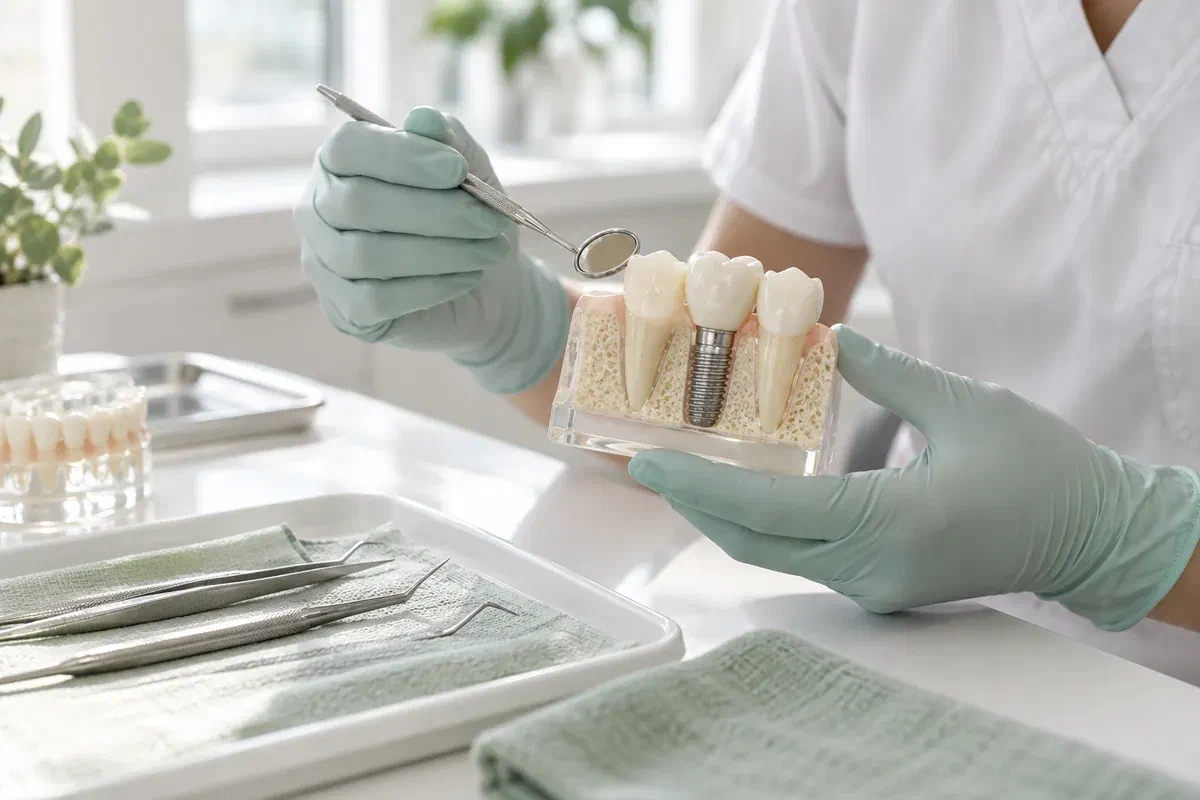
Illustrative discussion of ongoing implant maintenance with a patient
Restorative Dentistry

Dental Implant Maintenance in Milton

An implant that feels completely normal is a good sign, but it is not the same as a checked one. Book implant maintenance in Milton to review the crown or appliance, the gum around it, your bite and the way you clean it.

When nothing seems wrong

Comfort tells you part of the story.

Most people stop thinking about an implant once it settles in, and that is reasonable. It chews, it looks like a tooth, and nothing hurts. Maintenance exists for the things you cannot feel: how the gum around the restoration is responding, whether the bite still meets evenly, and whether your cleaning reaches every surface it needs to.

An implant is a system rather than a single object. There is the visible crown or appliance, the connecting parts beneath it, the soft tissue that seals around it and the bone that holds the fixture. A problem in one of those areas can look quite different from a problem in another, which is why a review looks at all of them instead of polishing and moving on.

Living in Milton makes it easy to fit a review into an ordinary week. Bring whatever you know about the implant, including where it was placed and any repairs since, and mention anything that has shifted in chewing, cleaning or your general health. The plan we discuss should fit the restoration you actually have.

Book a Milton implant review
Gloved clinician inspecting an implant teaching model with a dental mirror
Worth mentioning at your visit

Tell us what changed, even if it seems minor.

There is no need to work out which part is responsible before you call. Describe the sensation, when you notice it and how long it has been going on, and the clinician can look at the restoration and its surroundings with that in mind.

Chewing feels a little off

Perhaps the implant tooth now touches before the others, or one side feels heavier when you eat. Let us know about any fillings, crowns or orthodontic work done recently, because the implant has to work within the bite as a whole.

Something wiggles or clicks

A sense of movement could come from a crown, a bridge, an attachment or another component. It does not automatically mean the implant in the bone is in trouble, but it still needs someone to find out which part is moving and why.

Your routine has become harder

A new diagnosis, a change in medication or stiffer hands can make your usual cleaning tools awkward. Raise this openly so the maintenance plan reflects what you can realistically do each day.

Do not wait for your next scheduled review if a restoration becomes loose, the gum swells, there is discharge, or pain is getting worse. Call so it can be assessed.

What regular review offers

Each visit adds to a clearer picture.

Seeing the same implant over several appointments lets the team notice gradual change in the tissue, the restoration and how well your routine is working. It also helps separate an ordinary cleaning need from a concern that calls for a specific assessment or a repair.

No schedule can promise an implant will stay free of problems. Your plan should be built around you, and it may be adjusted when something new turns up. You are always welcome to ask what is being watched and why a particular interval suits your history.

Patient information: European Federation of Periodontology — dental implants

Records to compare against

Notes and earlier records give the clinician a baseline. If your implant was placed by another office, any details you can gather about the system and the restoration make it simpler for a new team to continue your care.

Two kinds of problem, both considered

Parts can wear or loosen, and tissue can become inflamed, and these are different issues. Looking at both keeps anyone from assuming every symptom is about cleaning, or that a loose part means the whole implant has to go.

Arrangements made in advance

Talk through replacement parts, how you reach awkward areas and who will handle a repair if one is needed. Settling those questions early makes a surprise much easier to deal with later.

How the appointment runs

From your history to a clear next date

What happens at a review depends on what you have. A single crown, a fixed bridge and a removable appliance held by implants each need slightly different attention, so the visit is shaped around your restoration.

  1. Catch up on what has happened

    We go over the original treatment, any repairs, past professional care and how you clean at home. Health and medication updates matter too, as do new symptoms, movement or trouble handling an appliance.

  2. Look at the restoration and tissue

    The clinician checks the implant tooth or appliance, how your teeth come together and the gum around it. Further records or imaging may be suggested if your history and the findings make them worthwhile.

  3. Clean, or plan further treatment

    Professional cleaning is matched to the restoration in your mouth. When a component, the tissue or the design needs a different kind of care, the team explains what was found and what is proposed.

  4. Settle home care and timing

    You leave knowing how to clean and handle the restoration, which signs should prompt a phone call and when to come back. If more than one clinician is involved, we confirm who looks after each part of your care.

Day to day in Milton

A steady routine and a number to call

The best plan is one you understand well enough to follow without thinking twice. Ask to be shown techniques, hold on to your treatment details, and get in touch when something changes rather than waiting for a reminder card.

Stick with the method you were shown

Use the brushes, floss or other aids suggested for your particular restoration. If a spot gets harder to reach or a tool starts to catch, tell us, since the answer may be a reassessment rather than pushing harder.

Leave the hardware alone

Please do not tighten a screw, adjust an attachment or glue a loose crown back in place. These parts need proper assessment and equipment, and home repairs can hide the real cause or damage pieces that could have been reused.

Keep your implant paperwork

Hold on to any implant system details, notes about major repairs and contact information for the clinicians involved. These help when care moves between offices or a part has to be assessed by a team that did not place it.

Possible next steps

The finding decides the response.

A review can point in a few different directions. The team should tell you plainly whether the issue is routine prevention, a part that can be replaced, or the health of the tissue that supports the implant.

When everything looks stable

Carry on with tailored maintenance

Regular review and professional cleaning continue, along with home-care advice suited to you. The interval reflects your risk factors and current condition, and you know how to report changes in between.

When a part is the problem

Check or repair a component

A part that is loose, worn or damaged may need its own restorative appointment and details about the implant system. Ask which piece is involved, whether a compatible replacement exists and what fixing it would achieve.

When cleaning alone is not enough

Address the supporting tissue

Inflammation or changes in the support around an implant may need closer assessment and treatment. The clinician can tell you whether a referral makes sense and how that care fits with ongoing maintenance.

Common questions

Straight answers about looking after an implant

Knowing who does what, and what each visit covers, makes long-term care far easier. These answers focus on keeping the whole restoration in good order once the original treatment is complete.

(905) 876-4488
My implant has never bothered me. Do I still need maintenance visits?
Comfort is encouraging, but tissue inflammation and component wear do not always cause pain early on. A review lets the clinician look for changes you would not notice yourself. The interval can be set around your history and how the restoration has been doing.
Is an implant review just a cleaning with a different name?
Cleaning is part of it, but a review can also cover the crown or appliance, the components, your bite, the tissue, health changes and whether new records are needed. Ask what your visit includes and whether anything separate is being recommended.
Can I bring my implant to a different office from the one that placed it?
Yes, ongoing care can often continue elsewhere. Gather what you can about the implant system, the restoration and past repairs, and share contact details for the original office. That information helps the new team understand what they are looking at.
Should I brush and floss around an implant the same way as my natural teeth?
Some of the same habits apply, but the shape of the restoration may call for particular brushes, floss or other aids. Ask to be shown the method for your implant and mention any area that feels hard to reach.
What should I do if I bite into something hard and the implant feels different afterwards?
Avoid testing it repeatedly or chewing on that side, and call to describe what changed. A crown, a component or the bite itself may be involved, and the clinician will need to examine it to tell which.
Since I live in Milton, can I just come in whenever something feels wrong?
Being close by helps, and you should call whenever a concern appears. A planned interval still matters, though, because some changes are only found during an examination. Agree on a schedule and treat extra calls as a supplement to it.
Implant care close to home

Give your implant the follow-up it was built for.

Visit our Bronte Street practice to review your implant restoration, the gum and bone that support it, and the routine you use at home. We can explain what needs watching, look into changes and arrange the next step when more than cleaning is called for.

If a piece has come off, keep it somewhere safe and call us. Mention any movement, swelling or growing discomfort when you book.

Visit Milton Dental Clinic
Unit 1, 342 Bronte St. S, Milton, ON L9T 5B7
Get directions Clinic hours
Monday–Thursday
11am–7pm
Friday–Sunday
By appointment only

Areas we serve

  • Milton
  • Oakville
  • Mississauga
  • Georgetown
  • Halton Hills
  • Acton
  • Campbellville
  • Brampton
  • Burlington
  • Puslinch
  • Rockwood
  • Erin
  • Caledon
  • Etobicoke
  • Old Milton
  • Bronte Meadows
  • Timberlea
  • Dorset Park
  • Dempsey
  • Clarke
  • Beaty
  • Coates
  • Harrison
  • Scott
  • Willmott
  • Ford
  • Bowes
  • Cobden
  • Walker
  • Mountain View
  • Milton Heights
  • Hawthorne Village
  • Valley View
  • Fallingbrook
  • Nassagaweya
  • Trafalgar
  • Esquesing
  • Nelson
  • Brookville
  • Moffat
  • Glen Williams
  • Norval
  • Limehouse
  • Stewarttown
  • Ashgrove
  • Hornby
  • Silver Creek
  • Speyside
  • Scotch Block
  • North Oakville
  • River Oaks
  • Glen Abbey
  • West Oak Trails
  • Palermo
  • Bronte Creek
  • College Park
  • Joshua Creek
  • Uptown Core
  • Preserve
  • Iroquois Ridge
  • Lisgar
  • Meadowvale
  • Meadowvale Village
  • Churchill Meadows
  • Erin Mills
  • Central Erin Mills
  • Streetsville
  • East Credit
  • Creditview
  • Heartland
  • Sheridan
  • Mount Pleasant
  • Credit Valley
  • Huttonville
  • Churchville
  • Springbrook
  • Northwest Brampton
  • Bram West
  • Fletcher's Meadow
  • Fletcher's Creek South
  • Alton Village
  • Orchard
  • Millcroft
  • Headon Forest
  • Tansley
  • Brant Hills
  • Tyandaga
  • Kilbride
  • Lowville
  • Aberfoyle
  • Morriston
  • Arkell
  • Hillsburgh
  • Freelton
  • Carlisle
  • Waterdown
  • Flamborough
  • Mountsberg

How can we help?

Milton Dental Clinic

Have a question about your smile? Choose the option that works best for you.

For urgent dental concerns, please call.
Messages are reviewed during clinic hours.