

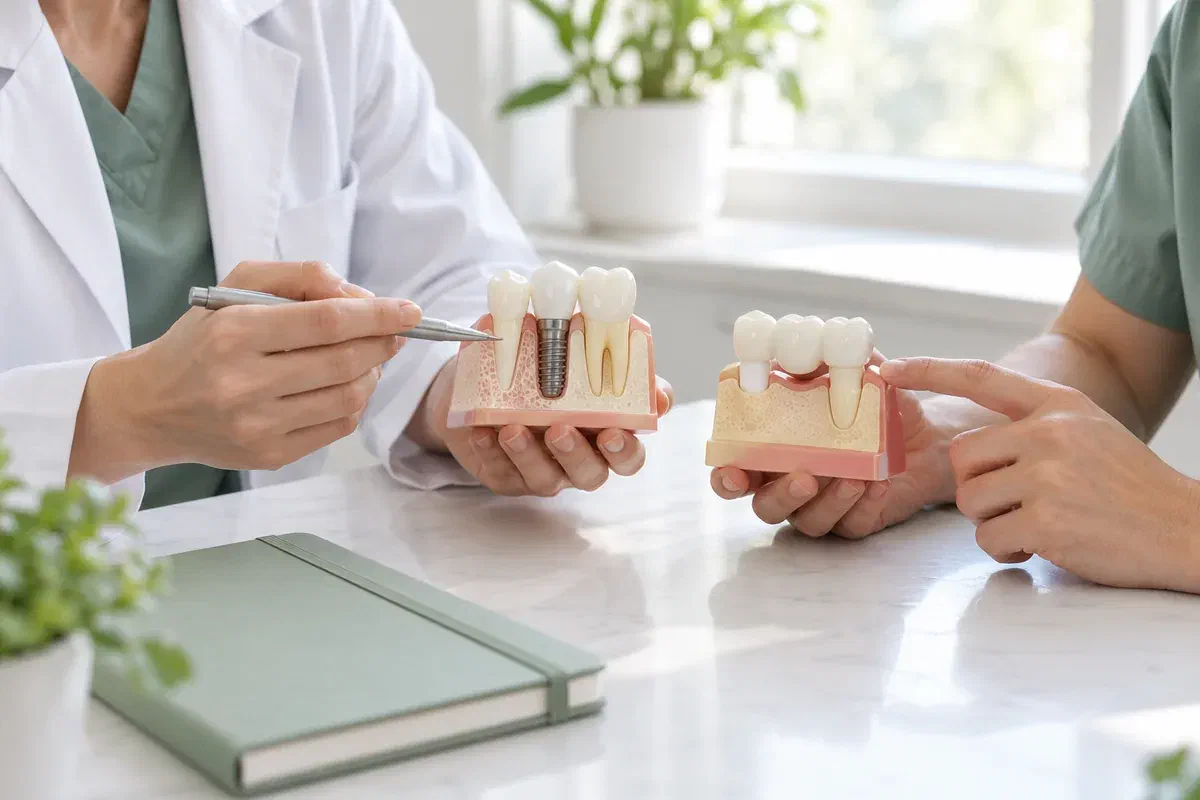
Illustrative patient discussion of a second opinion about implant treatment
Restorative Dentistry

Dental Implant Second Opinions

Take another look at an implant recommendation with room for your questions. A dental implant second opinion in Milton can help you understand the findings, compare complete treatment plans, and consider the choices that matter to you.

A closer look at an implant recommendation

Make space for the questions that are still unanswered.

A dental implant second opinion is a fresh assessment of a proposed treatment or a concern about an existing implant. It can help you understand the diagnosis, the purpose of the recommended steps, and the alternatives that may be reasonable. It does not begin with an assumption that an earlier recommendation was wrong.

Perhaps you have been offered several procedures at once, received different timelines, or remain unsure why an implant is preferred over keeping a tooth or choosing another replacement. Bring the questions in your own words. A useful consultation connects the recommendation to the findings in your mouth.

At Milton Dental Clinic, we can review the available information and explain what a further assessment can and cannot establish. Earlier records may help, but your current condition also matters. The aim is to give you a clearer basis for deciding how you want to proceed.

Arrange an implant second opinion
Dental professionals comparing implant and bridge teaching models
Reasons to seek another discussion

Identify what you want the opinion to clarify.

A focused question makes the appointment more useful. You may want to understand suitability, the proposed sequence, the condition of a natural tooth, or the maintenance involved in a particular restoration.

A recommendation to remove a tooth

If extraction has been suggested, ask what affects the tooth’s outlook and whether reasonable retention options have been considered. The second assessment should review the tooth itself before treating an implant as the inevitable next step.

Different plans that are difficult to compare

Two proposals may include different preparation, temporary teeth, grafting, or final restorations. Bring the written plans so the discussion can compare their scope and clinical reasoning, rather than relying on the final price alone.

A concern after implant treatment

Explain whether the issue is pain, appearance, movement, cleaning access, or something else. An existing implant may need records identifying its components and earlier treatment, and some concerns may require a specialist assessment.

A second opinion should not delay urgent assessment of significant pain, swelling, discharge, or a loose restoration. Call about changing symptoms so the immediate concern can be discussed.

What a further opinion can contribute

Understand the reasoning behind the choices.

A second consultation can give you another opportunity to review the evidence and ask how a proposed treatment addresses your priorities. It may support the original plan, suggest an alternative, or identify information still needed before either approach can be judged.

Different recommendations do not always mean one clinician has made a mistake. There may be more than one reasonable way to manage a situation, with different trade-offs. Ask where the opinions agree, where they differ, and which assumptions explain the difference.

Clarify the diagnosis and uncertainties

The discussion can separate established findings from predictions or questions that need further investigation. This is especially useful when the decision involves removing a tooth or committing to several stages of treatment.

Compare treatment with your goals

Your priorities may involve comfort, appearance, avoiding surgery, or managing ongoing care. A second opinion can help you examine whether the proposed pathway addresses those priorities and what limitations remain.

Prepare better follow-up questions

You may decide to return to the original clinician with a clearer list of questions. An additional opinion can support that conversation without requiring you to transfer all of your care.

Preparing for a useful second opinion

Bring the plan, the history, and the question.

The appointment may need more than a brief look at an estimate. Ask what records would be useful beforehand and clarify the assessment fees, expected scope, and whether additional investigations might be required.

  1. Explain the decision you are considering

    Describe the proposed treatment and what remains unclear. Share your goals, current symptoms, previous dental experiences, and any important health information so the clinician understands the context of the question.

  2. Review available records and examine the mouth

    Relevant treatment plans, imaging, and implant details can help the assessment. The dentist also examines the current situation and explains whether the available information is sufficient to form an opinion.

  3. Discuss findings and reasonable alternatives

    Review what the examination supports, what remains uncertain, and how the options compare. If a specialist opinion or further records are needed, ask which question that additional step is intended to answer.

  4. Summarize the next decision

    Clarify the main conclusions and any recommended follow-up. You can ask for an understandable outline of the discussion and decide whether to seek clarification from the original clinician, gather more information, or continue planning.

After receiving another opinion

Use the information to make the next conversation clearer.

A second opinion is most helpful when its reasoning can be understood alongside the original proposal. Keep the relevant notes together and avoid comparing brief phrases without the findings and assumptions behind them.

Check that the plans address the same problem

Compare which teeth or implants are involved, what preparation is included, and what final restoration is proposed. Two different scopes of care may produce different estimates and timelines without being directly equivalent.

Clarify how clinicians will communicate

If you want information shared, discuss the appropriate arrangements with the teams involved. Clear communication can help resolve questions about earlier findings, component details, or the responsibilities for future care.

Keep current dental needs under attention

While deciding about a long-term implant plan, follow advice about any active dental problem. Ask which matters can wait and which need earlier attention so the search for certainty does not leave a current concern unmanaged.

What the opinion may lead to

The next step depends on what the review establishes.

A second opinion does not have to produce a different treatment. Its value is in helping you understand the options and the information needed to choose among them.

When the findings support the proposal

Continue with an understood existing plan

The assessment may support the original recommendation and help clarify its purpose. You can still discuss details such as timing, temporary teeth, maintenance, and costs with the clinician who would provide the care.

When a different balance is reasonable

Consider another suitable approach

An alternative may involve retaining a tooth, changing the restorative design, or considering a non-implant replacement. Ask what benefit the alternative offers and which limitations or additional commitments it introduces.

When the evidence remains incomplete

Obtain more information before deciding

Further records, investigation, or specialist assessment may be appropriate. Clarify what decision that information could change and how any immediate dental concern should be managed while it is obtained.

Questions about implant second opinions

Bring your uncertainty into the conversation.

You do not need to prove a treatment plan is wrong to ask for another explanation. These questions can help define the scope of the appointment and what you hope to learn.

(905) 876-4488
Can I request a second opinion without deciding to change dentists?
Yes. You can seek another assessment and then decide how to use the information. Explain that your purpose is to understand a recommendation, and clarify the scope of the appointment. You may choose to discuss the findings with your existing dentist before making further decisions.
Will the second dentist need to repeat every scan?
Not automatically. Existing records may be useful if they are relevant and suitable for the question being assessed. The clinician decides whether additional imaging is justified and should explain why. Let the clinic know what records exist before arranging new investigations independently.
Can two implant plans both be reasonable?
Yes, depending on the findings and goals. Different approaches may balance surgery, restoration design, timing, and maintenance differently. Ask each clinician to explain the reasoning and limitations so you can compare complete plans rather than assuming a difference proves one is incorrect.
What should I bring if my concern is mainly the treatment estimate?
Bring the written estimate and treatment outline, including any separate surgical or restorative proposals. Ask which items are included, conditional, or excluded. A meaningful comparison also needs to consider the diagnosis and intended result, not only whether the totals differ.
Can a second opinion address an implant that was placed years ago?
Yes, an existing implant concern can be assessed, although earlier records and component information may be important. Describe the current problem and previous care. The dentist may need additional records or specialist input before offering a complete recommendation about repair or treatment.
Will a second opinion guarantee that I can avoid the recommended procedure?
No. The assessment may confirm that the proposed care is appropriate or identify another option, but it cannot promise the answer you prefer. The useful outcome is a clearer explanation of the findings, reasonable choices, and uncertainties affecting your decision.
Dental implant second opinions in Milton

Let’s take the time to understand the recommendation.

Arrange a consultation at our Bronte Street clinic to review an implant plan or an existing restoration concern. Bring the available records and the questions you want answered so the assessment can focus on the decision in front of you.

Tell the clinic about current pain, swelling, or movement when arranging the visit so urgent needs can be distinguished from a routine planning discussion.

Visit Milton Dental Clinic
Unit 1, 342 Bronte St. S, Milton, ON L9T 5B7
Get directions Clinic hours
Monday–Thursday
11am–7pm
Friday–Sunday
By appointment only

How can we help?

Milton Dental Clinic

Have a question about your smile? Choose the option that works best for you.

For urgent dental concerns, please call.
Messages are reviewed during clinic hours.