

Illustrative patient discussion of a second opinion about implant treatment
Restorative Dentistry

Dental Implant Second Opinions in Brampton

When a proposal covers several teeth at once, the size of the commitment can feel overwhelming. An implant second opinion for those coming from Brampton breaks a larger plan into parts you can question, compare and decide on with confidence.

When the plan involves more than one tooth

A big plan deserves a careful second read.

Some implant proposals deal with one gap. Others suggest removing and replacing several teeth, sometimes a whole section of the mouth, over a long course of treatment. The larger the plan, the more natural it is to want another dentist to look at it before you agree.

An implant second opinion is an independent reassessment. The dentist examines each tooth involved, reviews the records you bring, and explains how the recommendation for each one ties back to the findings. Seeking one says nothing negative about your first dentist; it simply gives you a second explanation.

From Brampton, it is worth gathering the written plan, X-rays, and any notes before you come, so a single visit can go as far as possible. We will be open about which questions can be answered at the appointment and which might need more records or a specialist’s input.

Get a second opinion on a larger plan
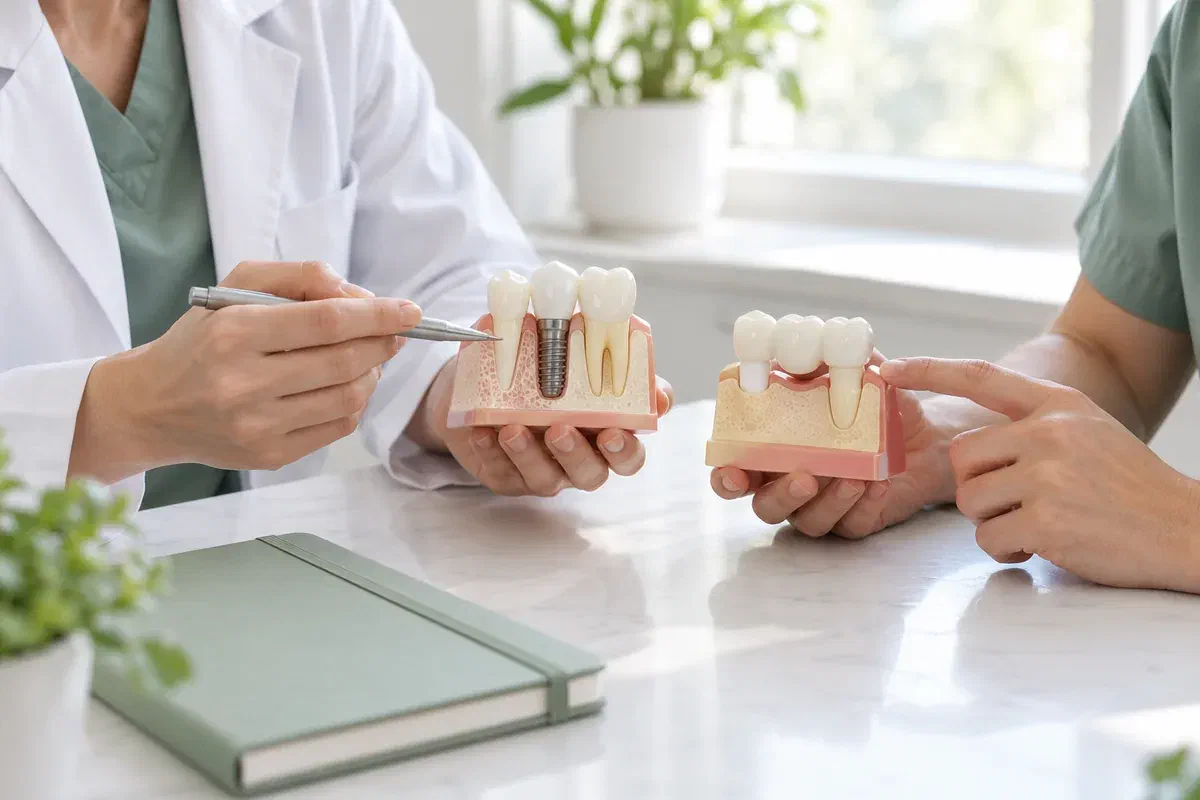
Dental professionals comparing implant and bridge teaching models
Questions worth separating

Tooth by tooth, the reasons may differ.

With a multi-tooth plan, it helps to ask about each part rather than the whole at once. Your concern might be one tooth marked for removal, the overall design, the order of treatment, or how much care the result will need.

Several teeth recommended for extraction

Each tooth may have a different outlook. Ask what is affecting each one and whether some could reasonably be kept. A careful second look examines them individually before treating a group replacement as the only route.

Designs that are hard to compare

One office might suggest individual implants, another an implant-supported bridge, another a different approach entirely. Bring the written proposals so we can compare what each includes and the reasoning, not just the totals.

Concerns about implants already in place

If you have existing implants and something has changed, describe it: pain, appearance, movement, or difficulty cleaning. Component records are often important, and some situations warrant a specialist assessment.

A second-opinion visit should never delay care for significant pain, swelling, discharge, or a loose restoration. Call the clinic about changing symptoms so they can be assessed promptly.

Why a second view helps with larger plans

Scale is easier to judge in smaller pieces.

A second consultation lets you go over the evidence for each part of the plan and ask how it serves your priorities. It may support the original proposal, suggest changes to some parts, or show that more information is needed before the whole can be fairly judged.

Different recommendations for a complex mouth don’t automatically mean anyone is wrong. Larger cases often have several reasonable designs, each balancing surgery, cost, appearance, and upkeep differently. Ask where the plans agree, where they differ, and why.

Sort findings from predictions

Some teeth may clearly need replacing, while for others the outlook is a judgment call. Knowing the difference matters when you are being asked to commit to extensive, multi-stage treatment.

Line the design up with your goals

You might care most about keeping natural teeth where possible, avoiding a removable appliance, appearance, or simpler cleaning. A second opinion can help you see which design matches those goals and what trade-offs it carries.

Return with targeted questions

You may choose to take what you learn back to the dentist who proposed the plan. Another opinion can help you have that conversation without transferring your care.

How the review works

Plan, records, examination, discussion.

A larger plan often needs a longer conversation than a quick look at a quote. Ask ahead which records would help, what the assessment fee covers, how broad the review will be, and whether further tests might be suggested.

  1. Outline the proposal and your doubts

    Explain what has been recommended and which parts you are unsure of. Share your goals, symptoms, earlier dental experiences, and important health information so the dentist can understand your question fully.

  2. Go through records and examine each area

    Treatment plans, imaging, and implant information all help. The dentist examines every tooth involved as it is now and explains whether the available records are enough to offer an opinion on each.

  3. Discuss the findings and alternatives

    We talk about what the examination supports, where uncertainty remains, and how the possible designs compare. If specialist input or more records are recommended, ask what question that extra step is meant to answer.

  4. Summarize where you stand

    Confirm the main conclusions and any follow-up advised. You can ask for an outline to take home and then decide whether to speak with your original dentist, gather more information, or continue planning.

Following the consultation

Compare the plans part by part.

For a larger case, the new opinion is easiest to use when its reasoning sits beside the original proposal. Keep notes together and compare whole sections, not short phrases taken out of context.

Make sure the scope matches

Check which teeth and implants each plan covers, what preparation is included, and what final restorations are proposed. Plans that replace different numbers of teeth will naturally differ in cost and timeline.

Arrange communication between teams

If you want findings shared, discuss the arrangements with each practice. Good communication can help with questions about earlier findings, component details, and who is responsible for each part of future care.

Don’t neglect current needs

Deciding on a large plan can take time. Meanwhile, follow advice about any active problems, and ask which can safely wait and which need attention sooner.

Where a second opinion may lead

From the whole plan to a revised one, or a pause.

The review doesn’t have to change the plan. Its value lies in helping you understand each option and what information you need to choose.

When the evidence supports it

Move forward with the original plan

The assessment may confirm the proposal and clarify why each tooth is included. Timing, temporary teeth, maintenance, and fees can then be discussed with whoever will provide the treatment.

When a different balance makes sense

Adjust part of the plan

Some teeth might reasonably be kept, the restorative design could change, or a non-implant replacement may suit part of the mouth. Ask what each change offers and what it requires of you.

When key questions remain open

Gather more information

Further records, testing, or a specialist assessment may be appropriate. Ask which decision that information could change and how current concerns will be managed in the meantime.

Multi-tooth plans: what Brampton visitors ask

What people ask about larger proposals.

When several teeth are involved, wanting the plan explained again needs no further justification. These answers may help you prepare.

(905) 876-4488
Can a second opinion cover only part of a larger plan?
Yes. You can ask us to focus on a particular tooth or section. Tell us when you book which part you most want clarified, so the consultation can be planned around it.
What is the difference between individual implants and an implant-supported bridge?
Individual implants each support one tooth, while an implant-supported bridge uses fewer implants to support several connected teeth. Each has its own considerations for cleaning, cost, and suitability, which the dentist can explain for your situation.
Is a removable denture still worth considering?
For some people, yes. Dentures avoid surgery and may suit certain health or budget circumstances, though they have their own limitations. Ask how one would compare with the implant options in your case.
Do I have to treat all the teeth at once?
Not always. Some plans can be phased, while others work best when certain steps happen together. Ask what the clinical reasons are for the proposed order and whether staging is an option.
Will you need to examine every tooth, not just the ones in the plan?
The rest of your mouth affects how a plan will work, so the dentist will usually look more broadly. This helps make sure the recommendations fit your overall dental health.
Will a second opinion reduce how many teeth I lose?
It may or may not. The review could support the original plan or suggest keeping some teeth, but it cannot guarantee a particular result. What it offers is a clearer view of each tooth’s situation and the choices available.
Implant second opinions for Brampton

We’ll go through it one tooth at a time.

Book a consultation at our Bronte Street location to review a multi-tooth implant plan or a problem with existing implants. Bring the written plan, imaging, and the questions you want answered so the visit can focus on your decision.

Let us know about any pain, swelling, or loose teeth or restorations when you call, so urgent needs are recognised before a planning discussion.

Visit Milton Dental Clinic
Unit 1, 342 Bronte St. S, Milton, ON L9T 5B7
Get directions Clinic hours
Monday–Thursday
11am–7pm
Friday–Sunday
By appointment only

Areas we serve

  • Milton
  • Oakville
  • Mississauga
  • Georgetown
  • Halton Hills
  • Acton
  • Campbellville
  • Brampton
  • Burlington
  • Puslinch
  • Rockwood
  • Erin
  • Caledon
  • Etobicoke
  • Old Milton
  • Bronte Meadows
  • Timberlea
  • Dorset Park
  • Dempsey
  • Clarke
  • Beaty
  • Coates
  • Harrison
  • Scott
  • Willmott
  • Ford
  • Bowes
  • Cobden
  • Walker
  • Mountain View
  • Milton Heights
  • Hawthorne Village
  • Valley View
  • Fallingbrook
  • Nassagaweya
  • Trafalgar
  • Esquesing
  • Nelson
  • Brookville
  • Moffat
  • Glen Williams
  • Norval
  • Limehouse
  • Stewarttown
  • Ashgrove
  • Hornby
  • Silver Creek
  • Speyside
  • Scotch Block
  • North Oakville
  • River Oaks
  • Glen Abbey
  • West Oak Trails
  • Palermo
  • Bronte Creek
  • College Park
  • Joshua Creek
  • Uptown Core
  • Preserve
  • Iroquois Ridge
  • Lisgar
  • Meadowvale
  • Meadowvale Village
  • Churchill Meadows
  • Erin Mills
  • Central Erin Mills
  • Streetsville
  • East Credit
  • Creditview
  • Heartland
  • Sheridan
  • Mount Pleasant
  • Credit Valley
  • Huttonville
  • Churchville
  • Springbrook
  • Northwest Brampton
  • Bram West
  • Fletcher's Meadow
  • Fletcher's Creek South
  • Alton Village
  • Orchard
  • Millcroft
  • Headon Forest
  • Tansley
  • Brant Hills
  • Tyandaga
  • Kilbride
  • Lowville
  • Aberfoyle
  • Morriston
  • Arkell
  • Hillsburgh
  • Freelton
  • Carlisle
  • Waterdown
  • Flamborough
  • Mountsberg

How can we help?

Milton Dental Clinic

Have a question about your smile? Choose the option that works best for you.

For urgent dental concerns, please call.
Messages are reviewed during clinic hours.