

Illustrative dentist and patient discussion of an implant treatment sequence
Restorative Dentistry

Dental Implant Treatment Planning in Puslinch

Your medicines, health conditions and habits all belong in an implant plan. For people travelling in from Puslinch, we look at how your health shapes the timing and order of each stage.

Health and the implant sequence

Your medical history is part of the plan

A list of medications rarely feels like dental information, yet it can influence when surgery is appropriate, how healing is monitored and whether your physician should be involved. The same goes for conditions such as diabetes, recent hospital care or smoking.

Implant planning gathers those details alongside the clinical steps: assessment, any treatment needed first, placement, healing, the final restoration and lifelong maintenance. Stages may be shared among clinicians and each one depends on the one before. The crown, bridge or appliance at the end is considered from the start, so it has room, looks natural, works for chewing and can be cleaned.

Living in Puslinch, you may want to know early which visits need recovery time or a driver. Share that, along with costs, your schedule and how you feel about a gap. We will weigh those while the clinical requirements and realistic timing lead.

Review your health history for implant care
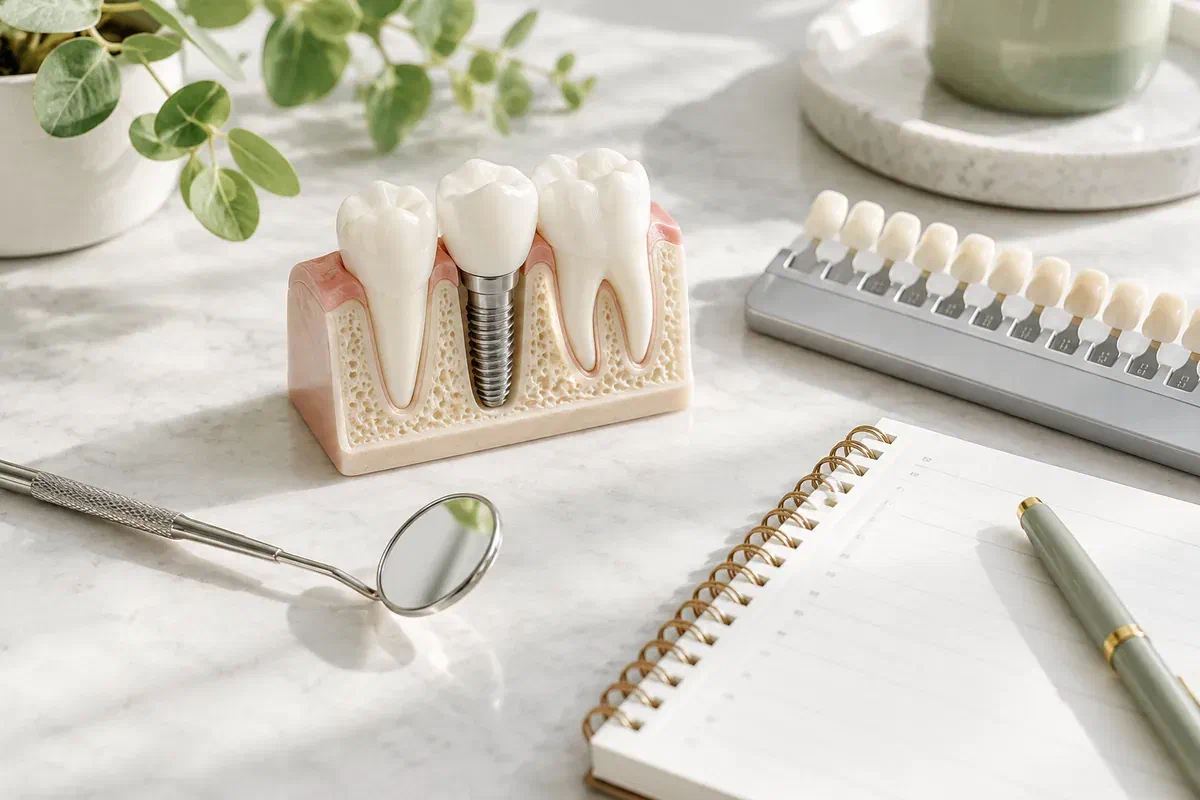
Implant teaching model, shade guide, and blank notebook on a consultation desk
Health questions that affect timing

What your dentist will want to know

Some parts of a plan are fixed early, while others wait on findings or input from your physician. Knowing which is which keeps an early timeline in perspective.

Conditions that need attention first

Gum disease, decay, a failing tooth or the state of the site may need treatment before an implant. Some general health conditions also need to be well managed. Ask what has to be addressed first and how readiness will be judged.

A temporary that suits your health

Ask whether a temporary tooth is appropriate and what it can manage. If you have a dry mouth or a sensitive gum, mention it, since comfort and protection of the healing site both matter.

Dental and medical teams working together

Your dentist may need to consult your physician or a specialist. Ask who coordinates the plan and how information will be shared, especially if medication changes are being considered.

A fast-track implant offer may not take your health history into account. Ask which findings, medical and dental, decide timing and what could alter it.

Why the full picture helps

Timing that respects your health

Planning with your medical history in view helps avoid scheduling a procedure at the wrong moment. It also lets you weigh the expected benefit of an implant against the time, upkeep and possible extra procedures.

No plan can remove every risk or promise a healing outcome. It should explain which uncertainties apply to you and how a change in health or findings would be handled, with revised estimates and consent discussed before going further.

Patient information: Canadian Dental Association — dental implants

The final tooth stays the goal

The intended crown, bridge or appliance still guides where support goes. Keeping it central means function, looks and cleaning are part of each decision.

Preparation you can plan for

Knowing ahead when you may need a medication review, someone to drive you or a quiet day helps. The team can say which dates move and which healing sets.

Honest comparison of choices

For some health situations, a bridge or removable appliance may be worth weighing seriously. Include upkeep and future repairs, not just the first treatment.

Our planning steps

Health first, then the sequence

The plan grows from conversation, examination and suitable records, sometimes with input from your physician. It gains detail as findings arrive, and we will tell you roughly when each choice needs to be made.

  1. Take a full history

    We review your missing teeth, existing restorations, medications, conditions and goals. The dentist examines the mouth and identifies what information, dental or medical, is still needed.

  2. Plan the restoration and preliminaries

    We discuss the final tooth or appliance and anything needed first. Imaging, a referral, site preparation, physician input and the limits of a temporary are all considered.

  3. Arrange the order and the estimate

    You see which visit comes when and who provides it. The estimate shows what is definite and what only applies if certain findings arise, and it names the health or healing factors that could shift timing.

  4. Re-check before each major stage

    The treating team reviews your current health and findings before each step to confirm the plan still fits. Changes are explained so you understand their effect on what remains.

Between visits

Tell us when your health changes

Keep your current plan, after-care instructions and the clinic’s contact details handy. A change in health or medication between visits is worth a phone call before the next stage.

Prepare for each appointment

Ask whether it is an exam, a procedure or a check-in, and whether you need a driver or to adjust anything. Follow the clinician’s instructions for that visit, and never stop a prescribed medicine unless your prescriber advises it.

Report new prescriptions or diagnoses

New medicines, a hospital visit, a planned surgery, symptoms near the site or a broken temporary can all matter. Let the clinic know so the team can assess the effect on the plan.

Keep up long-term reviews

After the final tooth is placed, cleaning guidance and regular checks continue. Ask who monitors the implant and the restoration, and how to arrange care if a problem develops.

Possible pathways

The safest route may not be the fastest

More than one approach may be clinically reasonable. Compare the groundwork, the extent of surgery, recovery, what covers the gap meanwhile, the restoration itself and lasting maintenance, with your health in mind. A route that asks less of your body may be worth a longer look.

When healing or preparation needs its own interval

A staged pathway

Removing a tooth, preparing the site, placement and restoration may be spaced apart. Ask what each pause is for and how readiness will be confirmed.

When findings and health allow coordination

Combined steps where appropriate

Some procedures can happen together in a suitable case. Ask which, and what would change if your health or conditions on the day made that unwise.

When another approach better fits your needs

A non-surgical replacement

A bridge or removable appliance avoids implant surgery and has its own upkeep. The comparison should reflect your health, priorities and what each can achieve.

Health and implant questions

Medical history, medicines and timing

Knowing why your health affects the plan helps you prepare. These questions separate medical and dental requirements from practical preferences.

(905) 876-4488
Can I have an implant if I have diabetes?
Many people with diabetes have implant treatment, but how well the condition is managed can affect healing. Your dentist may ask about your recent care and, in some cases, consult your physician before setting dates. Steady control and good gum health both support the plan, so it helps to keep regular medical follow-up during treatment.
I take a blood thinner. Do I need to stop it before surgery?
Do not stop or change it on your own. Tell the dental team which medicine you take, and they will advise whether to consult your prescriber. Any change should be decided with the doctor who manages it.
Does smoking affect implant planning?
Smoking is known to affect gum health and healing, so it is part of the discussion. Your dentist can explain how it may affect your plan, and you can ask about support if you are thinking about cutting back or quitting.
Why does my dentist ask about bone or osteoporosis medicines?
Certain medicines used for bone conditions can be relevant to oral surgery. Mention any you take now or have taken before, even by injection, so the team can consider it in planning. If you are unsure of a medicine’s name, bring the packaging or a pharmacy printout.
Will the treatment plan list the crown as well as the surgery?
It should show where the final restoration fits, though separate clinicians may quote separately. Ask which document covers each part, from the implant to the tooth or appliance on top, so nothing is left unaccounted for between offices.
Can medical appointments and implant visits be coordinated for trips from Puslinch?
Tell us about upcoming medical care when booking. The team can help you avoid scheduling a procedure too close to other treatment, and group shorter visits where the clinical sequence allows.
Implant planning for Puslinch

Bring your medication list.

Arrange an appointment at our Bronte Street practice to discuss implant care with your health history in view. We will review your starting point, flag decisions still open and show where your health fits among the groundwork, the restoration and its upkeep.

Bring an up-to-date list of medications and supplements, and any recent letters from your physician or specialist.

Visit Milton Dental Clinic
Unit 1, 342 Bronte St. S, Milton, ON L9T 5B7
Get directions Clinic hours
Monday–Thursday
11am–7pm
Friday–Sunday
By appointment only

Areas we serve

  • Milton
  • Oakville
  • Mississauga
  • Georgetown
  • Halton Hills
  • Acton
  • Campbellville
  • Brampton
  • Burlington
  • Puslinch
  • Rockwood
  • Erin
  • Caledon
  • Etobicoke
  • Old Milton
  • Bronte Meadows
  • Timberlea
  • Dorset Park
  • Dempsey
  • Clarke
  • Beaty
  • Coates
  • Harrison
  • Scott
  • Willmott
  • Ford
  • Bowes
  • Cobden
  • Walker
  • Mountain View
  • Milton Heights
  • Hawthorne Village
  • Valley View
  • Fallingbrook
  • Nassagaweya
  • Trafalgar
  • Esquesing
  • Nelson
  • Brookville
  • Moffat
  • Glen Williams
  • Norval
  • Limehouse
  • Stewarttown
  • Ashgrove
  • Hornby
  • Silver Creek
  • Speyside
  • Scotch Block
  • North Oakville
  • River Oaks
  • Glen Abbey
  • West Oak Trails
  • Palermo
  • Bronte Creek
  • College Park
  • Joshua Creek
  • Uptown Core
  • Preserve
  • Iroquois Ridge
  • Lisgar
  • Meadowvale
  • Meadowvale Village
  • Churchill Meadows
  • Erin Mills
  • Central Erin Mills
  • Streetsville
  • East Credit
  • Creditview
  • Heartland
  • Sheridan
  • Mount Pleasant
  • Credit Valley
  • Huttonville
  • Churchville
  • Springbrook
  • Northwest Brampton
  • Bram West
  • Fletcher's Meadow
  • Fletcher's Creek South
  • Alton Village
  • Orchard
  • Millcroft
  • Headon Forest
  • Tansley
  • Brant Hills
  • Tyandaga
  • Kilbride
  • Lowville
  • Aberfoyle
  • Morriston
  • Arkell
  • Hillsburgh
  • Freelton
  • Carlisle
  • Waterdown
  • Flamborough
  • Mountsberg

How can we help?

Milton Dental Clinic

Have a question about your smile? Choose the option that works best for you.

For urgent dental concerns, please call.
Messages are reviewed during clinic hours.