Movement while chewing or speaking
Notice whether the plate lifts as you bite, shifts with certain words or slips when you open wide. Each pattern can suggest a different cause from a denture that always feels unsettled.


Seeds under the plate, a raw patch on the gum, rinsing after every meal: these small irritations can mean a denture no longer meets the mouth closely. From Halton Hills, have the fit checked and the options explained.
It starts with raspberry seeds or crumbs that sneak beneath the base. Soon you are taking the denture out after lunch to rinse it, and a tender area appears where something keeps getting caught. None of this feels urgent, yet it can be a sign that the fitting surface and your gums have drifted apart.
Relining fills that gap with a new layer on the inside of the appliance, shaped to your gums as they are now. The teeth and the outside of the denture stay unchanged. Trapping and soreness can also come from the edges, a rough area or the bite, which is why the whole appliance is examined before a lining is suggested.
It helps to arrive with details. Which foods are the problem, where do they collect and has the sore patch come and gone? With those notes and a look at the denture in your mouth, the dentist can tell you if a reline addresses the cause or if a simpler or more extensive fix is the better match.
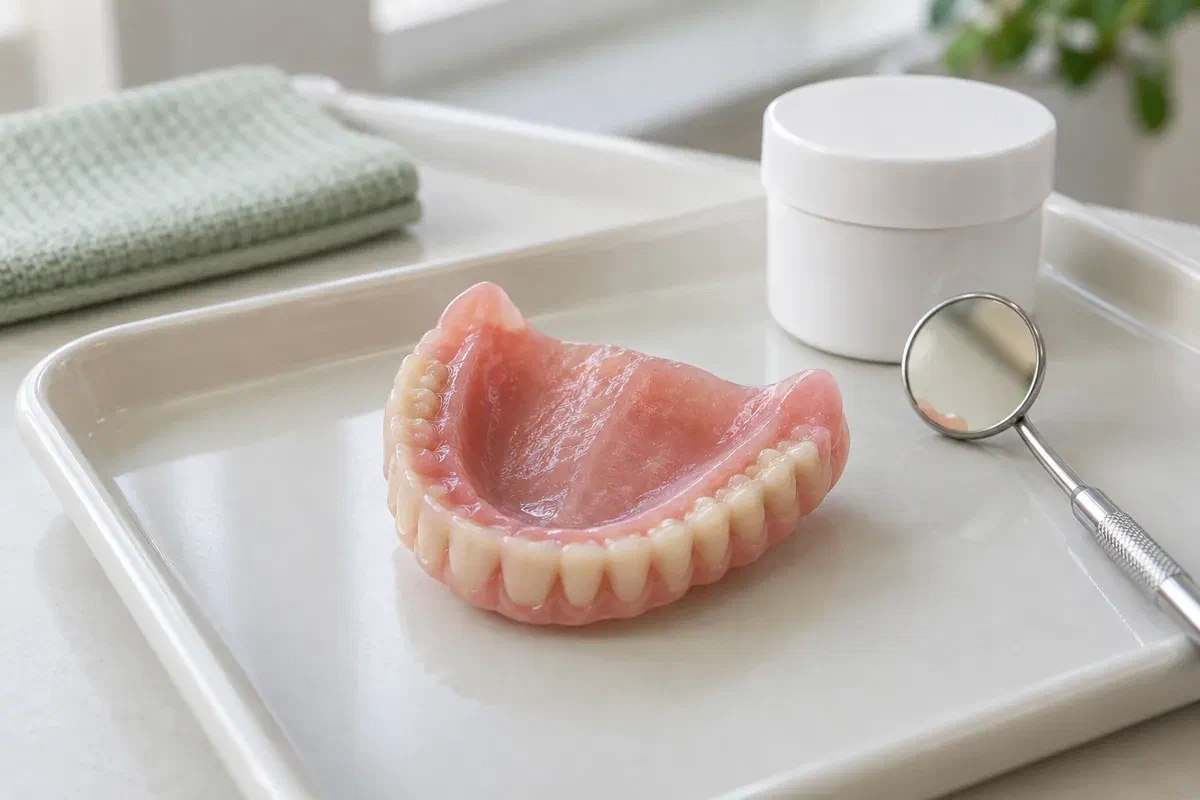
The dentist looks at where the denture gains support, how it behaves as you eat and speak and whether the gums are healthy. A similar complaint can lead to quite different advice for two people.
Notice whether the plate lifts as you bite, shifts with certain words or slips when you open wide. Each pattern can suggest a different cause from a denture that always feels unsettled.
If teeth were removed when the denture was made, the ridges may have changed since. Ask whether healing has reached a point where relining would be useful.
Report food collecting under the base or a tender area that returns, even if the appliance looks intact. The inner surface, the borders or a rough feature could be involved.
Have the denture examined before reaching for a pharmacy lining kit or extra adhesive. Both may seal out food for a while without revealing whether the appliance is still suitable.
With a base, bite and set of teeth that remain serviceable, renewing only the inner surface can be a direct way to deal with gums that have shrunk or reshaped. The dentist should explain the improvement you can reasonably expect, based on your own examination.
A reline also leaves some things untouched. Worn teeth stay worn, the borders are not fully rebuilt and a weakened base is not made dependable by a new lining. Ask which of your problems should ease and which would still need a different approach.
Patient information: Canadian Dental Association — dentures
The lining works on the surface in contact with your gums. Understanding that helps you judge whether it targets the food collection or soreness you keep noticing.
When the teeth and their arrangement still suit you, they are generally kept. Tell us what you value about the appliance as well as what frustrates you.
If healing continues, the plan might use an interim material and a later reassessment. Ask whether the lining and timing are designed for a transition or for the longer term.
The method and schedule depend on the appliance, your tissues and the material. You should know the steps, whether the denture will be away for a time and how follow-up will work before anything is done.
Arrive with the denture and tell us when the problems began. Recent extractions, earlier relines, sore spots and your adhesive routine all help the examination focus on what matters.
The dentist confirms whether the gums are healthy enough for treatment and whether the rest of the appliance is still suitable. Adjustment, rebasing and replacement are weighed alongside relining.
We discuss the material, any impressions and whether a laboratory is needed. For households farther out in Halton Hills, ask whether the review can be grouped with other appointments.
Fit and contacts are checked after the work and you receive cleaning instructions. Keep the review and let us know about any pressure, rubbing or movement that shows up in everyday meals.
Instructions vary with the material and your gums. Ask for guidance for this denture instead of assuming every cleanser or soak you used before is still appropriate.
Certain linings are easily damaged. Ask which brush, product, soaking routine and storage method are safe, and have the team demonstrate a cleaning technique for the new surface.
Keep track of food collecting, new pressure, rocking or a change in your bite, and when it happens. Do not keep pressing on a sore area or trim the lining yourself.
A relined denture still needs regular oral checkups. Your clinician can advise when the appliance and gums should be reviewed, particularly while healing or other changes continue.
The best questions connect the proposed lining to your appliance and your meals. Ask what should change, how visits are arranged and how to care for the denture afterward.
Book a visit at our Bronte Street practice to discuss a denture that traps food, rubs or feels loose. We examine how it is supported, how the teeth meet and the state of your gums, then recommend relining or a better-suited correction.
Let us know which foods cause trouble, along with any earlier linings or repairs.
