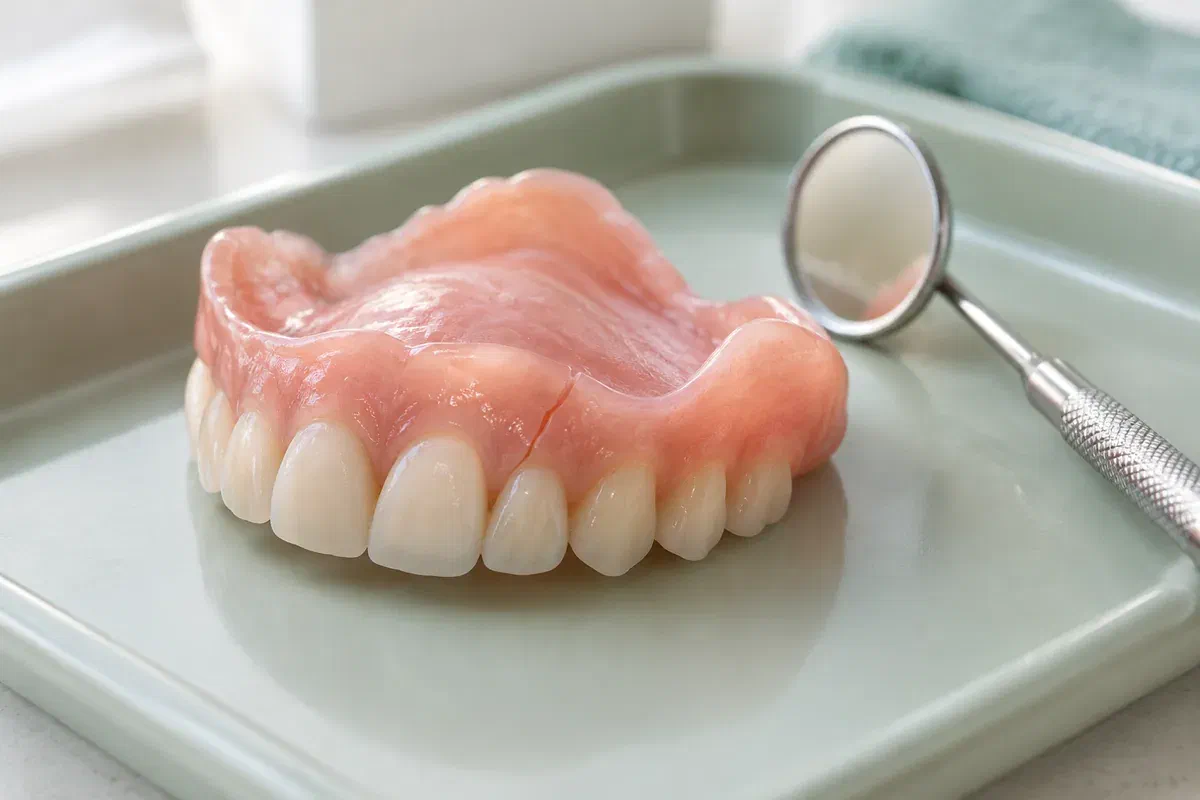
A crack in thinning acrylic
Older bases can be more prone to cracking where they have thinned or flexed. Avoid bending the denture, and tell us whether it fractured during a drop or with normal use.


Teeth worn flat, a base that has seen many years, and now a break. From Erin or Hillsburgh, bring that older denture to our Milton team to learn what a repair can restore, what it cannot renew, and which choice fits you.
Dentures age quietly. The artificial teeth wear down so chewing takes more effort, the pink acrylic may stain or thin, and the shape of your gums slowly changes underneath. Many people do not notice until something gives: a crack across the palate, a tooth that breaks away, or a clasp that finally snaps.
A repair can fix the damaged area, but it does not turn back the clock on the rest of the denture. Worn teeth stay worn, and a fit that has drifted stays drifted unless that is addressed too. Knowing this helps you decide whether a repair, a repair with fit work, or a new appliance is the better use of your time.
Our team welcomes people from Erin and the surrounding communities. Call our Bronte Street practice to describe the damage, then bring the denture and any pieces you found. The dentist will assess the break, the condition of the teeth and base, and your mouth, and explain the realistic choices.
The break itself is one part of the story. The dentist will ask how the denture had been working for you, whether chewing had become harder, and how the damage happened.
Older bases can be more prone to cracking where they have thinned or flexed. Avoid bending the denture, and tell us whether it fractured during a drop or with normal use.
Keep the tooth in a lidded container. If it was heavily worn, the dentist may discuss whether reusing it makes sense or whether a replacement tooth would be more suitable.
On an older partial, a clasp may weaken over time and then break. Leave it as it is. The clasp, the natural tooth it grips, and the fit are assessed together.
Please call before coming in so the team can advise on the appointment. Timing depends on the findings and any laboratory step, and a same-day repair cannot be guaranteed.
Fixing a contained area can keep an older denture in service when the base and teeth are still reasonably sound. The dentist will look closely at the surrounding material before suggesting it.
If this denture has been repaired before, or if chewing has become harder, mention it. The dentist can consider wear, fit, and bite as possible contributors, and the plan can address more than the newest break.
Patient information: Canadian Dental Association — caring for dentures
Wear, a cracked base, and a broken clasp each lead to different choices. Seeing what has happened to your denture makes the recommendation easier to understand.
If you are comfortable with how the denture looks and feels, a repair may keep that familiarity. Tell the dentist what you would miss if it were replaced.
Before agreeing to the work, find out its purpose, which limitations will remain because of the denture’s age, and when it should be reviewed. An older appliance often benefits from closer follow-up, since more than one area may be nearing the end of its useful life.
There is no need to decide beforehand whether to repair or replace. The assessment examines the denture and your mouth and sets out the options and arrangements.
Share roughly how old it is, when it broke, whether you have another to wear, and whether there is pain. Bring the appliance, the pieces, and details of earlier repairs.
The dentist checks the break, the wear on the teeth, and the condition of the base. Your gums, natural teeth, and bite are examined where relevant.
Discuss what each option involves, its cost, its timing, and any laboratory work. Ask whether a repair would be a lasting solution or a way to keep going while a new denture is made.
Any repaired appliance is checked in your mouth for comfort and how your teeth meet. Keep to the care advice and arrange a review if something feels off.
Cleaning every day and regular dental checks matter even more as a denture ages. Ask whether the repair or the denture’s condition calls for any extra care.
A towel or basin of water reduces the risk of another break if it slips. Use a case when it is out of your mouth, and ask for help if gripping it has become harder.
If chewing feels less effective or the denture clicks, wobbles, or shows a new line, call. These can be signs of wear or fit changes that are worth discussing.
Your gums and any natural teeth continue to change. Bring up sore spots, worn teeth, or extra adhesive use at your exams, so they are looked at together.
These answers help you think through what a repair can do for an older denture and what to do while you decide.
Contact our Bronte Street practice about a crack in an older base, a broken-off tooth, or a worn-out clasp. The dentist will assess the appliance, explain what a repair can and cannot do, and talk through whether a new denture is worth considering.
Call ahead to check availability, and bring every saved piece, unglued, in a closed container.
