A hairline crack or complete fracture
Resist pressing or bending the denture to see if the line opens up. Mention whether it appeared after a drop or showed up during normal wear, and how long you think it has been there.


A faint line in the acrylic is easy to ignore until it becomes a full break. From Georgetown, you can have our Milton team examine a hairline crack early, while there may still be more options for repairing it well.
Many denture fractures announce themselves quietly. While cleaning, you catch a thin line running from the edge toward the middle of the palate, or between two front teeth. It does not hurt and the denture still works, so it is tempting to carry on. That line, though, is a sign the material is under stress.
Cracks tend to grow with use, and a denture that splits completely may be harder to repair well than one examined early. Think about whether anything changed recently: a new rocking motion, a clicking sound, or a sore spot. Those details can explain why the line formed in the first place.
Our Bronte Street practice sees people from Georgetown and elsewhere in Halton Hills. Phone first for advice on wearing the denture until your visit. The dentist will examine the crack and the condition of the appliance, check how it fits, and explain whether repair, a fit correction, or replacement suits you best.
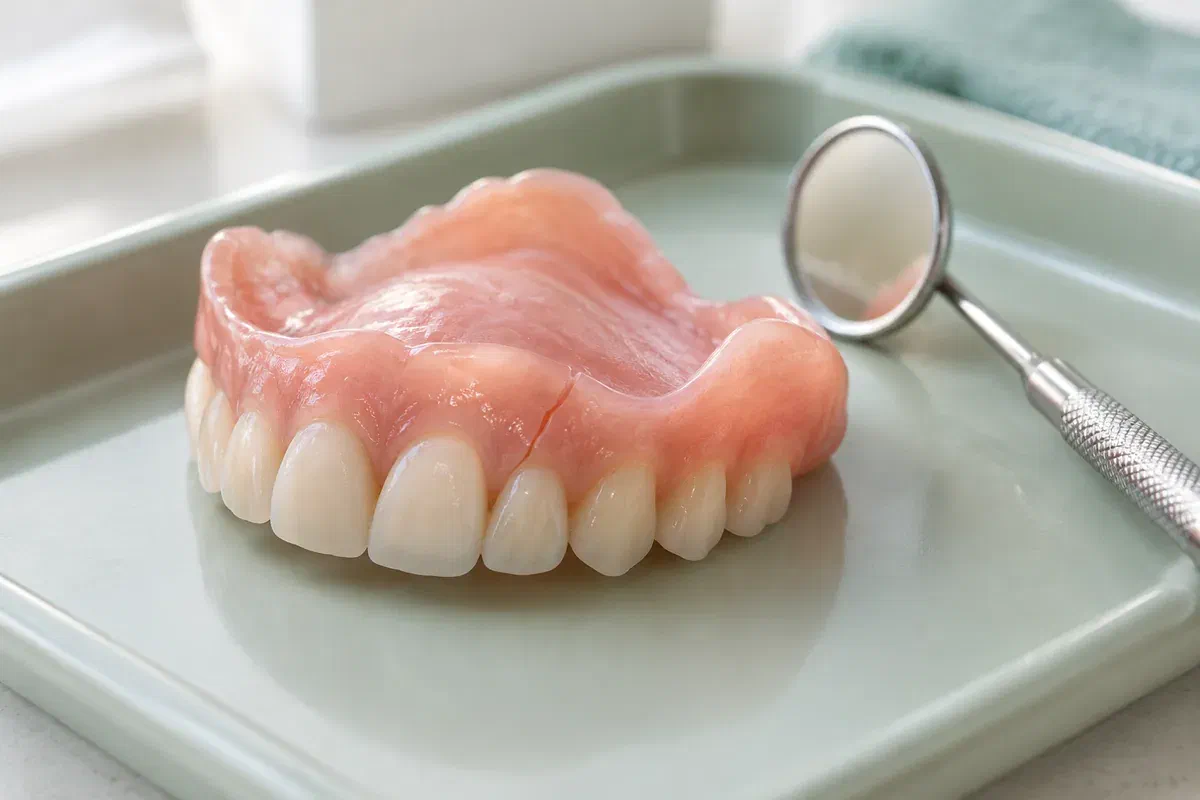
Some damage is subtle, some is impossible to miss. Either way, how the denture had been fitting and what you were doing when you noticed the problem help the dentist read the situation.
Resist pressing or bending the denture to see if the line opens up. Mention whether it appeared after a drop or showed up during normal wear, and how long you think it has been there.
A tooth that wiggles can come away while eating. If it already has, store it in a closed container and bring it along so the dentist can decide whether it can be reused.
If a partial denture’s clasp is bent or cracked, the appliance may feel unstable or press on a natural tooth. Avoid adjusting it at home; the clasp and tooth are assessed together with the fit.
Please call before coming in so the team can suggest an appointment. The time a repair takes depends on the findings and on any laboratory step, so it may not be finished the same day.
A localized repair can keep a good denture working when the surrounding material is sound. Looking at a crack before it becomes a full fracture gives the dentist a clearer view of the appliance as a whole.
If cracks have appeared before, the visit is a good moment to ask why. Fit, design, or bite forces may be contributing, and a plan that considers them can be more reliable than repairing each line as it appears.
Patient information: Canadian Dental Association — caring for dentures
A surface mark, a crack through the base, and a broken clasp all lead to different decisions. Understanding yours helps you weigh the suggested approach.
If the denture otherwise looks and feels right, a repair may preserve that. Let the dentist know what you would like to keep.
Ask what the repair will do, what it cannot change, and when it should be reviewed. This matters most for a denture that has developed cracks more than once.
You can contact us without knowing whether the crack is repairable. The assessment works that out, looks at your mouth as well as the denture, and explains timing and arrangements.
Describe the crack or damage, when you first saw it, and whether you can still wear the denture comfortably. Mention any pain, and bring the appliance with details of earlier repairs.
The dentist examines the line or break and the condition of the appliance overall. Where relevant, your gums, natural teeth, and bite are checked to find any underlying cause.
Talk through the work, its cost, the likely timing, and any lab involvement. Ask whether the repair is intended for the long term or as an interim measure.
Before you leave, the repaired appliance is tried in your mouth to see how it sits and how your teeth meet. Keep to the instructions you are given, and arrange a review if you feel pressure, rubbing, or movement.
Even after repair, a denture benefits from a quick look each time you clean it. Ask whether the repaired material or the cause of the crack changes how you should care for it.
Work over a towel or a basin with a little water, and keep the denture in its case when it is out of your mouth. Ask for tips if removing it has become awkward.
Hold the denture up to good light now and then. If you see a fresh line near the repair, hear clicking, or notice a change in fit, call so the team can judge how soon to see it.
Gums and natural teeth change over time. Mention sore areas, worn teeth, or increased adhesive use during exams so issues are addressed together.
These answers help you decide what to do when you spot a crack, and what to expect from a repair.
Reach our Bronte Street clinic about a hairline crack, a lost tooth, or a clasp that has bent. We will examine the denture, explain what a repair could involve, and point out fit concerns worth addressing alongside it.
Call first to check availability, and bring the denture and any pieces without glue or adhesive.
