
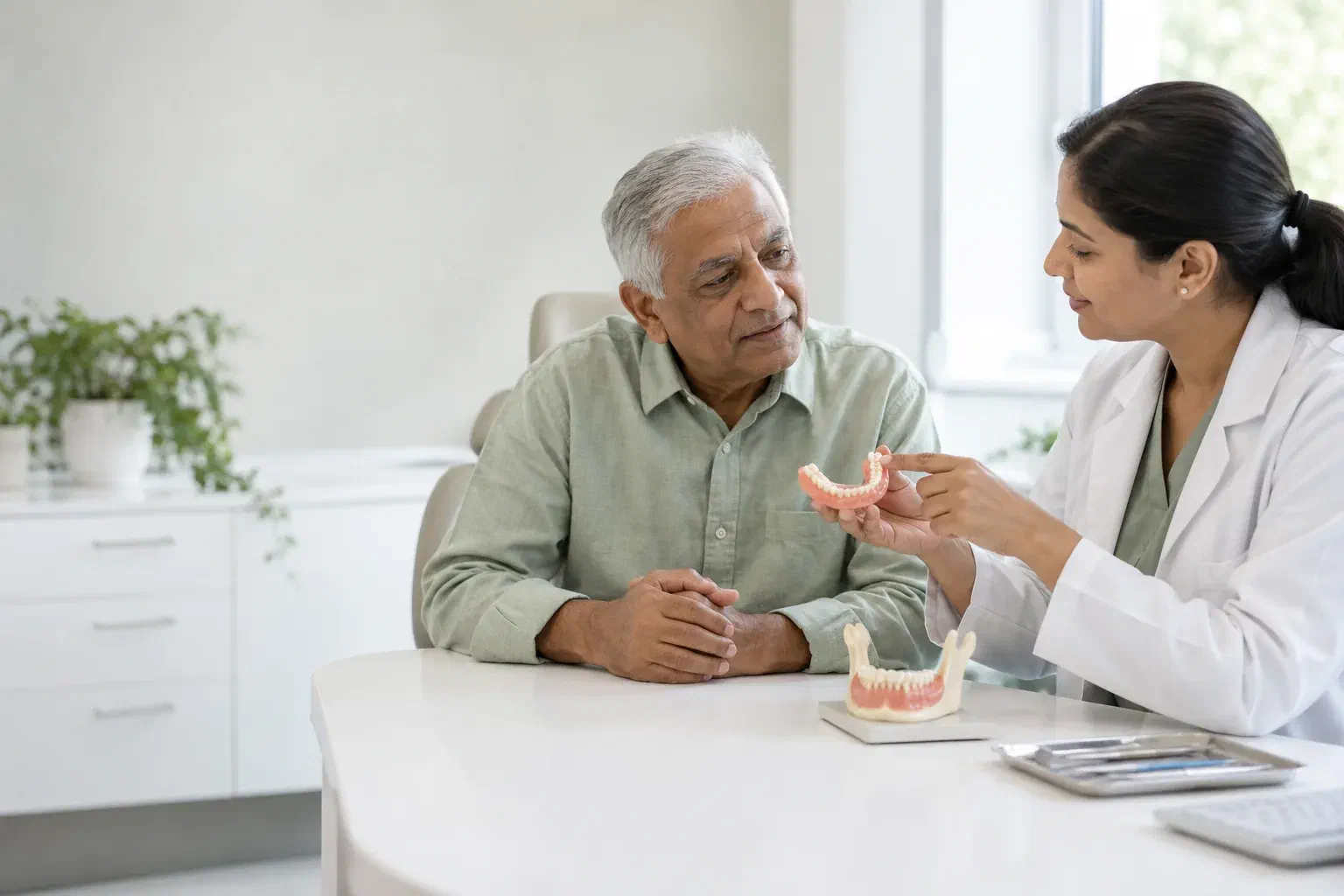
Illustrative consultation about movement of a lower denture
Restorative Dentistry

Denture Stabilization in Old Milton

A denture that fit beautifully for years can slowly start to wander. For neighbours in Old Milton, a short trip to Bronte Street brings a full look at fit, bite and support, and a plain explanation of what might help.

An old favourite that wanders

Why would a denture that fit for years start to move?

The mouth keeps changing after teeth are lost, even when the denture itself stays the same. Gums and the bone beneath them can reshape gradually, and the acrylic teeth wear with every meal. Over enough time, an appliance that once sat snugly may no longer match the surface it rests on.

That is why stabilization is better thought of as a goal than a single procedure. The answer for one long-worn denture could be a careful adjustment or a new fitting surface. For another, the teeth or the overall design may have reached the end of their usefulness, or the remaining support may point toward a conversation about implants.

For people in Old Milton who have worn the same denture for a long stretch, the first step is simply a thorough look. We examine the appliance and your mouth, ask what has crept into your routine because of the movement, and then explain which options are realistic and what each would involve.

Have a long-worn denture checked
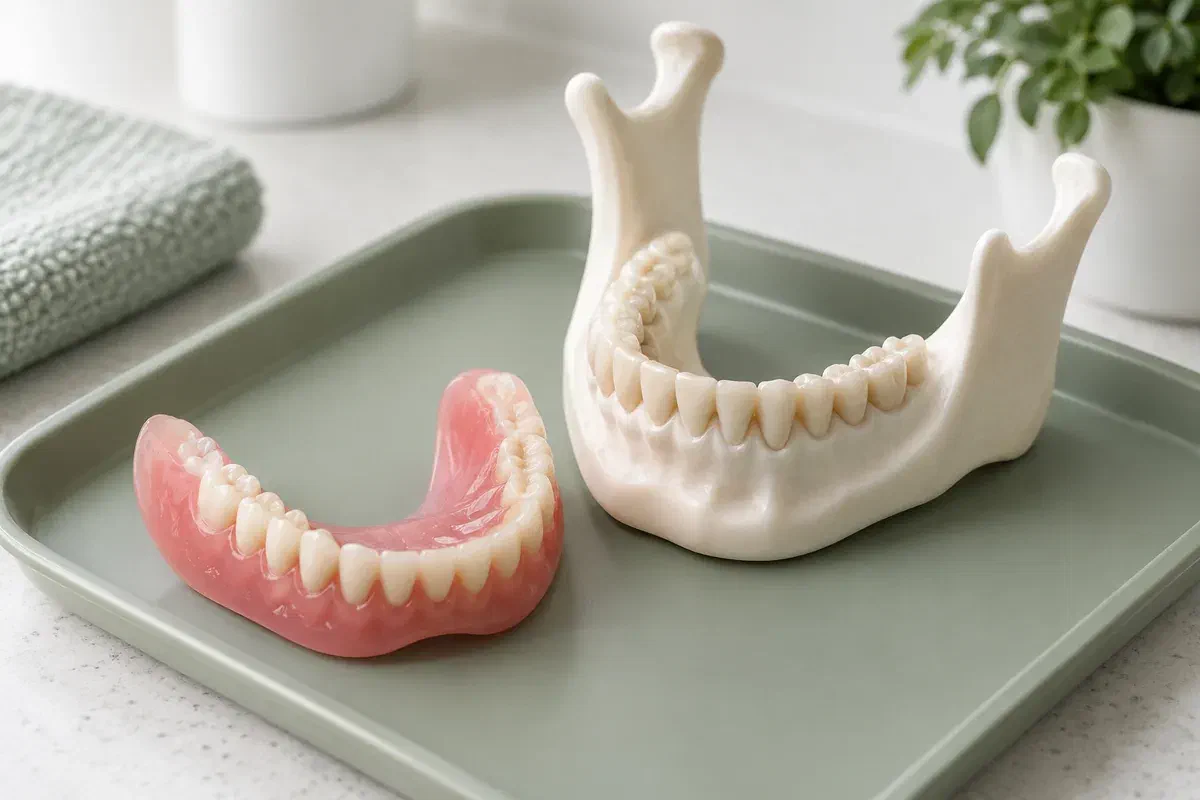
Lower removable denture beside a lower-jaw teaching model
Changes that creep in slowly

Small habits can reveal a lot

Gradual looseness is easy to adapt to without noticing. Before you come in, think about what you now do differently from when the denture was new, and bring those observations along.

You hold it in place while speaking

Pressing the denture up with your tongue during conversation, or avoiding certain words, suggests it lifts in speech. The dentist can check how the edges meet the surrounding tissue and whether the support beneath has changed.

Favourite foods have quietly disappeared

If crusty bread or firm vegetables have dropped off the menu, describe which foods cause rocking and on which side. Worn teeth and uneven contacts can contribute, so the bite is reviewed alongside the fit.

Adhesive has become a daily necessity

Moving from occasional adhesive to relying on it every morning is meaningful. Tell us which product you use and how much, so that it can be considered as part of the assessment rather than the full answer.

Let us know when booking if the denture is cracked, a tooth has come off, or the fit changed suddenly or painfully. The team can advise whether it should be seen quickly and how to manage until then.

Clarity for an older appliance

Knowing whether to refresh or replace

An assessment helps answer a question many long-time wearers have: can this denture be improved, or is it time for something new? It separates issues that can be handled within the existing appliance from those that need a different plan, and it makes the limits of each path easier to talk about.

No honest assessment ends with a guarantee that the denture will never shift. Instead, you hear what improvement is intended, what limitations may remain and what care will keep things working. Your ability to remove and clean the appliance comfortably stays part of every option discussed.

Patient information: Canadian Dental Association — dentures and overdentures

Find the main sources of movement

The dentist looks at support, how the teeth meet and the condition of the denture itself. Ask which of these matters most in your case and whether more than one needs attention first.

Compare what each choice really asks

Options differ in visits, cost, upkeep and day-to-day handling. Setting those demands beside the improvement you hope for helps you choose a path that matches your stage of life and routine.

Settle on expectations that make sense

Share the situations that frustrate you most. The clinician can describe where a proposed treatment may help and where a removable denture will likely still have some limits.

From first look to follow-up

Four unhurried steps

You can arrive without having chosen anything. Whether a reline, a new denture or implant support is worth pursuing becomes clearer once the cause of the movement has been examined.

  1. Share the denture’s story

    Bring the appliance and tell us how long you have had it, what repairs it has needed and when it began to loosen. Mention adhesive, any tender areas and changes in natural teeth you still have.

  2. A careful examination

    The dentist reviews your mouth and the denture side by side, checking support, fit and contacts. This shows whether the problem is local or part of broader change, and whether further records would help.

  3. Weigh the possibilities

    We outline what could be done within the current appliance and what would require replacement or additional support. Feel free to ask about benefits, the number of stages, maintenance and any referral involved.

  4. Treatment and a check-in

    Next steps follow the approach you choose. Once treatment is done, fit and function are reviewed, you receive care instructions, and we plan to look again at any movement or discomfort that persists.

After the change

New fit, new routine

Aftercare depends on what was done, from a small adjustment or new fitting surface to a replacement or extra support. Ask for guidance suited to the new arrangement rather than relying on the habits of the old denture.

Relearn the handling with help

A refreshed or new appliance may go in and come out differently. Ask for a demonstration and try it yourself with the team present. If your grip or eyesight makes handling tricky, say so, and we can talk through what works.

Keep to the maintenance plan

Certain designs include parts that need regular review or eventual replacement. Ask what upkeep is expected, how those visits are arranged and which signs mean you should return earlier than planned.

Note how and when looseness returns

Is it gradual or sudden, and during what activity? Coming back with those details makes it easier to tell a new issue apart from a limitation already discussed when the plan was made.

Three directions to consider

Which path suits your denture?

Each of these suits a different situation, and an examination decides which are relevant. The most involved option is not automatically the right one for an appliance that moves.

If the appliance is still sound

Adjust or reline the current denture

Where the rest of the denture remains suitable, targeted adjustment or a reline may be considered. Ask what specific movement it should correct and whether worn teeth or the bite need attention as well.

If teeth, base or design have aged

Replace a worn-out appliance

A new denture may be suggested when the existing teeth, base or arrangement are no longer appropriate. Replacement lets all of those be planned again together, with realistic expectations about removable support.

If another kind of support may suit

Explore implant-retained options

Some people may be candidates for a removable denture held by implants. That requires its own assessment and a discussion of surgery, healing, cleaning, upkeep, cost and alternatives. Looseness alone does not establish suitability.

Long-time wearers ask

Answers for a denture with some history

People who have worn a denture for many years often come in with similar questions. These answers are general; your examination will show what applies to you.

(905) 876-4488
How do I know if my denture is simply too old?
Age alone does not decide it. The dentist looks at the condition of the teeth and base, how well it fits and how it meets the opposite jaw. Sometimes an older denture can be improved, and sometimes replacement offers a better starting point.
Can a denture be relined more than once?
It can be, depending on the appliance. Each time, the dentist considers whether the rest of the denture is still worth keeping and whether a reline would address the real cause of the looseness, rather than only the fitting surface.
Do I need implants to stop my denture from moving?
Not always. Implant support is one possibility for suitable people, but adjustment, relining or a new denture may also be discussed. The choice depends on what the examination shows about your mouth and appliance.
My hands are less steady now. Will that affect my options?
It is helpful to mention. Some designs require more dexterity to insert, remove or clean, and that can influence which approach is practical. The team can show you techniques and talk about what would be manageable.
Is it normal for a new denture to feel strange after an old one?
An adjustment period is common, especially after many years with the same appliance. Ask what to expect, how to practise speaking and eating, and when a sore spot or lingering awkwardness should bring you back for review.
Can I walk over from Old Milton for a quick fit check?
Our Bronte Street clinic is close to Milton’s historic downtown, but please book first so time is set aside. A thorough stability check takes longer than a quick glance, and bringing the denture with you is essential.
Old Milton, close to home

Let’s look at what has changed

Come to our Bronte Street practice with the denture you have relied on for years. We will assess how it sits, how the teeth meet and how your mouth supports it, then talk through the options that may help.

Bring the denture, any adhesive you use and a note of the foods or moments that now feel less secure.

Visit Milton Dental Clinic
Unit 1, 342 Bronte St. S, Milton, ON L9T 5B7
Get directions Clinic hours
Monday–Thursday
11am–7pm
Friday–Sunday
By appointment only

Areas we serve

  • Milton
  • Oakville
  • Mississauga
  • Georgetown
  • Halton Hills
  • Acton
  • Campbellville
  • Brampton
  • Burlington
  • Puslinch
  • Rockwood
  • Erin
  • Caledon
  • Etobicoke
  • Old Milton
  • Bronte Meadows
  • Timberlea
  • Dorset Park
  • Dempsey
  • Clarke
  • Beaty
  • Coates
  • Harrison
  • Scott
  • Willmott
  • Ford
  • Bowes
  • Cobden
  • Walker
  • Mountain View
  • Milton Heights
  • Hawthorne Village
  • Valley View
  • Fallingbrook
  • Nassagaweya
  • Trafalgar
  • Esquesing
  • Nelson
  • Brookville
  • Moffat
  • Glen Williams
  • Norval
  • Limehouse
  • Stewarttown
  • Ashgrove
  • Hornby
  • Silver Creek
  • Speyside
  • Scotch Block
  • North Oakville
  • River Oaks
  • Glen Abbey
  • West Oak Trails
  • Palermo
  • Bronte Creek
  • College Park
  • Joshua Creek
  • Uptown Core
  • Preserve
  • Iroquois Ridge
  • Lisgar
  • Meadowvale
  • Meadowvale Village
  • Churchill Meadows
  • Erin Mills
  • Central Erin Mills
  • Streetsville
  • East Credit
  • Creditview
  • Heartland
  • Sheridan
  • Mount Pleasant
  • Credit Valley
  • Huttonville
  • Churchville
  • Springbrook
  • Northwest Brampton
  • Bram West
  • Fletcher's Meadow
  • Fletcher's Creek South
  • Alton Village
  • Orchard
  • Millcroft
  • Headon Forest
  • Tansley
  • Brant Hills
  • Tyandaga
  • Kilbride
  • Lowville
  • Aberfoyle
  • Morriston
  • Arkell
  • Hillsburgh
  • Freelton
  • Carlisle
  • Waterdown
  • Flamborough
  • Mountsberg

How can we help?

Milton Dental Clinic

Have a question about your smile? Choose the option that works best for you.

For urgent dental concerns, please call.
Messages are reviewed during clinic hours.