
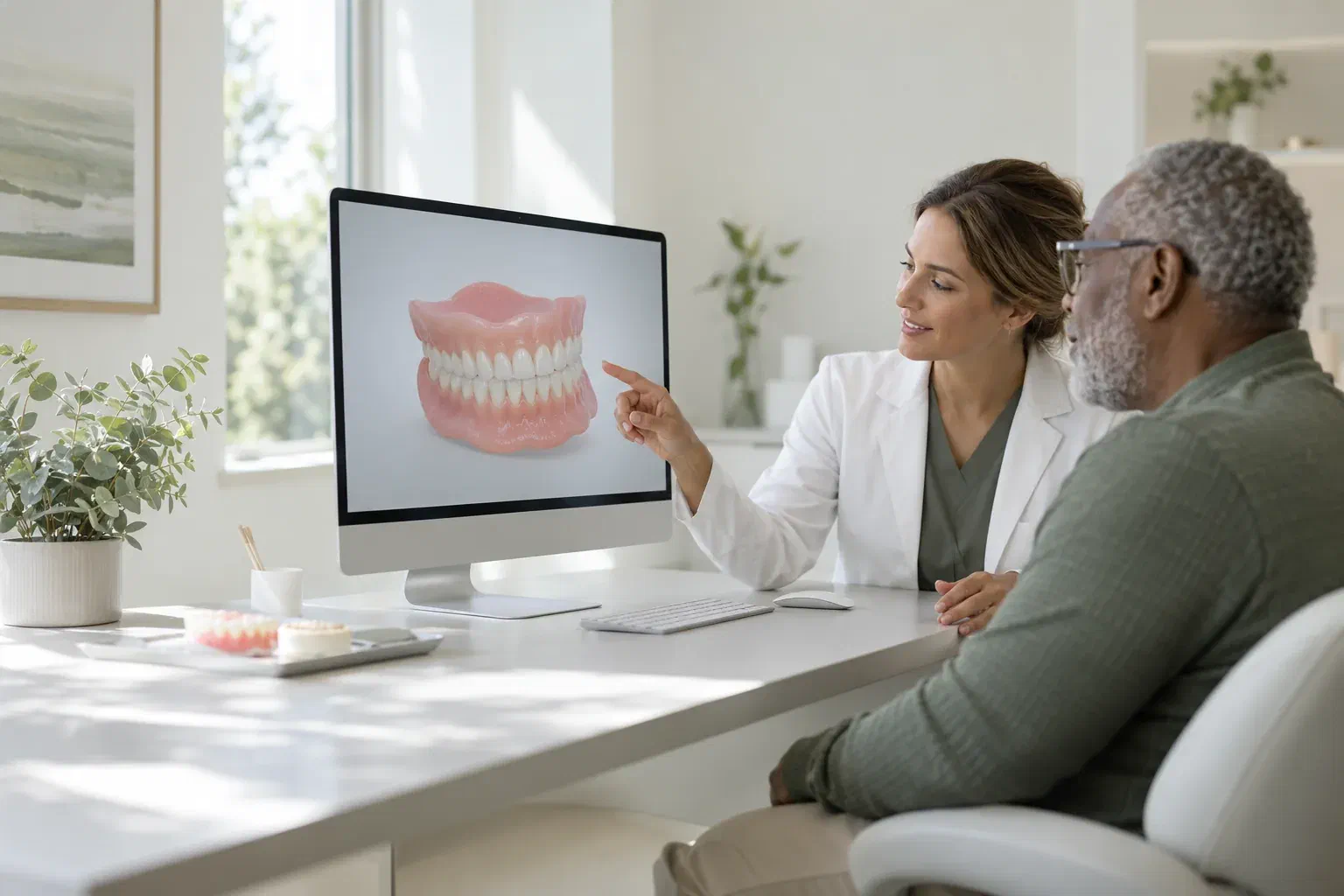
Illustrative patient and dentist reviewing a digital denture design
Restorative Dentistry

Digital Dentures in Oakville

Milled, printed, scanned, designed: denture vocabulary can blur together. This Oakville guide sorts out what each term means and how it relates to the records, try-ins and adjustments a well-fitting appliance depends on.

Making sense of the terms, for Oakville

A vocabulary lesson before a treatment plan.

Searching online for new dentures tends to turn up a pile of terms at once: intraoral scan, CAD design, milled base, printed teeth. They describe real methods, but they are not interchangeable, and none of them on its own tells you whether a particular denture will suit your mouth.

Broadly, a denture is called digital when a computer plays a role in designing or manufacturing it. That role can be large or small. A traditional impression might be scanned and designed in software, or the whole sequence might run through digital equipment. Either way, the appliance still has to be fitted, tested and adjusted on real tissues.

Coming from Oakville, you can bring the terms that confused you and we will match them to the actual steps proposed for you. Which records would we take? What would the base be made of? How would we confirm the fit before and after delivery? Those answers matter more than any single word on a brochure.

Ask what each step would involve
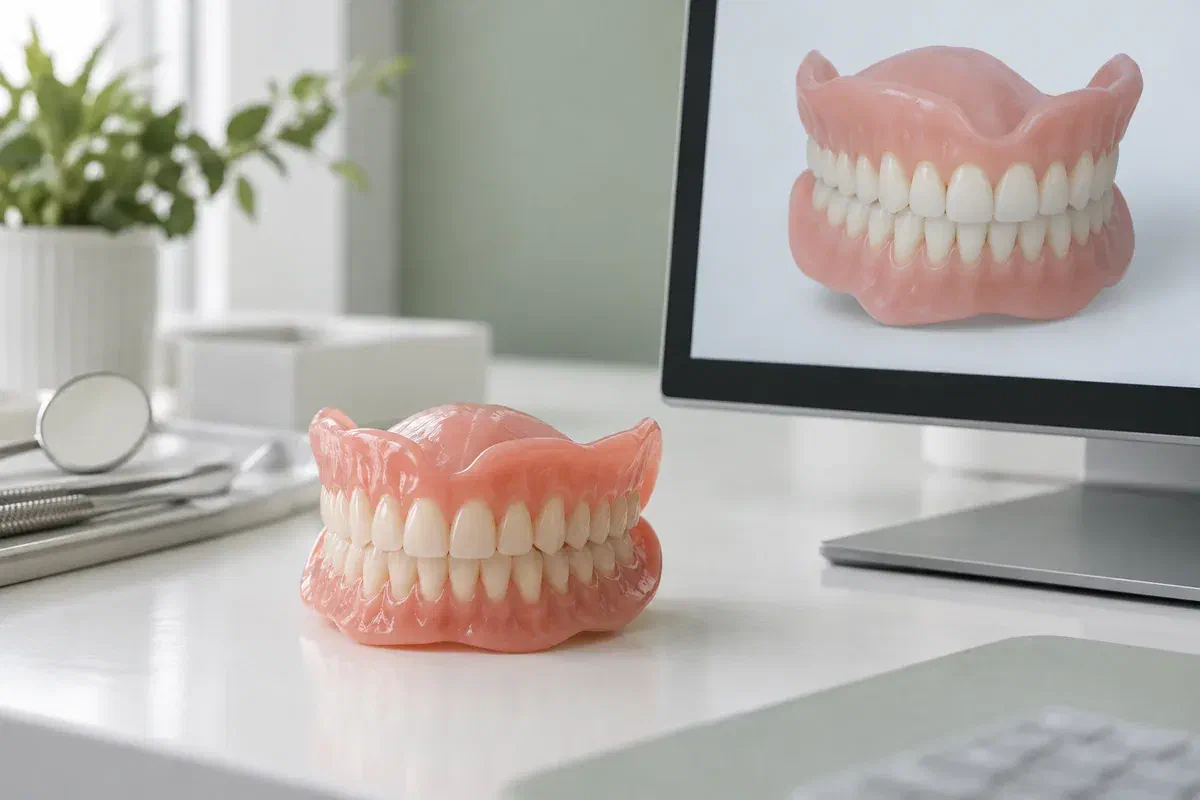
Removable denture beside an illustrative computer-based denture model
Three common starting points

Sort the question before choosing the method.

People explore digital dentures for different reasons, and the reason changes which details deserve attention. These three situations are worth separating.

Swapping out a denture you already wear

Your existing appliance is a source of information about what has worked and what has not. Treat it as evidence to examine, not a pattern to duplicate, since the mouth beneath it may no longer be the same shape.

Wanting to know what each visit is for

Request a plain breakdown of the records, trial fittings and follow-up reviews in the plan. A digital workflow has no built-in visit count, and the finished appliance always needs a clinical check.

Weighing one material against another

Milled, printed and conventionally processed dentures can use different materials. Those differences shape what repair and relining look like later, so ask about the actual appliance being proposed.

Software can show a convincing model, but a model is not a mouth. Whatever the design looks like on screen, the fit and feel are confirmed only by examination and fitting appointments.

Beyond the buzzwords

What design software is genuinely good at.

The strengths are mostly about organization. Tooth placement, base outline and bite relationship can be planned together and handed to production as one precise file, which some systems keep for later use.

That is worthwhile when it serves a good clinical outcome, and not otherwise. Digital fabrication does not, by itself, make a denture better than a conventionally built one. The fair test is how this process answers your fit, appearance and everyday needs, and what the dentist will look at to confirm it has.

Patient information: American College of Prosthodontists — clinical outcomes of digital dentures

Tooth layout you can talk about

A visual design can anchor a discussion about where teeth sit and how they show when you smile. Clarify when you will review it and how adjustments are checked before the denture is completed.

A traceable link to manufacturing

The records taken at the clinic feed directly into the design used for production. Seeing that chain helps you tell apart the decisions made by your dentist from the tools used to execute them.

Files that may outlast the appliance

Some designs are stored and could support a repair or remake down the road. Even so, new examination findings and records may be needed if your mouth or treatment goals have shifted.

The sequence, in practice

Records in, design out, fit confirmed.

Not every plan follows the same order. You should be told which steps apply, whether they include conventional impressions, a trial denture, lab fabrication or several follow-up visits.

  1. An assessment built around you

    The dentist examines the supporting tissues, any natural teeth and the denture you currently wear. What you find difficult about eating, talking, handling or appearance becomes part of the brief.

  2. Records chosen for a reason

    Impressions, a digital scan, bite records and photographs can be used alone or together. Ask what each contributes and whether your present appliance can be recorded as a reference.

  3. A design and material review

    You discuss the tooth arrangement and how it looks, and whether an interim try-in is possible. The team explains whether the denture will be milled, printed or processed another way, and what that means for upkeep.

  4. Delivery, then real-world checks

    The denture is fitted and you learn how to wear and clean it. Later reviews give the dentist a chance to relieve pressure or adjust contacts once you have used it at home.

After the fitting

Different materials, different instructions.

Digitally made dentures still need cleaning every day and examining periodically. Get guidance that fits the material you actually received, which may differ from what your last denture needed.

Match products to the material

Ask which brush and cleanser to use, whether soaking is suitable, and how to store the denture overnight. Something that suited an older acrylic set may not suit every newer material.

Book and keep the review

Tell the dentist about soreness, movement or a bite that feels off-balance. No production method removes the possibility that daily use will reveal something worth adjusting.

Know what you are wearing

Keep a note of the material and any design reference the clinic provides. If you ever change dentists, those details help explain the appliance’s history and repair options.

Comparing the methods

Milled, printed or made by hand?

Digital and traditional techniques can be combined in many ways. A useful comparison looks at clinical fit, materials, review opportunities, maintenance and how many appointments each route needs.

Proven methods, carefully applied

Conventional fabrication

A traditionally made denture can be thoroughly planned and well fitted. Ask how the impressions and bite records are taken, how you preview appearance and how adjustments are handled.

Choosing methods stage by stage

Mixed clinical and digital steps

Some plans pair conventional impressions or a wax try-in with computer design and production. Find out which steps in your plan are digital and why the dentist recommends that particular blend.

Fully digital, for suitable cases

Milled or 3D-printed dentures

Milling cuts the denture from a solid block, while printing builds it up in layers. These are separate methods with their own material characteristics, so ask how relines, repairs and maintenance would work for the one proposed.

Oakville questions, answered

Terms, trade-offs and what happens next.

These answers focus on the vocabulary people encounter, how the methods compare, and what to expect from the first appointment through to the review.

(905) 876-4488
What does CAD/CAM mean when it comes to dentures?
It stands for computer-aided design and computer-aided manufacturing. In denture terms, the appliance is designed in software and then produced by a machine, such as a mill or a printer. It describes how the denture is made, not whether it will suit you.
How is a milled denture different from a printed one?
A milled denture is cut from a pre-made block of material, while a printed one is built up layer by layer. Because the materials and processes differ, the questions about care and repair differ too. Ask which method is planned for you.
Is a digital scan more accurate than a traditional impression?
Both can produce useful records when used well, and the better choice depends on the area being recorded and the plan. Some workflows combine them. Ask why a particular method suits your mouth rather than assuming one always wins.
Can I see what my denture will look like before it is finished?
Many plans include a chance to review tooth shape, shade and arrangement, sometimes with a trial version in your mouth. Ask when that opportunity comes and how changes are weighed against what the appliance needs to do.
What should I bring to my first appointment?
Bring your current denture if you have one, a list of your medications and any notes on what bothers you about your present set. If dental records were taken elsewhere, mention it so we can discuss whether they are relevant.
Could I need an extra visit even with a digital process?
Yes, that is possible. Your records, any trial stages, preliminary treatment and follow-up all depend on your mouth and the method chosen. Ask for the expected sequence and what might add a step along the way.
From Oakville to our practice

Bring the brochure questions with you.

Arrange a consultation at our Bronte Street practice to sort the terminology into a real plan. We will examine your mouth, review any current denture and explain which records, materials and fitting stages each option would involve.

A short list of the terms or claims you have come across can make the conversation quicker and clearer.

Visit Milton Dental Clinic
Unit 1, 342 Bronte St. S, Milton, ON L9T 5B7
Get directions Clinic hours
Monday–Thursday
11am–7pm
Friday–Sunday
By appointment only

Areas we serve

  • Milton
  • Oakville
  • Mississauga
  • Georgetown
  • Halton Hills
  • Acton
  • Campbellville
  • Brampton
  • Burlington
  • Puslinch
  • Rockwood
  • Erin
  • Caledon
  • Etobicoke
  • Old Milton
  • Bronte Meadows
  • Timberlea
  • Dorset Park
  • Dempsey
  • Clarke
  • Beaty
  • Coates
  • Harrison
  • Scott
  • Willmott
  • Ford
  • Bowes
  • Cobden
  • Walker
  • Mountain View
  • Milton Heights
  • Hawthorne Village
  • Valley View
  • Fallingbrook
  • Nassagaweya
  • Trafalgar
  • Esquesing
  • Nelson
  • Brookville
  • Moffat
  • Glen Williams
  • Norval
  • Limehouse
  • Stewarttown
  • Ashgrove
  • Hornby
  • Silver Creek
  • Speyside
  • Scotch Block
  • North Oakville
  • River Oaks
  • Glen Abbey
  • West Oak Trails
  • Palermo
  • Bronte Creek
  • College Park
  • Joshua Creek
  • Uptown Core
  • Preserve
  • Iroquois Ridge
  • Lisgar
  • Meadowvale
  • Meadowvale Village
  • Churchill Meadows
  • Erin Mills
  • Central Erin Mills
  • Streetsville
  • East Credit
  • Creditview
  • Heartland
  • Sheridan
  • Mount Pleasant
  • Credit Valley
  • Huttonville
  • Churchville
  • Springbrook
  • Northwest Brampton
  • Bram West
  • Fletcher's Meadow
  • Fletcher's Creek South
  • Alton Village
  • Orchard
  • Millcroft
  • Headon Forest
  • Tansley
  • Brant Hills
  • Tyandaga
  • Kilbride
  • Lowville
  • Aberfoyle
  • Morriston
  • Arkell
  • Hillsburgh
  • Freelton
  • Carlisle
  • Waterdown
  • Flamborough
  • Mountsberg

How can we help?

Milton Dental Clinic

Have a question about your smile? Choose the option that works best for you.

For urgent dental concerns, please call.
Messages are reviewed during clinic hours.