Your current denture makes daily life awkward
Explain when it moves, what you avoid eating and how it feels to handle. Those details help guide the options, though they do not on their own establish that fixed implant teeth are suitable.


Between the first surgery and the final teeth there is a healing stretch to plan for. For Campbellville households, this page explains how a fixed implant denture is assessed and staged, what interim teeth involve, and the care afterwards.
People tend to picture the finished smile and forget the stretch that comes before it. A fixed implant denture, which some clinicians call a fixed implant bridge, is a full arch of teeth fastened to implants and kept in your mouth around the clock. That sets it apart from an overdenture you unclip, and it means there is usually a healing period, with interim teeth, between surgery and the final arch.
Throughout, two elements are being planned. Implants in the jaw supply the support. The arch above replaces the teeth and, where bone and gum have shrunk, some of that lost shape. Interim teeth are a chance to test how the bite, speech and appearance feel, and to start learning how cleaning underneath will work.
For households in Campbellville and the surrounding Nassagaweya countryside, a first visit to our Bronte Street office is the place to see the whole timeline. After an examination, Dr. Anjum can set out which fixed or removable designs are realistic, what records or specialist care might be involved and what you would wear at each stage.
A full fixed arch is generally discussed once a jaw has lost most of its teeth or will soon. Suitability is decided by examination, and part of that is checking whether any of your natural teeth can be kept.
Explain when it moves, what you avoid eating and how it feels to handle. Those details help guide the options, though they do not on their own establish that fixed implant teeth are suitable.
Ask about each tooth’s diagnosis and what keeping it would involve. A full-arch plan should come after that review, not assume that all remaining teeth will be removed.
Raise any concerns about grip, eyesight or steadiness, and whether someone helps you. Cleaning access shapes the design from the start, so it is worth discussing before anything is decided.
Your assessment and the planned teeth decide how many implants are used and where they go. A fixed number in an advertisement, or a package name, cannot settle that question.
For a suitable patient, the finished implant-supported arch keeps teeth attached through normal eating and talking. The improvement you can expect should be explained in light of your present problems and the planning findings.
Reaching the final arch is not the end of care. It is not maintenance-free, and no lifetime is guaranteed. Implants, gums, the arch and the forces you put on it all need ongoing review. Ask about complications, repair arrangements and ongoing costs at the beginning.
Patient information: Leeds Teaching Hospitals — dental implant patient information
The clinician should explain how implants carry the arch at each stage, interim and final. That lets you compare fixed and removable approaches on how they function.
Tooth position, gum replacement, speech and bite are connected. Tell the team what you notice with interim teeth, and ask how that feedback is used before the final arch is made.
A design suits you only if you can look after it. Ask for a practical explanation of cleaning access and review visits, so the long-term routine is clear before treatment begins.
Treatment usually runs through several stages and may involve a team. Ask who looks after each one, what interim teeth you will have and what could change the plan or its timing.
Teeth, gums, existing appliances and health history are reviewed, with suitable imaging. Records show the support available and whether any preparatory care is needed before implant planning.
Talk through fixed and removable options, implant support, materials, the type of interim teeth, risks and maintenance. Ask the reason for any extraction or graft, since they cannot be reversed.
Order depends on your findings and the agreed plan. When interim teeth are placed, and how much you can chew on them, are separate decisions, so fixed teeth on surgery day are not guaranteed.
Records and try-ins guide the finished teeth. The team checks your bite and function, shows you how to clean beneath the arch and sets dates to check on the teeth and the gum around each implant.
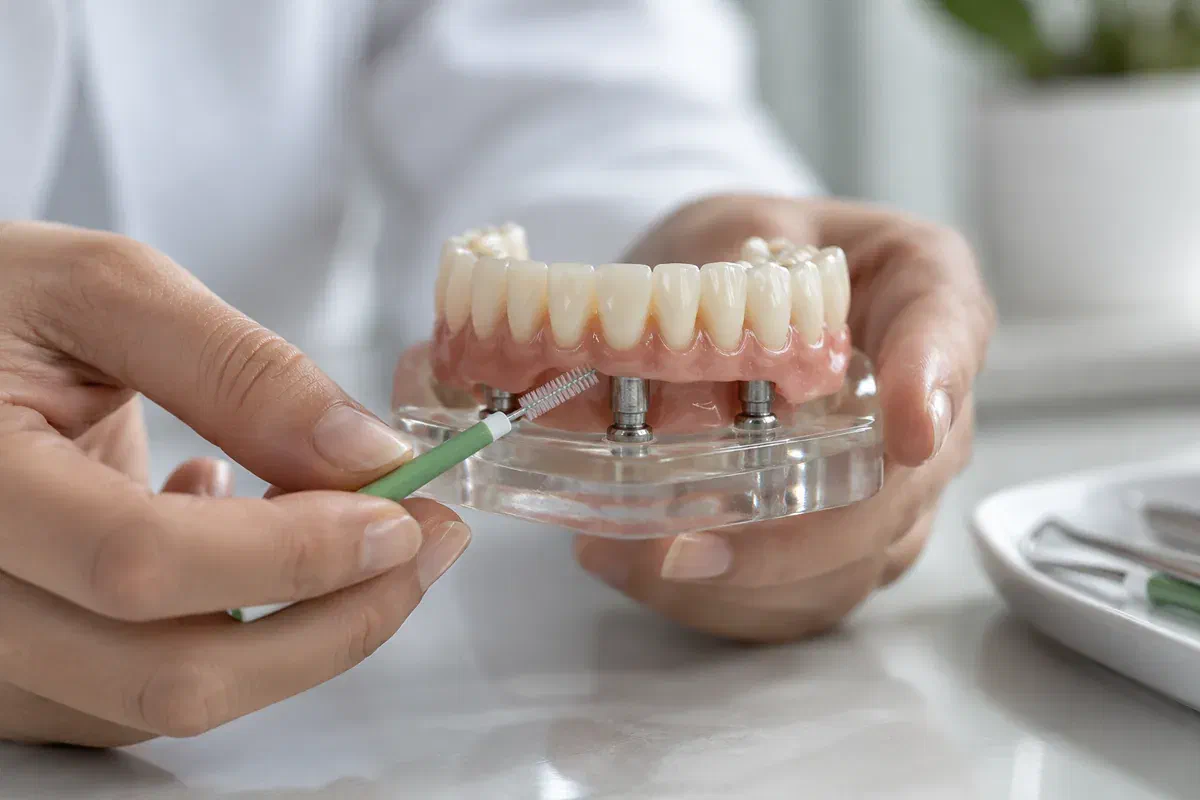
Whether interim or final, a fixed arch stays in, so cleaning must reach under it and around its supports. Ask the team to show you on the teeth you are wearing, using tools sized for those gaps.
Stick to the diet and cleaning advice given after surgery, then build the longer-term routine with the final arch. If any area is hard to reach, mention it so your technique can be adjusted.
Reviews look at gums, hygiene, contacts and components. Ask how often you will be seen in the healing period and afterwards, and whether the arch will ever be removed professionally.
Call about looseness, chipping, persistent bleeding or discomfort. Do not rock the arch or tighten parts yourself. For severe swelling, fever or pain, seek prompt care.
Patient information: Canadian Dental Association — dental implants and ongoing care
The interim period raises its own questions. These answers can help you prepare for the stages ahead.
Request a consultation with our Bronte Street team about a full-arch replacement. In that visit we will assess where you are now, compare designs that could suit and walk through each stage, including any specialist care.
Bring your current denture, if you have one, and any records from earlier implant or denture treatment.
