Removable teeth are holding you back
Tell the clinician when your denture moves, what you avoid and how handling it goes. Those concerns frame the comparison, but on their own they do not show that implant-supported fixed teeth are suitable.


Your health history shapes whether fixed implant teeth are a good idea and how they are planned. For adults in Rockwood, here is how medical factors, assessment, staged treatment and long-term upkeep fit together for a full arch.
Before talking about teeth, a good full-arch consultation talks about you: the conditions you manage, the medicines you take and how you have healed in the past. A fixed implant denture, sometimes described as a fixed implant bridge, is a complete arch of teeth anchored on implants. It stays in your mouth and is not taken out at home, which is the key difference from an overdenture.
It involves surgery as well as dentistry. Implants are placed in the jaw for support, and the visible arch replaces teeth and, where needed, lost gum. Health factors can influence the surgical part, while the arch itself has to be planned for appearance, speech, bite and cleaning access. Both halves rely on the same careful review.
Coming from Rockwood, northwest of Milton, you can start with an assessment at our clinic on Bronte Street South. Dr. Anjum will examine your mouth, go over your health history, compare fixed and removable choices and explain where specialist or physician input might help. Long-term maintenance is part of that discussion from the start.
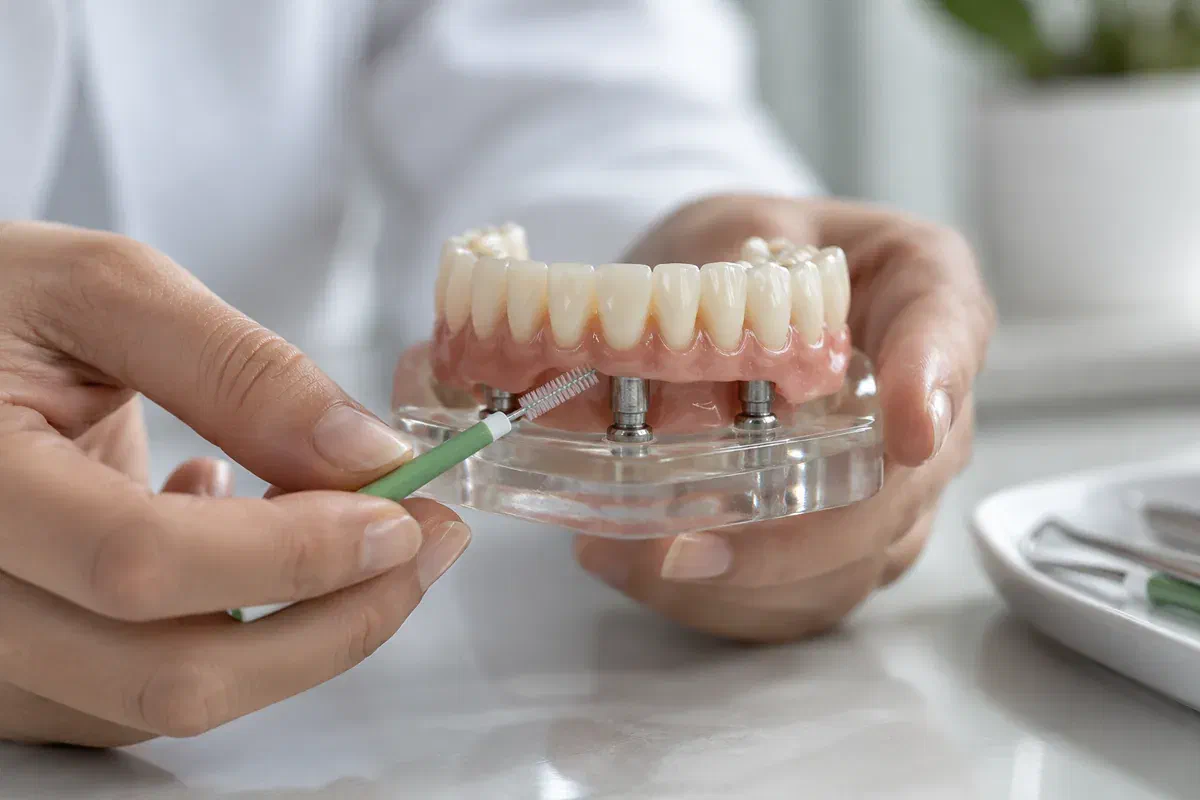
A fixed arch is commonly considered when most teeth in a jaw are missing or expected to be lost. Only an assessment can confirm suitability, and that includes whether any natural teeth can be kept.
Tell the clinician when your denture moves, what you avoid and how handling it goes. Those concerns frame the comparison, but on their own they do not show that implant-supported fixed teeth are suitable.
Each tooth deserves its own diagnosis. Ask what keeping useful teeth would involve, especially if your health makes surgery a bigger decision, before a full-arch replacement is planned.
Daily cleaning beneath fixed teeth matters from the planning stage. Mention conditions that affect grip, vision or energy, and whether someone helps you, so the design is considered in practical terms.
The number and positions of implants depend on your clinical findings, health and the restorative design. An advertised package or implant count cannot account for those.
For a suitable patient, implant-supported fixed teeth stay attached through everyday meals and conversation. The expected improvement should be explained relative to your current difficulties, health and planning results.
Fixed is not maintenance-free, and long-term success is never guaranteed. Implant and gum health, the arch material and your bite all need ongoing review, and some health conditions call for closer monitoring. Before deciding, raise what could go wrong, how a repair would be organized and what you would keep paying for after treatment.
Patient information: Leeds Teaching Hospitals — dental implant patient information
The clinician should explain how implant support and the final arch relate. That helps you compare fixed and removable designs by how they work, not by how they are described.
Where each tooth sits, how much pink material replaces lost gum, how you sound and how you bite are all linked. Share your priorities and find out when the planned arrangement can be reviewed before the final arch is made.
Being able to care for the arch over time is part of whether it fits you. Ask how cleaning access and professional reviews would work, especially if a health condition could affect your routine.
Treatment usually involves several stages and may include a coordinated team. Ask who manages each part, how interim teeth will work, and which health or clinical findings could change the sequence.
The clinician examines your teeth, gums and any appliance and takes a detailed medical history. Suitable imaging shows the support available, and some findings may mean speaking with your physician first.
Weigh fixed against removable designs, then go over the implant layout, what the teeth are made of, what you would wear while healing, the risks and the upkeep. If an extraction or graft is recommended, ask what it achieves and how your health affects recovery from it, since those steps are irreversible.
The sequence reflects your findings, health and the agreed approach. Interim tooth timing and chewing load are separate clinical decisions; planning for fixed teeth in the end is no guarantee of having them on the day of surgery.
Try-ins and final measurements shape the finished teeth. The team assesses your bite, demonstrates cleaning and sets review intervals for the arch and implant tissues that take your health into account.
Because you cannot take the arch out, cleaning must reach under it and around the parts that support it. Ask for a demonstration on your arch with tools suited to its spaces and your grip.
Settle on tools that slide gently into the spaces beneath the arch, and on a time of day when you have the energy to do it well. If a health change makes cleaning harder, let the team know so the method can be adapted.
Checkups assess gums, hygiene, contacts and components. Tell the team about new diagnoses or medications at each visit, and ask whether professional removal is planned.
Contact us about looseness, chips, persistent bleeding or discomfort. Avoid testing movement or tightening parts yourself. For fever, severe swelling or spreading pain, seek prompt care.
Patient information: Canadian Dental Association — dental implants and ongoing care
Medical history plays a real part in implant planning. These answers can help you prepare the information to bring and the questions to ask.
Book a consultation at the clinic on Bronte Street South and bring your questions about a full arch. Together we will review your health and dental starting point, compare designs that may suit and explain if physician or specialist input is needed.
Bring your current medication list and tell us about any conditions or treatments that affect healing.
